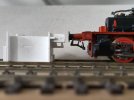
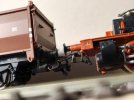
I moved the brass rod from the front to the side of the hook, reducing the extra projection to the minimum. It looks yet uglier (though would still disappear when blackened). It performs better but it's still marginal, and that's not really satisfactory.
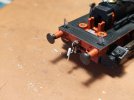
There are two reasons intrinsic to the coupling and the loco that mean it doesn't work every time. I fixed one: the striking surface had to be filed smooth to prevent the hoop sticking as it slides up.
The other is partly a weakness in the way this particular coupling is fixed (basically into slightly bendy plastic forming the buffer beam). The coupling can pivot slightly in its mounting hole. The
hook loop will hit the striker below the fulcrum. This tends to make the coupling pivot downwards. Having pivoted downwards, the slope of the striker is steeper and that makes the
hook loop much less likely to slide up it. Just a small change in the angle has a significant effect.
There's a third reason that can't be controlled at all, and that's the fact that H0 NEM coupling pockets quite often droop under the weight of the coupler. So different vehicles may present the
hoop loop at different heights, and the lower the
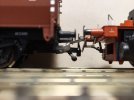
hook loop the less likely it is to slide up and over the hook. So much for the standard -- and the more expensive rolling stock tends to have thinner, more flexible plastic underframes and is therefore more likely to suffer from this fault. The wagon depicted is hovering on the edge of acceptability in this respect.
Back to the T3. I'm going to think about new frames.
[Edited to resolve weak brain swapping and combining hook and loop here and there]