The Heybridge Railway, 1889 to 1913

>> Three years on
  • RichardG

    Western Thunderer
    Still, the Heybridge Railway has now been underway for three years so here is a brief reflection on "whether I am doing it right".

    I have met up with the two members of a “broad gauge” press gang twice in less than a fortnight – once at British Sugar and then at St Edmondsbury Cathedral. These two always need some care – one is worryingly clever, and the other is a lot bigger than me. And, of course, their take on the hobby is a demonstrably commendable one.

    My house is small, and the longest indoor layout I can ever build will be about 3.5 metres long. I could find a space for an L-shaped arrangement, but the curve would be about a one-metre radius maximum, so two scale chains in 7 mm. I am best to save the site for something where the geography allows a tunnel; I have the trains from my last H0 project.

    I have seen few 7 mm layouts I would find satisfying to operate over any extended period, and needless to say I don’t find operating at home terribly engaging. I am sure this is because my layouts are never sufficiently complex. I do enjoy seeing my trains running over a decent distance, and I currently have access to at least five tracks to do this. Only the NEEGOG one supports analogue DC, but now I have two battery-powered locos I have a choice of motive power for the dead track at CSME, the stud-contact at a friend's layout, the three-rail in another garden, and the DCC at the friend of a friend. And this sort of roundy-roundy running is more fun with company.

    I am sure, something like the ScaleSeven or S Scale approach would be well worthwhile for me to investigate if I try for an obscure gauge where interoperability is never going to happen (perhaps one of the narrow gauges) and the project will always be small, well-defined and self-contained. But I am sure, the Heybridge Railway is best in a mixture of 0-F and 0-MF, because of the interoperability this gives me.

    I am less happy to realise I haven’t built a wagon for over a year, yet I have five unbuilt kits to choose from. I also want to extend “Heybridge Basin” and give it a cassette-based fiddle yard.
    DSC_7820.jpeg
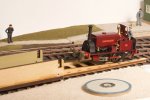
    In the meantime, a battery loco can pull itself and maybe a train in and out of a cassette, which I guess is either a gimmick or really useful, depending on where you run your trains :)

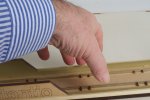
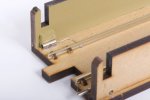
    This cassette and ramp are from Intentio.
     
    Finalising track on Modules A and B
  • RichardG

    Western Thunderer
    . . .

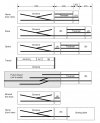
    Each module of the fiddle yard has two mating ends, while the diorama has only one. The layout has two viewing sides, so the terms left and right are potentially ambiguous; so I will call these ends α and β for the fiddle yard, and γ for the diorama. Sorry the default font on WT gives a slightly crummy-looking gamma but I've done the drawing . . .


    View attachment 208432
    I need to be careful to make sure I end up with a modular layout not a sectional one. "Home" and "Show" are relatively easy to make because module (A) is a terminus; "Option" is much more difficult.

    So the correct sequence to lay the tracks onto the baseboards should be this:
    . . .

    But before the stash, the layout.

    I have finally realised, I would prefer to look at the front of the railway not the back. This decision has taken some time to mature, but I think it is sensible.

    This means, I cannot use the traverser as drawn in my plans at home, because the wall behind the layout blocks movement of the deck. But I do want to run some trains, so I am working up a cassette-based fiddle yard. This leads me to minor changes in two modules, and a new diagram.

    Basin with modules 2.jpeg
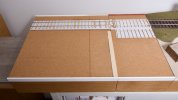
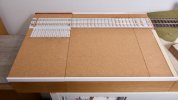
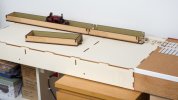
    Module B now has one track instead of three, and the second track on Module A is now a headshunt and not a through road. The sorting table is a new baseboard which I can eventually re-use for a completely different layout if I wish.

    Module B can form a scenic extension to Heybridge Basin, and I have been sufficiently motivated to lay the track.

    DSC_7841.jpeg

    DSC_7842.jpeg
    The tracks on Module A, Module B and Heybridge Basin (the diorama) all line up with each other. At long last, I have the beginnings of a modular layout :)
     
    ( Diversion : 0 gauge gauges )
  • Dog Star

    Western Thunderer
    I have struggled with some quite "deep" decisions along the way. One especially was whether to go for 31.5 mm gauge wherever possible, or to use it only around the common crossings.
    Snap! In my case the decision was between 32 and 33 mm! At home our railway is S7 end to end. When Peter and I started a 7mm layout (for our local club) those who were interested were willing to go S7. Now that Simon @Caggers is up north and the others are at even higher altitude there is no other S7 support. Inevitably "O-something" won the day because club members were buying Dapol. Not so easy once peeps asked about 31.5mm.... so our hand built track is 32mm for plain line and 31.5mm for turnouts (and only over the five or six timbers which support the check rails).

    Mind you, the 31.5 and 32 mm gauges live in my track box (alongside my S7 jigs) and I had a difficult moment when I found my 33mm gauges being used for track that was intended for the club layout.


    ... Soldering the rail ends onto brass woodscrews set into the sleepers allows no end of tweaking up and down as well as left to right, this method works really well.
    Just as we have done on Scruft's Junction and reported on WT. In our case the rail is bullhead so we use brass chairs (either S7 Group stores or C&L Finescale) with the chairs soldered to the screws and the rail soldered into the rail.

    Rgds, Graham
     
    GER single bolster wagon (1889) . . part 1 build
  • RichardG

    Western Thunderer
    I think everyone has a stash unless they have chosen a scale with no commercial support. This is mine, recently slimmed down to nine models:
    . . .

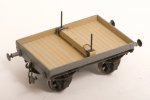
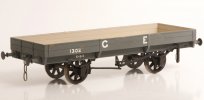
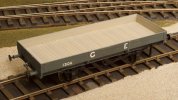
    The first model from my stash is the Ragstone kit for a GER single bolster wagon to diagram 29. These wagons were built from 1889 to 1898 with wooden sides (later ones had steel sides), and the model will be useful when the railway carries timber overhanging the end of a wagon.

    DSC_7886.jpeg
    The kit includes buffers and couplings, and I’ve bought it a set of wheels.

    DSC_7888.jpeg
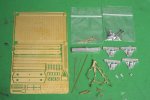
    The castings include some lost wax ones with very neat details.

    DSC_7891.jpeg
    In fact I think they are worth a photo of their own.

    DSC_7892.jpeg
    To begin, the four sides of the floor fold up and laminations go onto the outsides.

    I think my soldering skills are evolving through three stages. The first stage was to make something that held together. The second was to do this neatly, and the third (underway) is to do it so it doesn’t show.
     
    Cassette-based fiddle yard . . part 1 baseboard and cassettes
  • RichardG

    Western Thunderer
    . . .

    View attachment 188069
    A few weeks ago I bought a second hand traverser (minus track), this already assembled from a kit by Grainge and Hodder. I was so pleased with it I ordered three new baseboard modules from the same firm to go with it.

    I somehow imagined these were on a four- or six-week lead-time but they arrived last Tuesday. Knowing how modern timber goes banana-shaped within days of bringing it into the house I proceeded to ignore the wagon kit and assemble the three new baseboard modules.

    One of these modules is the basis for Heybridge Basin, this will be a very simple diorama but I have started a thread for it so the posts stay together and don’t get lost between the trains here.

    View attachment 188070
    Heybridge Basin is part of a larger scheme with the traverser and the other two baseboard modules.

    The intention is to build a fairly adaptable and reconfigurable fiddle yard which I can re-use later when I build a more sophisticated layout. Also, the 1200 mm module easily fits in the back of a Mk2 Yaris with the rear seat folded and plenty of passenger legroom. So if Heybridge Basin turns out to be any good, I can take it to shows.

    I have done all of the "structural woodwork" for the baseboard modules so I can relax with this done and maybe I will have a go at the wagon this week.

    Last year I bought a secondhand traverser to make the basis of a modular fiddle yard. I want to give this a “scale” appearance with scenics and spiked FB track so it blends into the layout, and at the moment I cannot face building the track nor the task of getting all the tracks to align properly.

    So I have looked for an easier build, and bought some Intentio cassettes.

    DSC_7998.jpeg
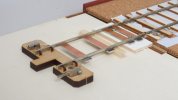
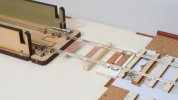
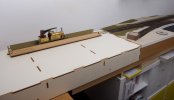
    The new baseboard is a standard 900 x 400 mm unit from Grainge and Hodder, equipped with two pattern-makers dowels. The dowels let me connect it to my diorama of Heybridge Basin or my intermediate Module A or Module B. All four baseboards have the same track alignment.

    DSC_8003.jpeg
    The connecting track has a slight gradient because my “standard” is code 100 FB rail with spikes on 4 mm cork while Intentio are expecting code 125 BH in chairs on 3 mm cork.

    DSC_8001.jpeg
    I have already written more about the electrical connectors than most people will ever want to read, this culminates here.

    DSC_8015.jpeg
    If I restrict myself to short cassettes then I have a space for my photo background too.
    It seems to me, I could assemble a fresh set of cassettes and re-use this baseboard for a 00 or H0 project. I could even build some power supplies inside it to run controllers and ancillaries on multiple alternative layouts. This would save me repeatedly building near-identical power units and then struggling to find space to keep them.
    I now have the essence of a layout and it's only three years since I started! The Intentio cassettes give me potentially unlimited storage and they can hold my Y14 too. I have a feeling, the traverser may never get its track . . .
     
    Cassette-based fiddle yard . . part 2 bracing and electrics
  • RichardG

    Western Thunderer
    I have added some bracing underneath the fiddle yard, and made up the first electrical connections between baseboards.

    DSC_8060.jpeg
    I put stripwood along the lower sides of the baseboard, and then a diagonal brace.

    This approach is mechanically more effective than the diagonals supplied with the kit (these go between the central cross members) and it leaves the baseboard surface clear of obstructions. The structure is now very rigid, and it still weighs under 2 kg.

    DSC_8052.jpeg
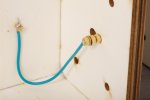
    I have decided to use the dowels to carry the track power between baseboards.

    When the brass machine screw is tightened up, there is a tendency to pull the dowel crooked as the plywood compresses. The dowel still engages, but with a tiny bit of friction. I found that I could tighten up the two woodscrews on the dowel, and this pulled everything square again.

    DSC_8046.jpeg
    I think there is a case here to choose pattern-makers dowels over cabinet maker's dowels. It is much easier to make an electrical connection.

    I have run out of 4 BA hardware but when I have wired up Module A and Module B I can expect to add and remove modules at will and the track power will get connected in the process.

    DSC_8065.jpeg
    Nellie had to be the first two-rail analogue loco to run onto the cassettes.

    So far, everything seems to work :)
     
    Cassette-based fiddle yard . . part 3 low-side cassette
  • RichardG

    Western Thunderer
    The Intentio cassettes have relatively deep sides. I have assembled another cassette, this time cutting down the sides to improve access to the stock.

    DSC_8114.jpeg
    I have shortened the sides and put in some strip wood to reinforce the floor. Aluminium angle might be better but I settled for some wood I had to hand.

    DSC_8145.jpeg
    The mildly stylish “slash cut” arrangement suits my left-handedness :cool:

    DSC_8139.jpeg
    The electrical connections are the same as on my other cassettes. I didn't show how I took the wires from the terminals to the rails, so this is how I did them.

    DSC_8153.jpeg
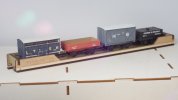
    Four pre-grouping wagons (plus brake) are likely to make the longest train on the railway.

    DSC_8157.jpeg
    I have a functioning fiddle yard. Two "short" cassettes (far left) match up with one "medium".

    I am a bit surprised how flat the modified cassette sits on its baseboard. If warping occurs, I can think about fixing some aluminium strips along the sides.
     
    Loco no.4, ex-LB&SCR (1902) . . naming as 'Heybridge'
  • RichardG

    Western Thunderer
    View attachment 223761
    I have repainted and highlighted some of details of No.4, especially the cab floor and the brake gear. I treated myself to a tin of Humbrol Metalcote "Gunmetal" (this colour suggested by @Yorkshire Dave earlier) and this is appearing in all kinds of places on my locos.

    View attachment 223760
    The loco had her first run at NEEGOG today. This was the first time she had pulled a train, and all went splendidly. The running seems to be faultless, well done Dapol. I am not a great fan of RTR (especially at exhibitions) but it is difficult to abstain when it is this good, costs so little and is such a decent choice for the railway.

    An update on my Dapol Terrier.

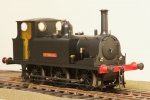
    The LB&SCR gave their Terriers the names of places, and I imagine that the Heybridge Railway continued this practice for their own locomotive. H&LLR number 4 is now 'Heybridge'.

    DSC_8255.jpeg
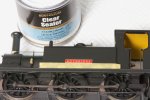
    The clear sealer from Rustoleum sticks to most surfaces, including plastic and brass. The narrow tape is from Tamiya. I copied the location of the plates from a photo of 'Freshwater'.

    DSC_8269.jpeg
    This is my first portrait using my magnolia backdrop board. Tastes vary but I like the warmth and softness. I am glad I repainted the rails too.

    The plates on all of my locos are from Light Railway Stores. Their service is very good (usually six to eight weeks for custom plates) and I think they bring a little life to the models. I cannot do much more to this one before weathering.
     
    Renault model AX (1908)
  • RichardG

    Western Thunderer
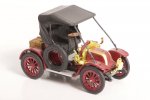
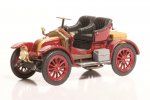
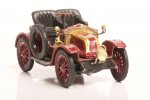
    I have my first motor car for the project, a 1908 Renault AX.

    DSC_8257.jpeg
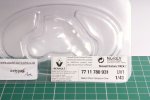
    The source model is a diecast model by Norev. It looked okay-ish but was let down by the garish brass work. Also the provision of a roof without a windscreen seemed odd.

    DSCF3312.jpeg
    The model was “an officially licensed Renault product” so hopefully it is fairly accurate.

    DSC_8356.jpeg
    I pulled off the roof moulding and repainted as many of the details as I could. I left the upholstery as bare plastic.

    DSC_8361.jpeg
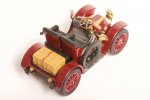
    All of the prototype photos I have found show a boot as part of the coachwork instead of the tied-on trunk here.

    DSC_8357.jpeg
    I had trouble finishing the top of the scuttle panel (no burgundy paint) but to be honest, the model will look okay on the layout and it stands up to inspection much closer than the two foot rule.

    I forgot to mention, the brass paint from the AK Xtreme Metal range responds to burnishing with a cotton bud a day or two after application. It’s a lot better than the gold-plated effect used by model manufacturers.
     
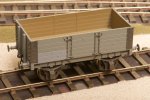
    5-plank open, internal use (1890s style)
  • RichardG

    Western Thunderer
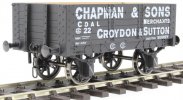
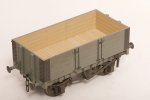
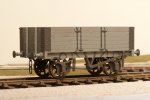
    When I started in 7 mm scale, a well-meaning friend explained I could buy wagons RTR for less than the cost of a kit. I bought two Dapol wagons from Hattons - a salt wagon, and this 5-plank open for Chapman and Sons of Croydon.

    7F-052-004_20200810_3548881_Qty1_1.jpeg
    Photo from Hatton’s web site this morning, I forgot to photograph the model before I started.

    This wagon has been on the go for most of three years. It is in the style of a RCH wagon, but I’m not sure which standard. It has a 9 ft wheelbase and timber solebars, so it will look okay on the Heybridge Railway.

    DSC_8404.jpeg
    I cut off the the brake gear on one side to backdate it towards the 1887 standard. The block of styrene is holding the compensation bar into place.

    DSCF3166.jpeg
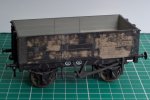
    I took an air eraser to the body to remove the pooling symbols. Later I removed the paint from a few planks, and later still I stripped almost everything.

    DSC_8380.jpeg
    I repainted the model in Railmatch 'Diesel Roof Grey' to use up some paint from a former life and I worked up the underframe too, and the model stayed like this for a couple of years. By now the inside had been repainted three times. Last week I did a test patch with Vallejo 'Medium Sea Grey' but decided the difference wasn’t really worth the effort, and took this off again.

    DSC_8410.jpeg
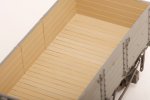
    I have however repainted the inside better to try to represent the unpainted planks. This is a varying mixture of Ammo ‘Old Wood’ and ‘New Wood’. I like the variety here. I also think, repainting the interior makes the Diesel Roof Grey look better.

    DSC_8403.jpeg
    I have dusted some brown powder along the body too, so the model is weathered but not obviously.

    DSC_8407.jpeg
    I can attempt the interior ironwork one day but the model may well still be "wrong". A friend has pointed out, the 19th century builders might have used hardwood not softwood for their wagon bodies; these would be a different colour. At the moment I am happy because the interior looks more like wood than it has ever done before, and at the moment it doesn't look out of place. Of course, as time goes by I learn more; and one day I may suddenly decide I know the model is wrong and alter something again.

    The back story for this will be, the railway bought the wagon as an ex-demonstrator from the manufacturer. This explains the obvious mileage on the underframe. Whether the 19th century wagon builders actually had demonstrators I don't know, but why not.
     
    Further interiors for open wagons
  • RichardG

    Western Thunderer
    The prototype is not well know, if it ever existed; but there is evidence of origins to those in the know. My railway layout . . . will be a might have been, and I think its service vehicles should be might have beens as well.

    Suitably encouraged by the Dapol 5-plank I have returned to one of my first kit-built 7mm wagons and repainted its interior in a similar way.

    DSC_8429.jpeg
    This floor is a piece of embossed styrene. This time I made a paler mixture with the paints and worked over the result with some grey and brown powders.

    DSC_8433.jpeg
    The stationary engine is here to help to show the colouring. Brown powder on the outside is barely visible but has taken away the showroom look.

    I can see a technique evolving here. The main thing seems to be to apply an undercoat of the Old Wood (the paler of the two Ammo colours) first, so the mixed colours can go on quite thinly and will tone with what is underneath them.
     
    GER single bolster wagon (1889) . . part 2 paint and stanchions
  • RichardG

    Western Thunderer
    . . .

    View attachment 226314
    I shortened the brake lever by a millimetre because it seemed too long, and now I wonder if it was right in the first place. The bolster is resting loose for the time being.

    For this wagon I want to try adding the couplings after painting, see if this is any easier. So this is the end of my build for this GER bolster wagon :)

    All of this painting practice has given me the confidence to finish the timber-sided bolster wagon. The GER built these wagons from 1889 to 1898 so I can try to represent a wagon which is nearly new, just a few years old. I saw what I was looking for at the Middy . . .

    P1050190.jpeg
    This is the sort of look I would like for the floor. This photo is heavily manipulated (because of the sunlight) but the floor is part way through fading from brown to grey.

    DSC_8511.jpeg
    I have added some Vallejo Medium Sea Grey and white to the mix of Ammo New and Old Wood.

    DSC_8522.jpeg
    The bolster and the two lashing loops remain posable.

    The sides of the body are a bit thin. The 1923 RCH drawings show 2-3/8 inch (60 mm) thick timber for the sides of a wagon, and I expect earlier wagons were much the same maybe thicker. This scales down to 1.4 mm, so the sides really ought to have three layers of brass not two. The tender truck from Connoisseur models has the same error. I can put this right in future builds.

    I lost the couplings supplied with the kit and used some from Roxey Mouldings. Apart from this I built the model entirely from parts supplied in the kit, with no alterations or substitutions except for the four body supports where I misunderstood the instructions. I am very pleased with the model.

    DSC_8529.jpeg
     
    Last edited:
    Water column, second attempt
  • RichardG

    Western Thunderer
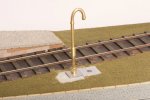
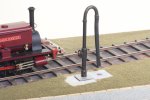
    The first casualty of the project was the water column. Too flimsy, too vulnerable, too permanent. I caught the thing on something or other most every time I moved the baseboard, and the last time I straighten it up it broke off.

    DSC_8614.jpeg
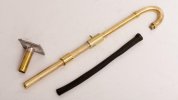
    I have made its replacement from 5 mm round brass, this turned down along most of its length. The bottom and valve body are K&S tube, and the base is the alternative casting from the original kit by Duncan Models.

    DSC_8601.jpeg
    I thought Fate would take a hand when I put in the bend so I didn’t take a photo beforehand. I expected the metal to crack but I annealed it twice and then did the bend in the vise and it worked.

    DSC_8652.jpeg
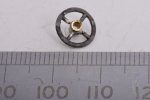
    The original hand wheel was lost. The replacement is the steering wheel from a Matchbox car, soldered onto a new boss.


    DSC_8659.jpeg
    I finished the model with antiquing patination fluid instead of paint. I burnished this with a cotton bud to make the surface look more like metal and then added a coat of varnish. The hose is from the first model, thank you again to @chigley for this.

    I will suppose the water column was cast in Bentall's foundry and not bought in from the GER. It's better for me to have a freelance model rather than a GER one. I think the machined brass looks so much crisper than a white metal casting. The model lifts out for transit too :)
     
    NSR low-sided open wagon (c.1880)
  • RichardG

    Western Thunderer
    View attachment 216828
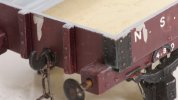
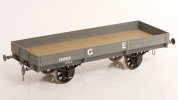
    I bought this wagon because it seemed so unusual.

    View attachment 216829
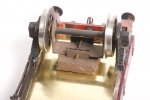
    The buffers are retained and sprung behind the headstocks. Sadly the builder recorded only what was already written on the sides, and not their name.

    Please, do we know when this buffer conversion might have happened? I don't have any books on the North Staffs, so general information on build dates and scrapping would be very helpful too. The model is very heavy, I think from a white metal kit.

    DSC_6722.jpeg
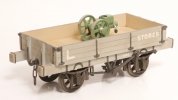
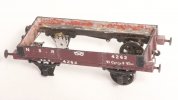
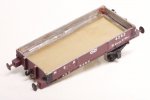
    I bought this North Staffordshire Railway wagon because the buffers appealed and the model seemed nicely-finished. In my innocence, I bought a wagon where the load of ballast was an integral part of the model . . . I want it to be able to carry something else . . .

    DSC_8689.jpeg
    Eventually, the floor succumbed. The kit has been assembled using glue throughout.

    DSC_8682.jpeg
    Amazingly, the four sides stayed together.

    DSC_8685.jpeg
    I soldered in a new floor, this is 0.45 mm brass.

    DSC_8695.jpeg
    The primer rather highlights the lumps of glue used during initial assembly.

    DSC_8697.jpeg
    The paint job survived my efforts at cutting out the ballast, the heat from the soldering iron and three minutes in the ultrasonic bath - but not the “low tack” masking tape.

    DSC_8703.jpeg
    Wheels and compensation unit tidied up and re-installed.

    DSC_8706.jpeg
    Cosmetic floor from styrene sheet.

    I am trying to tidy up some loose ends before the end of the year. This model has been in bits for at least three months, so it is good to see it sitting on four wheels before Christmas. I know I have said this before, but Happy Christmas :)
     
    GER wool wagon (1880)
  • RichardG

    Western Thunderer
    When I started this project I didn’t have a clue how I would represent the neighbouring GER. I have built two wagons and bought two more, and this week one more has arrived. This is a wool wagon to GER diagram 11, from the Ragstone kit and supplied by “The Train Shop” through eBay.

    DSC_8800 (1).jpeg
    I doubt I will ever know the name of the builder but the build is nicely sharp and clean and flat. The paint was missing in a few places so I have repainted the inside.

    DSC_8804.jpeg
    The primer is Vallejo 70.601 Grey Surface Primer. This seems to hold on most matt surfaces including patination fluid dabbed onto bare brass.

    DSC_8824.jpeg
    The repaint is much as for my earlier wagons but with a little extra grey to imply an older wagon.

    DSC_8813.jpeg
    The transfers have not been varnished and I lost most of the second "2"s on both sides. I pulled off what was left with masking tape and I can try for something easy like "1"s another day.

    DSC_8834.jpeg
    The wool trade had diminished by the 1890s and GER repurposed these wagons for general merchandise. This wagon has given me an idea for another traffic on the railway: victuals for coastal and European shipping. I guess, packing cases and barrels.

    I still need a GER brake van to recreate trains brought in by the Y14. This could be a way away, the only one I have seen was scratch built by its exhibitor.
     
    LT&SR horse box (1878) . . part 1 unboxing
  • RichardG

    Western Thunderer
    I tidied up a lot of loose ends at the end of last year. This was good but starting Heybridge Basin means I haven’t tackled even a moderately complex kit since ‘Lady Marion’ in 2023.

    DSC_8840.jpeg
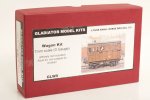
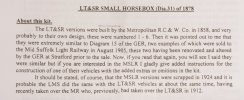
    I found the Slater’s instructions for the Manning Wardle almost impossible to understand, but I did end up with a loco. So on the basis that what doesn’t kill me makes me stronger, I want to try a Gladiator horse box next. This is for LT&SR diagram 31, built in 1878. Such a horse box could be bringing a prize animal to an agricultural show near the railway.

    DSC_8843.jpeg
    A familiar story, I cannot understand swathes of the instructions. I mean, the opening sentence here leaves me completely bamboozled - who was the designer? The instructions include I think fourteen errata. There are two parts marked “do not use” which have to be used, and I have just found a fifteenth mistake working through the narrative to see which part goes where. A bit of a comedy really. Still, the Manning Wardle experience lets me prepare. And there is nothing in this paragraph here to influence the build.

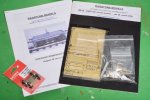
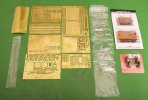
    DSC_8838.jpeg
    The kit is obviously well-presented, and the use of heat-sealed polythene for the detail parts seems really sensible. The etch nearest the camera is signed by George Dawson of Majestic Models. Some of George’s other models are now with Connoisseur Models, and the tender truck is George’s design. The red ink is marking the parts I know I need to ignore.

    I will try to put everything together in my head first, then sit back and enjoy the build. The photos included in the kit are encouraging, and I can look at the similar horse box at the Middy if I think this helps.
     
    ( Diversion : sixteen wagons at NEEGOG )
  • RichardG

    Western Thunderer
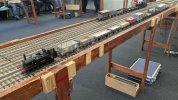
    A few days ago I assembled my collection of kit- and scratch-built wagons into a train, 19 wagons in all. This lot was slightly too much for 'Heybridge' to get underway without wheelslip, so I took away three wagons. The rest made for a nice-looking train at NEEGOG earlier today.

    2025-01-11 11.20.33.jpeg
    I need to work out how to best record a complete train. The main thing is, there are no coal wagons here, and no timber either. The Heybridge Railway would have carried very little of these; most went along the Chelmer and Blackwater Navigation.

    2025-01-11 12.14.11.jpeg
    The train made several laps, I think people enjoyed watching it. My recent acquisitions had their first run here too.

    When I get my GER brake van (and this is looking like a scratch build for something suitably 1890s) then I can put the Y14 on the front and call this a GER train. It's funny how the original idea for a such a minimal light railway is bringing along quite so much stock to run a service :)
     
    LT&SR horse box (1878) . . part 2 solebars ends and sides
  • RichardG

    Western Thunderer
    I tidied up a lot of loose ends at the end of last year. This was good but starting Heybridge Basin means I haven’t tackled even a moderately complex kit since ‘Lady Marion’ in 2023.

    View attachment 230743
    I found the Slater’s instructions for the Manning Wardle almost impossible to understand, but I did end up with a loco. So on the basis that what doesn’t kill me makes me stronger, I want to try a Gladiator horse box next. This is for LT&SR diagram 31, built in 1878. Such a horse box could be bringing a prize animal to an agricultural show near the railway.

    View attachment 230742
    A familiar story, I cannot understand swathes of the instructions. I mean, the opening sentence here leaves me completely bamboozled - who was the designer? The instructions include I think fourteen errata. There are two parts marked “do not use” which have to be used, and I have just found a fifteenth mistake working through the narrative to see which part goes where. A bit of a comedy really. Still, the Manning Wardle experience lets me prepare. And there is nothing in this paragraph here to influence the build.

    View attachment 230744
    The kit is obviously well-presented, and the use of heat-sealed polythene for the detail parts seems really sensible. The etch nearest the camera is signed by George Dawson of Majestic Models. Some of George’s other models are now with Connoisseur Models, and the tender truck is George’s design. The red ink is marking the parts I know I need to ignore.

    I will try to put everything together in my head first, then sit back and enjoy the build. The photos included in the kit are encouraging, and I can look at the similar horse box at the Middy if I think this helps.

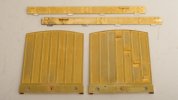
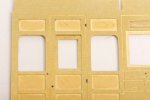
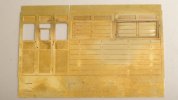
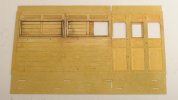
    The Gladiator kit for the LT&SR horse box is underway. The sides have rather a lot of strapping detail, all half-etched too, so I have started half-way through the instructions.

    DSC_8877.jpeg
    The solebars are simple folded-up L shapes with half-etched overlays sweated on. The ends fold up too, this is all straightforward.

    DSC_8863.jpeg
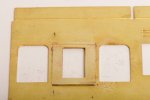
    The casements for the grooms compartment can be modelled closed or open. If they are to be closed, the etched trimming line will be visible.

    DSC_8860.jpeg
    So for the closed window I have attached the casement inside-out.

    DSC_8866.jpeg
    I have trimmed the other casement so I can fix it open.

    The beading on the upper doors is cut from half-round brass wire with the corners mitred. I am sweating this into place with the usual 40 W iron.

    DSC_8879.jpeg
    Returning to the first side, I have set the sliding flap open as well. So a horse can have a look outside.

    The overlays for the door hinges and their strapping are much more difficult, and I have borrowed a RSU from a mate. So I am teaching myself how to use this. There is a helpful article by Jol Wilkinson in MRJ 74.
     
    GER C53 (1903 onwards)
  • RichardG

    Western Thunderer
    A small diversion as the Modern Image arrives at the Heybridge Railway.

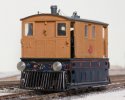
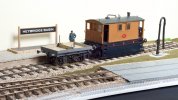
    The railway would have hired in a loco when ‘Blackwater’ or ‘Heybridge’ were away for repairs or overhaul. The first such loco is a class C53 tram from the GER.

    DSC_9037.jpeg
    The model has been scratchbuilt with a styrene body and a brass chassis. It was built by the vendor’s father, and the vendor has remotored it and upgraded the gearbox.

    DSC_9039.jpeg
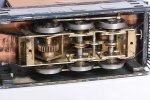
    The model runs as an 0-4-0, this makes the side rods much easier with such a short wheelbase. The driven axle is rigid and the other two are compensated around a central rocking arm. The compensated axles are supported in home-made hornblocks.

    DSC_9011.jpeg
    Pedants will know these locos left their side skirts “at home” when they returned to Stratford, but I don’t think this will trouble me very much. It is such a lovely model. The livery is correct for the period of the Heybridge Railway though the running number is from a 1921 loco.

    DSC_9020.jpeg
    This loco is going to fit into the scene here very well.
     
    Top