The Heybridge Railway, 1889 to 1913

NER class H2 . . painting
  • RichardG

    Western Thunderer
    View attachment 250396
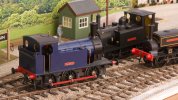
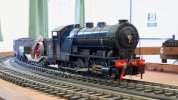
    There are so many detail posts on the progress of ‘Quintus’, here are two photos of the model as now built.

    View attachment 250397

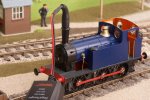
    Four months on, I have got the painting of the ex-NER H2 underway.

    When I bought the kit I was in two minds whether to build it as an H2 or as some kind of freelance variant with an open cab. After the experience of ‘River Pant’ I settled on an H2, to represent a visiting locomotive. This would get a pro paint job in lined NER livery.

    When the build got underway I realised the kit will not build any of the three NER prototypes. There were variations in sandboxes, steps, brakes and tanks, and the kit provides a permutation which doesn’t quite match up with any of them. So I decided it is best for me to imagine I am building a fictional fourth member of the class.

    Such a loco clearly never ran on the NER, and this gives me a free hand with the livery. Logically it might be black to match up with ‘Blackwater’ and ‘Heybridge’, but I think an Oxford blue will suit the loco so this is what I have done.
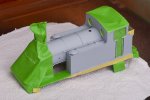
    DSC_1953.jpeg
    Body primed (U-Pol Acid #8), then masked for body colour.
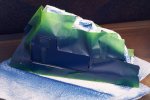
    DSC_1962.jpeg
    The sides didn't receive enough paint so I masked them again and topped them up.
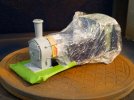
    2026-02-27 08.18.54.jpeg
    The cling film is my own idea though I expect other people are already using it.
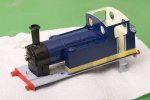
    DSC_2001.jpeg
    Masked to brush paint the running boards.
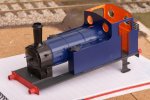
    DSC_2009.jpeg
    The red inside the cab is my undercoat for the scrumbling used by the NER.

    This operation has consumed ten consecutive days:
    0 primer (20th February)
    1 brush acrylic (Vallejo) inside cab and onto buffer beams
    2 mask
    3 spray blue enamel (Precision)
    4 mask, spray more blue enamel (Precision)
    5 wait
    6 wait
    7 mask, spray black acrylic (Tamiya)
    8 wait (probably unnecessary)
    9 mask, brush detail areas (Vallejo)

    My use of enamel followed by acrylic came about because I already had the paint. I haven’t had any problems with the different chemistries reacting with each other, but I did take a few days off to let things cure.
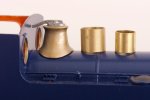
     
    ( Diversion : painting parts to look like brass )
  • RichardG

    Western Thunderer
    The subject of painting parts to make them look like polished brass came up in a private conversation and I think a photo is worth sharing here.
    DSC_2056.jpeg
    This is a painted white metal casting and two offcuts of brass tube. One offcut dull, the other polished.
    The paint is AK Xtreme Metal "brass", brushed on over Tamiya fine surface primer, left to harden and then burnished with a cotton bud. A mate has tried a buffing wheel on a similar casting before starting. I could try this next time.

    For comparison, the brass colour on the insides of the cab windows is Vallejo 70.996 "gold". This looks okay on small areas.

    I think I have a fair representation of dull brass, but polished brass is still evading me. Clearly I could buy a posh component made out of real brass, but if you aren't careful a set of such parts costs as much again as the kit.

    Finishing off the H2 is going so slowly the thing is gathering dust :rolleyes:
     
    . . power and radio control
  • RichardG

    Western Thunderer
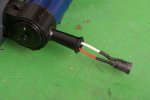
    I have made a start on wiring up the NER H2 . . .

    DSC_2100.jpeg
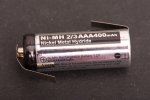
    The loco is receiving seven NiMH batteries, these ones are two-thirds AAA size and branded ‘Digimax’.

    Choosing NiMH technology removes the worries associated with LiPo, and I can use the charger from my similarly-powered Y14. I have a feeling, 400mAh is plenty of capacity to drive the incredibly efficient motor in the Slater’s SG38.

    DSC_2060.jpeg
    Test running has shown, with the seven batteries partly charged as supplied (8.4 volts off-load), the loco can reach a scale 23 mph. This seems just right to me, which is fortunate because shoe-horning in an eighth battery would be difficult if not impossible. Charging the batteries takes this up to just over 9 volts.

    DSC_2062.jpeg
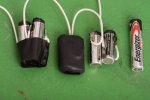
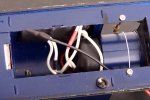
    The batteries are in three groups, one for the boiler and one for each side tank. The ones in the side tanks are short enough to leave room for a power switch on one side and a fuse on the other.

    DSC_2070.jpeg
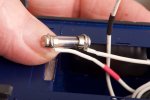
    I have gone for one fuse for the whole battery pack. I expect some experts will tell me how potentially dangerous this is but to be honest, I think an open circuit is far more likely as a failure mode.

    Thinking about only single fault conditions:
    • the charging socket connects the negative side of the battery pack to the metalwork of the model, and so a short circuit across the entire battery pack is possible in the wiring outside the battery pack or in the r/c board.
    • a short circuit within one group of two or three batteries needs the factory insulation around an individual battery to fail. This is unlikely, because the heatshrink prevents movement and chafing.
    So this is a 3 amp fuse, large enough to never blow in normal operation and placed here as a last resort to save the model before a fire gets underway.

    DSC_2078.jpeg
    Here are most of the electrical parts to be fitted into the model.

    DSC_2084.jpeg
    The charging socket is the first part to be fixed into place. This is an interference fit into the chimney, and it is now there forever unless I choose to destroy it by taking it out. I don’t like this sort of approach to assembly but there is very little free space to play with. Putting the socket here is easier than putting it in the coal bunker because the wiring ends up where it is wanted.

    WhatsApp Image 2026-03-14 at 19.11.05.jpeg
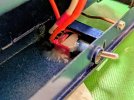
    The power switch had to be wired up before fixing it into the model, this is fast-setting epoxy glue. Thanks to @simond for the suggestion to put the switch here, the result is going to look really neat yet still accessible and easy to use.

    DSC_2086.jpeg
    Here are the power switch, the fuse (opposite the switch) and all of the batteries. What seemed like a huge empty space is getting filled up. I have enough room for the Micron MR603 receiver or the motor, but not both. So the assembly pauses again while I await a smaller receiver, this will be the Micron MR601.

    DSC_2103.jpeg
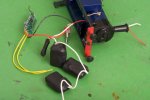
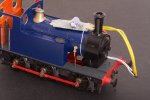
    In the meantime I have a temporary lash-up so I can give the loco some test runs.

    I have touched in the paint along the edges of the running boards! These are now enamel, the Vallejo acrylic was just falling off through handling the model.
     
    Last edited:
    GER 14-ton machinery wagon (1886) New
  • RichardG

    Western Thunderer
    The railway needs some kind of implement or machinery wagon to carry a motor car. Last year I bought a kit for a GWR Serpent as a quick and easy fix, and spent most of January trying to build it before giving up.

    Afterwards I discovered that D&S Models do a kit for a GER 14-ton machinery wagon to diagram 25. This wagon is more substantial than the railway needs to carry a mere car, but it is a step in the right direction. It could easily carry a threshing machine instead, perhaps for an agricultural show I still think about modelling.

    These wagons were built in batches from 1886 onwards, and the design must have been successful because some survived into BR days.

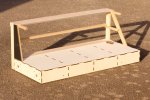
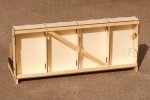
    DSC_2142.jpeg
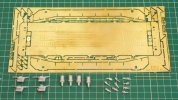
    This is what you get in the kit, along with a sheet of instructions.

    At a glance, I can see that none of the parts are numbered or labelled. There are etched loops here to make the lashing rings (good) but nothing to secure them to the deck. There is provision to add springing to one of the axles but no material to provide the actual spring. There are no couplings, and the buffers are solid white metal.

    My first impression is that this kit builds a model a little more sophisticated than the NER Lomac from Connoisseur Models, but the instructions are much more basic. The NER Lomac is of course the first etched kit for countless modellers, including me!

    I have read through the instructions and it is fairly easy to see how the designer expects the kit to go together. There are photos of these wagons in Tatlow, and so I feel happy to make a start. I am determined, this model will not go the way of the Serpent.
     
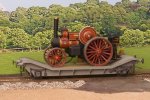
    ( Diversion : a traction engine as a load for a wagon ) New
  • RichardG

    Western Thunderer
    DSC_2195.jpeg

    For the record, here is the model without any ballast weights.

    Going back to the suspension . . . I can add some pieces of sheet lead underneath the model, perhaps 80 grams or so. This will give me live springing on an unloaded wagon.

    But! A white metal model of a traction engine is going to weigh most of 300 grams (thanks to @Osgood for this depressing fact!); and even the static boiler I built a while ago weighs 150 grams. Either of these loads is going to make the suspension bottom out; but if I remove the sheet lead and arrange the boiler with care, I can retain the live springing.

    And so, my thoughts turn to making the lead weights removable. Perhaps a turnbutton to hold them in. The trouble is, I have never heard of anyone doing this before. When I "invent" something, I usually find that either everyone else already does this or it isn't terribly useful. I know I can do this, but I do welcome thoughts on whether it is sensible.
     
    ( Diversion : Middy steam on Easter Monday ) New
  • RichardG

    Western Thunderer
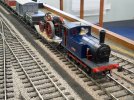
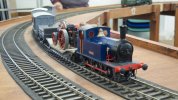
    Some photos from the Middy on Easter Monday. The Hudswell-Clarke 'Illingworth' was enjoying its last day of public passenger service, it goes out of ticket today.

    2026-04-06 14.35.25.jpeg
    The loco carries its usual name on the other side.

    2026-04-06 14.34.53.jpeg
    I dread to think how the AI bots will interpret these two photos in years to come.

    2026-04-06 12.19.30.jpeg
    Taking a break at Dovebrook after changing the loco on the train.

    This was the second day of public passenger services to Aspall. The station was completed just days before, but is currently landlocked. You can leave the train but not leave the station.
     
    Fowler road locomotives New
  • RichardG

    Western Thunderer
    On the bright side, Corgi do a 1:50 scale showman's engine and one of these has just arrived.

    DSC_2230.jpeg

    The top of the chimney is a scale 13 ft 5 in above rail level - right on the limit of the loading gauge. Yet the model is 15% undersize.
    I have had a go at the Corgi model of a Fowler showman’s engine to make it into a road locomotive.

    DSC_2238.jpeg
    The model is to 1:50 scale. If I view it as being 1:43.5 scale, the headroom under the canopy is a bit limited but there is a more compact road locomotive hiding inside.

    DSC_2282.jpeg
    So here is some modelling by subtraction. It was usual for the chimney to be detached for carriage by rail so this is what I have done here. The surgery is awful but the tarpaulin hides everything. The original chimney is unusable but I can think about this if and when the model gets chained down onto a wagon.

    When I remove the canopy I will reveal an empty space where a scale model would have its connecting rods and valve gear. I could have a tarpaulin to conveniently cover this!
    DSC_2287.jpeg
    Contrary to my first impression, there is a representation of the motion in the castings.

    DSC_2286.jpeg
    I have repainted as much of the model as I can, but the yellow wheels are difficult to alter. I wish I had bought a model with a less flamboyant livery.

    When I was young, my father had a fabric tarpaulin with metal eyelets around the edges and it was green. Thus I have always thought of tarpaulins as being green but I guess they were other colours a long time ago. If Edwardian tarpaulins were never green I do hope someone will tell me.

    Incidentally, the Corgi model currently weighs 300 grams, much the same as the kit from Duncan Models.
    The modified engine weighs 200 grams. This is still far too much for the springs in my GER machinery wagon, but my NER Lomac has a rigid chassis and seems suitable to carry a locomotive from Leeds to Essex.

    The NER Lomac entered service in 1913, the year my railway was dismantled, so this working must have happened during the months after the official closure of the line.
     
    Swapping out Dinghams for 3-links New
  • RichardG

    Western Thunderer
    I have done a little re-balancing of my wagon fleet. The Brymbo wagon jars in my mind. I am pleased with the brake gear but somehow, the combination of unprotypical model and distant operator seems that bit too wrong. I would probably keep it if it was a better model or a more local owner. At least I know what I did to the brakes, the photos are on WT, and I could do similar rebuilds to different models.

    I said goodbye to my GWR Hydra a while ago. This was a scale model and suitable but I couldn't devise a sensible load for it to bring to the Heybridge Railway. So I suppose I am doing fairly well if I have built 14 wagons and only let go of one.

    I bought some 9ft sleepers from a modeller in Devon and discovered he wanted to downsize his GER collection. So I could hardly resist these . . .

    View attachment 213318

    View attachment 213320
    According to Tatlow (LNER wagons vol.1 p.188), the GER built 3,000 four- and later five-plank wagons to diagram 16 during the decade to 1895. So this model fits my the layout perfectly. I have a Mystery Load too, if I try using playing cards for operations.

    View attachment 213319
    I don't know about the drop side wagon yet. Studying Tatlow, it looks as though these didn't make it into the LNER. But drums of electric cable could be making their way to Bentall's factory or, via the navigation to Chelmsford.

    The GER painted these wagons slate grey and this is usefully different to the greys of the wagons belonging to the Heybridge Railway. Thank you Peter.

    As far as rebalancing goes, I now have three GWR wagons instead of four, and three GER wagons instead of one, and I have gained two absolutely beautiful models to do this. Good.

    Two years ago I bought two scratchbuilt wagons with Dingham couplers. After I pulled off the Dinghams and put in 3-link hooks, the wagons would rarely couple up to my other stock and never to each other because the buffer heads are set too far forwards. I guess this helped to make make a train look better, with the Dinghams holding wagons further apart than usual.

    DSC_2298.jpeg
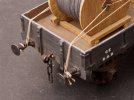
    The buffer stems are set rock-solid in their stocks and I have wanted to do something useful without altering the original wagons. I have ended up putting short lengths of 1mm wire through the hooks, so the hooks and their chains sit that little bit closer to the faces of the buffers. I think this is reasonably in keeping with the models, and better than fitting some over-thick coupling base plates.

    Anyway, the roping on this wagon is far too good for me to undo it to change the buffers.
     
    Fowler road locomotives . . part 2 New
  • RichardG

    Western Thunderer
    I've done my repaint!

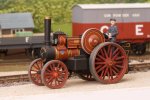
    No, the money from the showman's engine has gone on another 1:50 Corgi model, a Fowler road locomotive. I don't know what I was thinking of when I bought the model with yellow wheels. My palette is invariably red, grey and black, with occasional blue for a couple of railway locos.

    DSC_2310.jpeg
    Viewed as a 1:43.5 Fowler, the chimney is a bit short but (unlike the first loco with a canopy) it does fit within the loading gauge.

    DSC_2316.jpeg
    If I add a driver, the chimney looks short (is he driving a 9 inch scale loco?) but I will need courage to take a hacksaw to this one. Though I'm sure the prototype would fold down for transport by rail. Suppose I remove the "Super Lion" and add some etched plates over the gilt-coloured rectangles, this might be enough.
     
    Top