The Heybridge Railway, 1889 to 1913

Sleeper-built buffer stop . . part 1: construction
  • RichardG

    Western Thunderer
    I haven't finished a model since the build of the Slater's MW F class last year so it seems like a good idea to try something straightforward and follow it through to completion all in one go. I have plenty of sleepers now so I have made the buffer stop for the goods yard at Heybridge Basin.
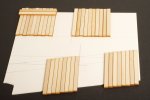
    DSC_6528.jpeg
    Sleepers glued onto 1.5 mm mount board. One sloping side here needed a mirror image and had to be re-done.
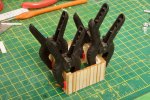
    DSC_6530.jpeg
    The model is fairly square, but not spot-on.
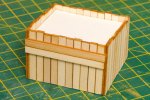
    DSC_6536.jpeg
    The important thing for me is to make something sufficiently uneven to look as though it was build by people not a laser, but not with so much slack it looks sloppy.
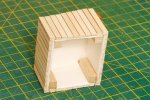
    DSC_6534.jpeg
    This is my first attempt at a "robust" scenic model in 7 mm scale. I hope this is good enough but if others have seen similar structures fail in a rough shunt then do say.
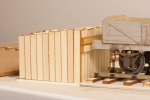
    DSC_6541.jpeg
    Posed at Heybridge Basin.

    Sometimes it is quite satisfying to see a rapid result. This model only took one evening, plus a few minutes the next day to fit the top and arrange the carboard packing underneath. Painting can follow after I have built a few more scenic items.
     
    Last edited:
    Yard crane . . part 1 build
  • RichardG

    Western Thunderer
    I can see two ways to continue this workbench thread. I can either try to paint the buffer stop (and each successive model) or just carry on with the building. I’m not very good at painting (might improve!) and I am waiting for warmer weather to spray primer outdoors, so I will carry on with the building . . .

    Rewind to last January:

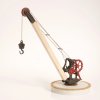
    I am building the Peco yard crane in 7mm scale. Their p/n LK-735.

    View attachment 207232

    View attachment 207233
    Please, do we know whether this is a model of a real crane, or perhaps an amalgamation of a few different prototypes? Then I could tweak the model before painting it. Searches are (unsuprisingly) bringing me only adverts for the kit.

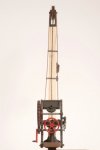
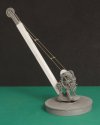
    The yard crane for Heybridge Basin is from the Peco kit. I have shortened the jib a bit so the model looks better in the scene, not for any prototypical reason.

    DSC_6543.jpeg
    I have based the jib on a crane preserved at Ellesmere Wharf on the Shropshire Union Canal. The steel girders provided for the jib in the kit are wrapped up inside the white styrene to represent a timber beam.

    DSC_6547.jpeg
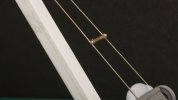
    I have added a brass spindle to attach the two stays. This arrangement seems to be more common than fixing the stays to the frame holding the pulley, as portrayed in the kit.

    DSC_6545.jpeg
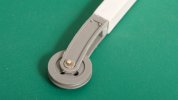
    The rollers for the chain are brass wire, tube and 14 BA washers.

    DSC_6546.jpeg
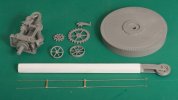
    This all comes apart for painting.

    I have picked up a particularly stupid habit of dipping the brush for Plastic Weld into the bottle of phosphoric acid flux, this being followed by pondering why the plastic joint has fallen apart. Also the brush carries contamination onto the model, hence the stains on the jib. Hopefully the primer will still stick :rolleyes:
     
    Water column . . part 1 build
  • RichardG

    Western Thunderer
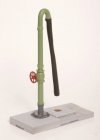
    I have assembled a water column for Heybridge Basin from a Duncan Models kit. This column is described as GER pattern but the design is so plain it ought to pass as generic.

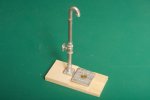
    DSC_6570.jpeg
    The plywood base is something solid to fix the column onto. I can build up the surrounding ground level with foam board or similar.

    DSC_6563.jpeg
    The kit provides a base with detail of what I think is stone setts. The grating is a cab grill made for 4mm scale.

    DSC_6572.jpeg
    The idea of the card underneath is to let me prise the model off the baseboard if I ever want to re-use it somewhere else.

    DSC_6580.jpeg
    The model will have to stand quite close to the railway if the hose is to reach a water filler in the middle of a loco.

    I’ll put off making the hose until after painting. The stash of unbuilt kits is diminishing but I am gaining a collection of almost-but-not-quite-finished models in its place.
     
    Sleeper-built buffer stop . . part 2: finishing
  • Lancastrian

    Western Thunderer
    I can see two ways to continue this workbench thread. I can either try to paint the buffer stop (and each successive model) or just carry on with the building. I’m not very good at painting (might improve!) and I am waiting for warmer weather to spray primer outdoors, so I will carry on with the building . . .

    Rewind to last January:


    The yard crane for Heybridge Basin is from the Peco kit. I have shortened the jib a bit so the model looks better in the scene, not for any prototypical reason.

    View attachment 213952
    I have based the jib on a crane preserved at Ellesmere Wharf on the Shropshire Union Canal. The steel girders provided for the jib in the kit are wrapped up inside the white styrene to represent a timber beam.

    View attachment 213949
    I have added a brass spindle to attach the two stays. This arrangement seems to be more common than fixing the stays to the frame holding the pulley, as portrayed in the kit.

    View attachment 213951
    The rollers for the chain are brass wire, tube and 14 BA washers.

    View attachment 213950
    This all comes apart for painting.

    I have picked up a particularly stupid habit of dipping the brush for Plastic Weld into the bottle of phosphoric acid flux, this being followed by pondering why the plastic joint has fallen apart. Also the brush carries contamination onto the model, hence the stains on the jib. Hopefully the primer will still stick :rolleyes:
    Richard,

    Don't paint the buffer stop, stain it with diluted Indian ink. 1 to 1 with water should suffice, and you can build up layers until you get a nice old and worn look to it.
     
    Ballast - geology and sources
  • RichardG

    Western Thunderer
    Aggregates were extracted near Heybridge Basin but I still don't know what they were. I am guessing sand and gravel as found throughout the middle of Essex.

    Would almost certainly have been sand and gravel, either from the buried river channels which criss-crossed the area or from estuarial / ancient beach deposits.
    This material generally drains very well, unless it contains too much fine sand / silt / clay (which might be the case with material coming from further east where the rivers slowed and lighter particles dropped out.

    As-dug, often rounded, aggregate was maybe not the best ballasting material compared to angular 4" down rock or slag due to insufficient large (+ 4") stone to help resist lateral movement but it certainly drained well, and was the staple ballasting material on light railways wherever deposits were found.

    In the case of the Middy the (main?) source was just a short distance east of where construction started at Haughley station. where a ballast pit was dug.
    The Heybridge Rly would have had to pay more for imported material if local aggregate was not used.

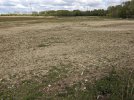
    I doubt I will ever discover what came out of the aggregate workings near Heybridge, but I did take a couple of photos in the Gipping Valley (Suffolk) last week.

    2024-04-26 11.24.12.jpeg

    2024-04-26 13.05.06.jpeg
    These deposits are beside some excavations now full of water, near Pipps Ford Lock.

    I wonder, is this the sort of stuff we are talking about for ballast?
     
    LTSR cattle wagon
  • RichardG

    Western Thunderer
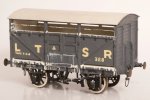
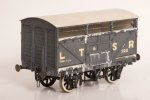
    I have always imagined the Heybridge Railway failed to develop a sustainable traffic in livestock; the GER at Maldon did it better. Nevertheless, individual wagons would have brought prize cattle and sheep to the agricultural show held in 1908.

    This model is the work of Doug Thomas.

    DSC_6717.jpeg

    DSC_6713.jpeg

    I bought this model from the Epson and Ewell MRC at the Kempton Park show yesterday. Doug clearly loves pre-grouping railways, and I feel privileged to have this.
     
    Last edited:

    Water column . . part 2 painting
  • RichardG

    Western Thunderer
    I have assembled a water column for Heybridge Basin from a Duncan Models kit. This column is described as GER pattern but the design is so plain it ought to pass as generic.

    View attachment 213988
    The plywood base is something solid to fix the column onto. I can build up the surrounding ground level with foam board or similar.

    Buying a few really nice wagons built and painted by others has given me a boost to start painting my own backlog of models, and first up is the water column.

    E H Bentall operated a foundry and I suspect this sort of thing was well within their capabilities. If not then the railway contractor could have used the nearby Maldon Ironworks.

    DSC_6899.jpeg
    I have chosen this shade of green for my models of Bentalls products, so using it here ties the company into the railway. The hose is heatshrink sleeving, thanks Ken @chigley.

    The paint is Halfords grey primer, Tamiya and Vallejo acrylics (brushed), and Humbrol enamel satin varnish.
     
    Last edited:
    Compact waiting shelter . . part 1 painting
  • RichardG

    Western Thunderer
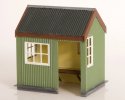
    I have just bought a printed model by accident. The seller described this as "resin" so I imagined it was a kit of parts cast from resin.

    View attachment 216616
    I don't know the technical details so I'm not sure whether this is helpful to people making their own prints; but the model is vastly better than the prints I have bought in the past i.e. five+ years ago.

    View attachment 216615
    I cannot see any traces of glue so I guess this was printed all in one piece. I am amazed!

    From 'Narrow Minded Railworks', through eBay.

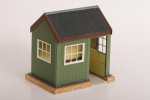
    I can get a suitably minimal waiting shelter for my light railway by looking to narrow gauge. This is a model of a structure at Sylfaen on the Welshpool and Llanfair Light Railway, created as a one-piece print by Narrow Minded Railworks. The original building was still there a few years ago, but in a sadly dilapidated condition and looking like potential salvage for scrap rather than restoration.

    DSC_6940.jpeg
    My livery is fictional, with my chosen shade of “Bentall Green” making an appearance again to hint at the imaginary origin. I am trying to represent corrugated iron (not corrugated galvanised iron) for the roof hence the darkish shade.

    DSC_6941.jpeg
    I have been told, “if you can see it you can get a brush on it” but this was impossible when the handle of the brush was larger than the access spaces. I cut out a new seat top from card, painted it and then glued it in.

    The paint is again Halfords grey primer, Tamiya and Vallejo acrylics (brushed), and Humbrol enamel satin varnish.
     
    Mixed crates and parcels
  • RichardG

    Western Thunderer
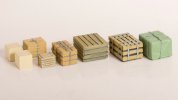
    I bought a bag of of mixed crates and parcels from Skytrex to help me practice painting. These are castings, some resin and some metal.

    DSC_6922.jpeg
    I seem to be using Vallejo 860 ‘medium fleshtone’ in my mixes for many wood finishes. Well, it doesn't look much like any flesh I have ever seen! These actually look quite convincing in real life. I showed them to a mate and he thought they were made of wood and I had only painted in the details.

    Halfords grey primer, Vallejo acrylics (brushed), and Humbrol enamel satin varnish.
     
    ( Diversion : thoughts and reference sources for white paint )
  • RichardG

    Western Thunderer
    Returning to model white for a moment . . .

    Interesting that you mention white /off white / cream colours. I tend to go a bit rogue when I'm painting and generally don't use black or white neat when painting scenic items. IMO they tend to look to harsh. I tend to use an off white, sometimes also followed by a light grey wash rather than a pure white. Similarly I add some grey or brown to black.

    Back in the 1980s, my father was still choosing “white” gloss for indoor woodwork because it looked more gentle than the new “brilliant white”. He used Wilko own brand, its weakness was a tendency to yellow. White paint only started to stay white quite recently, certainly well after the Heybridge Railway.

    I suspect much of the white paint available to Victorians and Edwardians was more of a pale cream. Something like Vallejo Ivory seems to be a good starting point for this, adding their ‘White’ to freshen it up. I can live with the window frames on the waiting shelter but I'll put less white in the mix next time.
     
    Yard crane . . part 2 new jib and finishing off
  • RichardG

    Western Thunderer
    The yard crane for Heybridge Basin is from the Peco kit. I have shortened the jib a bit so the model looks better in the scene, not for any prototypical reason.

    DSC_6543.jpeg

    I have based the jib on a crane preserved at Ellesmere Wharf on the Shropshire Union Canal. The steel girders provided for the jib in the kit are wrapped up inside the white styrene to represent a timber beam.

    I have returned to the yard crane, this is the last scenic model in my backlog for painting.

    I wanted to paint the crane blue to tie in with the present-day colour scheme on the Chelmer and Blackwater, but while the Victorians used blue paint on plenty of ploughs and locos, I haven’t found a single crane. So the model is mostly black, like the crane on Nellie the crane tank.

    My paint jobs on the styrene-covered jib didn’t work out. The attempt at a wood effect was wrong, and overpainting it all in white looked too modern. So I decided to try real wood for the jib.

    DSC_6997.jpeg
    I bought this piece of maple from Monks Gate models, already machined and trimmed to size. The pegs are from 6BA screws, these screwed and locked into the plastic parts with CA glue and then secured into oversize holes in the jib with epoxy glue.

    DSC_7007.jpeg
    Then I added the assembly of the guy cables with the guide rollers. I know epoxy glue won’t stick metal to plastic but maybe it will hold onto acrylic paint, with the stiction of the paint doing the rest.

    DSC_7004.jpeg
    Somehow I let this gap open up too and overlooked it until it was too late to put right. So this gets the only filler in the model. The Peco mouldings are too good to need any filler.

    DSC_7030.jpeg
    There are several angles to contend with but the rollers ended up reasonably parallel to each other and to the crane. They look okay from usual viewing angles. I can understand why Peco simplified this model for their kit - the moulded jib sections were impossible to get wrong. I am making things about as difficult as I can cope with.

    DSC_7013.jpeg
    Brass chain from Slater’s, 24 links per inch and dipped into Birchwood Casey 'Perma Blue' to add the colour.

    DSC_6944.jpeg
    I had several goes at painting the concrete for the base. The first was too brown, the next was too grey and the third looked like dead flesh. This is the fourth version. I am pleased with the bricks.

    DSC_7023.jpeg
    The brake wheel fell off a month or so ago and vanished. This week I tidied and cleaned all of the nooks and crannies in the room, I gained a 10BA nut and lots of fluff but no brake wheel. Peco can supply a spare sprue :)

    DSC_7028.jpeg
    :drool:
    The Meccano hook is heavy enough to stay put keep the chain taught and not blow around in the slightest breeze. I have omitted a “safe working limit” notice. I can add one if this is needed in 1894.

    Halfords grey primer, Halfords 228 Volvo Dark Grey (as black), Vallejo acrylics (brushed), and Humbrol enamel satin varnish. The jib remains bare wood because attempts at adding colour made it different but not better.
     
    ( Diversion : easy concrete using talc on paint )
  • RichardG

    Western Thunderer
    . . .

    Concrete can be a difficult colour to achive as it all depends on the cement/sand/aggregate mix. Modern concretes tend to be grey whereas older concretes start off as a cream colour but weather to all shades.

    I usually start with a pale yellow/cream colour and add tiny amouts of pale browns to mix the colour I'm after. I also add a very tiny drop of red.

    View attachment 218853

    All my painting and washes is done with acrylics.

    I admire this work a great deal, but in spite of the detailed recipe I ended up with a perfect rendition of Peach. So I have gone back to a method which has worked for me before.

    DSC_7072.jpeg
    This is Johnson's baby powder sprinkled onto wet gloss enamel paint and then left to dry out. The idea is from a book by Gordon Gravett, "Modelling Grassland, and Landscape Detailing" where the author repeatedly suggests ways of laying something granular onto something sticky.

    I laid the paint rather thick (horizontal surface) and this brings some texture to the result. If I lay the paint more thinly I get a finer-looking result with a more even appearance, less blotchiness. The talc is white so the final colour is a muted version of the original paint. The paint is an old tin of Humbrol gloss, slightly stodgy and the talc soaks up a great deal of the wetness straight away.

    Obviously this doesn't have the finesse of Dave's work but it has given me a result for this building floor.
     
    Compact waiting shelter . . part 2 plinth
  • RichardG

    Western Thunderer
    The waiting shelter has reached the lighting table on its way from workbench to layout.

    shelter.jpg
    The plinth is hardwood strips glued onto a card base and faced with embossed styrene. I cut notches all around the top and filled then with mortar colour to complete the bricks. I simply could not do this in a smaller scale. 7 mm scale lets me choose the compromises I want to make, smaller scales force them onto me.
    .
    shelter 2.jpg
    The building is a light sliding fit into its plinth. I can fix it later with one or two shims.
     
    Telegraph office
  • RichardG

    Western Thunderer
    DSC_7132.jpeg

    This has lead me to sucumb to a second building from Narrow Minded Railworks, this one they intend to go with a ground frame.

    I am pleased with how the waiting shelter turned out and this has led me to buy a second building from Narrow Minded Railworks. I envisage this as a telegraph office for Heybridge Basin. This model is a kit rather than a one-piece 3D print.

    DSC_7148.jpeg
    The kit includes alternative doors (left- and right-handed), laser-cut glazing and an MDF floor panel. I had already glued the floor panel onto the baseboard when I remembered to take a photo of the kit.

    DSC_7207.jpeg
    I didn't realise 3D printing could do this sort of detail :eek:

    I mean, the finger holes in the dial on the telephone, the desk handles and the door furniture. The fire buckets are hollow so can be modelled to be holding clear water.

    It seems, I need to make a Morse key to replace the telephones (wrong period) and paint the rest.
     
    ( Diversion : GER Y14 on SM32 narrow gauge )
  • RichardG

    Western Thunderer
    View attachment 187458
    To recap slightly, this is my Y14 and its tender on 15th March [2023]. I bolted the subassemblies together before sending them off to Warren for painting.

    I never imagined one model loco could bring so much happiness, even though it spends nearly all of its life in a display case because my layout is too small for it.

    Today it was on the Narrow Gauge, indeed the narrowest gauge.

    P1050957.jpeg

    P1050960.jpeg

    P1050971.jpeg

    P1050970.jpeg

    P1050964.jpeg

    P1060004.jpeg
    "Tornado" belongs to another member of the club.

    925 was painted by @warren haywood and still looks wonderful a year on. I try to remember to use a cloth when I pick it up. The rigid chassis does not inhibit running i.e. the loco stays on the track. Which is, of course, really good when the track is a scale 1.3 miles long and you want to sit and unwind and watch the trains go by.
     
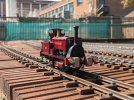
    Manning, Wardle "Lady Marion" painted and completed
  • RichardG

    Western Thunderer
    MW Class F 'Lady Marion', Unpainted

    These are my photos of 'Lady Marion' unpainted, all taken on 10th December which was the day after the test runs at NEEGOG.

    View attachment 204748

    View attachment 204752

    View attachment 204753

    View attachment 204750

    View attachment 204749

    View attachment 204751
    I do think the High Level 'Roadrunner' fitted in well here. It is almost invisible from above. The external trappings of radio control (switch, aerial and charging socket) will be almost impossible to see too.

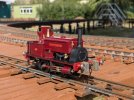
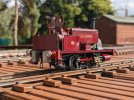
    "Lady Marion" is back on the workbench :)

    DSC_5663.jpeg
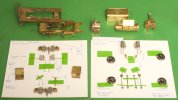
    A while ago, I dismantled the loco and sent these parts off to @warren haywood.

    DSC_7444.jpeg
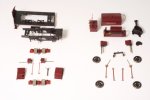
    There are also control parts, mechanical parts and castings which didn't need painting.

    DSC_7438.jpeg
    The parcel with Warren's work has arrived. The wheels have kept their rear markings and every other part is handed or unique in some way.


    DSC_7441.jpeg
    The cellulose paint is so thin it reveals flaws I never noticed, but things like the filled-in holes below the quadrant will never show on the finished model.

    I am delighted with all of this. Hopefully, the rebuild will involve nuts and bolts and a little glue, and no soldering except for the wiring.
     
    . . test running
  • RichardG

    Western Thunderer
    Lady Marion had her first long test run today, this was on the club's SM32 track. There is a chunky wheel drop on the pointwork, but nothing bad enough to hinder progress.

    2024-09-04 12.08.24.jpeg
    I chaperoned her for the first lap to remove twigs and berries.

    2024-09-04 12.06.23.jpeg
    I think the sunlight brings out a new depth of colour in the paint.

    2024-09-04 12.03.33.jpeg
    Industrial background!

    There were no derailments, she never stalled, and perhaps above all she didn't try to bind to someone else's radio gear. A fine day out.

     
    Loco no.4, ex-LB&SCR (1902)
  • RichardG

    Western Thunderer
    As the Heybridge and Langford Light Railway developed, trains became too heavy for the two Manning Wardles and indeed the foundry could only lend out 'Lady Marion' on an occasional basis. I am imagining, the railway gained the use of a NER class H2 (LNER J79) or something similar around 1898. This loco needs to be built and past performance suggests this will take me another year.

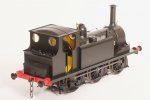
    Looking for a quick fix, I have indulged myself in a Dapol Terrier. For me, this represents one of the surplus locomotives sold off by the LB&SCR in 1902 and subsequently exported to South America, and with a fictional placement in between. The cylinders are much the same size as the H2, and it fits the layout and the period. Indeed, I can usefully suppose the H2 returned to the NER when the Terrier arrived. I don't have room for more than two locos at a time, and even this is a squeeze.

    DSC_7645.jpeg
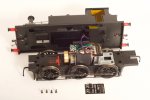
    Here are the innards of a Dapol Terrier. This model runs really well, but I think they all do.

    DSC_7650.jpeg
    I have removed the firebox glow feature and the Westinghouse brake hoses, added some coal, and fitted three-link coupling chains.

    I bought a yard of this chromed steel chain. It seems to blacken by heating to cherry red and quenching in oil, but the camera still finds the chrome. The links are overscale too, but if it proves easier to use than scale links I might standardise on it.

    DSC_7657.jpeg
    The Terrier is HLLR no.4.
     
    GER Y14 coaling
  • RichardG

    Western Thunderer
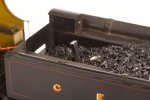
    I have spent over a year thinking about how to add the coal to my Y14. The quandary being, how to extract the power socket and the toggle switch if I want to change the battery pack. Ideas for a lift-out coal load got more and more involved and less and less likely to work.

    I have finally accepted that the battery pack is specified for 500 charge/discharge cycles, and I am managing barely five a year. The battery will probably outlive me, and so I’ve decided, whoever gets the loco after I'm gone can have the fun of chipping out the coal to do the rebuild, and then topping it up later.

    DSC_7703.jpeg
    I put masking tape over the “RF inlet ports”, painted the chrome fittings in black, and then glued in the coal.

    DSC_7710.jpeg
    To my complete surprise, the bright chrome toggle switch barely shows up. The chrome is reflecting the coal all around it.

    I don't need black sleeving over the toggle or other skullduggery.
     
    Manning, Wardle "Lady Marion" front charging socket
  • RichardG

    Western Thunderer
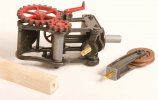
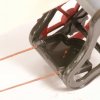
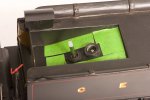
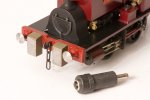
    "Lady Marion" has a charging socket inside the front of the smokebox. I couldn't find a space inside the frames to fix a suitable socket, and wiring back into the boiler is easier from inside the smokebox.

    DSC_7811.jpeg
    The tiny smokebox dictated a miniature power socket, which in turn needs a coaxial adaptor to let me connect a charger with a standard plug.


    DSC_7809.jpeg
    Despite my planning and expectations from the recess in the front buffer beam, I had to turn down the outside of the adaptor to let it clear the coupling hook. One of the magnets has fallen off the smokebox door twice, but the door stays put with only one.

    To quell (or indeed promote) the obvious follow-up, the loco imagined here is indeed contemporary with the story of Pinnochio.
     
    Last edited:
    Top