Graham, I did have a think about using the buffers this way on my MW class F but it seemed difficult to arrange the wiring. A 9F or a main line diesel has a great deal more space to arrange everything. I am happy enough with the coaxial power socket in the tender of my Y14, so I went for the same here. They can use the same charger.
The good news is, the Micron MR601a receiver has arrived and I have installed it inside the H2

The MR601a is substantially smaller than the MR603 I was using outside the loco in my previous posts. The quiescent current consumption is higher because there isn’t space for the power management components on the larger board, so battery life will be shorter - this is something I must accept as the price of miniaturisation.
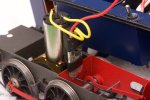
I have used heat shrink sleeving to tie the receiver onto the motor stay. The aerial is the black wire extending forwards between the frames. Nicely away from metalwork and in free space.
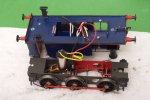
The long red and black wires are extra-flexible wire so they are easy to curl up inside the body.
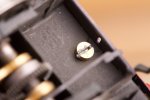
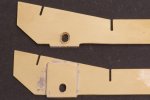
The rear coupling will obstruct the body fixing screw above it. If I had been paying attention I could have rectified this when I cut my new frame spacers. I want to run the loco for a while, and then add the coupling when I expect the body is there to stay.
I do like this toggle switch. It is easy to see, easy to use and easy to accept.

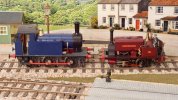
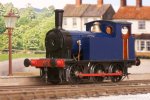
Sod’s law has left me with the join in the backscene exactly where I want to pose models in an anonymous setting. Backscene retouched, model as is.
This loco is promising to be the most usable of the three r/c locos I have built so far. The Y14 is too big for the layout, the class F is a bit of a fiddle for recharging.
The model wants for coal and a crew and minor fettling, but the build is essentially now complete