The Heybridge Railway, 1889 to 1913

RichardG

Western Thunderer
Seems to me a couple of contacts underneath the loco would be a better option, with corresponding contacts between the rails in the fiddle yard, or disguised in some way.

Yes I can imagine they could be nearly invisible if placed carefully under the chassis and made a dark colour. The mating contacts in the fiddle yard could be quite tall. Perhaps something for a future loco.

DSC_2123.jpeg
In the meantime I will settle for this :)
 

Dog Star

Western Thunderer
Richard,

Richard Carr - on WT - has experimented with dead rail locos and with methods of battery charging.... I think that using loco buffers to a yard buffer stop featured on his S7 layout... or was Scale7JB that experimentor?

Rgds, Graham
 

RichardG

Western Thunderer
Graham, I did have a think about using the buffers this way on my MW class F but it seemed difficult to arrange the wiring. A 9F or a main line diesel has a great deal more space to arrange everything. I am happy enough with the coaxial power socket in the tender of my Y14, so I went for the same here. They can use the same charger.

The good news is, the Micron MR601a receiver has arrived and I have installed it inside the H2 :)

The MR601a is substantially smaller than the MR603 I was using outside the loco in my previous posts. The quiescent current consumption is higher because there isn’t space for the power management components on the larger board, so battery life will be shorter - this is something I must accept as the price of miniaturisation.
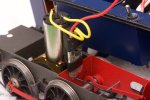
DSC_2115.jpeg
I have used heat shrink sleeving to tie the receiver onto the motor stay. The aerial is the black wire extending forwards between the frames. Nicely away from metalwork and in free space.
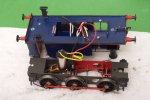
DSC_2111.jpeg
The long red and black wires are extra-flexible wire so they are easy to curl up inside the body.
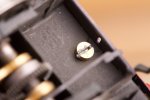
DSC_2124.jpeg
The rear coupling will obstruct the body fixing screw above it. If I had been paying attention I could have rectified this when I cut my new frame spacers. I want to run the loco for a while, and then add the coupling when I expect the body is there to stay.
DSC_2125.jpeg
I do like this toggle switch. It is easy to see, easy to use and easy to accept.

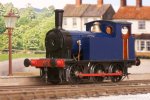
DSC_2134.jpeg
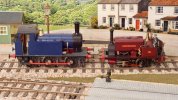
Sod’s law has left me with the join in the backscene exactly where I want to pose models in an anonymous setting. Backscene retouched, model as is.

This loco is promising to be the most usable of the three r/c locos I have built so far. The Y14 is too big for the layout, the class F is a bit of a fiddle for recharging.

The model wants for coal and a crew and minor fettling, but the build is essentially now complete:drool:
 

RichardG

Western Thunderer
DSC_2137.jpeg

I wish I were better at visualising the big picture. These two are all I need to provide a respectable service at Heybridge Basin for the period 1907 to 1912. One from the railway, one from the foundry. Both radio controlled. If one should fail, I have two analogue locos no.4 'Heybridge' (Terrier) and no.1 'Blackwater' (Class K) which I can put in their place. If I want to show a visiting GER loco, I have the C53 tram (analogue).

If I want to model the 1890s, 'Lady Marion' is fine and so is the GER Y14 (this is very much a pre-1900 loco because of its specification) though a bit big for the layout. 'Blackwater' ran throughout the life of the railway, but would be difficult if not impossible to convert to r/c. In fact, so far I haven't managed to remove the body shell. So the obvious gap in my r/c fleet is loco no. 2 or loco no.3, neither built yet. In fact, neither is terribly well-defined although if no.3 was to be a MW old class i then there is an unbuilt kit for this on the shelf!

Supposing no.4 arrived in 1904 (when it supposedly replaced no.2 and no.3) then I still have a "r/c gap" for 1905 and 1906 (only 'Lady Marion'), but I hardly need to be able to model every year of the railways notional existence using multiple forms of control.

The Y14 is a bit of an odd one out. For simplicity, I think it will be best for all of my additional visiting locos to be analogue. The only constraint is the need to have only one analogue loco on the layout at a time, but this isn't too much of a hardship in such a small space.

Something about this project which I like especially is that most of the models are from kits and occasionally from scratch. It is a personal interpretation of a railway, without bias caused by bringing in incorrect RTR models. The only conspicuous "ready made" thing is a chunk of the backscene at Heybridge Basin, but this image is quite anonymous and it is from a large range. It will appear on other people's layouts, but it won't call itself out in the way of a popular building kit.

Please excuse the ramble. I am between models.
 

RichardG

Western Thunderer
Your last photo is very believable... there is so much to like in this view.

Thank you Graham.

Four years ago, I wanted the modelling in this project to be of such a standard as to blend in with the ready-to-run offerings from Dapol and Minerva and so on. I am starting to realise, I can now make a better model. For example the view through the chassis of the H2 would not be possible with a diecast chassis.

I am sure it it is best for me to carry on making my models as well as I can, and this is going to leave some of my RTR models looking a bit simplistic. The best solution is to replace them with models I make myself. This is okay for the odd wagon, but it would be a struggle to build the Old Class i as a replacement for ‘Blackwater’, however logical this might be.

I am pushed for space for trains as well as for the layout, and a job lot of RTR H0 has just gone to Ellis Clark. Unfortunately this has not freed up any space in the hobby room because it has been in the office for the last two years! Another display cabinet is needed. I want to keep the models I have made; they remind me of how my experience is growing.
 

RichardG

Western Thunderer
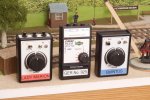
I have one fresh conclusion from making my third r/c loco and it concerns the arrangement of the handsets.

A Micron receiver can be bound to only one transmitter handset, while one handset can be bound to any number of receivers. So if your layout is strictly one engine in steam, you really only need one handset. You just switch on the loco you want to use, and leave the others switched off.

A more sophisticated solution is to buy into the Micron "Selecta" system by purchasing a suitable handset. This will control up to twelve locos. You select control of a particular loco through a rotary switch, and you can configure the loco to keep running or to stop when you turn the switch to select a different loco. My feeling is, this would be good on a roundy-roundy. If you have an end-to-end layout, the system is still only really suitable for one engine in steam. Unless I suppose it is a very large layout where one train is running throughout the duration of the journey of another.

Both of these approaches have a problem in that you (or more likely, your executors) cannot sell an individual locomotive because it will be unusable without a handset. So the third approach is to buy a handset for each loco. The big advantage of this is two or more people can drive two or more locos at the same time. This is what I have done for 'Lady Marion' and 'Quintus'.

The GER Y14 has its own handset too. This loco has the Fosworks system, which is perfectly satisfactory but too big to fit into a small 7mm tank loco. Having given up on the "Selecta" approach, I will leave the Y14 loco as it is. There is no benefit in refitting it with a Micron receiver.

DSC_2140.jpeg
The layout might end up needing a shelf along the front to hold these.
 
GER 14-ton machinery wagon (1886) New

RichardG

Western Thunderer
The railway needs some kind of implement or machinery wagon to carry a motor car. Last year I bought a kit for a GWR Serpent as a quick and easy fix, and spent most of January trying to build it before giving up.

Afterwards I discovered that D&S Models do a kit for a GER 14-ton machinery wagon to diagram 25. This wagon is more substantial than the railway needs to carry a mere car, but it is a step in the right direction. It could easily carry a threshing machine instead, perhaps for an agricultural show I still think about modelling.

These wagons were built in batches from 1886 onwards, and the design must have been successful because some survived into BR days.

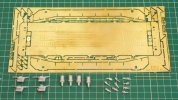
DSC_2142.jpeg
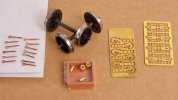
This is what you get in the kit, along with a sheet of instructions.

At a glance, I can see that none of the parts are numbered or labelled. There are etched loops here to make the lashing rings (good) but nothing to secure them to the deck. There is provision to add springing to one of the axles but no material to provide the actual spring. There are no couplings, and the buffers are solid white metal.

My first impression is that this kit builds a model a little more sophisticated than the NER Lomac from Connoisseur Models, but the instructions are much more basic. The NER Lomac is of course the first etched kit for countless modellers, including me!

I have read through the instructions and it is fairly easy to see how the designer expects the kit to go together. There are photos of these wagons in Tatlow, and so I feel happy to make a start. I am determined, this model will not go the way of the Serpent.
 

RichardG

Western Thunderer
I think it is best for me to start with the buffers. These look like the weakest part of the kit; and if the main build goes pear-shaped I will at least have a set of buffers to show for my efforts :confused:

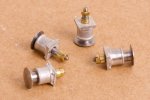
DSC_2150.jpeg
I am using the heads and stems from a set of second-hand buffers of unknown manufacturer. The white metal stocks are drilled and trimmed to suit.

DSC_2155.jpeg
The stems are too long for the stocks so I have cut spacers from brass tube.

There is a certain satisfaction in getting four buffers from four castings and not messing up at least one of them! This is a task where the lathe helps so much.

DSC_2159.jpeg
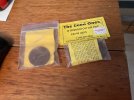
I have found an etch of turnbuckles left over from the NER Lomac, and some coupling hooks. Also some split pins to secure the lashing rings to the deck.

I have some suitable chain left over from the mobile crane.

So hopefully I now have a complete kit, ready to start and I won't be stuck for bits part-way through.
 
Last edited:

RichardG

Western Thunderer
So hopefully I now have a complete kit, ready to start and I won't be stuck for bits part-way through.

What a stupid thing for me to write. With the Serpent behind me I feel like I am going out of the frying pan into the fire.

DSC_2161.jpeg
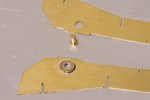
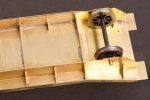
The holes for the wheel bearings here are hopelessly oversize. Perhaps there is a historical reason for this, were bearings larger in the olden days?

DSC_2165.jpeg
Anyway, the bearings will fall right through the oval holes and it will be impossible to build suspension without the wheelset twisting itself back and forth horizontally.

I have put washers behind the round holes, and pieces of brass sheet behind the oval holes. It seems sensible to sort this out while I can still hold the frames against each other.
 

RichardG

Western Thunderer
There is a useful article on these wagons by Brian McCarthy in GE Journal no. 90 dated April 1997. The article explains, these wagons were built with frames in the style of a loco; and so assembly begins as if I were building a loco chassis.

This kit has been etched with quite a large cusp on every edge. I have been using a sanding disc in the mini drill to remove the cusps and this has sped things up rather well. Thank you to @Nick Dunhill who mentioned this method in passing during his build of a BR Standard 3.

DSC_2171.jpeg
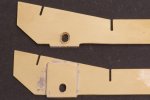
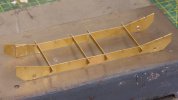
The slots in the frames are far too wide for the cross-members, so I made a wedge to hold each joint in alignment while I soldered it up.

DSC_2176.jpeg
Every cross-member is offset towards to centre of the wagon so the gaps in the slots will be hidden behind the flanges to be added later.

This is a very difficult way to build a wagon. It is hugely easier to begin with the deck, form it to shape and then build onto this. Nevertheless, the assembly is flat.

DSC_2182.jpeg
I now diverge from the instructions (such as they are!) because I think my way is going to be easier.

I heard some little “pops” from the deck while I was soldering this up, but after a little manipulation, everything is still flat. Next time, it might be wise to anneal the deck so it is de-stressed before assembly. All of this soldering is using solder paste and the microflame torch, and virtually no clean-up is necessary.

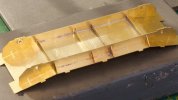
With the frames and the first four cross-members secured to the centre section of the deck, I have a robust assembly to which I can add more parts. I have tried placing a buffer beam and a curb rail onto the model and they fit. So I am a lot happier than I was two days ago!
 

magmouse

Western Thunderer
I have been using a sanding disc in the mini drill to remove the cusps

Could you say a bit more about this, please Richard? A picture of what you describe as a sanding disc would be be helpful, as well as a description of how you orient the part and the disc. My concern with this method is the risk of digging too deep into the metal.

Nick.
 

simond

Western Thunderer
I bought some discs in a model shop in Detroit many years ago - maybe 2001…. And I use them in my Proxxon, generally hand holding both the part and the mini-drill. If Proxxon made a similarly sized angle grinder, it would be both safer and easier! Always wear glasses, and be careful it doesn’t snatch in a cut.

I’ve still got a few discs left, wish I’d bought more! They’re pretty fine grit.

image.jpg

best
Simon
 

RichardG

Western Thunderer
Could you say a bit more about this, please Richard? A picture of what you describe as a sanding disc would be be helpful, as well as a description of how you orient the part and the disc. My concern with this method is the risk of digging too deep into the metal.

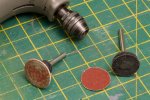
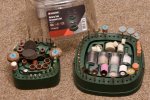
The discs I am using are sanding discs not cut-off discs. They are discs of aluminium oxide paper with a self-adhesive backing, stuck onto to a pliable mount made from some kind of synthetic rubber.

DSC_2183.jpeg
On the left is the one I have been using. It is nearly worn out and I cannot find the spare discs. On the right is a smaller disc with its mount.

DSC_2184.jpeg
The smaller version is from this "Rotary Tool Accessory Set" by Parkside. I seem to remember this set cost less than £10, so about 3p per item!

I am holding the mini-drill in my dominant hand and the brass part in my other hand. You see the cusp disappear before your eyes. The drill speed is I guess around 12,000 rpm.

I don't think there is any great risk of "digging in", but you can remove too much material if you linger too long. I have done this (just once!) and it shows up in one of my photos if you look carefully.
 

RichardG

Western Thunderer
With the bearing holes sorted out and the initial assembly of frames and floor complete, the build has become a whole lot easier. The subsequent parts seem to be fitting together without difficulty.

DSC_2191.jpeg
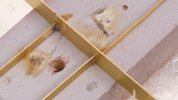
The wheels have to go in before fixing the ends of the frames to the ramped parts of the floor. Then I put in the short pieces of cross brace (eight of these in all) followed by the curb rails.

I guess most of the cross braces have been made incomplete to let fit everything onto a half sheet of brass. A real perfectionist would cut new ones but they only show when you look underneath. I can use the space between them to glue in some lead sheet.

DSC_2188.jpeg
The springs are piano wire pressing onto the tops of the bearings. I am using Fry's Powerflow (paste flux) to get the solder to flow onto the steel wire. Clean up was with cellulose thinners, hopefully the paint will stick.

DSC_2186.jpeg
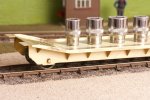
When the wagon is loaded up with 40 grams of sockets, the bearings are sitting half-way up their slots.

I think this ought to be about right, but the instructions tell me, “[the springing] should be enough to take up track discrepancies not the vehicle weight”. I’m not entirely sure what this really means, because track discrepancies can be upwards as well as downwards. I guess, if the model starts to bounce off the track then I’ll have to add more ballast.

For the record, the springs are 0.48 mm diameter piano wire. The choice of size was entirely empirical. Anything thinner seemed wishy-washy, anything thicker was too stiff.

Today I have gone from a slightly doubtful-looking open framework to the essence of a machinery wagon. Any initial similarities with the Serpent have been blown away and I am optimistic about the rest of the build :)
 

simond

Western Thunderer
the instructions tell me, “[the springing] should be enough to take up track discrepancies not the vehicle weight”.
I wonder if this is a reference to having the bearings touching the top of their slots - I think there was a real reluctance to have actual springing on models - the tendency was for down-only movement to be provided. I don’t know why, but my initial experiments with springing resulted in a loco that could do a decent impression of a nodding dog, perhaps the wisdom of the day was that proper springing simply didn’t work.

atb
Simon
 

RichardG

Western Thunderer
I wonder if this is a reference to having the bearings touching the top of their slots

Thinking about the track at NEEGOG, I am sure a useful springing mechanism needs to be able to let a wheel climb up at a baseboard joint just as much as to drop down. I can try propelling the wagon at a fair speed, with its fixed axle leading and with its sprung axle leading, and see if there is any difference. If so then this introduces a concept of a "directional wagon" optimised for use on roundy-roundys!

The wagon seems fine trundling through my pointwork at home. I doubt whether the springing will make a blind bit of difference here, and if I think it is making things worse I have the option to put a rocking axle in its place. The wheelbase is 140mm, longer than everything I have made so far, so I suspect some kind of suspension would be wise.
 

simond

Western Thunderer
Thinking about the track at NEEGOG, I am sure a useful springing mechanism needs to be able to let a wheel climb up at a baseboard joint just as much as to drop down. I can try propelling the wagon at a fair speed, with its fixed axle leading and with its sprung axle leading, and see if there is any difference. If so then this introduces a concept of a "directional wagon" optimised for use on roundy-roundys!

The wagon seems fine trundling through my pointwork at home. I doubt whether the springing will make a blind bit of difference here, and if I think it is making things worse I have the option to put a rocking axle in its place. The wheelbase is 140mm, longer than everything I have made so far, so I suspect some kind of suspension would be wise.

I fully agree. have a vague memory of an MRJ from years back in which the author tried variously suspended wagons (rigid, compensated, wobbly axle first, rigid axle first, suspended somehow, suspended otherhow, etc) through a typical crossover (A6 for example, I can’t recall) on an inclined plane, which was progressively adjusted to increase speed. All very commendably controlled and scientific. I cannot recall the details but I think they concluded that suspension worked, which probably isn’t a great surprise.

I can imagine that a wagon with a compensated axle might well behave assymetrically, the inertia of the wagon body in roll must be higher than that of the wobbly axle , but I’m struggling to imagine the combination of speed and grim tracklaying that would make it matter. The Dapol system seems rather better in any case, but again, does it actually matter?

my recent experience with springing is quite positive and I shall continue to apply it to wagons, and eventually coach bogies too. I think I’m pretty much converted to CSB for locos. Of course in the case of locos, there is the matter of electrical continuity to consider (except in your case with your R/C locos!) in addition to track holding and tractive effort, and these factors in combination would certainly suggest that some form of suspension or compensation is going to offer some benefit.

cheers
Simon
 
Top