
You are using an out of date browser. It may not display this or other websites correctly.
You should upgrade or use an alternative browser.
You should upgrade or use an alternative browser.


simond
Western Thunderer
There’s a post on the 3D printer thread if anyone is interested in how FEPs are replaced.
3D Printing - whether to buy, what to buy and how to use it?
small amount of stringing which tends to remove itself when rail is threaded through From my limited knowledge its not only the printer that's important but the tweaking of the print software, and in this case using PLA+ filament. I am in the situation of needing the knowledge and inspiration...
www.westernthunder.co.uk
Last edited:

simond
Western Thunderer
Fluorinated ethylene propylene (FEP) is a copolymer of hexafluoropropylene and tetrafluoroethylene. It differs from the polytetrafluoroethylene (PTFE) resins in that it is melt-processable using conventional injection molding and screw extrusion techniques.[2] Fluorinated ethylene propylene was invented by DuPont and is sold under the brandname Teflon FEP. Other brandnames are Neoflon FEP from Daikin or Dyneon FEP from Dyneon/3M.
FEP is very similar in composition to the fluoropolymers PTFE (polytetrafluoroethylene) and PFA (perfluoroalkoxy polymer resin). FEP and PFA both share PTFE's useful properties of low friction and non-reactivity, but are more easily formable. FEP is softer than PTFE and melts at 260 °C; it is highly transparent and resistant to sunlight. (Wikipedia)
Well, you did ask...
In this context, the FEP material is used to create the flexible transparent drum-skin that forms the bottom of the print tank, and through which the UV light pattern is projected to create the image on the print plate. You can see part of it in the image in my post 1861 above - I suppose it looks a bit like tracing paper but it is very much more flexible. Indeed, very like a non-stick drum-skin.
FEP is very similar in composition to the fluoropolymers PTFE (polytetrafluoroethylene) and PFA (perfluoroalkoxy polymer resin). FEP and PFA both share PTFE's useful properties of low friction and non-reactivity, but are more easily formable. FEP is softer than PTFE and melts at 260 °C; it is highly transparent and resistant to sunlight. (Wikipedia)
Well, you did ask...
In this context, the FEP material is used to create the flexible transparent drum-skin that forms the bottom of the print tank, and through which the UV light pattern is projected to create the image on the print plate. You can see part of it in the image in my post 1861 above - I suppose it looks a bit like tracing paper but it is very much more flexible. Indeed, very like a non-stick drum-skin.

Dangerous Davies
Western Thunderer
Simon
the thought of PTFE being heated worries me. Are we talking about low-ish temperatures which it doesn't break down? I ask because of the risk of hydrofluoric acid being released and the associated health hazards.
I worked in a steelworks producing silicon steel (3% Si) for transformer laminations. We used HF in our pickle line where it was treated with utmost respect.
Keep up the good work
Dave
the thought of PTFE being heated worries me. Are we talking about low-ish temperatures which it doesn't break down? I ask because of the risk of hydrofluoric acid being released and the associated health hazards.
I worked in a steelworks producing silicon steel (3% Si) for transformer laminations. We used HF in our pickle line where it was treated with utmost respect.
Keep up the good work
Dave
simond
Western Thunderer
Dave,
thanks for the comment and concern! I would be most averse to cooking PTFE and well remember the dire warnings regarding overheated o-rings in the Ford development labs in Dunton from my days in the auto industry. PTFE (and Viton) o-rings are of course used in live steam models and the risk of overheating is certainly something to be aware of.
For folks who do not know, overheated PTFE will release hydrofluoric acid which, even in very small quantities can cause very damaging skin burns which are particularly difficult to treat. If in any doubt whatsoever, handle any overheated o ring (or other similar components) with rubber gloves, bag it and bin it along with the gloves, and wash anything it may have touched with plenty of water.
there‘s a link here https://www.alliedsystems.com/pdf/LongReach/Bulletins/LRSB0003.pdf which suggests that there’s a real, but rather remote risk.
in respect of the FEP on a 3D printer, it gets up to a pleasantly mild 25 degrees C, and that’s very much at the safe end of the scale.
best
Simon
thanks for the comment and concern! I would be most averse to cooking PTFE and well remember the dire warnings regarding overheated o-rings in the Ford development labs in Dunton from my days in the auto industry. PTFE (and Viton) o-rings are of course used in live steam models and the risk of overheating is certainly something to be aware of.
For folks who do not know, overheated PTFE will release hydrofluoric acid which, even in very small quantities can cause very damaging skin burns which are particularly difficult to treat. If in any doubt whatsoever, handle any overheated o ring (or other similar components) with rubber gloves, bag it and bin it along with the gloves, and wash anything it may have touched with plenty of water.
there‘s a link here https://www.alliedsystems.com/pdf/LongReach/Bulletins/LRSB0003.pdf which suggests that there’s a real, but rather remote risk.
in respect of the FEP on a 3D printer, it gets up to a pleasantly mild 25 degrees C, and that’s very much at the safe end of the scale.
best
Simon
simond
Western Thunderer
So instead of FEP, I decided to break my Unimat 
happily turning some wheels on a coarse scale 3R impulse purchase into something suitable for 0MF when I was interrupted by a loud “bang” and a smell of the smoke getting out of something which I expect is/was a capacitor. It still runs, though it doesn’t feel like a good idea.
I shall dismantle and investigate…
Meanwhile, @Giles, I believe you had an alternative solution involving sheep? Could you please point me in the right direction?
thx
Simon
happily turning some wheels on a coarse scale 3R impulse purchase into something suitable for 0MF when I was interrupted by a loud “bang” and a smell of the smoke getting out of something which I expect is/was a capacitor. It still runs, though it doesn’t feel like a good idea.
I shall dismantle and investigate…
Meanwhile, @Giles, I believe you had an alternative solution involving sheep? Could you please point me in the right direction?
thx
Simon

oldravendale
Western Thunderer
That seems a bit cruel, particularly in today's enlightened world. Anyway, you'd have to build a treadmill and capture a sheep both of which will probably take a while.... I look forward to seeing the gearing to get the speeds you'll need on the lathe.Meanwhile, @Giles, I believe you had an alternative solution involving sheep? Could you please point me in the right direction?
thx
Simon
simond
Western Thunderer
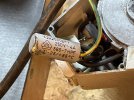
now, let’s see if we can get one of these or something similar. Not sure what it actually is/was…
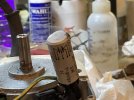
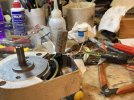
trying to read it in a sensible direction, I have
(D) (S) 25 / 085 / 21
SW
Y= gn/ge (There is a diagram to the left - looks like two switches, five connections)
bl
[ERO] J3
F1740 - 325 - 5522
0,025uF X
+ 2x2500pF Y
250V ~ 4A
560-7 HPF (There is a logo to the left - looks like “VDE” in a triangle)
-25 / +85 C
R57
It has five connections, two blue, two black and a green/yellow presumed ground.
the uF and pF confirm my suspicion that it was a capacitive thingy, I guess to shift the phase of the field, but it’s not my domain.
it’s not well, in any case
Last edited:
simond
Western Thunderer
Well, lots of references on the www.
Entstör-Kondensator ERO Typ F1740-325-3511, 0.025 µF + 2x 2500 pF / 250 V~, NOS | eBay UK for example, however, I find it extraordinary that seven other people are looking at this in the last hour….
And this suggests a separate box might be the simpler approach. Five wire XY suppressor - UK Vintage Radio Repair and Restoration Discussion Forum particularly as old capacitors don’t fade and die, they go bang…
I’m not sure why they need a start and a run, and I’m no longer sure that’s what this is.
but we have a tame electronics guru at work. He’ll know, and he’s kind enough to put it words I understand too
more soon…
Simon
Entstör-Kondensator ERO Typ F1740-325-3511, 0.025 µF + 2x 2500 pF / 250 V~, NOS | eBay UK for example, however, I find it extraordinary that seven other people are looking at this in the last hour….
And this suggests a separate box might be the simpler approach. Five wire XY suppressor - UK Vintage Radio Repair and Restoration Discussion Forum particularly as old capacitors don’t fade and die, they go bang…
I’m not sure why they need a start and a run, and I’m no longer sure that’s what this is.
but we have a tame electronics guru at work. He’ll know, and he’s kind enough to put it words I understand too
more soon…
Simon

michael080
Western Thunderer
As it seems to be a suppression capacitor, I would assume that the motor has some kind of commutation. A starter capacitor would be used if the motor is a shaded-pole type
As the name says, these suppresion capacitors are used to suppress sparks that occur between the commutator and the brushes, mainly if the brushes move from one commutator segment to the next.
Your motor would run without this capacitor, but your TV- and radio reception may be quite bad as long as the motor runs
As the name says, these suppresion capacitors are used to suppress sparks that occur between the commutator and the brushes, mainly if the brushes move from one commutator segment to the next.
Your motor would run without this capacitor, but your TV- and radio reception may be quite bad as long as the motor runs
simond
Western Thunderer
Thanks Michael,
I had seen the term “suppressor” in the vintage radio thread, but I’m far from clear about how to wire it in, given three capacitors and five wires. Three wires would have been clearer, but which way to fit the caps? It does run with it in its current, rather unhappy, form. If it is commutated, there are no external brush holders, so the brushes may also not be in the first flush of youth!
Hopefully I’ll know more tomorrow. It would not be difficult to have a small enclosure on the back of the motor with a couple of external capacitors inside. Wiring will be fiddly but feasible.
Meanwhile, I have located a speed-controlled motor with roughly twice the power for £159 which is tempting, and Giles has been most helpful.
best
Simon
I had seen the term “suppressor” in the vintage radio thread, but I’m far from clear about how to wire it in, given three capacitors and five wires. Three wires would have been clearer, but which way to fit the caps? It does run with it in its current, rather unhappy, form. If it is commutated, there are no external brush holders, so the brushes may also not be in the first flush of youth!
Hopefully I’ll know more tomorrow. It would not be difficult to have a small enclosure on the back of the motor with a couple of external capacitors inside. Wiring will be fiddly but feasible.
Meanwhile, I have located a speed-controlled motor with roughly twice the power for £159 which is tempting, and Giles has been most helpful.
best
Simon

Osgood
Western Thunderer
I gave up and went to wiki for the answer to RUN capacitors:

 en.wikipedia.org
Motor capacitor - Wikipedia

smgee
Western Thunderer
I believe using a 24V electric scooter motor is a popular upgrade/replacement, combined with a switched-mode speed control. I've seen a thread somewhere, which I now can't find! Ebay seems to have motors in a range of power outputs, e.g. 150W for about £20, or a complete kit for £130.Thanks Michael,
I had seen the term “suppressor” in the vintage radio thread, but I’m far from clear about how to wire it in, given three capacitors and five wires. Three wires would have been clearer, but which way to fit the caps? It does run with it in its current, rather unhappy, form. If it is commutated, there are no external brush holders, so the brushes may also not be in the first flush of youth!
Hopefully I’ll know more tomorrow. It would not be difficult to have a small enclosure on the back of the motor with a couple of external capacitors inside. Wiring will be fiddly but feasible.
Meanwhile, I have located a speed-controlled motor with roughly twice the power for £159 which is tempting, and Giles has been most helpful.
best
Simon
Dangerous Davies
Western Thunderer

simond
Western Thunderer
Thanks Dave, the website is very helpful.
I have the motor in bits, the brushes are ok, but there is a lot of muck in there, which I need to clean, and I can then trace the wires.
My cap is not a pass-through, all the wires come out of the same end, but I don't think that's an issue.
Will pop up a diagram when I can
thanks again
Simon
I have the motor in bits, the brushes are ok, but there is a lot of muck in there, which I need to clean, and I can then trace the wires.
My cap is not a pass-through, all the wires come out of the same end, but I don't think that's an issue.
Will pop up a diagram when I can
thanks again
Simon
simond
Western Thunderer
lots of Unimat info here too