
You are using an out of date browser. It may not display this or other websites correctly.
You should upgrade or use an alternative browser.
You should upgrade or use an alternative browser.
Rivermead Central
- Thread starter 40057
- Start date

ASAP, but when it has a full set of wheels.Would be nice to see more pics of the Scot?
Tony
It’s a super model, one of Bassett-Lowke’s best representations. And the very last new locomotive model added to Bassett-Lowke’s standard 0 gauge range.
Martin

simond
Western Thunderer
Martin,
Older motors tend to higher currents, and 0 gauge, being larger, may place greater demands too.
Measurement is easy if you have a power supply, controller and a multimeter with a 10 A range, and, of course, the subject to test.
I would suggest a 5A controller would be more than adequate for any sensible model, including double-motored Heljan diesels, Pittman motored US outline models and older models such as your Scot.
atb
Simon
Older motors tend to higher currents, and 0 gauge, being larger, may place greater demands too.
Measurement is easy if you have a power supply, controller and a multimeter with a 10 A range, and, of course, the subject to test.
I would suggest a 5A controller would be more than adequate for any sensible model, including double-motored Heljan diesels, Pittman motored US outline models and older models such as your Scot.
atb
Simon
Thanks very much, Simon.Martin,
Older motors tend to higher currents, and 0 gauge, being larger, may place greater demands too.
Measurement is easy if you have a power supply, controller and a multimeter with a 10 A range, and, of course, the subject to test.
I would suggest a 5A controller would be more than adequate for any sensible model, including double-motored Heljan diesels, Pittman motored US outline models and older models such as your Scot.
atb
Simon
I shall proceed on the basis a 5A controller is what is needed for Rivermead Central (but not for the Royal Scot!).
And a smaller controller as and when for Rowan Colliery.
Martin
Hi TonyWould be nice to see some pics in a disassembled state so we can see what you are doing though.
Tony
Will do.
Thanks for your interest.
Martin
So, to recap. Just over a year ago I bought a Bassett-Lowke rebuilt Royal Scot. It had originally been a clockwork model but had at some time been fitted instead with a Bearwood Models electric motor. The original clockwork mechanism was included in the sale. Using that, I will restore the locomotive to as-built condition and run it on Rivermead Central. The price I agreed for the locomotive did not include the Bearwood Models motor (for which I have no use) so I will be returning this to the vendor once I have completed the motor exchange.
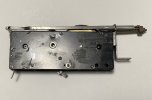
This is the clockwork motor as purchased:
The wheels, coupling rods and valve gear have, of course, been removed and transferred to the electric motor. This is the loco with the electric motor in it:

This is the electric motor extracted from the locomotive:
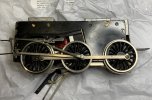
The task in hand is to remove the wheels, coupling rods and valve gear and fit them to the clockwork motor. The difficulties I anticipate based on experience are issues such as nuts and screws that won’t undo and wheels that don’t run true on their new axles. It is often apparent, for example, that when the wheels were originally fitted some hand filing was done on the axle squares to get the wheels to fit and run true. I expect to need to undertake similar fettling.
This is where I got to this evening:
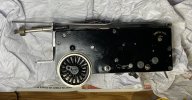
The rear driving wheels are fitted to the clockwork motor. They are running true and I hope I shall not need to remove them again.
I have test fitted one of the front driving wheels and it is very far from true. I can see that the square on the driving axle has some surplus metal at the base on one side. Tomorrow’s job is to work out exactly where I need to file some tiny amounts from the axle to get close(r) to true running.
Martin
This is the clockwork motor as purchased:
The wheels, coupling rods and valve gear have, of course, been removed and transferred to the electric motor. This is the loco with the electric motor in it:
This is the electric motor extracted from the locomotive:
The task in hand is to remove the wheels, coupling rods and valve gear and fit them to the clockwork motor. The difficulties I anticipate based on experience are issues such as nuts and screws that won’t undo and wheels that don’t run true on their new axles. It is often apparent, for example, that when the wheels were originally fitted some hand filing was done on the axle squares to get the wheels to fit and run true. I expect to need to undertake similar fettling.
This is where I got to this evening:
The rear driving wheels are fitted to the clockwork motor. They are running true and I hope I shall not need to remove them again.
I have test fitted one of the front driving wheels and it is very far from true. I can see that the square on the driving axle has some surplus metal at the base on one side. Tomorrow’s job is to work out exactly where I need to file some tiny amounts from the axle to get close(r) to true running.
Martin

Yorkshire Dave
Western Thunderer
Just comparing the electric and clockwork mechanisms (although the mechanism is reversed between both photos) it appears the wheel/axle spacings do not match or is it an optical illusion?
Whatever you use, make sure it has sufficient current capacity. Visiting older locos will easily draw 2-3 amps on occasion, and it is frustrating if the power supply keeps tripping. A lot of coarse old O-gaugers (in both senses) use older analogue style laboratory power supplies where both voltage can be controlled, and maximum current can be pre-set.
simond
Western Thunderer
Re the power supply, it is a balance between meeting the current draw of the motor, and causing damage in case of a short circuit.
5A at 12V is obviously 60W and we can all remember how hot a traditional light bulb could get. A pinpoint short could get a lot hotter (that’s how resistance soldering works!) and thus pose a fire risk, but the controller should shut down safely in such a case.
In any case, avoid short circuits and turn it off when you leave the room.
5A at 12V is obviously 60W and we can all remember how hot a traditional light bulb could get. A pinpoint short could get a lot hotter (that’s how resistance soldering works!) and thus pose a fire risk, but the controller should shut down safely in such a case.
In any case, avoid short circuits and turn it off when you leave the room.


oldravendale
Western Thunderer
Martin... More info and photos of the controller sent to you via PM. I suggest you ask for views about the Helmsman controller on here - a lot of advice is already forthcoming - but I'm the first to admit that it hardly has the looks of a period controller.
Brian
Brian
Hi DavidJust comparing the electric and clockwork mechanisms (although the mechanism is reversed between both photos) it appears the wheel/axle spacings do not match or is it an optical illusion?
Unfortunately, no, that is not an optical illusion because I have made a stupid mistake which you spotted before I did.
I have used the wrong axle position for the rear wheels so they will have to come off and be moved back.
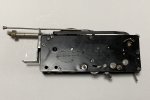
The large size Bassett-Lowke 6-coupled clockwork mech allows for alternative axle spacings:
With a very few exceptions, after c.1930, for 6-coupled locos, two standard driving-wheel spacings were used. Pacifics had their driving wheels at 48 mm + 48 mm. Nearly all other 6-coupled locos had driving wheels spaced at 53 mm + 58 mm. The smaller sized 6-coupled mechanism also has a 53 + 58 mm wheel spacing (no variation with this mechanism). I haven’t measured it but the Royal Scot will be 53 + 58 mm and since the coupling rods used with the Bearwood Models motor are undoubtedly original Bassett-Lowke rods, that is what they will be.
Looking at the above motor, the leading, driven, axle is on the right. Always in the same position. As this is a motor for a 4-6-0, the middle axle is at 53 mm and a stub. Just to the right of the stub is the pilot hole for an axle 48 mm from the driving axle. Had this motor been destined for a Pacific, the pilot hole would have been drilled out and a pair of wheels on a through axle fitted. The 48 mm spacing uses the small gap between the front of the drive spring and the rear of the reversing mechanism so avoids the need for stub axles. To the back of the motor are full sized axle holes for the 48 + 48 and 53 + 58 mm spacings respectively.
The very few exceptions to the standard wheel spacings included the two Princess Royal Pacific models (6200 and 6201), so the model copied the prototype. The early Jubilees had bodies made by Marklin and Marklin got the length wrong. The body is too short and there isn’t room for the standard 4-6-0 wheel base. A 48 + 48 mm Pacific-type mech was fitted to these models. There is one of these Jubilees on display in the NRM, just inside the entrance to the store. The uncatalogued 1950s GW Castle made at Northampton also has the Pacific wheel spacing. This means it will run on standard Bassett-Lowke track. The much more expensive, catalogued, true-to-scale 1950s Castle model has the prototype’s wheel spacing and requires large radius curves.
Martin
Hi PhilFrom memory, not always reliable these days, but weren't some of the older Bassett-Lowke motors 24 Volt? Just in case the EMU turns out to be one of those.
Pre-WW2, nearly all Bassett-Lowke electric models were offered as either 12 V DC or 20 V AC. Post war, everything was 12 V DC.
Martin
Hi PieterA very nice Royal Scot Martin, I assume fairly few of the rebuilt ones were made by B-L.
You raise a fascinating question. Just how many models were Bassett-Lowke having made and selling?
To my knowledge, there is very little hard evidence about the numbers of models made. In a few cases, there is information. I believe BDV Cigarettes’ contract with Bassett-Lowke was for 100,000 Duke of York 4-4-0s for the tobacco company’s coupon scheme. On top of that number are all the Duke of York models Bassett-Lowke sold themselves. We are talking a lot of these 4-4-0s, perhaps 200,000 or more.
Although it is not generally known, pre-WW2, the semi-mass-produced hand-painted locomotives were individually numbered. This was not some phoney ‘limited edition’ marketing scheme. The numbers were not publicised and can be hard to find. Presumably the purpose was factory records, or similar. Anyway, it does provide a basis for estimating production numbers of these models. My pre-war Duchess (awaiting a motor and restoration) is number 33. A friend has Duchess number 16. A year or so ago on eBay, Duchess number 31 was offered for sale (the number could be seen under the rear coupling hook in one of the photos in the listing). If we treat these three locomotives as a random sample from the population of Duchesses, a cleverer person than me could I think calculate an estimate of the total number produced, or at least a range in which the actual total number lies. The chances of finding three examples all numbered below 34 if there were actually hundreds made must be vanishingly small. The total was probably fewer than a hundred and possibly fewer than fifty. There might have only been 33. It is however, hard to extrapolate from the Duchess figures because the model was introduced in 1939. Production or sales (or both) might have been — almost certainly were — greatly affected by the outbreak of war.
The post-war semi-mass-produced models, such as the Royal Scot, were not numbered. Evidence suggests Bassett-Lowke’s sales were buoyant for a few years after production resumed in the late 1940s, but then 0 gauge went into rapid decline. The rebuilt Royal Scot was the last new locomotive model added to the regular range (excluding the very expensive types individually built to order). Only offered 1954–1957. What would sales have been? One a week? That’s 200 models. My best guess is probably fewer. By the 1950s, most models were electric. Say, 10 per cent of production was clockwork. That would be 20 rebuilt Royal Scots with clockwork motors. As I say, no hard evidence, just guess work guided by indications of the overall position.
I have long wanted a rebuilt Royal Scot. A very handsome engine and an historic model marking the end of an era of wonderful tinplate locomotives. But hard to find. No wonder if there actually were only twenty or so made.
Martin
John R Smith
Western Thunderer
Thank you Martin for that scholarly and interesting summary of the B-L six-coupled mechanisms. My post-war parallel boiler black Royal Scot is 53+58mm, as you would expect, with a controlled clockwork motor like yours. It is a very smooth runner. One I don't think you mentioned was the LMS 2-6-4 tank, which is also 53+58. Strangely, mine does not enjoy going through 3 foot radius points, even though the Scot is perfectly happy doing so. The back-to-back measurements are all fine at 27mm, so I am puzzled and will have to investigate more carefully. I also have a 48+48mm close-coupled mech (in a freelance engine) which is probably from a 'Flying Scotsman'. This is a super runner and probably the best of the bunch (with no stub axles).
John
John
simond
Western Thunderer
I’m not totally confident but this appears to be a probability question akin to dealing three aces or choosing three correct lottery balls.If we treat these three locomotives as a random sample from the population of Duchesses, a cleverer person than me could I think calculate an estimate of the total number produced, or at least a range in which the actual total number lies. The chances of finding three examples all numbered below 34 if there were actually hundreds made must be vanishingly small.
We know there must be at least 33 made, if we assume that the numbers are sequential.
The probability of drawing three specified number (cards, balls) from 33 would be 1 in 5456. [It’s 33 factorial divided by ( 3 factorial multiplied by (33 - 3) factorial) ] - order doesn’t matter and you can’t “see” the same number twice. As this has actually happened, it’s the baseline.
As the total quantity of possible models increases, the probability of having seen three specific numbers, 16, 31 & 33 decreases. It would be around 1.8 times less likely if there were 40 to choose from, and 3.6 times less likely if there were 50. And nearly 30 times less likely if there were 100.
But, this does not take into account a couple of imponderables. You didn't actively choose to see three locos, you saw three by chance. If there had been sixty six, would you have most likely seen six? I don’t think there’s any way of calculating that.
And of course, you didn’t say “I want to see numbers 16, 31, and 33” before you saw them, you didn’t specify, so it’s not really the same thing as dealing three aces.
I know a cleverer person than me, and he’s a bit of a statistician, I shall debate the question with him.
simond
Western Thunderer
I have debated it, he suggests a more reasoned approach:
What is the most probable largest number when you draw three numbers at random from a deck of n numbers?
A provisional answer to this question is if n=43, the most probable largest number is 33.
He thinks there is a better solution, because the smallest number also informs the answer, and he has not considered this yet.
kids eh?
What is the most probable largest number when you draw three numbers at random from a deck of n numbers?
A provisional answer to this question is if n=43, the most probable largest number is 33.
He thinks there is a better solution, because the smallest number also informs the answer, and he has not considered this yet.
kids eh?
Hi SimonI have debated it, he suggests a more reasoned approach:
What is the most probable largest number when you draw three numbers at random from a deck of n numbers?
A provisional answer to this question is if n=43, the most probable largest number is 33.
He thinks there is a better solution, because the smallest number also informs the answer, and he has not considered this yet.
kids eh?
This is fascinating. I know I don’t know how to make an estimate. I’m also pretty sure the information we have will allow one, albeit based on a small sample. The analogy that occurred to me was a ‘mark and recapture’ experiment used by zoologists to estimate the size of a population. Catch and tag some animals, release them back into the area with the wild population, set traps and see what proportion of the catch are marked specimens. But it’s not the same as that either. What a mark and recapture type calculation might do is allow an estimate of post-WW2 Duchess production, the post-war models not being numbered.
Martin
Last edited:
An update on the Royal Scot’s motor.
I regard reinstating the clockwork mechanism as a restoration, returning the locomotive to its authentic, original condition. However, it’s also going to be a working model and I want it to work as well as possible. So whilst a ‘factory fault’ may be ‘authentic’, I will correct it if I can and certainly if remedial work will be invisible yet improve performance. By the mid-1950s, I think it is fair to say quality control at Northampton was not as good as it might have been. Standards had definitely fallen and so had sales while the range of models offered was shrinking.
As described in my post #250, when I got it, the clockwork motor was not working at all well. I initially identified the problem as misalignment of the driven axle. Which in turn I realised was due to the motor side plates being not exactly opposite each other. I concluded the misalignment was ultimately due to the bracket that supports the control rods in front of the cab and is the means of securing the rear of the motor in the locomotive body. This bracket certainly wasn’t quite square. As can be seen here, it is entirely hand-made by cutting out, drilling and bending a piece of heavy-gauge steel plate:
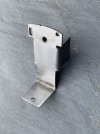
It perhaps says a lot about the works at Northampton, or the volume of models being made, that a part needed for every locomotive built (albeit with variations depending on the particular type) was being scratch built for each model.
After bending the bracket so that the corners were right angles (or very nearly) I reinstated it in the motor. I was able to get the motor side plates into alignment (or very nearly) and the motor then performed apparently satisfactorily on test. Problem solved, I thought. However, working on the motor over the last few days, I kept wondering if the side plates had crept back out of alignment. Fitting the rear wheels confirmed the axle was not perpendicular to the long axis of the motor. Somehow the misalignment problem had returned.
This time I think I have found the ultimate cause. The problem was due to inaccuracy in the hand-made rear bracket. The arm that goes into the motor on the rhs (looking forward) was slightly too long:
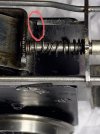
I have shortened the arm of the bracket at the top by about 1 mm using a needle file — the area ringed above. Prior to shortening, the arm of the bracket was in contact (just) with the main spring at its anchor point, wrapped around the top pillar. As the spring moved during winding/unwinding, it was pushing on the arm of the bracket, and hence pushing backwards the right-hand side plate of the motor.
This was a tiny and difficult inaccuracy to find, but was seriously reducing the performance of the motor. I am pretty sure the motor will never have been a strong puller, using too much of the energy stored in the spring to overcome internal friction due to the misalignment of gears.
So, once the repair is finished, my Royal Scot should be the best it has ever been. Like for like, a clockwork locomotive will generally not be as powerful as an electric or live-steam engine. Add in the friction of sharp curves and heavy tinplate coaches with plain bearings — a clockwork express loco will need to be as strong as it can be. I’ll try to get 46100 as close to mechanically perfect as I can for its future service as a top-link locomotive on Rivermead Central.
Martin
I regard reinstating the clockwork mechanism as a restoration, returning the locomotive to its authentic, original condition. However, it’s also going to be a working model and I want it to work as well as possible. So whilst a ‘factory fault’ may be ‘authentic’, I will correct it if I can and certainly if remedial work will be invisible yet improve performance. By the mid-1950s, I think it is fair to say quality control at Northampton was not as good as it might have been. Standards had definitely fallen and so had sales while the range of models offered was shrinking.
As described in my post #250, when I got it, the clockwork motor was not working at all well. I initially identified the problem as misalignment of the driven axle. Which in turn I realised was due to the motor side plates being not exactly opposite each other. I concluded the misalignment was ultimately due to the bracket that supports the control rods in front of the cab and is the means of securing the rear of the motor in the locomotive body. This bracket certainly wasn’t quite square. As can be seen here, it is entirely hand-made by cutting out, drilling and bending a piece of heavy-gauge steel plate:
It perhaps says a lot about the works at Northampton, or the volume of models being made, that a part needed for every locomotive built (albeit with variations depending on the particular type) was being scratch built for each model.
After bending the bracket so that the corners were right angles (or very nearly) I reinstated it in the motor. I was able to get the motor side plates into alignment (or very nearly) and the motor then performed apparently satisfactorily on test. Problem solved, I thought. However, working on the motor over the last few days, I kept wondering if the side plates had crept back out of alignment. Fitting the rear wheels confirmed the axle was not perpendicular to the long axis of the motor. Somehow the misalignment problem had returned.
This time I think I have found the ultimate cause. The problem was due to inaccuracy in the hand-made rear bracket. The arm that goes into the motor on the rhs (looking forward) was slightly too long:
I have shortened the arm of the bracket at the top by about 1 mm using a needle file — the area ringed above. Prior to shortening, the arm of the bracket was in contact (just) with the main spring at its anchor point, wrapped around the top pillar. As the spring moved during winding/unwinding, it was pushing on the arm of the bracket, and hence pushing backwards the right-hand side plate of the motor.
This was a tiny and difficult inaccuracy to find, but was seriously reducing the performance of the motor. I am pretty sure the motor will never have been a strong puller, using too much of the energy stored in the spring to overcome internal friction due to the misalignment of gears.
So, once the repair is finished, my Royal Scot should be the best it has ever been. Like for like, a clockwork locomotive will generally not be as powerful as an electric or live-steam engine. Add in the friction of sharp curves and heavy tinplate coaches with plain bearings — a clockwork express loco will need to be as strong as it can be. I’ll try to get 46100 as close to mechanically perfect as I can for its future service as a top-link locomotive on Rivermead Central.
Martin