Rivermead Central

40057

Western Thunderer
After a bit of a rabbit hole dive into model railway building papers - Merco was founded in the 1930s by Edward Beal and Sir Eric Hutchison (two notable railway modellers of their day). Lithograph brick and wagon papers produced for both O and 'OO'.

After seeing the extract from the Basset Lowke cataloge then wood is the material to use.
Thank you.

The introduction of brick papers might have been linked to the increased popularity of 00 gauge, since the wooden brick sheets were for 0. Actually, Bassett-Lowke brick sheets were close to correct for Gauge 1 and were used for the factory made buildings in both 0 and 1 scales. Wooden brick sheets made by other manufacturers and introduced later than Bassett-Lowke’s were closer to correct scale for gauge 0.

Martin
 

40057

Western Thunderer
Happy New Year to everyone on WT. I continue to be amazed, inspired and entertained by some of the wonderful modelling and layouts described on this forum. Over my morning coffee, I’ve just been reading the EM Gauge ‘70s January Update, for instance. Really excellent.

Future plans for Rivermead Central? Two and a half years since I retired and started to work on the layout much more actively. I’ve learnt quite a lot in that time. Not least, I have a much better idea how long it takes to make a building or other structure. Extrapolating from what has been done to date, it might take three years to get all the buildings and track in place on the western half of the layout. That’s my priority. I can then connect the Cavendish Goods branch to the main circuit and complete that — so allowing trains to be operated. Thereafter, I’ll get the rest of the track down on the base-boards against the east wall. That side can then be used — initially — as a fiddle yard and the scenery progressively added to convert it to scenic model railway.

In line with the above strategy, in 2026, repairing/rebuilding more Lowko Track points is a top priority. I need to get more of the retaining wall in place between the high- and low-level baseboards. It would be nice to be able to lay track in the yard at Cavendish Goods this year.

It’s not holding up other work, but I want to finish the ‘scenery’ around the yard at Cairnie Junction. Specifically, the structures against the north wall of the room behind the buffer stops. And the fence separating the Benham’s siding from the railway company sidings. If I get these elements in place, time permitting, I can start on the Cairnie Junction station platforms and buildings. I have bought Timber Tracks kits for the buildings which should greatly reduce the build time. I have one other building that is needed in the north-west of the layout, between the north wall of the room and the north end of platform 1; the station hotel. Not sure of the style yet (early Victorian?) but I can definitely imagine some posh Minic cars parked in front.

I must try harder in 2026 to progress some stalled rolling stock restoration projects. I like having several different and diverse projects on the go. Swapping between them adds variety to modelling activities. But I have too many partly repaired items of rolling stock. Some of these are probably 80% finished (at least). I need to get more completed rather than starting repairs on as-yet untouched items.

Finally for 2026, I have agreed with Tom Mallard for him to design and build me a shunter for the yard at Cairnie Junction. Exactly when construction will start depends on Tom’s other commitments, but we have the motor for the model and a prototype identified. Mostly, it has to be admitted, shunting with clockwork locomotives is not ideal (too fast, for a start). The plan is to build a locomotive specifically for shunting with controls designed for ease of use, including a variable speed control.

Martin
 
Last edited:

John R Smith

Western Thunderer
Mostly, it has to be admitted, shunting with clockwork locomotives is not ideal (too fast, for a start). The plan is to build a locomotive specifically for shunting with controls designed for ease of use, including a variable speed control.

I wonder if the Bing four-coupled two-speed clockwork motor would be any good in this respect? I have noted two of these have come up in the last week, both powering Bassett-Lowke "Duke of York" 4-4-0 engines, the earliest release with 1927 on the tenders. One went very cheaply because the tinplate was in poor condition, but the clockwork looked OK.

John
 

40057

Western Thunderer
I wonder if the Bing four-coupled two-speed clockwork motor would be any good in this respect? I have noted two of these have come up in the last week, both powering Bassett-Lowke "Duke of York" 4-4-0 engines, the earliest release with 1927 on the tenders. One went very cheaply because the tinplate was in poor condition, but the clockwork looked OK.

John
Hi John

I am not aware of Bing making a two-speed clockwork motor in 0 gauge. Gauge 1 and larger only, as far as I know. Certainly, not for the Duke of York which was a ‘bargain basement’ production. Also, I believe the motors for the Duke of Yorks were made in Northampton (the first, prior to that Bing motors were used even when the bodies came from Winteringham’s).

Martin
 

John R Smith

Western Thunderer
Hello Martin

Now I am really intrigued. This is the red DOY which I noticed, which was listed and sold this week -

DOY 1927 01.jpg

This one is from the first few years of production. If we look at the levers, the centre control does not look like a B-L mechanism auto-start lever, but it does look like Bing two-speed controls -

DOY 1927 02.jpg


And the coupling rods do not look like B-L items, but they do look like Bing -

DOY 1927 03.jpg

The seller was Trevor Salt, who is well known and I believe respected. His description was as follows -

"Bassett Lowke O Gauge Clockwork LMS 4-4-0 Freelance Tender Locomotive 1927 ‘Duke of York’,
This locomotive is in used working condition, there bodies have a lot of scratches and marks but it has an excellent 2 speed mechanism that’s a lovely runner in both directions,"


Strangely, there was a green "1927" listed this morning which had an identical mechanism and coupling rods.

John
 

40057

Western Thunderer
Hello Martin

Now I am really intrigued. This is the red DOY which I noticed, which was listed and sold this week -

View attachment 254346

This one is from the first few years of production. If we look at the levers, the centre control does not look like a B-L mechanism auto-start lever, but it does look like Bing two-speed controls -

View attachment 254347


And the coupling rods do not look like B-L items, but they do look like Bing -

View attachment 254348

The seller was Trevor Salt, who is well known and I believe respected. His description was as follows -

"Bassett Lowke O Gauge Clockwork LMS 4-4-0 Freelance Tender Locomotive 1927 ‘Duke of York’,
This locomotive is in used working condition, there bodies have a lot of scratches and marks but it has an excellent 2 speed mechanism that’s a lovely runner in both directions,"


Strangely, there was a green "1927" listed this morning which had an identical mechanism and coupling rods.

John
Hi John

The mechanism in the DoY should be the same as the one in your 1190 compound. I suspect Winteringham’s effectively copied the earlier Bing motors, but my understanding is the DoY was entirely Northampton made. Northampton also, for instance, copied the Bing coupling shape.

Regarding two speeds, the description is wrong. Look at my post #620. These are Bing-made motors. Two speeds in Gauge 1 only. Look at the price difference for the Gauge 1 motor between with and without two speeds. The extra cost for two speeds is pretty much the entire price for a DoY. Even the best Bing-made 0 gauge locos (you have a Precursor tank) don’t have two speeds. There is no way a two-speed mech would or could have been produced only for the cheapest 0 gauge model in the range.

Martin
 

John R Smith

Western Thunderer
The mechanism in the DoY should be the same as the one in your 1190 compound. I suspect Winteringham’s effectively copied the earlier Bing motors, but my understanding is the DoY was entirely Northampton made. Northampton also, for instance, copied the Bing coupling shape.

Hello Martin

Well, I went and did what I should have done in the first place, which was to go away and do some proper in-depth research using my catalogue collection and the power of the Internet. And I found of course that you are absolutely correct, and that I had jumped to erroneous conclusions. Yes, it seems that neither Bing nor Bassett-Lowke ever made an O Gauge two-speed clockwork mechanism. As far as I can determine, the motor in the 1927 DOY must be B-L's first own design and build clockwork 0-4-0 mech, and as you say is essentially exactly the same as in my 1190 Compound. There are subtle differences, which fooled me, but they are not because it was made by Bing. So the middle control lever (which is for the brake auto-start) is not centred in the cab, but closer to the brake lever than the reversing lever. By the 1930 version, this lever has been moved to the centre. And the coupling rods are unusual, but I think that they are early B-L not Bing. Checking this out, all the unaltered 1927 versions of the DOY I can find have these rods, which change to the plain version later on. And these fancy coupling rods are the same in the 1928 catalogue, when it specifies "an additional gadget to enable the locomotive to start from the track when special brake rail is used" - hence the centre control in the cab.

So why Trevor Salt should have described this engine as two-speed I don't know. I have messaged him to enquire, but I have had no reply.

The reason why I thought there must be a two-speed O Gauge Bing clockwork mechanism in the first place was because I had previously noticed three lever cab controls on these early 1920s Bing engines. Firstly a LNWR short Precursor 4-4-0 -

Bing Pre Tank LNWR.jpg


Where you can see the third lever in the centre of the bunker. This one must presumably be prior to 1923. These were the coupling rods that made me think the DOY mech was Bing in the first instance. Another example is a 4-4-0 Precursor in red LMS livery -


Bing Pre Tank LMS.jpg

This one is post-1923, but perhaps not by much. Neither of the engines appear in the 1928 catalogue. The long Precursors, 4-4-2s like mine, never seem to have three levers, just two (brake and reverser). I had assumed (unwisely) that these centre levers must be for a two-speed control. Which begs the question, what are they for? If they are for an auto-start feature, then it looks as if Bing had this "gadget" well before Bassett-Lowke did in 1928. And if so, why was it never fitted to the long Precursors?

Once again, I seem to end up with more questions than answers. I look forward to your comments . . .

John

 

40057

Western Thunderer
Hello Martin

Well, I went and did what I should have done in the first place, which was to go away and do some proper in-depth research using my catalogue collection and the power of the Internet. And I found of course that you are absolutely correct, and that I had jumped to erroneous conclusions. Yes, it seems that neither Bing nor Bassett-Lowke ever made an O Gauge two-speed clockwork mechanism. As far as I can determine, the motor in the 1927 DOY must be B-L's first own design and build clockwork 0-4-0 mech, and as you say is essentially exactly the same as in my 1190 Compound. There are subtle differences, which fooled me, but they are not because it was made by Bing. So the middle control lever (which is for the brake auto-start) is not centred in the cab, but closer to the brake lever than the reversing lever. By the 1930 version, this lever has been moved to the centre. And the coupling rods are unusual, but I think that they are early B-L not Bing. Checking this out, all the unaltered 1927 versions of the DOY I can find have these rods, which change to the plain version later on. And these fancy coupling rods are the same in the 1928 catalogue, when it specifies "an additional gadget to enable the locomotive to start from the track when special brake rail is used" - hence the centre control in the cab.

So why Trevor Salt should have described this engine as two-speed I don't know. I have messaged him to enquire, but I have had no reply.

The reason why I thought there must be a two-speed O Gauge Bing clockwork mechanism in the first place was because I had previously noticed three lever cab controls on these early 1920s Bing engines. Firstly a LNWR short Precursor 4-4-0 -

View attachment 254416


Where you can see the third lever in the centre of the bunker. This one must presumably be prior to 1923. These were the coupling rods that made me think the DOY mech was Bing in the first instance. Another example is a 4-4-0 Precursor in red LMS livery -


View attachment 254417

This one is post-1923, but perhaps not by much. Neither of the engines appear in the 1928 catalogue. The long Precursors, 4-4-2s like mine, never seem to have three levers, just two (brake and reverser). I had assumed (unwisely) that these centre levers must be for a two-speed control. Which begs the question, what are they for? If they are for an auto-start feature, then it looks as if Bing had this "gadget" well before Bassett-Lowke did in 1928. And if so, why was it never fitted to the long Precursors?

Once again, I seem to end up with more questions than answers. I look forward to your comments . . .

John
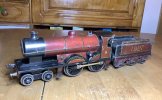
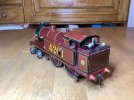
Hi John

The middle lever on the ‘short Precursor’ tanks is a brake-restart for track control. You will notice it passes through a slot in the back of the cab, not a circular hole. The forward/reverse and ‘normal’ brake controls have to be pushed/pulled in/out to operate. Hence a circular hole is fine. The brake-restart has to be pulled out and pushed down so a notch engages with the bottom of the slot to hold the control so it pulls on a spring which keeps the brake off.

I think the Bing 4-4-2 scale Precursor tanks pre-date the brake-restart device, as simple as that.

Martin
 

John R Smith

Western Thunderer
I think the Bing 4-4-2 scale Precursor tanks pre-date the brake-restart device, as simple as that.

That sounds reasonable. We notice that the clockwork mechanism is different between the 4-4-2 and 4-4-0 Precursor tanks, the mounting points are two bolts on each side tank for the short version, whereas the long Precursor mounts are underneath.

More than sixty years ago now, I remember being very puzzled by the clockwork B-L engines we had at the Club. I could not work out what the central knob and lever was for, and of course we had no manuals or tech data in those days. Neither my Father nor anybody else at the Club had a clue, they were all preoccupied with live steam (Enterprises) and had no interest in clockwork. These days I realise that as we had no track control ramps I could not have used the re-start in any case.

John
 

40057

Western Thunderer
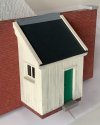
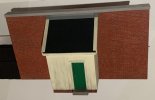
The storage shed is now joined to the wall, permanently:

08735308-19B7-40D3-BDFE-A5777BCB657E.jpeg

8AA4751F-01F9-4C12-A16D-00AFDBFDF5C8.jpeg

Three 3/4” wood screws through the wall into wood blocks fastened inside the shed. It ain’t moving. The flashing needs to be secured and bent over the top of the wall so it will be under the coping. Also the flashing added to cover the top of the wooden roof edging strips where they abut the wall. The shed is currently ‘floating’ a few mm up from the bottom of the wall. A strip of plywood, painted grey to match the base-boards, will be fastened under the shed and in front of the wall and fence. The plywood will obscure the bottom of edge of the wall and fence (so these don’t look like they are sat on the ground surface, but buried in it). The plywood strip will also be the means of fixing the whole assembly in position on the layout (as per previous builds).

My original plan was to have the storage shed at the north (right-hand) end of the wall and a fire-bucket shelter to the south of the shed. Having abandoned the idea of a fire-bucket shelter, the storage shed is now the only ‘buttress’ keeping the wall and fence vertical, and the only connection between the wall and the plywood ‘ground’ in front of it. So I have fixed the shed approximately half way along the wall.

Martin
 

40057

Western Thunderer
Hello Martin

Well, I went and did what I should have done in the first place, which was to go away and do some proper in-depth research using my catalogue collection and the power of the Internet. And I found of course that you are absolutely correct, and that I had jumped to erroneous conclusions. Yes, it seems that neither Bing nor Bassett-Lowke ever made an O Gauge two-speed clockwork mechanism. As far as I can determine, the motor in the 1927 DOY must be B-L's first own design and build clockwork 0-4-0 mech, and as you say is essentially exactly the same as in my 1190 Compound. There are subtle differences, which fooled me, but they are not because it was made by Bing. So the middle control lever (which is for the brake auto-start) is not centred in the cab, but closer to the brake lever than the reversing lever. By the 1930 version, this lever has been moved to the centre. And the coupling rods are unusual, but I think that they are early B-L not Bing. Checking this out, all the unaltered 1927 versions of the DOY I can find have these rods, which change to the plain version later on. And these fancy coupling rods are the same in the 1928 catalogue, when it specifies "an additional gadget to enable the locomotive to start from the track when special brake rail is used" - hence the centre control in the cab.

So why Trevor Salt should have described this engine as two-speed I don't know. I have messaged him to enquire, but I have had no reply.

The reason why I thought there must be a two-speed O Gauge Bing clockwork mechanism in the first place was because I had previously noticed three lever cab controls on these early 1920s Bing engines. Firstly a LNWR short Precursor 4-4-0 -

View attachment 254416


Where you can see the third lever in the centre of the bunker. This one must presumably be prior to 1923. These were the coupling rods that made me think the DOY mech was Bing in the first instance. Another example is a 4-4-0 Precursor in red LMS livery -


View attachment 254417

This one is post-1923, but perhaps not by much. Neither of the engines appear in the 1928 catalogue. The long Precursors, 4-4-2s like mine, never seem to have three levers, just two (brake and reverser). I had assumed (unwisely) that these centre levers must be for a two-speed control. Which begs the question, what are they for? If they are for an auto-start feature, then it looks as if Bing had this "gadget" well before Bassett-Lowke did in 1928. And if so, why was it never fitted to the long Precursors?

Once again, I seem to end up with more questions than answers. I look forward to your comments . . .

John
Hi John

I should add that if you look at the coupling rods on the DoY and the LNWR short Precursor you will see they are not the same. The Bing version has pronounced rounded ends. The ends of the Northampton version are much less curved.

Martin
 

40057

Western Thunderer
I am not exactly sure how, but very cold, miserable weather always does seem to slow progress. Thick cloud and such short days too, lack of daylight probably is one contributory factor. Anyway, I now have all the flashing in place along the top of the roof of the storage shed:

30195D6A-5492-42B1-883E-6CE01E2309C8.jpeg

Not a great photo due to the aforementioned lack of daylight.

Next I need to fix the coping to the top of the wall between the two end pieces already fastened in place. The length of coping is cut to size and painted; it just needs glued onto the top of the wall and secured with wood screws vertically down into the wall. The only other part of the whole structure still to attach is the strip of plywood on which the shed rests and which is how the structure is held in place on the layout.

Martin
 

John R Smith

Western Thunderer
It's coming along nicely, Martin.

I may be starting a new building project at Kingswell Street, shortly, provided that things work out. I have always wanted an island platform rather than the single-sided one that I have now, but I have never found one the right width (about 5 inches). If successful, this would mean that I could run passenger or parcels trains from either side of my two arrival/departure roads. John Neale had just the thing in his latest sale, but unfortunately it was one of the rarest examples of Bassett-Lowke stations and consequently went for £370 which was way out of my range (that was the starting price, so I did not even bother to bid).

However, I have now found a Milbro island platform which seems good for size at £40, so it is on it's way to my humble cottage and we will see how it goes.

John
 

40057

Western Thunderer
It's coming along nicely, Martin.

I may be starting a new building project at Kingswell Street, shortly, provided that things work out. I have always wanted an island platform rather than the single-sided one that I have now, but I have never found one the right width (about 5 inches). If successful, this would mean that I could run passenger or parcels trains from either side of my two arrival/departure roads. John Neale had just the thing in his latest sale, but unfortunately it was one of the rarest examples of Bassett-Lowke stations and consequently went for £370 which was way out of my range (that was the starting price, so I did not even bother to bid).

However, I have now found a Milbro island platform which seems good for size at £40, so it is on it's way to my humble cottage and we will see how it goes.

John
Hi John

Two (longer?) platforms will certainly give scope for more interesting and intensive operations. Does this mean you will widen or lengthen the base-boards?

Although I would like to use period commercially built stations, I never thought it was a viable option for my layout. Most are far too short and all assume straight track. There are Bassett-Lowke stations that are long enough, but designing a layout where the stations have a perfectly straight 9’ platform would have seriously reduced the scope for the rest of the layout. So I’m doing what a model railway builder would have done a century ago and I’m building bespoke stations that fit the spaces I have.

Martin
 

John R Smith

Western Thunderer
Hello Martin

The idea is that a new island platform would replace the existing single-sided platform -

Layout Plan Web.jpg
So there will be no need to alter the baseboards. It just has to be about 34 -36 inches long, and 5 inches wide. Which sounds simple, but is not so easy to find. I particularly want to replace the existing Givjoy station, because the buildings are covered in paper litho to represent the doors and brickwork -

Platform Staff on Mail Web.jpg

This is all very charming, but at odds with my other buildings which are pre-war B-L and Milbro and built of brickwood. I do admire your approach - and your buildings - and on my other railway projects I have indeed built my own structures and platforms. Kingswell Street is intended to be a sort of museum layout, though, and as such one of my self-imposed rules is that all the rolling stock and buildings should have previously been on a coarse-scale layout from my chosen period.

John
 
Last edited:

40057

Western Thunderer
Hello Martin

The idea is that a new island platform would replace the existing single-sided platform -

View attachment 254749
So there will be no need to alter the baseboards. It just has to be about 34 -36 inches long, and 5 inches wide. Which sounds simple, but is not so easy to find. I particularly want to replace the existing Givjoy station, because the buildings are covered in paper litho to represent the doors and brickwork -

View attachment 254750

This is all very charming, but at odds with my other buildings which are pre-war B-L and Milbro and built of brickwood. I do admire your approach - and your buildings - and on my other railway projects I have indeed built my own structures and platforms. Kingswell Street is intended to be a sort of museum layout, though, and as such one of my self-imposed rules is that all the rolling stock and buildings should have previously been on a coarse-scale layout from my chosen period.

John
Hi John

I can see why you want to replace the station. I don’t think the makers would be insulted if I describe it as a ‘toy station’ — because that was the intended market. The term ‘coarse scale’ as used today is a very broad church. It now includes things that would have been seen very differently when made. Meccano Ltd did not describe (generally) the Hornby 0 gauge range as scale models, and they weren’t. Except a few items (the lithographed vans, the ‘true-to-type’ 4-4-0s) were of a comparable standard to Bassett-Lowke’s cheaper scale models. Meccano Ltd made and sold toys aimed at children, good quality, but goods vans with a blue roof and bright green station platforms were not realistic and not intended to be. Bassett-Lowke, the Leeds Model Co. Exley and Mills all made models. Scale models, as they would have been described at the time. ‘Coarse scale’ as a description of these is really retrospective, like the ‘World War’ becoming the ‘First World War’ or British Railways standard coaching stock being renamed as Mk1. Even within the ranges of the scale model manufacturers there were different qualities. For example the three grades of wagon sold by Bassett-Lowke (my post #597), or the two qualities of coach Exley made pre-WW2 (my post #74). A collection or museum of vintage items could include any of the above, depending on the owner’s tastes. A vintage model railway, I would contend, needs to use items of a similar ‘standard’ to look right. The decision what to include to produce a harmonious result is a judgement, of course. For me, for example, I consider Mills wagons to be too plain to fit in, whereas Mills locomotives would be ‘too scale’. I am happy to have both lithographed tinplate Bassett-Lowke coaches and the short type pre-WW2 Exley’s, though I wouldn’t mix them in the same rake. The coaches in these two ranges are of comparable length and level of detail — and also match the standard of lithographed Bassett-Lowke locomotives and wagons. Despite my efforts to keep to ‘a standard’, I certainly do have items that wouldn’t work together, e.g. detailed wooden wagons and lithographed wagons. I’ll just use these on different days, with the appropriate locomotives.

Martin
 
Last edited:

Roger Pound

Western Thunderer
Martin,
Please may I use your thread for the purpose of thanking yourself and John for your fascinating coversations which for me are both educative and entertaining. My own experience of Basset Lowke 0 gauge was limited to using several variations of Precursor 4-4-0 tender locos owned by a dear friend, now long deceased, on his layout. Once again, thanks for bringing back happy memories to an old guy.

Roger.
 

40057

Western Thunderer
Martin,
Please may I use your thread for the purpose of thanking yourself and John for your fascinating coversations which for me are both educative and entertaining. My own experience of Basset Lowke 0 gauge was limited to using several variations of Precursor 4-4-0 tender locos owned by a dear friend, now long deceased, on his layout. Once again, thanks for bringing back happy memories to an old guy.

Roger.
Delighted you find it interesting, Roger.

Martin

PS The ‘Precursor’ locos were probably examples of Bing’s ‘George the Fifth’ models. Introduced, as a lithographed model, pre-WW1. Produced in modified form after WW1 with a different motor. Sold by Bassett-Lowke in LNWR and LMS livery, but sold in many other liveries through Gamage’s and other outlets. Numerous variations out there, including over-painted versions (as Queen Mary) with additional detail made (modified) at Northampton. One of the ‘Queen Mary’ upgrades can be seen in the store room part of the NRM.
 

40057

Western Thunderer
Today, I attached the rest of the coping to the wall behind the storage shed. The heads of the countersunk screws fixing the coping have been covered with filler and a coat of grey paint applied:

1ECEB7BB-EF0E-4478-8CE3-8AA4C9F924EE.jpeg

BF9574A0-ABF2-4E0A-985D-EB7CB88CBF01.jpeg

It looks almost finished. I will need to put another coat of grey paint on the coping and then apply some weathering to the coping and as run-off onto the shed roof.

I can now see — more or less — what the final appearance will be, however. I am happy this is going to be a nice addition to the layout.

Martin
 

Roger Pound

Western Thunderer
PS The ‘Precursor’ locos were probably examples of Bing’s ‘George the Fifth’ models. Introduced, as a lithographed model, pre-WW1. Produced in modified form after WW1 with a different motor. Sold by Bassett-Lowke in LNWR and LMS livery, but sold in many other liveries through Gamage’s and other outlets. Numerous variations out there, including over-painted versions (as Queen Mary) with additional detail made (modified) at Northampton. One of the ‘Queen Mary’ upgrades can be seen in the store room part of the NRM.
I am in error, Martin - they were indeed George the Fifth class locos. LMS, LNWR liveries I recall but the other two escape me - I just clearly remember he had four of them and they all went well. My only excuse is that until recent years, before leaving Gauge 0, I owned a Precursor 4-4-0 purchased second hand, which could out-pull most things. I have no idea of whose kit or what motor - it just looked the part and performed like a Precursor at it's best.

Roger.
 
Top