readingtype’s workbench

readingtype

Western Thunderer
Adam, thank you. It seems the most significant mistake was to think I should use the higher temperature solder. I will take note of that, and (hopefully sooner rather than later) clean things up and have another go.

Ben
 
  • Like
Reactions: AJC

AJC

Western Thunderer
Adam, thank you. It seems the most significant mistake was to think I should use the higher temperature solder. I will take note of that, and (hopefully sooner rather than later) clean things up and have another go.

Ben

No worries - sooner would be better, of course, I've put lots of things back in the box to stew because I'm irritated at myself for doing something that turned out to be daft. I think the current record holder is my Terrier which took about a decade owing to screwing up something of another. The actual work of correcting that? A couple of hours.

Adam
 

spikey faz

Western Thunderer
Far from a masterpiece but here are the wheels refitted. The thing zipped round the MRC test track earlier today staying firmly on the rails. The second and fourth axles have the least play so the loco tends to adopt a slightly tangential aspect on curves, but it stays on.

I think the reasoning I was struggling with earlier in the week about the back to back runs as follows. I have a 'finescale' 00 back to back gauge. I used it to set the axles before I had skimmed the wheels. This meant everything was extremely tight on the track, pretty much guaranteeing a derailment as flanges will start to climb the side of the rail almost as soon as they touch, and touching is likely with very little tyre width in between. Now the wheels are probably roughly up to the standard the gauge was made for, things will go better.

View attachment 164024
I wonder if you've tried limiting the sideplay on the first, third and fifth axles whilst leaving the second and fourth axles with more sideplay. This may help to guide the loco into curves. It may also stop the crosshead clouting the crankpins on the front wheels, although you've not mentioned any clearance problems here.

There was an article by Iain Rice in a magazine back in the 1980s (I think) where he was building a 2-8-0 locomotive. He had problems with it derailing, but solved it by limiting axle sideplay as above. It's one of those articles that's stuck in my mind for some reason! :)

Mike
 

AJC

Western Thunderer
There was an article by Iain Rice in a magazine back in the 1980s (I think) where he was building a 2-8-0 locomotive. He had problems with it derailing, but solved it by limiting axle sideplay as above. It's one of those articles that's stuck in my mind for some reason! :)

Mike

If it’s the piece I’m thinking about, it was a S&DJR 7F, for an EM system with some rather tight curves. Probably an early MRJ? If so, it’ll be this one in no. 23.


Adam
 

spikey faz

Western Thunderer
If it’s the piece I’m thinking about, it was a S&DJR 7F, for an EM system with some rather tight curves. Probably an early MRJ? If so, it’ll be this one in no. 23.


Adam
That's the one! :thumbs:

Mike
 
  • Like
Reactions: AJC

simond

Western Thunderer
limiting the sideplay on the first, third and fifth axles whilst leaving the second and fourth axles with more sideplay

I predict that this will not help - if you limit the sideplay on 1, 3 & 5, then sideplay on 2 & 4 is quite irrelevant - because you will have created a rather long 0-6-0! (assuming axle 3 has flanges)

limited sideplay on 1&3 works on a 2-8-0 as 2 will go one way, and 4 will go the other, and 1 needs to be snug between the slide bars anyway.

I would suggest (though I have not tried it) that the optimum on a 10 wheeler would be to constrain 1 & 4 and allow sideplay on 2, 3 & 5.

Of course, if it's a 9F, you have no flanges on 3 so it should probably be constrained to stop the wheel tread falling off the railhead.

Constraining 4 rather than 5 will share the offset between 2 & 5 and thus minimise the necessary throw on the other axles


hth
Simon
 

readingtype

Western Thunderer
I would suggest (though I have not tried it) that the optimum on a 10 wheeler would be to constrain 1 & 4 and allow sideplay on 2, 3 & 5.
I hope the time will come when I can try that. It's on the far side of conquering hornblock fitting, I think, unless I get diverted into an attempt to make the frames for the BR 94 before then.

In support of @simond 's suggestion I think, the earlier version (T 16) of the loco had the fourth axle as the driving axle and especially long piston rods and slidebars but as it happened that proved not to be a good idea[1] and the later, numerically greater series (T 16.1) had the drive on the centre axle.

[1] T 16 on Wikipedia (DE)
 
deadrail

readingtype

Western Thunderer
Diversion into dead rail and gauge 1 (1:32 scale).

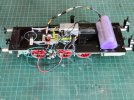
Due to very clear instructions, and as far as I can judge also due to good product design, I was able to turn a Märklin Prussian T3 - or rather its frames and running gear - into a basic radio controlled vehicle very quickly. I have had fun running it up and down on the carpet without any interceding track. The radio control kit and the battery all come from Micron Radio Control.
1000007818.jpg
However gratifying it was to prove the concept, all the real work lies ahead. The loco needs a new boiler, because although the batteries come very close to fitting inside it, the original boiler barrel is a mazak casting that tapers almost 4mm along its length. So the batteries only have a hope of fitting at the open end. And the loco desperately needs a re-paint. Though I am not tied to a red-chassis-red-wheels paint job, the Märklin Museum livery cannot stay.

I think this model overall is very sound. Its detailing is basic but I can imagine getting pleasure from re-doing the springing and compensation a little bit more convincingly. And then there is the missing air pump; I just missed the chance to buy a casting from a supplier before they shut up shop. Modelling that should be an interesting project.

Yes this is another unrelated project; but that's how I enjoy spending my modelling time, and I have found the insights and techniques learned often feed into one another.
 

readingtype

Western Thunderer
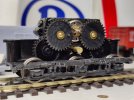
Another background project that I have recently spent time on is to fill in underneath a resin print BR class 37 in 1:87 with the bits that hold it up and make it go.
1000009766.jpg

The bogies, no surprise, come from the Lima Deltic or class 50, possibly one from each as I've been raiding the £1 rummage boxes at shows.

The cosmetic surgery wasn't brilliantly executed but that's OK for the reason above. The concept was proven, to me at least. I think I'd prefer to put time into drawing the frames rather than cut up lots more of them though, as they are still rather approximate even after a cut and shut and have some other disadvantages.

1000009767.jpg

Thing is though I've had a lot of fun working out what might fit and what would not. A setback was the discovery that the Lima pancake didn't fit (blindingly obvious, I know!) but then I found out about micromotors. The 12mm unit in this bogie is held in a plug turned from acrylic to fit in the space which contained the Lima ring magnet and armature. It's much more powerful than they were. And much smaller.

1000009727.jpg

The underframe was marked out on plastic card on a silhouette cutter and then cut with a knife. The space for the motor bogie was approximated and has been one of the areas where quite a bit of tweaking has taken place. I am coming to appreciate how strong the bond that the solvent makes can be.

1000009765.jpg

The drawgear bothered me a lot as fixing any kind of coupling directly to the plastic seemed dubious. The solution has come with a piece of rectangular section brass tube, fixed with screws through the base of the chassis. This also allowed me to release the motor bogie through the front rather than downwards, a trick used in quite a few commercial models but generally not in ones with such crude mechanisms to my knowledge. As the sides of the chassis module come right around the motor it seemed that vertical removal would be very difficult. Pulling out the axles was necessary. So I am happy to have found an alternative.
1000009762.jpg

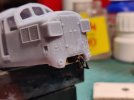
This is a test fit of one of the coupling hooks (OBKs). The resin print is from Lincoln Loco, scaled up from TT. It's really lovely and I hope to do it justice in the end! Fuel tanks remain to be attended to.

 
Last edited:

readingtype

Western Thunderer
I seem to have been distracted. No matter, things go on.

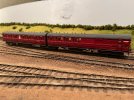
Currently I am starting to assemble a set of Quint Arts for Orchard Wharf, the Model Railway Club layout I'm involved with. The Quint Arts are an Isinglass 3D printed kit. They were designed rather like injection mould plastic kits with separate sides, roofs and floors and offered a challenge I hadn't expected, in that many of the parts were warped quite severely on arrival and seemed still to be in the process of doing so after delivery. Unlike moulded plastic these are resin and although they flex they are brittle. I hesitated. But they have now been in my possession for half a decade and it's time to build them or abandon them.

1000014815.jpg

Orchard wharf is at Ally Pally this year, hopefully along with a more or less finished Quint Art set from me...
 

readingtype

Western Thunderer
Depending on the resin used, a bath in hot water might help.
Thank you @simond - tempted to say I did that and forgot to take the Quints along :) I did in fact fix various parts down to wooden battens and soak them for a bit in hot water. If it did anything, it was an improvement. Ages ago though so how much I don't remember.
 

readingtype

Western Thunderer
A rather cruel close up showing the current state of what won't be a showcase model, but I hope will do good layout service. I wanted to show that the warping, which was pretty much at its worst on the floor of the outer ends of the first and last carriage, has all but gone. It was severe enough that I really struggled to use the buffer height as a guide to the ride height. Because the bogie pivots included in the kit didn't agree with me, figuring out what was needed to replace them became a blocker to progress. Now thankfully resolved, and you can see the highly sophisticated washer based pivot solution adopted. And no, this isn't the final coat of paint.

1000015014.jpg
Ben
 

readingtype

Western Thunderer
Should there be a recognised technique for constructing carriage running boards in 4mm scale I would be grateful to hear it. I'm pondering 0.7mm brass rod for the hangers and brass strip for the boards. I thought both sides could be done together by using a lengths of rod bent into inverted U shapes and glued to the underside of the floor. But this might already have been tried by others and found wanting!
 

Tim Watson

Western Thunderer
Depends how accurate your bending is. I might be more inclined to drill some holes tucked in behind the sole bars to locate the rods, with the right angle pre-bent and use a simple spacing jig to locate them whilst the Araldite is curing. If you pre-tin the step support and running boards then soldering shouldn’t be an issue, especially if you use nickel silver rod - it’s also stronger.

Tim
 

James Spooner

Western Thunderer
I must admit I admire your bravery doing a quint. I made a twin set from the same source and wound up treating it as a scratch aid. The sides needed a lot of sanding down to make the panels smooth, the underframe detail was largely replaced by MJT components, the bogie attachment was scratch built but the worst thing was trying to get the windows fitted in a half decent fashion.

Nigel

IMG_9782.jpeg
 
Top