The Heybridge Railway, 1889 to 1913

RichardG

Western Thunderer
we use Ansmann extensively for our products at work.
One of the negatives of retirement is you lose all connections with current practices. Still, it sounds like I am in good company.

I would want to check, but my recollection is that NiMH chargers will detect the battery voltage and simply float continuously once they’re fully charged. They don’t shut down per se, but the current will be tiny.
I have checked the instruction book for the ACS48, from which I quote:

"The charger continues to charge the battery
pack while connected. Therefore, determine
the charging time based on the table (see
picture 2). Disconnect the battery pack
after the calculated time in order to prevent
overcharging".


This is a menace when the battery manufacturer's claimed capacity is greater than the true capacity.

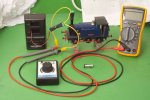
I have given my battery pack a fresh dose of 116 mA for another 100 minutes, with no sign of the current falling away and no signs of overheating either. So the pack has now had 3 hr 30 min of charge.

3.5 (hours) x 116 mA = 406 mAh, which is near enough the capacity printed on the batteries and rather more than my estimates. Yet I still don't have a clue whether the pack is fully charged.

Something else I don't know is, does the charging process waste power? I mean, if a battery had a true capacity of 300 mAh, and I charged it for three hours at 100mA, would it end up fully charged? Or maybe I have to add some extra energy (extra time) to compensate for losses.
 

simond

Western Thunderer
Oh, that’s not what I expected. Bit of a nuisance, but I guess you could make a timer as a charge controller. Or even a coulomb counter. Arduino?

re your question about adding extra energy. I’d say “yes” because if they get (even just a bit) hotter than ambient, then some of the charging energy has been wasted.
 

RichardG

Western Thunderer
From the point of view of a battery charger, the battery pack inside 'Quintus' looks like a rather large PP3 battery. I mean, seven cells, 8.4V, NiMh technology. So I am going to try the Annsmann model 'Powerline 2', which is designed to charge such PP3 batteries. Most of the spec looks sensible:
  • Intelligent charger for 1 or 2x 9V PP3 NiMH rechargeable batteries with 8.4V nominal voltage
  • Automatic charge start after rechargeable battery is inserted
  • Microcontroller-monitored charge control
  • Multiple over-charging protection through voltage monitoring (-dU) and safety timer
  • Fully-charged detection and automatic changeover to pulse maintenance charging
On the downside the charge rate is just 70 mA, so perhaps a four-hour process to recharge 'Quintus'. Better four hours and a cool loco than one hour and a big worry (Vapex) or an indefinite time and indefinite result (ACS48).

If this works, I might convert 'Lady Marion' from LiPo to NiMh. This would overcome a different worry.
 

RichardG

Western Thunderer
DSC_2727.jpeg
Sadly the Ansmann 'Powerline 2' seems to be completely unsuitable for charging 'Quintus'.

At power-up, the charger sends a series of test pulses to the battery pack, the pulses ranging from about 15 to 60 mA. This pulses continue in a cycle for five minutes, whereupon the charger shuts down and indicates that it considers the battery to be faulty.

There is probably a lesson to be learnt here. Most AAA battery chargers are designed, unsurprisingly, to charge AAA batteries. If you use the two-thirds AAA battery in a model you are using a non-standard battery and really, you are on your own. I've got a kitchen timer, I can use this with the Ansmann ACS48.

The Powerline 2 might still be useful - I can buy some NiMh PP3 batteries for my r/c handsets. Maybe convert 'Lady Marion' to NiMh. But I have made no progress in my quest to charge 'Quintus' accurately and automatically.
 
Manning, Wardle "Lady Marion" . . "Poover" battery and terminals New

Boyblunder

Western Thunderer
View attachment 265672
Sadly the Ansmann 'Powerline 2' seems to be completely unsuitable for charging 'Quintus'.

At power-up, the charger sends a series of test pulses to the battery pack, the pulses ranging from about 15 to 60 mA. This pulses continue in a cycle for five minutes, whereupon the charger shuts down and indicates that it considers the battery to be faulty.

There is probably a lesson to be learnt here. Most AAA battery chargers are designed, unsurprisingly, to charge AAA batteries. If you use the two-thirds AAA battery in a model you are using a non-standard battery and really, you are on your own. I've got a kitchen timer, I can use this with the Ansmann ACS48.

The Powerline 2 might still be useful - I can buy some NiMh PP3 batteries for my r/c handsets. Maybe convert 'Lady Marion' to NiMh. But I have made no progress in my quest to charge 'Quintus' accurately and automatically.
Richard,
I have been using these "Poover" PP3 sized Li-ions with built in USB C chargers https://www.ebay.co.uk/itm/144773411390 for several things and initially found them very useful. Both have now expired after slightly less than 2 years due mainly to lack of charging in the last 6 months I think. I've no idea what the real capacity is, probably not 1200ma. Perhaps you can try one? Just need to extend the USB C socket to somewhere convenient.
Robin
 

RichardG

Western Thunderer
I have been using these "Poover" PP3 sized Li-ions with built in USB C chargers

I have one of these Poover batteries inside 'Lady Marion'. The eBay listing suggests they are selling well.

It's useful to know about batteries failing, and good to see they are still for sale. I wonder what their shelf life is.

DSC_2785.jpeg
I did a bit of design planning to leave myself some access to the USB socket!

This loco also has a coaxial power connector behind the smokebox door, so I can charge a NiMh battery in situ in the loco.

The Poover battery gives me just one problem. When I refit the saddle tank, if I should momentarily touch both battery terminals (shorting them together) then the battery resets itself. I have to connect the USB charging cable for a few seconds to get it to reset itself.
 

Yorkshire Dave

Western Thunderer
The Poover battery gives me just one problem. When I refit the saddle tank, if I should momentarily touch both battery terminals (shorting them together) then the battery resets itself. I have to connect the USB charging cable for a few seconds to get it to reset itself.

Couldn't you line the relevant area inside the saddle tank with insulation tape or make up a thin plasticard cover (a bit like a miniature waiting shelter) to slip over the terminals prior to refitting the saddle tank to prevent accidental shorting?

Untitled cover.jpg
 

RichardG

Western Thunderer
When I started in 0 gauge (summer of 2021), I thought the FS wheel was really quite a crude thing; but somehow I accepted it without much thought and got on with making models. I now know, the ScaleSeven wheel will run perfectly well on 0-MF track, and a model so fitted looks a lot better. But running such a narrow wheel on a tired 0-F layout is likely to bring disappointment.

I have been looking for a middle-of-the-road wheel profile which will look better than a FS one and still run at on the 0-F tracks at NEEGOG.

The trolley runs fine on 'Heybridge Basin' but really I thought it would. I am now waiting for some cassette-deck style drive bands to let me try it over a distance at NEEGOG.
DSC_2836.jpeg
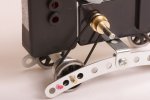
This contraption now has a drive belt. This is a square-section belt sold for cassette players and CD/DVD drives, and it is slightly sloppy. The pulleys have a vee groove with a flat base and 60-degree sides and, more by luck than judgement, they are gripping the belt beautifully. And so, the thing drives itself along. This photo also shows my experimental wheel profile.

DSC_2842.jpeg
I have rebuilt the superstructure(?) to set the C of G centrally above the pivot on the side frame, and to leave the C of G unpleasantly high. All-up weight is about 200 grams and the wheelbase is 70 mm, so much the same as a white metal wagon. Running speed is north of a scale 100 mph, so I fear I have been perceived as more hooligan than mad engineer, but the speed really only adds to the fun.

Well, I put the machine on the track at NEEGOG this morning, and it completed lap after lap without difficulty. It ran perfectly in both directions, including the curved legs of two Peco 6ft points in both leading and trailing directions. In fact, it never derailed. This was more than a mere surprise, I was amazed. I expected it to derail at a moment’s notice.

A better idea might be to reduce the flange to 0.66 mm (the scale height, adopted by the S7 standards) and keep the original tyre width of 3.4 mm. The wider tread giving the wheel as much support as possible when it runs through a 0-F crossing. This is easy to make using the S7 wheel profile tool. It also gives the opportunity to reduce the tyre diameter a little, to improve the appearance.
Arguably I am doing nothing new. The wheel standards from the Guild state that the fine scale flange can be reduced to 0.6 mm if suspension is provided. But I am staggered that this works so well on a track I have seen to derail so many models. The wheel profile seems to relying heavily on its coning too, because the flanges are so far away from the check rails.

DSC_2849.jpeg
This is the wheel profile I tested at NEEGOG today, photographed beside a ScaleSeven wheel from Peartree. The test wheel has the same shape but it is the same width as a FS wheel.

RG7 would seem to describe the standard you seek.
I don’t have a big enough ego to call this RG7, but what it is seems to fit the bill for future wagon builds on my mixed 0-F and 0-MF Heybridge Railway. It is also very easy to pull the wheels apart on their axle to create a wagon compatible with ScaleSeven, for when I have a layout run such a wagon.

The testing has all been rather satisfactory.

 
Top