
You are using an out of date browser. It may not display this or other websites correctly.
You should upgrade or use an alternative browser.
You should upgrade or use an alternative browser.
Threadmarks
View all 198 threadmarks
Reader mode
Reader mode
Recent threadmarks
Fowler road locomotive - chimney folded part 2 ( Diversion : herding sheep at Spetchbury Halt ) NER class H2 . . named as 'Quintus' . . at NEEGOG (9 May) ( Diversion : wheel flanges ) New . . battery endurance New NER class H2 . . charging New Manning, Wardle "Lady Marion" . . "Poover" battery and terminals New
RichardG
Western Thunderer
The rigid towing bar stops the engine running away into the Defender, though I suppose with too much speed it could end up propelling the car.How would such a machine be unloaded? What would be needed?
Yes, I can see detail of the perch bracket at 10:22 in the video.The bit between the pan and the smokebox is called the perch bracket, it looks much too heavy on the model.
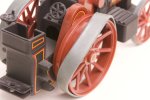
Watching the video a second time, I think the most glaring error in the model is the colouring of the tyres. These are made out of soft, pliable plastic. If I can't paint them, perhaps I can make replacements from styrene.
Thank you @mswjr (I'm sorry I don't know your name) it is really helpful to have a close-up video showing this engine.
Cassette-based fiddle yard . . part 4 new base module with shelf
RichardG
Western Thunderer
. . .
View attachment 227475
The electrical connections are the same as on my other cassettes. I didn't show how I took the wires from the terminals to the rails, so this is how I did them.
View attachment 227472
Four pre-grouping wagons (plus brake) are likely to make the longest train on the railway.
View attachment 227471
I have a functioning fiddle yard. Two "short" cassettes (far left) match up with one "medium".
I am a bit surprised how flat the modified cassette sits on its baseboard. If warping occurs, I can think about fixing some aluminium strips along the sides.

The fiddle yard has turned out to be a bit cramped (photo in October 2024) and I am making a new one to use the same cassettes.
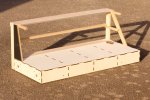
The new fiddle yard is a reversible design, for use at home and at a show. The layout connects to either end, so the open side of the fiddle yard can be at the front of the layout or at the back.
There will be a display board for exhibitions, a shelf to hold cassettes and stowage for r/c handsets.
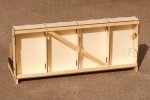
The basis of this is a kit from Grainge and Hodder. I have dispensed with the cross-braces supplied in the kit because I don't think they will achieve anything useful in this application. I have put in the diagonal brace instead, to stop the long sides moving relative to each other.
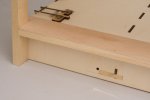
The brace going under the baseboard had to go in through a hole in one side. This is now blanked off.
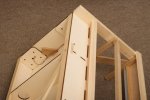
I have taken photos to show parts of the structure before I add the display board. With triangulation in two planes the whole thing is very stiff and shows no desire to settle on a skew.
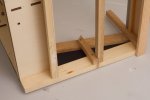
The short lengths of oak are a shelf support and something to hold a lighting strip.

A mock up before I add the display board and fix the shelf, with the unmodified Corgi road locomotive for continuity.
I want to think I could eventually add further stub tracks so I can use this creation for other track gauges. Especially my H0 and H0e models because I have no workable layout for these at the moment.

RichardG
Western Thunderer
If those are G&H alignment dowels, there should have been some 2.5 - 3mm ply packers in the bag to bring the face of the dowel near-flush with the end of the baseboard.
No . . . the dowels for this baseboard have needed work.
Up until now I have used pattern maker's dowels from Station Road Baseboards throughout the baseboards in this project. Every module is a G&H one. Unfortunately these dowels are no longer stocked because of quality and tolerance problems.
Of course I didn't know this when I ordered the baseboard last year. I do know that G&H sell their own dowels but I don't know their specification, or whether they will mate with my existing ones. So I have improvised.

For the first end, I salvaged the dowels from the old fiddle yard. The dowels carry the track power from one module to the next. Up until now I have used brass bolts to connect wires to the dowels; this time I used the lathe and some solder. Such is progress as skills improve.

For the second end, I bought some 12 mm dowel pins and turned them down to fit. The new diameters are about 7.95 mm for the business end and 8.05 mm for the part driven into the baseboard. It is easier for me to turn steel down to fit the baseboard than to open up the holes in the plywood and keep them concentric.
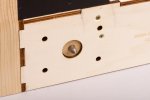
The packing pieces supplied with the baseboard kit are giving me some cosmetic trim.
I am glad I went for pattern makers dowels. The fitting clearance is about 4 thou, while ordinary bullet dowels give about 12 thou. The sloppier fit is fine for finescale 0 gauge, but I it would risk taking my 0-MF track out of spec at the baseboard joints.
Last edited:

RichardG
Western Thunderer
A mock up before I add the display board and fix the shelf
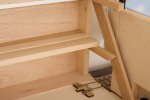
The rear-most shelf slat is bracing the display board, and the display board is holding the same slat straight and level. The other two shelf slats are loose, I can fix these after I put the finishes on the other parts.

The Intentio medium cassette is here to give scale.
So I now have a fiddle yard with a shelf long enough to hold three small cassettes from Intentio (or one small and one medium); and some nooks and crannies to hold r/c handsets and the uncoupling hook. I can see myself fitting this out with its own lighting, perhaps an analogue controller too. A second stub track will go at the front left corner to let me turn the whole unit end for end.
The top panel can hold a sign with the name of the layout at a show, or more paraphernalia at home. The display (on the other side of the display board!) is probably beyond the scope of WT. I have gathered up some photos and prepared a map for this. A sheet of Perspex is on order to finish it off.
Last edited:

RichardG
Western Thunderer
That cassette looks rather different to all of mine - is it very old or very new? It doesn't have full-length sides.
Back here in Part 3:
The Heybridge Railway, 1889 to 1913
I use this cassette so much I forget it is non-standard. The length is as Intentio intended it to be, 578 mm.
RichardG
Western Thunderer
No kerb rail on the top shelf?
No plan for a kerb rail. I don't need one at home, and anything left here at a show will look like clutter and be vulnerable to theft.
RichardG
Western Thunderer
I’m hoping the new fiddle yard will make the layout easier to operate. The previous version could only comfortably hold two rows of cassettes, and when using a combination of medium and small cassettes (train plus loco), they would overhang the end of the board.
The new version can accommodate twice as many cassettes, and everything now fits on the board without any overhang.
The new version can accommodate twice as many cassettes, and everything now fits on the board without any overhang.
Fowler road locomotive - chimney folded part 2

Yorkshire Dave
Western Thunderer
I think the most glaring error in the model is the colouring of the tyres. These are made out of soft, pliable plastic. If I can't paint them, perhaps I can make replacements from styrene.
Could you use permanent marker pens to colour them assuming there are suitable colours available?
RichardG
Western Thunderer
Could you use permanent marker pens to colour them assuming there are suitable colours available?
I don't know yet but thanks for changing the subject back to modelling. I have been making things up as I went along for the last week, used up a lot of offcuts but thoroughly fed up with woodwork. Thankfully the FY is serviceable and ready for use.
RichardG
Western Thunderer
Could you use permanent marker pens to colour them assuming there are suitable colours available?
Certainly, the ink from red and black Sharpies sticks permanently, though it dries with a slight sheen. Perhaps I could use this as an undercoat for something else which is a better colour? The Sharpie colours are too intense - I want a wishy-washy shade of beige.
I've also tried Indian ink and an acrylic ink and they simply slide around on the surface of the tyre. So the Sharpie looks like the best formula so far.
RichardG
Western Thunderer
And the photo of the A7 13141 gives you all the info you need for the hinged chimney ( it simply folds forward and hangs vertically against the smoke box door)
Like this?
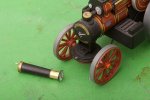
This is less sophisticated than it looks. Corgi put a steel peg through the chimney/smokebox casting and down into the front axle assembly. The top part of this peg is now passing through the chimney, brass tube, and flange, with epoxy glue holding everything together.
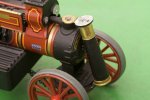
This is all held onto the model with a wire hook underneath and a peg into the front of the smokebox. So the piece of wire posing as a pivot here is holding nothing into place except itself.
This is the only hobby I know where you can take a pristine model out of its box and put a saw through it, and somehow do this feeling upbeat and happy.


RichardG
Western Thunderer
The loco will be "Deborah" because this suits Paul Daniels' assistant and is also the person who taught me retail. Plates are on order from LRS

Threadmarks
View all 198 threadmarks
Reader mode
Reader mode