The Heybridge Railway, 1889 to 1913

( Diversion : Middy steam on Easter Monday ) New

RichardG

Western Thunderer
Some photos from the Middy on Easter Monday. The Hudswell-Clarke 'Illingworth' was enjoying its last day of public passenger service, it goes out of ticket today.

2026-04-06 14.35.25.jpeg
The loco carries its usual name on the other side.

2026-04-06 14.34.53.jpeg
I dread to think how the AI bots will interpret these two photos in years to come.

2026-04-06 12.19.30.jpeg
Taking a break at Dovebrook after changing the loco on the train.

This was the second day of public passenger services to Aspall. The station was completed just days before, but is currently landlocked. You can leave the train but not leave the station.
 
Fowler road locomotive (1902) New

RichardG

Western Thunderer
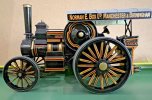
On the bright side, Corgi do a 1:50 scale showman's engine and one of these has just arrived.

DSC_2230.jpeg

The top of the chimney is a scale 13 ft 5 in above rail level - right on the limit of the loading gauge. Yet the model is 15% undersize.
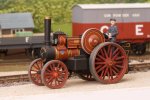
I have had a go at the Corgi model of a Fowler showman’s engine to make it into a road locomotive.

DSC_2238.jpeg
The model is to 1:50 scale. If I view it as being 1:43.5 scale, the headroom under the canopy is a bit limited but there is a more compact road locomotive hiding inside.

DSC_2282.jpeg
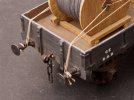
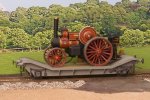
So here is some modelling by subtraction. It was usual for the chimney to be detached for carriage by rail so this is what I have done here. The surgery is awful but the tarpaulin hides everything. The original chimney is unusable but I can think about this if and when the model gets chained down onto a wagon.

When I remove the canopy I will reveal an empty space where a scale model would have its connecting rods and valve gear. I could have a tarpaulin to conveniently cover this!
DSC_2287.jpeg
Contrary to my first impression, there is a representation of the motion in the castings.

DSC_2286.jpeg
I have repainted as much of the model as I can, but the yellow wheels are difficult to alter. I wish I had bought a model with a less flamboyant livery.

When I was young, my father had a fabric tarpaulin with metal eyelets around the edges and it was green. Thus I have always thought of tarpaulins as being green but I guess they were other colours a long time ago. If Edwardian tarpaulins were never green I do hope someone will tell me.

Incidentally, the Corgi model currently weighs 300 grams, much the same as the kit from Duncan Models.
The modified engine weighs 200 grams. This is still far too much for the springs in my GER machinery wagon, but my NER Lomac has a rigid chassis and seems suitable to carry a locomotive from Leeds to Essex.

The NER Lomac entered service in 1913, the year my railway was dismantled, so this working must have happened during the months after the official closure of the line.
 

Overseer

Western Thunderer
If Edwardian tarpaulins were never green I do hope someone will tell me.
A green tarpaulin in 1913 is highly unlikely. Railway tarps (and presumably others but I haven’t researched them in any detail) at the time were proofed by soaking the canvas in a hot concoction of tar and linseed oil then hanging them up to dry for a couple of weeks, so were black when new and faded to grey. I will have to check the dates when green tarps took over - post WW2 from memory. There is a good article on Midland Railway tarps in one of the Midland Records.
 

RichardG

Western Thunderer
Thank you Fraser.

For the times before colour photography, it is cheering to learn that we know enough about some processes to know what colours the items could be.
 

magmouse

Western Thunderer
A green tarpaulin in 1913 is highly unlikely. Railway tarps (and presumably others but I haven’t researched them in any detail) at the time were proofed by soaking the canvas in a hot concoction of tar and linseed oil then hanging them up to dry for a couple of weeks, so were black when new and faded to grey. I will have to check the dates when green tarps took over - post WW2 from memory. There is a good article on Midland Railway tarps in one of the Midland Records.

For more lightweight applications, you might be looking at oil cloth. Modern oil cloth is plastic coated, but originally it was made with canvas type cotton fabrics coated with linseed oil. Multiple coatings, with drying time between, resulted in a waterproof material used for coats ('oilskins'), covers, and similar applications. Having experimented with making this (long story, not railway related...) if you use an unbleached cotton and boiled linseed oil that is also unbleached/clarified, the result is quite a yellowish colour. I assume it's possible to dye the fabric either before or after the oil treatment, though for utilitarian uses, possibly one wouldn't bother.

Nick.
 

Rob Pulham

Western Thunderer
I used good old lense tissue for mine. Painted with a light patchy coat of Vallejo German Grey primer.

1775726632910.png

While taking the snip of the chimney top and canvas cover, I also noted from the photo that mine too has a representation of the motion cast into the top. So I reckon it's the same basic casting for the main body but Richards example has a few more embellishments to make it represent a different model of the prototype than mine.

By coincidence Chris's first full railway painting (she had done some abstract parts of locomotives prior to this one) also featured most of a traction engine. I recall that she found it very challenging to get all the spokes of the wheels in the right orientation.

boys%20and%20their%20toys%20.jpg
 

James Spooner

Western Thunderer
All this reminds me of a visit I paid a couple of years ago to Collection X, the late Peter Rampton’s collection of narrow gauge locos and carriages stashed away in a number of barns. Amongst them was a spare boiler that had been sent down to South Africa by Bagnall with the several locos they sold to a steel works (apparently it was known as the ‘Empire pack’ of spares sold to enable purchasers keep their fleet running). This spare boiler had never been used and still had waxed paper blocking up all of the tubes and a bundle of spares in the smokebox. The point of this ramble is that the hole in the smokebox, where the chimney would go, was filled with a large wooden bung, similar to a cork, and that might be an alternative to a tarpaulin…

Nigel
 

Yorkshire Dave

Western Thunderer
I have these two taken by my grandfather at Keighley in the 1960's. The Temperance Hall is now a 'spoons (Wetherspoons) :).

As far as I can research she was built by Fowler in 1920 which is a bit late for your time period but it does show a smaller traction engine with the people providing a sense of scale.

Keighley c1964 101.jpg

Keighley c1964 102.jpg
 

Osgood

Western Thunderer
All this reminds me of a visit I paid a couple of years ago to Collection X, the late Peter Rampton’s collection of narrow gauge locos and carriages stashed away in a number of barns. .......

Looky here:


RichardG

Western Thunderer
the hole in the smokebox, where the chimney would go, was filled with a large wooden bung, similar to a cork, and that might be an alternative to a tarpaulin…
I suppose, I want a bung for a brand-new locomotive and a tarpaulin for one already in service.

Though I need a tarpaulin here to hide the ghastly mess I made of the original chimney base and smokebox front :))

As far as I can research she was built by Fowler in 1920 which is a bit late for your time period but it does show a smaller traction engine with the people providing a sense of scale.
It's good to know Fowler made locos this size, being rather smaller than the one from 1902 later rebuilt as a showman's loco.

I have learnt quite a bit about dismantling these Corgi models and I am tempted to offload this first attempt and then try again. It would be much easier to start with a road locomotive in a period livery instead of a showman's engine in a modern one.
 
Last edited:

mswjr

Western Thunderer
Nearly all fowler road locomotive had a hinged chimney, so it could swing down for this type of transport. and yes the livery is a little bright, most were just black as they were working and not show engines, But corgi do black fowler road locos,
 

Attachments

  • 52283244364_84484eba8a_b.jpg
    52283244364_84484eba8a_b.jpg
    339.8 KB · Views: 7

mswjr

Western Thunderer
This one on E bay at the moment 10.00 pound, If you want a smaller engine corgi do a Garrett in traction engine or roller form, Search for corgi vintage glory of steam. Garretts were common in your early period.
 

Attachments

  • s-l1600.jpg
    s-l1600.jpg
    400.4 KB · Views: 7

RichardG

Western Thunderer
This one on E bay at the moment 10.00 pound

Found it! This is Corgi ref. 80104.

This model might be a good starting point. The Corgi "gilt" finish rubs off easily to leave the gloss paint underneath. Remove the whole canopy and make a taller chimney, and the model will look right on a 7mm layout. Arrange the chimney to fold forwards and downwards and it can sit on a Lomac. With the smokebox already the right shape, making a new base for the chimney will be easier too.

I am a bit wary of the Corgi Garrett - it might be a bit small for a 7mm setting.
 

Yorkshire Dave

Western Thunderer
If you have the time and patience strip down the die cast model to bare metal and repaint. This reveals the crisp and any subtle detail hidden under the thick factory paint and it's what I do with any die cast vehicle as with this Corgi 1/43 Ford Transit.

FT01.jpg

Transit 1.jpg

And yes, there is a newspaper on the dash - commensurate with the numberplate and tax disc colour for the year. :)
Transit 4.jpg
 

RichardG

Western Thunderer
@Yorkshire Dave your Transit makeover is fabulous. I won't be able to do the same on a Corgi traction engine, partly because the factory paint is still better than I can manage; but also because these models look really difficult to take apart. In particular, the wheels seem to be locked onto their axles.

So I am taking the route of least resistance. I have sold my first attempt (with its green tarpaulin) to a member of NEEGOG who has just built a Lomac. That was handy! And ordered a Corgi model no. 80111, another B6 but with a more subdued colour scheme and needing no structural changes except to provide a longer chimney which appears to be hinged downwards.

The chimney mod won't be especially easy because there is a steel pin vertically through the front end of these models, but I can have a go.
 
Top