Rivermead Central

40057

Western Thunderer
Martin

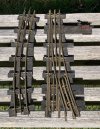
I got the ground disc signals you can see here as a job lot from John Neale (of Stop the Drop auctions). I have no idea who made them, but they are nicely done, all brass and soldered construction, although obviously somewhat over scale. On my layout all the signals and turnouts are directly operated, and I have no lever frame or interlocking.

View attachment 237632

I have tried to correctly signal all shunting moves in addition to the main running line semaphores (which are pre-war Hornby lattice as you can see). This makes the layout more fun to operate, but I have to confess that I am guilty now and then of running a SPAD! I like your plan to use vintage colour light signals which will be different, but I must confess I have no idea when colour light ground signals were introduced. And I can see that calling on or shunt ahead colour lights would also be a problem. The other snag with colour lights is of course that you cannot see from the rear what aspect they are showing.

I shall continue to follow your postings with great interest.

John

Hi John

Thank you for your comments.

That’s a nice looking Milbro BG in your photo!

Your ground discs do look commercially made, but I can’t suggest a likely manufacturer. I see you are also using post-WW2 Bassett-Lowke Scale Permanent Way. No third rail — so clockwork, or two-rail track? I can’t say I have ever seen more than two or three 2-rail Bassett-Lowke turnouts. Rare things. Please tell us more!

I would be very interested to see more about your railway on WT.

Martin
 

40057

Western Thunderer
Martin, do you have any examples of bulbs and bulbholders? Both screwed and bullet type were used, the smallest readily available size being the Edison 5.5mm thread (Edison Screw Liliput size E5 or LES- as used on Minic cars with electric lights) and a similar size non-threaded which is used by various people such as Marklin as well as in aircraft, power station and car instruments. Both still available in a variety of voltages. Cheap screw adjustable voltage regulators are available on Ebay to allow you to set lights to exactly the right level of rounded golden glow. By the way I think the "Southern" approach is the perfect place to use coloured lights, if you know what I mean....

Hi Pieter

More useful information. Thank you.

Most of my Milbro signals have no innards or wiring left. All removed before I got them. But it can’t have been a screw-in bulb as access is from the back only.

Yes, there is an ‘in joke’ there for some when viewing the railway. But practical considerations may dictate otherwise.

Martin
 

John R Smith

Western Thunderer
No third rail — so clockwork, or two-rail track? I can’t say I have ever seen more than two or three 2-rail Bassett-Lowke turnouts. Rare things. Please tell us more!

I would be very interested to see more about your railway on WT.

Hello Martin

Thank you for your comments. I am glad that you like the Milbro van, I noticed that you also seem to be keen on Milbro. I spent quite a long time refurbishing that one, very carefully as the finish over wood is so delicate. I ended up repainting the roof - inside the workmanship is first-class, all in pattern-grade mahogany. I have another Milbro LMS corridor 1st queued up on the workbench when time allows - this one has a full interior with the lace antimacassars on the seat tops!

There is no electricity on my railway, as all of the engines are clockwork (or spring drive). Like you, I grew up enthused by Jack Ray and Norman Eagles in the MRN and RM. I must be lucky, as I have not found too much difficulty in obtaining two-rail B-L track, a lot of it in the original boxes. I have only used brass rail, and I do have a good stock of spare battens / rail / chairs. In fact, I do still have a few pieces of batten which came from the club layout which I and my father were members of back in the late 1950s and early 1960s.

I have been following this epic build of yours with great interest, and I seriously admire your very high and meticulous standard of workmanship. I have no wish to highjack your thread, having already described my small opus at great length over on RMweb (in the 7mm Section). But when I have a chance to take a couple of photos, I do have a query for you regarding a mystery wagon . . .

John
 

John R Smith

Western Thunderer
Martin

I was thinking a bit more on your colour light signal project. A site you may already have seen, but just in case you have not, is "Railway Signs and Signals of Great Britain". There are four pages dedicated to shunting signals -

Shunting Signals

Within these pages is some very useful info about colour light shunting signals and also their dates of introduction, which you were asking about (some schemes as early as the 1920s).

I hope this helps.

John
 

40057

Western Thunderer
Martin

I was thinking a bit more on your colour light signal project. A site you may already have seen, but just in case you have not, is "Railway Signs and Signals of Great Britain". There are four pages dedicated to shunting signals -

Shunting Signals

Within these pages is some very useful info about colour light shunting signals and also their dates of introduction, which you were asking about (some schemes as early as the 1920s).

I hope this helps.

John
Thank you. I was not aware of that website. I will take a look.

As per my reply to @magmouse above, I’m close to concluding the southern approach to Cairnie Junction station is not the best location to use my colour-light signals. Because of practical issues such as distance from the nearest electrical socket and finding somewhere to put the control panel, I’m realising I’m creating unnecessary difficulties for myself — which wouldn’t arise if, for example, I used the colour-lights in Rivermead Central station. If the colour-lights are going to be used for Rivermead Central, it will be a couple of years at least before I need to start repairing them.

I haven’t seen your layout described on RM web, I’m afraid. It’s simply not a website I look at. One could easily spend many hours everyday looking at stuff on the web, which is not how I want to spend my time. After always completely avoiding social media, I decided to make just one concession when I retired — I joined WT.
 

John R Smith

Western Thunderer
I’m close to concluding the southern approach to Cairnie Junction station is not the best location to use my colour-light signals.

Martin

That sounds very sensible. It would be nice to use the colour lights eventually though, elsewhere on the layout. What sort of semaphore signals are you intending to use?

I haven’t seen your layout described on RM web, I’m afraid. It’s simply not a website I look at. One could easily spend many hours everyday looking at stuff on the web, which is not how I want to spend my time. After always completely avoiding social media, I decided to make just one concession when I retired — I joined WT.

Completely understood. Surfing the Net is a ghastly way of wasting precious time! (and I do far too much of it). But that was the way that I found Rivermead Central, so sometimes good things do turn up.

John
 

40057

Western Thunderer
Martin

That sounds very sensible. It would be nice to use the colour lights eventually though, elsewhere on the layout. What sort of semaphore signals are you intending to use?


Completely understood. Surfing the Net is a ghastly way of wasting precious time! (and I do far too much of it). But that was the way that I found Rivermead Central, so sometimes good things do turn up.

John
Not given much thought to the semaphores — because I don’t have to. Have to install the missing base-board and retaining wall section, build the tunnel mouth for the low-level track emerging into Cavendish Goods yard, repair several more Lowko Track points, lay the track on the high level baseboards, lay the track on the low level base-boards …

Then I’ll start to think about signalling. The only reason for giving consideration to signalling at all at this stage was that if I opted for colour-lights, wiring would have to be installed before fixing the missing section of retaining wall. If the colour-lights are going elsewhere (I will use them), then signalling is now off the agenda for quite some time.

The semaphore signals will probably be Bassett-Lowke and most likely a mixture of different types and dates, as per many real locations.
 

40057

Western Thunderer
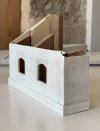
I have commenced construction of the Cairnie Junction yard office:

0900D8FD-5056-45B4-9008-60CAA315C864.jpeg

The approach is the same as with my previous buildings. Panels with brick etc. detailing from LCUT Creative fastened to a plywood and strip wood carcass using wood glue and moulding pins. In this case, the front of the building is adapted from the lower front wall designed for a ‘medium signal box’. The windows were too near the ground for my purpose so I trimmed a couple of courses of bricks off the top and added six footing courses stepped out by 2”. This brought the windows to a good height. The doorway will be on the north wall, nearest the camera in the above photo, to the right of where the wall currently ends. The chimney will be at the south end of the building. The roof will be made of vintage plywood impressed with slate detailing, as used on previous buildings. I’ll probably paint the footing courses as engineering bricks.
 

40057

Western Thunderer
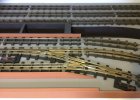
My original plan for Rivermead Central did not involve any provision for electric traction. However, not long after the main base-boards were built (c. 25 years ago), I decided I wanted to electrify the line between Cairnie Junction and Rivermead Central. My intention was to operate the branch using an e.m.u. — ideally, a Bassett-Lowke Euston—Watford set. A friend who has a business dealing in vintage toys and trains had a couple of boxes full of 3-rail brass Lowko Track. I bought all he had. A large quantity of straight 15” track panels — 49 in total, I think — about half in immediately useable condition. The rolled sheet-brass rails used to make 3-rail Lowko Track are very easily bent or dented, unlike the rails made of tinplate. So often individual rails need to be replaced in the brass version of Lowko Track. Nearly all the 49 straight track panels I bought could be repaired if I needed to. Along with the large quantity of straights, there were only four 3’ 2 1/4” radius curves. I later found a couple more. Also three 3’ 2 1/4” radius turnouts, one of which had a completely mangled switch blade. The two turnouts in good condition were fully dismantled, cleaned and rebuilt (as described previously in this thread) and installed on the layout at Cairnie Junction several years ago:
915FD5F8-3A39-4028-AA4B-44F46544832D.jpeg

These two turnouts provide the connection between the centre road and the track serving platform 2 at the north end of the platform.

Not much more electric track has been laid since these turnouts were put in place. Apart from the general slow progress with the layout, specifically the problem has been finding more 3-rail Lowko Track — curves and points. After that initial purchase from my friend, I have found hardly any 3-rail Lowko Track in the last twenty years. A bit of a surprise given that tinplate Lowko Track is fairly common. And quite a problem in terms of building my planned layout.

Several things might have contributed to the relative scarcity of 3-rail Lowko Track.

When it was first sold, pre-WW1, most model railways (and many homes) were without electricity.

Electric Lowko Track was really quite expensive. In the early 1930s, Bassett-Lowke had introduced 3’ radius tinplate track, marketed as ‘Sixfut’. Without the third rail, a circle of Sixfut track was 8/4, a 3’ radius point was 4/3. A 3’ 2 1/4” radius circle of tinplate (‘clockwork’) Lowko Track was 22/6, a turnout was 11/-. The Lowko Track was more than twice as expensive as the equivalent in Sixfut tinplate, but much more realistic. For electric track, the circle of Sixfut was 18/4, a turnout cost 7/9. For electric Lowko Track, a 3’ 2 1/4” radius circle was 48/-, a turnout 15/6. Again, the Lowko Track was more than twice the cost of using Sixfut. But, in 0 gauge, a Lowko Track electric turnout also cost more than a tinplate bogie coach, or three to five tinplate wagons, depending on the particular types of wagon. A Lowko Track, electric, double-track cross-over was 50/-. That was more than the price of a whole train of tinplate bogie coaches (14/6 each).

In the early 1930s, Bassett-Lowke introduced a simplified version of its Scale Permanent Way, sold as Popular Permanent Way. Fifteen inch lengths of 3’ radius ‘plain’ (i.e. without a third rail) Popular Permanent Way cost 3/2 (the Lowko Track equivalent cost 1/5). But the electric version of the Popular Permanent Way curve was 3/10 or only 3/- with steel running rails — while the equivalent Lowko Track piece was also 3/-. Popular Permanent Way 3’ radius electric turnouts were 17/6, the electric Lowko Track version only 2/- less. Once the Popular Permanent Way track was offered, electric Lowko Track really doesn’t look like a good buy. The Popular Permanent Way track was clearly superior in strength and appearance, but cost very little more than Lowko Track if third-rail track was required.

After so long without any sign of further electric Lowko Track, I was delighted to buy a quantity a few days ago. The track was offered on a well-known internet auction site. The collection of track I have bought really does look like someone’s ‘train set’. There are sixteen 3’ 2 1/4” radius curves (i.e. a complete circle) one 3’ 2 1/4” radius turnout and two straights. A classic model railway set up on the carpet — a circle or oval and a short siding. Given that Lowko Track was sold until about 1935, it is just possible that the original owner has only recently passed away or gone into a care home. The track I have bought is certainly dirty enough to have been in an attic for seventy years or more.

So this batch of track has solved my shortage of electric curves. And I have another very repairable turnout:
96FD8A6A-6F33-47C1-BD8C-40405A1C91AA.jpeg

I still need to find another, right-hand, electric Lowko Track turnout. Another couple of electric turnouts after that would be nice, but are not essential. I now have more than enough electric plain line, straights and curves.

I still don’t have an e.m.u or electric locomotive of any kind.

 
Last edited:

John R Smith

Western Thunderer
Martin

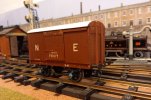
I mentioned on my last post here that I had a mystery wagon which I would like you to have a look at, and see if you can shed some light on it. In your post #65 on 5/2/24 you describe your King Bros wagon which is attributed to Windsor Models and Leslie Forrest. Just after Christmas I acquired this quite basic but rather charming NE van -

NE Van 01 Web.jpg

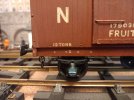
It is of wood construction, with a solid wood roof. I wonder if it might also be a Windsor model, partly because of the very neat hand lettering, and in particular these painted bolt heads on the solebar -

NE Van 02 Web.jpg

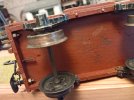
Which are white with a a tiny black dot in the centre. Underneath, as you can see, my van also has the two long pins holding each solebar in place. But things get even more strange -

NE Van 03 Web.jpg

Like your King Bros wagon, this van has the very same date (30/4/74) pencilled on the underside. It would seem imposible that this is just mere coincidence? The references I have seen suggest that Leslie Forrest retired in 1958, so this is unlikely to be a builder's date, if it is a Windsor Models product. But it does seem to suggest that both wagons were in the same place on that day in 1974.

Looking forward to your thoughts on this.

John
 

40057

Western Thunderer
Martin

I mentioned on my last post here that I had a mystery wagon which I would like you to have a look at, and see if you can shed some light on it. In your post #65 on 5/2/24 you describe your King Bros wagon which is attributed to Windsor Models and Leslie Forrest. Just after Christmas I acquired this quite basic but rather charming NE van -

View attachment 238241

It is of wood construction, with a solid wood roof. I wonder if it might also be a Windsor model, partly because of the very neat hand lettering, and in particular these painted bolt heads on the solebar -

View attachment 238242

Which are white with a a tiny black dot in the centre. Underneath, as you can see, my van also has the two long pins holding each solebar in place. But things get even more strange -

View attachment 238243

Like your King Bros wagon, this van has the very same date (30/4/74) pencilled on the underside. It would seem imposible that this is just mere coincidence? The references I have seen suggest that Leslie Forrest retired in 1958, so this is unlikely to be a builder's date, if it is a Windsor Models product. But it does seem to suggest that both wagons were in the same place on that day in 1974.

Looking forward to your thoughts on this.

John
Hi John

Definitely Windsor, no doubt at all.

The moulding pins upwards through the solebars and the painting style, specifically the bolt heads on the solebars, are diagnostic of Forrest’s work.

A very nice van.

As you say, the date can’t be a coincidence. But its significance? Almost certainly, we will never know. The two wagons must have been together then and become separated.

Thanks for sharing the photos.

Martin
 

40057

Western Thunderer
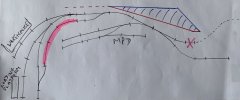
Back to the mundane. Specifically, the ‘missing’ section of high-level base-board shown here hatched blue:

E889041A-A264-498D-9FF2-8910861921E0.jpeg

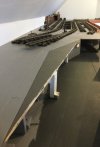
Fixed in place this morning:

DC1801E6-AD4D-4147-841A-C28CF36F3FB2.jpeg

It will be painted mid-grey to match the rest of the high-level boards. I’m embarrassed by the less-then-elegant joinery on display in the supports for the new piece of base-board. I’d better get that covered up as soon as possible. In practical terms, the supports are plenty strong enough and the board is level and at the correct height.

After further careful consideration, I have decided against using the colour-light signals in this location. The advantage of using them here was they are short and don’t have fragile protruding parts. At Cairnie Junction, the sidings (where shunting takes place) are behind the running lines (which need signals). Tall signals in the way are definitely unhelpful when leaning over to stop or reverse a shunting locomotive, or for coupling/uncoupling. But due to the difficulty of getting a power supply to the location, no access under the base-board when construction is complete and the lack of a suitable place for a control panel, means the colour-light signals are going elsewhere — probably Rivermead Central station.

The consequence of not needing to install electrical wiring under the new section of base-board is that track laying should start sooner. The bare area to the left in the above photo will have the point-work for access in and out of the goods sidings and the split for either platform 1 or the centre road + platform 2 through the station. Junctions that most trains that run on the layout will use. I have to complete the rebuilding of a right-hand Lowko Track point before any of this track-work can be laid. I’ll get that done as soon as I can; getting more track in place is a definite priority.
 

John R Smith

Western Thunderer
Gosh, Martin - I hope that you're tall. That's an awful long way to lean across to wind locos or deal with couplings!

By the way, what are your views on couplings? Due to deteriorating eyesight and awkward reaches, I have banned three-link couplings and converted everything to drop-links.

John
 

40057

Western Thunderer
Gosh, Martin - I hope that you're tall. That's an awful long way to lean across to wind locos or deal with couplings!

By the way, what are your views on couplings? Due to deteriorating eyesight and awkward reaches, I have banned three-link couplings and converted everything to drop-links.

John
The operating area runs up the right hand side of the photo. The maximum reach required is about three feet except in the corners of the room — which won’t have track in them except the Benham’s siding in the NW corner.

However, on the west side of the room where the base-boards are widest, the back of the layout is a stretch. More than I realised when getting the base-boards built. I will work round this by making sure the tracks at the back are less used. One movement a day, notionally, in/out of the Benham’s siding, for instance.

I keep the original, or original type, of couplings on everything — so have a mixture. Where I have a choice, I use a rigid single link — see the coupling on 828’s tender above. A scale coupling on the front of 828 for sake of appearance. The tender coupling plus working sprung buffers mean 828 should be fine coupled to either ‘tinplate’ or scale 3-link couplings.

Edit: Sorry, just realised the coupling on the back of 828’s tender is not visible in the photo posted in this thread. Can be seen here:
https://www.westernthunder.co.uk/threads/tom-mallard’s-workbench-cr-828-in-7mm-gwr-saints-in-4mm.3213/page-19#post-326920
 
Last edited:

John R Smith

Western Thunderer
Hmmm. I have found some serious problems with buffer-locking derailments when propelling stock fitted with three-links back through three-foot radius points and reverse curves. Especially when mixing up short and long wheelbase wagons. And with clockwork one often has less choice over the speed of the propelling movement! With finescale it is generally OK because the minimum radius is usually six feet or larger, and there are tighter clearances between wheels and track and wheels and axleguards. Now I am contradicting myself, because you will have noticed that my Windsor van above has in fact got some rather characterful three-links. But it also has a set of LMC style very oversize buffers, which I hope will save the day . . .
 

40057

Western Thunderer
Hmmm. I have found some serious problems with buffer-locking derailments when propelling stock fitted with three-links back through three-foot radius points and reverse curves. Especially when mixing up short and long wheelbase wagons. And with clockwork one often has less choice over the speed of the propelling movement! With finescale it is generally OK because the minimum radius is usually six feet or larger, and there are tighter clearances between wheels and track and wheels and axleguards. Now I am contradicting myself, because you will have noticed that my Windsor van above has in fact got some rather characterful three-links. But it also has a set of LMC style very oversize buffers, which I hope will save the day . . .
Your Windsor van has buffers by Leslie Forrest. Another indicator he was the builder. Normal, round, buffers with rectangular-ish nickel silver plates soldered on to the buffer heads — to address exactly the kind of problems you describe.

Generally though propelling through tight radius curves is problematic — especially if done at speed. I don’t know if your curves are what Bassett-Lowke sold as 3’ radius (actually 2’ 10 1/2”) or 3’ 3” radius (actually 3’ 2 1/4”) — see my post #150. My Lowko Track is 3’ 2 1/4” radius or larger, and that does make a difference compared to the post-WW2 notional 3’ radius.

I’m working on an idea for controllable shunting, of which more in due course.

Martin

PS If you haven’t looked at Tom Mallard’s thread, you should.
 
Top