Rivermead Central

John R Smith

Western Thunderer
PS If you haven’t looked at Tom Mallard’s thread, you should.

Indeed I have, and your 828 is superb. When I first saw it, my first thought was "Beeson" - it is very heartening that there are still builders around who can produce models of this stature. And being clockwork really piles on the credit, of course.

Who will be entrusted with the magnificent blue finish?

John
 

40057

Western Thunderer
Indeed I have, and your 828 is superb. When I first saw it, my first thought was "Beeson" - it is very heartening that there are still builders around who can produce models of this stature. And being clockwork really piles on the credit, of course.

Who will be entrusted with the magnificent blue finish?

John
We still need to discuss getting it painted. As a clockwork model it will handled — all the time. So the paintwork needs to be robust to cope with that. Then there is the endless debate about the exact shade of blue …
 

adrian

Flying Squad
We still need to discuss getting it painted. As a clockwork model it will handled — all the time. So the paintwork needs to be robust to cope with that. Then there is the endless debate about the exact shade of blue …
Fortunately Tom used nickel-silver which takes paint much better than brass. Other than that I'd say a good quality enamel should be suitable, my Dad used Joseph Mason paints for his paint range, unfortunately I don't have any details of the colours he used for CR. They used the same paint for some of the larger models, Bob Moore's Johnson Compound in the NRM and some of the 10 1/4" gauge loco's on the Stapleford Miniature Railway. Given suitable primer and time to harden it has proven to be robust to some quite heavy handling and use.
 

Ian@StEnochs

Western Thunderer
We still need to discuss getting it painted. As a clockwork model it will handled — all the time. So the paintwork needs to be robust to cope with that. Then there is the endless debate about the exact shade of blue …

Martin,

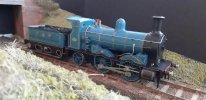
Please excuse my intrusion but it may help your deliberations. I am no expert on Caledonian colours but have built and painted a few models in Caley blue in my time. There are many versions of Caley Blue on the market and even I know that some are very much figments of the makers imagination! However we do know that there were two basic colours in the Edwardian period Dark and Light Blue. You have to choose whatever pleases yourself in the knowledge that not everyone will agree with you.

I was lucky to know the late Jim MacIntosh, he of the definitive Caley Livery book, who gave me 2 tins of paint, one each of dark and light blue, that had been mixed specially for him. I think he had had it mixed by Masons but I may be wrong there. The light 'Perth' blue 0-4-2 uses that paint.

CR 0-4-2 Drummond Rebuild No 278.jpg
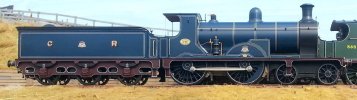
The Dunalistair on the other hand was finished long before I got the paint from Jim and is straight Humbrol 15 which had been recomended to me by Mike Gilgannon, the well known modeller of all things Caley. However it is virtually identical in colour to the paint from Jim.

Dunalistair 1.jpg

On both models the Red on the valences is Precision Paints Caledonian Purple Brown. I think it may be a little dark but I have not been criticised for it even though I have had 'earnest' discussions with 'experts' on the blues!

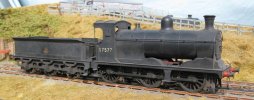
However, forgive me but I still think the best colour for an 812 is BR dirty Black! Sorry :)

Ian.

57577 At Auchlin.jpg
 

40057

Western Thunderer
Martin,

Please excuse my intrusion but it may help your deliberations. I am no expert on Caledonian colours but have built and painted a few models in Caley blue in my time. There are many versions of Caley Blue on the market and even I know that some are very much figments of the makers imagination! However we do know that there were two basic colours in the Edwardian period Dark and Light Blue. You have to choose whatever pleases yourself in the knowledge that not everyone will agree with you.

I was lucky to know the late Jim MacIntosh, he of the definitive Caley Livery book, who gave me 2 tins of paint, one each of dark and light blue, that had been mixed specially for him. I think he had had it mixed by Masons but I may be wrong there. The light 'Perth' blue 0-4-2 uses that paint.

View attachment 238429
The Dunalistair on the other hand was finished long before I got the paint from Jim and is straight Humbrol 15 which had been recomended to me by Mike Gilgannon, the well known modeller of all things Caley. However it is virtually identical in colour to the paint from Jim.

View attachment 238430

On both models the Red on the valences is Precision Paints Caledonian Purple Brown. I think it may be a little dark but I have not been criticised for it even though I have had 'earnest' discussions with 'experts' on the blues!

However, forgive me but I still think the best colour for an 812 is BR dirty Black! Sorry :)

Ian.

View attachment 238435

Hi Ian

Not at all. Thank you for your comments.

Those are lovely models — 0 gauge?

Part of the problem is neatly illustrated by your photos of the two blue engines — which look very different colour-wise though you say not in real life. I have the Caledonian Liveries book. A weighty and scholarly tome. To my mind, it completely ignores one very good contemporary source for the shade of blue. Although there is discussion of post-cards, book illustrations and some exhibition models, nothing at all is said about contemporary mass-produced model railway locomotives of CR prototypes. Leaving aside the Carette promotional model of Cardean, sold by the CR, there were five models of CR blue locos made in numbers during the ‘light blue’ period. All were retailed exclusively by Bassett-Lowke but were sourced from different manufacturers. Bing made 4-4-0 no.142 (in gauges 0 and 1), the 112 tank (0,1,2) and a freelance 4-4-0T (0 only). The drawing for the 4-4-0 and a CR 112 are illustrated in earlier posts in this thread. The Bassett-Lowke model of a Pickersgill 4-4-0 was manufactured by the Leeds Model Company. The post-WW1 models of no.142 were made at Northampton by Winteringham’s. I had chance to examine several of these models at the Brighton Toy and Model Museum some years ago. In particular, to look at unvarnished paint on the underside which is unlikely to have faded either. There was close agreement in the shade of blue between the different models. It was a darker colour than is often used now. It appeared to be identical to a paint sample of the BR express passenger blue used briefly in the early 1950s.

It seems to me that if any or all of the various contemporary manufacturers got the blue obviously wrong, it is unlikely that the colour would be the same. Also, I would expect to have seen complaints in the contemporary model railway press. Sure, Bassett-Lowke did make mistakes — but generally the company strove for accuracy and customers expected it. I think the contemporary mass-produced models are probably the most reliable evidence we have for what a light blue engine looked like. I shall use that as the basis for painting (though it won’t be me that applies the paint).

I’m sure in real life the colour changed in service due to fading, dirt, darkening of varnish etc. I believe that’s why BR abandoned the express blue livery — it couldn’t be touched up because the new paint was never a colour match. In that connection, I will point out my CR 112 is a completely different blue on top (where the paint is under a thick coat of 100-year-old varnish) to underneath where the actual paint is exposed. The varnish greatly darkens the colour and must add brown/yellow. The varnish will have made less difference when new, so I guess when sold the whole loco was roughly the colour the underside is today.

Martin
 
Last edited:

40057

Western Thunderer
Fortunately Tom used nickel-silver which takes paint much better than brass. Other than that I'd say a good quality enamel should be suitable, my Dad used Joseph Mason paints for his paint range, unfortunately I don't have any details of the colours he used for CR. They used the same paint for some of the larger models, Bob Moore's Johnson Compound in the NRM and some of the 10 1/4" gauge loco's on the Stapleford Miniature Railway. Given suitable primer and time to harden it has proven to be robust to some quite heavy handling and use.
Thank you for this. Enamel paint seems appropriate, in keeping with the vintage ethos.

As for colour, see below …
 

Fitzroy

Western Thunderer
Martin, I definitely second your opinion re contemperaneous Edwardian/Georgian(!) model train colours. In my opinion they are spot on with each other and the idea of them being wrong seems very very unlikely. Bassett Lowke and Hornby litho LNER greens were identical and they matched perectly to some repair paint that came over to Australia with Flying Scotsman on her tour. I remember Corgi much more recently getting an engine made in China and it was fine- apart from the colour. Many were the howls of outrage!
 

40057

Western Thunderer
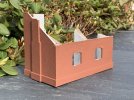
Steady progress with the next section of ‘wall covering’ to go at the back of the layout just south of the Benham’s works. The boundary wall:

8E802ACF-4D98-4337-BB12-F53760208E0A.jpeg

And the yard office:

426AE352-00D8-49D8-9FD5-302F46ED0482.jpeg

A way to go, obviously, but already a good idea of the final appearance.

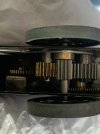
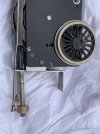
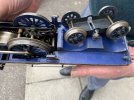
If anyone has been wondering about the rebuilt Royal Scot (probably not), the good news is the clockwork motor sent for repair has now arrived back. The bad news is that apart from the addition of much oil to the gears, the motor as returned was no different from when I sent it away. I had diagnosed the problem as being the side plates not in accurate alignment. As a result, the driven axle was not perpendicular to the longitudinal axis of the motor and the gears in the reversing clutch were binding:

63EACE1B-4E97-4D1F-88C0-1379391B0851.jpeg

(Temporary wheels fitted to keep the axle in place).

What I had wanted the repairer to do was to take the motor apart and reassemble it with the side plates exactly opposite each other. I don’t have the experience or equipment to do that safely given the very large and vicious main-spring — which could easily cause injury if it ‘escaped’ during the repair work.

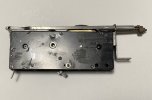
Whilst wondering what to do next, I started to think about why the side plates were not correctly aligned. There is no sign the motor has been dropped, the side plates are not bent, what could be the cause? In fact, the motor appears hardly used. That may well be correct if it was faulty from the time of manufacture. I eventually concluded the culprit had to be the bracket that supports the controls in the cab, at the right hand end here:

814A4499-1E33-4410-8A6E-B6265BD95422.jpeg

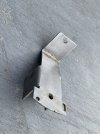
There are six pillars between the side plates — brass rod with a countersunk steel screw in each end. Assuming the holes in the side plates themselves are accurately drilled, it is difficult to see how the pillars would force the plates out of alignment. The rear bracket, however, has two screws holding it in place on each side and is heavy gauge steel plate bent into shape:

0B628FD7-4E02-44B5-82A3-75A37156EE0F.jpeg

Sure enough, when removed from the motor, it was very obvious that the forward projections on each side with the fastening holes were not aligned with each other and the whole plate was slightly twisted top to bottom.

With the rear bracket removed, I loosened one screw in each pillar a quarter turn and applied some gentle pressure to the side plates. Then I wound the spring by a few turns of the key and took off the brake. The pressure of the expanding spring did appear to push the side plates back into their correct relative position. So I re-tightened the screws in the pillars. Straightened and reattached the rear bracket. The lock-nuts on the speed control were missing so I replaced those. Amazingly, I actually had 5BA steel half-nuts in stock:

A8DE6FB3-6B42-434F-A36F-9D4BC1096FBA.jpeg

As can be seen, the motor now has four temporary wheels fitted so it can be track tested. If it performs satisfactorily (or better), I will then fit the proper wheels and valve gear and, finally, install it in the rebuilt Royal Scot.
 

John R Smith

Western Thunderer
If it performs satisfactorily (or better), I will then fit the proper wheels and valve gear and, finally, install it in the rebuilt Royal Scot.

Martin

Let us hope that it does. I wonder if somebody dropped the motor when the mechanisms were being swapped, thus bending the rear bracket?

I also have a B-L Scot with exactly the same controlled clockwork motor. Certainly, your photo of the reversing gears looks like bad news, obviously out of line. And it is hard to see how it could have come from the factory that way. If it is any comfort, my Scot is a very sweet runner and one of the best I have, in either direction.

In my admittedly limited experience, if the running is no better, the correct course of action would be to remove the main spring and then, and only then, to strip down the mech to find out what is going on. Which is what I would imagine you had expected your repairer to do.

John
 

Ian@StEnochs

Western Thunderer
Hi Ian

Not at all. Thank you for your comments.

Those are lovely models — 0 gauge?

Part of the problem is neatly illustrated by your photos of the two blue engines — which look very different colour-wise though you say not in real life. I have the Caledonian Liveries book. A weighty and scholarly tome. To my mind, it completely ignores one very good contemporary source for the shade of blue. Although there is discussion of post-cards, book illustrations and some exhibition models, nothing at all is said about contemporary mass-produced model railway locomotives of CR prototypes. Leaving aside the Carette promotional model of Cardean, sold by the CR, because it is clearly in dark blue livery, there were five models of CR blue locos made in numbers during the ‘light blue’ period. All were retailed exclusively by Bassett-Lowke but were sourced from different manufacturers. Bing made 4-4-0 no.142 (in gauges 0 and 1), the 112 tank (0,1,2) and a freelance 4-4-0T (0 only). The drawing for the 4-4-0 and a CR 112 are illustrated in earlier posts in this thread. The Bassett-Lowke model of a Pickersgill 4-4-0 was manufactured by the Leeds Model Company. The post-WW1 models of no.142 were made at Northampton by Winteringham’s. I had chance to examine several of these models at the Brighton Toy and Model Museum some years ago. In particular, to look at unvarnished paint on the underside which is unlikely to have faded either. There was close agreement in the shade of blue between the different models. It was a darker colour than is often used now. It appeared to be identical to a paint sample of the BR express passenger blue used briefly in the early 1950s.

It seems to me that if any or all of the various contemporary manufacturers got the blue obviously wrong, it is unlikely that the colour would be the same. Also, I would expect to have seen complaints in the contemporary model railway press. Sure, Bassett-Lowke did make mistakes — but generally the company strove for accuracy and customers expected it. I think the contemporary mass-produced models are probably the most reliable evidence we have for what a light blue engine looked like. I shall use that as the basis for painting (though it won’t be me that applies the paint).

I’m sure in real life the colour changed in service due to fading, dirt, darkening of varnish etc. I believe that’s why BR abandoned the express blue livery — it couldn’t be touched up because the new paint was never a colour match. In that connection, I will point out my CR 112 is a completely different blue on top (where the paint is under a thick coat of 100-year-old varnish) to underneath where the actual paint is exposed. The varnish greatly darkens the colour and must add brown/yellow. The varnish will have made less difference when new, so I guess when sold the whole loco was roughly the colour the underside is today.

Martin

Hi Martin,

Thanks for your kind words, the three locos are S7, first two are scratch built and the 812 started from a Meteor models kit.

When I hold my IPad against the Dunalistair the model is much darker than the image on the screen but I have a lot more pictures of the same engine and they vary in shade. Photographs and screens do not always portray colours accurately

At the time that Basset Lowke we’re producing their models there were virtually no colour pictures around, the Railway Magazine did colour plates, and few of their customers would have seen the real thing. As all 5 of the BL Caley locos were commissioned I would expect that they would specify the finish and probably supply colour swatches and possibly the paint. Whether or not they had consulted the Caledonian as to accuracy we will never know but consistency of colour across BLs range would be important. I am of the opinion that most buyers would be happy to accept the colour as supplied, they did after all accept a lot of compromises in outline and details which modellers now are much less likely to.

Jim MacIntosh in his book is very careful not to specify an exact shade but places lots of information, both descriptive and pictorially, to the reader to let them make up their own mind. At this advanced date who can say we didn’t get it right?

Most of my own model production is of G&SWR subjects of which there is very little source material, especially on colours. We do know that dark Green predominated with Crimson lake valances. I long ago decided on a shade of green which appeared to me to fit with what descriptions I have found. Not everyone agrees with me but in recent years I haven’t met anyone who actually saw an engine in G&SWR livery and knows better! I do however take pains to ensure that the appropriate parts get green or red or whatever but l don’t loose sleep over it.

I suggest you do the same and choose the paint colour you are happy with.

Ian
 

40057

Western Thunderer
Hi Martin,

Thanks for your kind words, the three locos are S7, first two are scratch built and the 812 started from a Meteor models kit.

When I hold my IPad against the Dunalistair the model is much darker than the image on the screen but I have a lot more pictures of the same engine and they vary in shade. Photographs and screens do not always portray colours accurately

At the time that Basset Lowke we’re producing their models there were virtually no colour pictures around, the Railway Magazine did colour plates, and few of their customers would have seen the real thing. As all 5 of the BL Caley locos were commissioned I would expect that they would specify the finish and probably supply colour swatches and possibly the paint. Whether or not they had consulted the Caledonian as to accuracy we will never know but consistency of colour across BLs range would be important. I am of the opinion that most buyers would be happy to accept the colour as supplied, they did after all accept a lot of compromises in outline and details which modellers now are much less likely to.

Jim MacIntosh in his book is very careful not to specify an exact shade but places lots of information, both descriptive and pictorially, to the reader to let them make up their own mind. At this advanced date who can say we didn’t get it right?

Most of my own model production is of G&SWR subjects of which there is very little source material, especially on colours. We do know that dark Green predominated with Crimson lake valances. I long ago decided on a shade of green which appeared to me to fit with what descriptions I have found. Not everyone agrees with me but in recent years I haven’t met anyone who actually saw an engine in G&SWR livery and knows better! I do however take pains to ensure that the appropriate parts get green or red or whatever but l don’t loose sleep over it.

I suggest you do the same and choose the paint colour you are happy with.

Ian
Thank you.

I think you underestimate Bassett-Lowke and their customers.

Bassett-Lowke had an agency and (from 1921) their own shop in Edinburgh. Lots of their customers saw Caledonian locos all the time. The promotional models of Cardean and 12-wheeled coach sold by the CR were sourced from Bassett-Lowke, manufactured by Carette. So Bassett-Lowke and the CR had a relationship. I also see in Bassett-Lowke’s writings a strong commitment to accuracy. Models were simplified, for reasons of price and what was technically possible, and had coarse wheels, so they could run on temporary tinplate tracks, but what could be got right generally was right. It is extremely unlikely that Bassett-Lowke would not have known or not been bothered about getting the right colour blue.
 

John R Smith

Western Thunderer
Models were simplified, for reasons of price and what was technically possible, and had coarse wheels, so they could run on temporary tinplate tracks, but what could be got right generally was right. It is extremely unlikely that Bassett-Lowke would not have known or not been bothered about getting the right colour blue.

This all reminds me of the seemingly endless debate around the exact colour of the LBSCR gamboge engines, back in the MRN during the 1950s. I tend to agree with Martin and Fitzroy, that B-L would certainly have had the opportunity and the resources to get contemporary colours correct - and that their customers would also have been familiar with CR blue or the later LNER green, and would have voiced their displeasure had it been wrong.

But there are a few oddities. The first edition of the B-L Royal Scot in the late 1920s and early 1930s seems to have had a shade of crimson lake which is far too light and just looks plain wrong. All the surviving examples seem to be the same. Which is very odd, when the contemporary first edition of the Midland Compound in O gauge, no 1190, has a much darker shade of lake which looks correct. Even stranger, the first reissue of the compound post-1945 (no 1063) was in brown, a colour as far as I know never carried by any LMS engine -

Backscene II B-L 1063 Web 02.jpg

It is not unnatractive, I admit, and she is a good runner. I have heard various stories to explain this aberration, none of which entirely satisfy me I have to say.

John
 
Last edited:

40057

Western Thunderer
This all reminds me of the seemingly endless debate around the exact colour of the LBSCR gamboge engines, back in the MRN during the 1950s. I tend to agree with Martin and Fitzroy, that B-L would certainly have had the opportunity and the resources to get contemporary colours correct - and that their customers would also have been familiar with CR blue or the later LNER green, and would have voiced their displeasure had it been wrong.

But there are a few oddities. The first edition of the B-L Royal Scot in the late 1920s and early 1930s seems to have had a shade of crimson lake which is far too light and just looks plain wrong. All the surviving examples seem to be the same. Which is very odd, when the contemporary first edition of the Midland Compound in O gauge, no 1190, has a much darker shade of lake which looks correct. Even stranger, the first reissue of the compound post-1945 (no 1063) was in brown, a colour as far as I know never carried by any LMS engine -

View attachment 238520

It is not unnatractive, I admit, and she is a good runner. I have heard various stories to explain this aberration, none of which entirely satisfy me I have to say.

John
Having stood up for Bassett-Lowke’s commitment to accuracy, I will of course readily admit mistakes were made — as in any walk of life and by model manufacturers today. The early lithographed Royal Scots are far too bright. They haven’t faded — inside and underside surfaces are the same shocking red. I don’t know who did the lithography, but the colour on the early Royal Scots is wrong and was corrected in later production. The brown compounds date from the late 1940s. The colour is the brown used for LMS wagons. I’m sure this was just a straightforward mistake. Whether the wrong colour was specified by Bassett-Lowke in their instructions to the company doing the lithography (perhaps one digit given incorrectly in a number) or the error was made due to confusion by the lithographers, I’ve no idea. Either way, Bassett-Lowke was lumbered with a large number of printed tinplate sheets that were the wrong colour. I’m sure whoever unpacked the consignment at Winteringham’s got a horrible shock. Bassett-Lowke will obviously have known the colour was wrong, but at a time of metal rationing and shortages, scrapping the wrongly printed sheets was presumably unthinkable. Some brown compounds were made up and sold. But customers will equally have known the brown compounds were not correct. I’m sure there will have been sales resistance. As a damage limitation exercise, quite a lot of the brown compounds were over-painted by hand in LMS black livery, lined red and with transfers used for numbers and company initials. The brown lithographed compound parts must have been a very expensive mistake.
 

40057

Western Thunderer
Hi Martin,

Thanks for your kind words, the three locos are S7, first two are scratch built and the 812 started from a Meteor models kit.

When I hold my IPad against the Dunalistair the model is much darker than the image on the screen but I have a lot more pictures of the same engine and they vary in shade. Photographs and screens do not always portray colours accurately

At the time that Basset Lowke we’re producing their models there were virtually no colour pictures around, the Railway Magazine did colour plates, and few of their customers would have seen the real thing. As all 5 of the BL Caley locos were commissioned I would expect that they would specify the finish and probably supply colour swatches and possibly the paint. Whether or not they had consulted the Caledonian as to accuracy we will never know but consistency of colour across BLs range would be important. I am of the opinion that most buyers would be happy to accept the colour as supplied, they did after all accept a lot of compromises in outline and details which modellers now are much less likely to.

Jim MacIntosh in his book is very careful not to specify an exact shade but places lots of information, both descriptive and pictorially, to the reader to let them make up their own mind. At this advanced date who can say we didn’t get it right?

Most of my own model production is of G&SWR subjects of which there is very little source material, especially on colours. We do know that dark Green predominated with Crimson lake valances. I long ago decided on a shade of green which appeared to me to fit with what descriptions I have found. Not everyone agrees with me but in recent years I haven’t met anyone who actually saw an engine in G&SWR livery and knows better! I do however take pains to ensure that the appropriate parts get green or red or whatever but l don’t loose sleep over it.

I suggest you do the same and choose the paint colour you are happy with.

Ian
Hi again Ian

Ultimately of course you are correct. There are no eye-witnesses left. Establishing the colour with absolute certainty would require either finding the paint recipe or an unambiguously authentic paint sample. Neither seems likely.

For 828, like many models of pre-grouping locomotives, Tom and I have had to rely on ‘most likely’ or ‘probable’ for some details on the model. Features that changed on the real locos c.1915–23, for example. In the absence of a photograph of 828 from a particular angle at the relevant period, some things had to be inferred from photos of other class members or from different times. No doubt you have often had to do this yourself. We have tried very hard, using the best available evidence, to be as accurate as possible.

The colour of the loco is clearly one of its most obvious characteristics. It’s not like putting a rivet in the wrong place — you can’t miss it. So, in the absence of unambiguous fact, best available evidence is the best we have. We need to use that.

I’ve read/consulted Jim MacIntosh’s book. As you say, a huge amount of information is presented. None of it definitive. But there is a complete blind spot regarding contemporary mass-market railway models. I think they are actually the best evidence we have.

You comment that Bassett-Lowke may not have been too careful to get the colour right as there were a lot of other compromises in the outline and details of their models which wouldn’t be accepted now. Of course, standards have improved enormously over the last 100 years. But assessing a pre-WW1 model on current criteria is like judging the conduct of a mediaeval king according to modern day morality and behavioural norms. The king is not going to look good even if he was very enlightened for the time, and striving to do right.

Bassett-Lowke was a business that needed to trade profitably. It was selling sophisticated toys for adults to the well-educated, better-off members of society. People who were interested in real railways and who used them. The firm could only manufacture using the technologies of the time. Electricity was often not available so power was usually clockwork or steam. Both these methods of propulsion introduced unavoidable compromises into the appearance and proportions of models. Since permanent model railways were rare, models had to be able to run on temporary tracks laid on a table or floor. So sharp radius curves — more compromises. Uneven floors — so big flanges, more compromises. The departures from true scale in the models made should not be viewed as incompetent mistakes or indifference to accuracy. That would be to interpret the models against present day expectations and circumstances. The compromises were there for a reason, one in the pre-1914 world — whether that was the track, the method of propulsion or production at a price the market would bear. Within the envelope of what was practically and economically possible, the pre-WW1 models sold by Bassett-Lowke (especially those designed by Greenly and made by Bing) were as accurate as they could be. That mattered to Bassett-Lowke and to the company’s customers. It was what distinguished the scale models in Bassett-Lowke’s catalogues from the toys sold by others.

Colour and livery were one area where models could be very true to reality — so they were. For well known liveries such GNR, Midland, NER, SECR etc etc etc, the Bassett-Lowke models of the time are generally acknowledged to be in correct colours. Having got the others right, why would the Caledonian models, uniquely, be painted in some random shade? I’m sure they weren’t.

So what was Caledonian blue? As it happens, I was able to examine a Bing made CR model today. A Gauge 1 model of CR no.142 belonging to a fellow enthusiast. The model was made between 1910 and 1914. It was an expensive model for adults (most children would not be strong enough to wind it up). To make something this good and not bother to get the colour right seems utterly implausible.
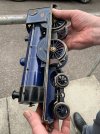
2BC19BBA-4C60-4F65-98E3-A1873079660E.jpeg

The model is quite thinly varnished. Where the varnish is thicker, such as around the base of the dome, the colour has darkened more.

The underside is not varnished, and is a lighter/brighter shade:
137975A7-38C4-4F6D-ABCE-99F8B20DAD1A.jpeg

I think the photo shows the colour accurately.

My 112 tank (post WW1) is a closely similar colour underneath but much darker on top as it has a very thick coat of varnish.

Even in the photographs above, where the light has fallen differently on the different surfaces, the colour looks different. Looking at the underside of no.142, ‘sky blue’ does seem a reasonable description. The model of no.142 today was sat next to a model of GER 0-6-0. That really was dark blue.

I do note that the number plate has a red background — which other evidence suggests is wrong or was not usual with the lighter blue. Could the above engine be in the darker blue livery, i.e. correct but out of date? I don’t think so, but can’t 100 per cent rule that out. Bassett-Lowke’s range of scale models did not really get going until after the CR livery change. The colour shown above was still being used on models made in the 1920s. If just shown the colour in isolation, I think I would call it a mid-blue.

In terms of interpreting contemporary photographs, which often make CR locos look a really pale colour, there is a good check on the website of the Brighton Toy and Model Museum here:


Look at the colour of the model of Cardean as we see it today, the colour it really is. Then look at how it appears in the 1910 photograph of the same model. Not the same shade at all, but much, much paler. So the evidence there is clear too. In a proper controlled test, the pre-WW1 photograph compared to reality, the photograph has significantly misrepresented the colour. We can’t make that comparison with a real locomotive but the model is a good substitute.

So, I think there is a very strong case — best available evidence — for the colour on the underside of no.142 shown above to be post-1906 Caledonian blue.

 
Last edited:

JimG

Western Thunderer
Another source for Caledonian Blue was the livery of the early Glasgow Blue Trains which was purported to be based on Caledonian locomotive livery. My avatar has a poorish rendering of this, but in the slightly later yellow panel period where the blue was unchanged. A few years after introduction, the blue was changed to BR blue.

Jim.
 

magmouse

Western Thunderer
This is a fascinating discussion. A couple of thoughts:

Firstly, I would expect the varnish to have somewhat darkened the paint colour from day one, so if the underside of the model is unvarnished, it doesn‘t necessarily represent the original colour. Those managing the paint process at the time would have understood the effect of the varnish and allowed for it.

Secondly, regarding the catalogue/advert photo you linked to, the photographic emulsions at that time were mainly sensitive to blue light, so blue objects came out looking pale compared to other colours. A dark background has been used for that photo, and I suspect the photographer did this deliberately, knowing the main subject would appear light in tone, and therefore stand out clearly.

Nick.
 

John R Smith

Western Thunderer
Secondly, regarding the catalogue/advert photo you linked to, the photographic emulsions at that time were mainly sensitive to blue light, so blue objects came out looking pale compared to other colours.

Absolutely. You cannot trust any pre-1930 B/W photographs for correct rendition of relative brightness between colours. These emulsions were not panchromatic (lsensitive to all colours) but orthochromatic (very sensitive to the blue end of the spectrum but insenitive to reds). This was so that the glass plates or large format film negatives could be dish developed under a red safelight. As a result, in photographs of railway locomotives of the era, buffer beams will often appear almost black.

John
 

40057

Western Thunderer
This is a fascinating discussion. A couple of thoughts:

Firstly, I would expect the varnish to have somewhat darkened the paint colour from day one, so if the underside of the model is unvarnished, it doesn‘t necessarily represent the original colour. Those managing the paint process at the time would have understood the effect of the varnish and allowed for it.

Secondly, regarding the catalogue/advert photo you linked to, the photographic emulsions at that time were mainly sensitive to blue light, so blue objects came out looking pale compared to other colours. A dark background has been used for that photo, and I suspect the photographer did this deliberately, knowing the main subject would appear light in tone, and therefore stand out clearly.

Nick.
I am sure you are right that the varnish would have some immediate effect. Undoubtedly, the varnish will also have darkened and yellowed with age after 110+ years. However, comparing above and below on no.142, I would say the thin coat of varnish has not greatly altered the colour. Since the Gauge 1 4-4-0 is not mine (and lives a long way away), I can’t do a side-by-side comparison with my 112 tank. I’m pretty sure the unvarnished blue paint underneath is the same or very similar on the two locos. My 112 (made in 1921 or ‘22) is very thickly varnished (they usually were) and is today much, much darker above than no.142. So, it seems, same paint but a different colour.

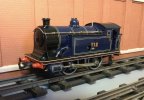
Here’s my 112:

57A5F924-37AA-4E70-A449-086BE1E108C9.jpeg

And, yes, there is a Bassett-Lowke livery error on display here — incorrect blue cylinders.
 

40057

Western Thunderer
I am sure you are right that the varnish would have some immediate effect. Undoubtedly, the varnish will also have darkened and yellowed with age after 110+ years. However, comparing above and below on no.142, I would say the thin coat of varnish has not greatly altered the colour. Since the Gauge 1 4-4-0 is not mine (and lives a long way away), I can’t do a side-by-side comparison with my 112 tank. I’m pretty sure the unvarnished blue paint underneath is the same or very similar on the two locos. My 112 (made in 1921 or ‘22) is very thickly varnished (they usually were) and is today much, much darker above than no.142. So, it seems, same paint but a different colour.

Here’s my 112:

View attachment 238610

And, yes, there is a Bassett-Lowke livery error on display here — incorrect blue cylinders.
Hmmm. I think I am going to excuse the rare livery error of 112’s blue cylinders. Or perhaps, more accurately, suggest it as ‘made up’ rather than ‘a mistake’.

The 112 tanks were first sold, in gauges 1 and 2, pre-WW1. They were loosely based on an LSWR prototype but made in numerous different liveries (not including LSWR). So basically a free-lance design in the liveries offered. But a way of producing an 0-4-0T that could haul passenger coaches on a model railway with a little bit of plausibility (as the LSWR inspiration for the model was used for passenger work).

The 112 was thus not representative of any real CR locomotive though stylistically it had similarities with contemporary CR designs.

Now, everyone reading this knows outside cylinders on CR locos were the same purple-brown used for the frames etc. Bassett-Lowke got it wrong! Not really. When were those familiar outside-cylinder CR locos built? 1915 and later. When the CR 112s were introduced, real CR locos in blue livery had inside cylinders. I think the two Killin branch tanks and some elderly 0-4-2s may have been the only exceptions? Modern CR locos, which the 112 represented, had inside cylinders. So Bassett-Lowke adapted CR livery for their freelance design. That’s not necessarily a mistake. It’s quite likely Bassett-Lowke didn’t know there were a few blue outside-cylinder CR locos — or ignored them as looking nothing like a 112.

I’ve only just spotted this. My mistake was applying knowledge available now to perhaps inappropriately judge something made at an earlier time.

In a perfect world, someone at Bassett-Lowke should have revisited the livery spec. for the CR 112s when production resumed post-WW1. But for what was essentially a free-lance model, who was going to think of that? An understandable oversight, surely.
 
Last edited:
Top