7mm Richards P48 US Thread

simond

Western Thunderer
I presume the pipes and froth are recycling Trump speeches?

joking aside, what was the cabless unit that had fallen off? Is it a couple of motor bogies with no gen set powered from an adjacent loco, as I’d have expected a mule (ie fill loco without cab) to have cooling etc, and it doesn’t look that way, or is it a brake tender?

or am I, rather like it, off the tracks?

belay that, the third video explains that it is a road slug, which is a pair of motor bogies with no prime mover. I think I recall Mick explaining about them a while back

good effort by the rescue crew.
 
Last edited:

mickoo

Western Thunderer
I presume the pipes and froth are recycling Trump speeches?

joking aside, what was the cabless unit that had fallen off? Is it a couple of motor bogies with no gen set powered from an adjacent loco, as I’d have expected a mule (ie fill loco without cab) to have cooling etc, and it doesn’t look that way, or is it a brake tender?

or am I, rather like it, off the tracks?

belay that, the third video explains that it is a road slug, which is a pair of motor bogies with no prime mover. I think I recall Mick explaining about them a while back

good effort by the rescue crew.
Correct, slugs, mules or TEBU's is the name, old chassis striped out and filled with concrete and motor cables extended to pilot, master locos need to be converted as well to provide sockets for power cables for motors.

In simple terms most engines cannot use 100% of their engine power at low speed, so they shunt it to a TEBU that can use that excess power and add traction. I think the crossover is around 20-25 mph where TEBU's are switched out and full power goes to the engine motors.

Most slugs are cut down old units but some railroads limit the amount of cut down and retain a full body and cab with controls, those are road slugs as opposed to yard slugs seen in the video, that yard slug is probably ex NS going by the profile and it still has dynamic brakes so maybe a cross over unit.
 

richard carr

Western Thunderer
While I've been away in Chicago and Texas, I have been thinking about how to fix the gradient and smooth it out.

I got back yesterday morning, so in the evening I set about fixing it by removing one of the supports using that to join two of the boards together and then putting 2 other supports to keep everything nice and smooth. This is the result.

20260203_195904.jpg


20260203_195920.jpg

Now I expected this to cure all the problems, but it didn't the locos still stalled almost after getting to this point so something else was also causing a proble.
 

mickoo

Western Thunderer
When I did my first section my grades were overly steep (a down side to having one section long and flat across the bridge), 3-4% in real Railroad terms, on the straight a single loco could easily handle 20 cars, as soon as a curve became a factor it dropped to 13.

I got myself a little Trend digital level box, it's more a representative tool and I place it on a short piece of metal to extend the measuring distance; it soon shows up any short sections that are steeper than the surrounding area.


To be fair that reworked grade you've done looks much better and smoother so I'd be hedging toward the curve just adding more drag.

One other interesting aspect I found was that when I run a full train (27-35 cars depending on car lengths) it requires three locos, put all three at the front and it will stall, stick one on the back and it works fine, moving a helper on the back reduces a lot of the drag at the rear of the train on curves.
 

richard carr

Western Thunderer
Hi Mick

The gradient is now smooth enough. The one at the other end is actually steeper but trains just run easily up the gradient.
So I suspected it was a power supply issue, the layout is split into two parts, the yard part has the Digitrax DCS210 command station powering it and the new bit has another DCS210 running as a booster powering it.
The new part has several feeds at the far end, but the new gradient just had power coming through the rails, to a point about half way along it.
So I tested it for a voltage drop, the first half of the gradient had 14.9 volts, the second half only had 14.1 volts. To be honest I thought would be near enough, it's only a 0.8 volt difference. Anyway I decided to run a feed all the way down the layout with some 16 gauge silicon wire, once that was in place the voltage rose to 14.8 volts.
Well what a difference 0.7 volts make, trains just run up the hill now, they do slow down a little bit towards the top of the incline, but in a realistic way that you might expect to see.
The other thing is the current draw, 2 Sunset SD9s only draw 1.2 amps taking 16 cars up the hill. I need to try some of the atlas locos, although the MTH single motor GP38 can't get 7 cars up the hill, it stalls from lack of traction.

I'll post some videos the show the difference later.
 

Jordan or Plymouth Mad

Mid-Western Thunderer
One other interesting aspect I found was that when I run a full train (27-35 cars depending on car lengths) it requires three locos, put all three at the front and it will stall, stick one on the back and it works fine, moving a helper on the back reduces a lot of the drag at the rear of the train on curves.
As per the prototype? :) ;) :thumbs:
 

mickoo

Western Thunderer
Hi Mick

The gradient is now smooth enough. The one at the other end is actually steeper but trains just run easily up the gradient.
So I suspected it was a power supply issue, the layout is split into two parts, the yard part has the Digitrax DCS210 command station powering it and the new bit has another DCS210 running as a booster powering it.
The new part has several feeds at the far end, but the new gradient just had power coming through the rails, to a point about half way along it.
So I tested it for a voltage drop, the first half of the gradient had 14.9 volts, the second half only had 14.1 volts. To be honest I thought would be near enough, it's only a 0.8 volt difference. Anyway I decided to run a feed all the way down the layout with some 16 gauge silicon wire, once that was in place the voltage rose to 14.8 volts.
Well what a difference 0.7 volts make, trains just run up the hill now, they do slow down a little bit towards the top of the incline, but in a realistic way that you might expect to see.
The other thing is the current draw, 2 Sunset SD9s only draw 1.2 amps taking 16 cars up the hill. I need to try some of the atlas locos, although the MTH single motor GP38 can't get 7 cars up the hill, it stalls from lack of traction.
I'll post some videos the show the difference later.
14.1 V unloaded, I'll wager it dropped lower than that once loaded, but nice solution.
 

Jordan or Plymouth Mad

Mid-Western Thunderer
I need to try some of the atlas locos, although the MTH single motor GP38 can't get 7 cars up the hill, it stalls from lack of traction.
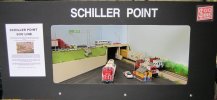
Many years ago now when I just had my small layout 'Schiller Point', I repowered my old Atlas/Roco F-Units with newer Atlas 'China drive' from an F3, putting one motor in each loco, with a resistor to drop the speed. It was fine for tootling about on a plank - worse than useless once my loft layout was up & running - they could barely get themselves round the corners, never mind much stock!! My locos definitely need all-axle drive.

Edit- gratuitous picture of Schiller Point, based on a real piece of land that exists just north of the real Schiller Park in Chicago....
000038435328.Jpeg
 

richard carr

Western Thunderer
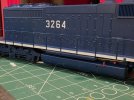
Another pair of Sunset SD40s have arrived so over the weekend I printed some air tanks to get that task out of the way.

20260208_150642.jpg

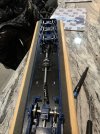
Thankfully it's an easy job to get these switched over. Two screws holds the fuel tank in and then the existing tanks can be prized off

20260210_185150.jpg

Then you just need to take a good look at some photos of your chosen prototype to get the exact position of the tanks, it does vary a bit by railroad.

20260210_194834.jpg

Then you can superglue them the footplate and add some pipe work

20260210_194849.jpg

The other thing I have been doing is matching up the loco performance as these all need to run as pairs or even larger consists. It does surprise me just how varied the DCC motor settings end up to get them running the same.
 
Top