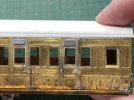
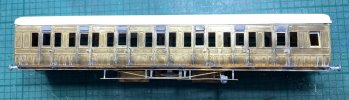
To cap it all - roofs!
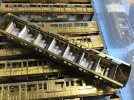
Back in the dim and distant, Past Me thoughtfully deployed her Silhouette cutter to make roof bracing pieces. It had been decided we could use the provided vacuum-formed roofs, but more on that shortly.

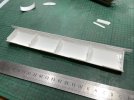
The first task was to check the roof mouldings for fit against the bodywork. Then to trim to length and square up the ends. I did this by holding the roof on the body with quite an overhang at one end. I carefully drew a pencil along the outside edge of the top of the coach end to leave a mark under the white plastic roof. A sharp scalpel blade was used to carefully trim almost up to the mark, with finishing by file and sanding stick, checking against an engineer's square. Once happy one end was pretty square, the process was repeated to trim the moulded part to length. I allowed about a 0.75mm overhang each end.
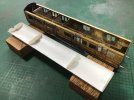
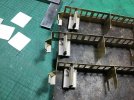
I’ve cut way too many roof braces, but I didn’t know. Blocks of scrap styrene are used as support. At the outer ends, the idea is the roof is a tight fit between the ends, so it’s held by friction. I think they will require a little glue once final assembly is done. Each brace is glued in, pressed down carefully to ensure the roof meets it - each moulding is ever so slightly different. Hopefully, the braces will hold the profile adequately. Past Me didn’t account for the internal parts getting in the way, so a little surgery has been required here and there.
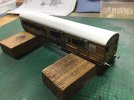
One roof done. Unfortunately, although I have enough mouldings for all 16 coaches, nearly half are gash*. It looks like they’ve been trimmed from the sheet so they’re not deep enough to fit the profile without gaps along the sides. Annoying. I can still finish up the remaining roofs with suitable detailing like rain strips, carriage board clips and ventilators, while we hope replacements will arrive and actually fit.
Ah, ventilators. The Great Eastern Railway is sort of famous for being careful with the pennies. Looking through the photo references, it seemed that many coaches were missing lots of roof vents. Were they removed during their service lives, or were they never installed in the first place. It seemed to me it was different if a coach was built with gas or electric lighting, or was converted later. I needed a pattern.
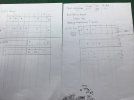
Eventually, some kind of pattern appeared. Smoking compartments (which also provided an answer to another question) and the lavatory seemed to be favoured with the luxury of a roof vent. The rest of the passengers had to make do with door droplights and louvred vents. Incidentally, I’ve never thought about how roof vents actually worked. Did they draw air into the coach, or encourage air out of it? Anyone know?
*Gash. I believe in the Royal Navy, this term was used for refuse and detritus that would be ejected over the side into the Oggin. In the print world, it referred to material that was essentially rubbish - some typeset galley with an error in it, for example - but kept in case it was useful for patching up other errors on artwork. Every paste-up artist, me included, had a "gash drawer" near their drawing board.