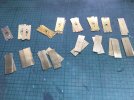
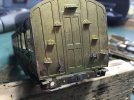
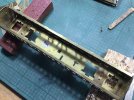
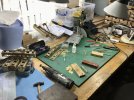
4mm On Heather's workbench - on a Holden to…Yarmouth?

A journey begins
  • Heather Kay

    Western Thunderer
    I do try, but sometimes a thread title doesn’t work on the first go. I’ll think on it.

    It started with a phone call. A chap called and asked if I’d be interested in helping him by building some coaches. Well, as it’s more or less what I do these days, I said I was happy to chat about it further. I do try to take notes when chatting on the phone, but it made much more sense for him to email me with more details. I prefer email as it’s easier to keep a digital paper trail of correspondence.

    The project sounded interesting. As we were going to be in Shropshire attending a modelling exhibition of some flavour, we arranged that we might pay a visit to give everything a proper looking at. We arrived one morning, were ushered into the rather grand house, and diverted into the dining room. The not insubstantial table was covered in lots of bits of Great Eastern Railway brass coach kits, all neatly laid out for inspection.

    The upshot of it all was the client had acquired a selection of part-built models from a good friend who had died a few years before. The client wasn’t happy building coaches, being much more interested in goods stock and operation. He was building a P4 layout set around the London area modelling LNER in 1928, and wanted to have the coaches completed so he could run them in the fashion of passing trains while the fun part of shunting was going on in the foreground. He also wanted to have them finished as a tribute to commemorate his late friend.

    Well, I looked at the parts, we chatted about what was wanted, and it all looked fairly straightforward. We agreed an estimated price per coach to complete to a certain specification, which was to be set out fully in due course. We left, not taking the kits with us. The client was going to acquire some further kits and various components and upgrades, and would be happy to bring it all down to sunny Kent at a later date.

    At that later date, I received a plastic tool box full of the part-built kits. There was a detailed folder with outline information about the coaches, and a stack of society journals all carefully annotated. On the understanding I couldn’t get stuck in for some time, we left it that I should assess what was required to complete the builds, the client would buy everything and arrange for it to be delivered to me.

    And so, over the intervening three years or so, more and more bits and bobs have turned up. Into the mix has been added some Isinglass 3D printed Quints, but they’re definitely for another day.
    B714900A-4430-4194-990E-DA3D567ED169.jpeg

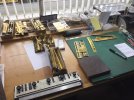
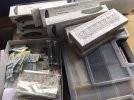
    Elsewhere on WT, you may have noted I’ve been tracklaying on my test plank. The time had come to get serious about the boxes that had been slowly gathering dust on the top of my build queue shelf. At first blush, it was a daunting mass of all sorts. I spent a while sorting, unwrapping and generally trying to work out what I had taken on.
    91B45DC6-C58C-4106-9B16-D8855C890BAC.jpeg

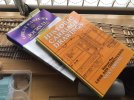
    Knowing next to nothing about things Great Eastern Railway, the pile of reference material made a good read. With a slightly better understanding of what the coaches were and what they looked like, I began to sort stuff out.
    86900FB3-1A95-44E4-9817-6859B06ADEBF.jpeg

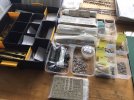
    I have spent this morning going through lots of bags of castings. To try and be methodical about this multiple build - there will be 16 50ft coaches to start with - I separated castings into various tubs. Bogie details, underframe, body details, roof details. The original builder had done quite a good job on the sides, ends and underframes, so all I need to do is clean them and make and minor repairs as necessary. There are five builds to start, and I’m thinking I might kick off with one of them to familiarise myself with the way they are supposed to be assembled.

    Discussion has been had about couplings, roofs and gangways. It is expected there will be two complete rakes of coaches, topped and tailed by brake thirds. The outer ends of the brakes will have good detailing, and Dingham couplers. The rest will be joined together with some form of semi-permanent coupling, and probably cardboard-style gangways. The kit roofs are vacuum formed styrene sheet, and although almost three decades old they are still in relatively good order. Nevertheless, the client wants to go for aluminium extruded section roofs, so we’ll have to order some from Wizard Models. I have plenty to occupy me before I get that far! Aside from the supplied interior partitions, it’s been agreed that no seating need be fitted.

    In a future post, I shall give a bit more detail on what the various diagrams are, and how we hope things will end up. Let the adventure begin!
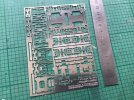
     
    Starting to build a coach
  • Heather Kay

    Western Thunderer
    David, thank you for your post. It got me thinking, which is usually a good thing.

    I decided it would useful to try to find images of these coaches. Unfortunately, period images are hard to come by - and I spent a good while seeking them, believe me. The client's reference material has photos, but they tend to be of the coaches towards the end of their working lives in BR livery. By then, all the updates and modifications had been done. Perhaps I should set out the scope of this job before I get too much further.

    The aim is to produce two full rakes of eight gangwayed coaches. I’m still very hazy about the make-up of each rake, because the number of coaches doesn’t add up. At the last assessment, the coaches are:

    • Diagram 227 1st/3rd Composite, 3 number
    • Diagram 419 3rd, 7 number
    • Diagram 541 3rd Brake, 6 number

    If you recall, I am ignoring the Isinglass Quints at this stage. Now I’m questioning myself as to whether it’s two 8-coach rakes. I think I will need to hail Shropshire and settle the question.

    Either way, I have 16 coaches to build. Twelve have already been started, with floor/underframe, body sides and ends mostly assembled. Four are new builds, plus all those bogies. The guitar string turned up yesterday, by the way.

    While I was waiting for the string, and having thoroughly confused myself trying to work out combinations of braking, lighting and step boards, I decided I could do worse than actually get stuck into some construction. I chose a D.227 Composite, and aimed to put together the floor/underframe to see how long it would take.

    0878DC06-3A20-4B49-89C7-F85517262573.jpeg

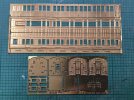
    I forgot to take a photo of the floor fret. I’ll do it on another build, so make do with the body sides and ends. These D&S kits have a copyright year of 1984. That they’re still being produced, and still look this good, shows the care with which they were designed. The instructions, though, leave a lot to be desired. They’re not as bad as the classic ABS intensely-typewritten sheet with few diagrams, but not far off. It took a couple of reads to catch the way Mr Pinnock was thinking, but I got there.

    E8B4843E-23E7-4743-BA7E-3D0E481151D8.jpeg

    As well as the brass, in the box we find styrene in sheet and strip form, brass wire and a small bag of castings and fixings. There’s also the vacuum-formed roof. I know many pooh-pooh the supplied roof, and I understand why. I have been looking at alternatives, which chiefly come down to aluminium extrusions, and I will acquire an example to try for size. I am also quite willing to try the plastic out. The material is thick, the form quite rigid, and even the ancient stuff from the original kits still seems okay. Styrene has a habit of yellowing and becoming brittle over time, but there’s no sign of that on roof mouldings that must be at least 20 years old. I am formulating an idea or two to help keep the shape, but let’s just leave it that I am happy to try and use the plastic roof, and so is my client.

    1D031679-F1B7-4C07-8525-B35EADA15315.jpeg

    64C061BE-A9B1-486C-A63E-C78DE5288E15.jpeg

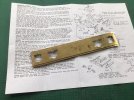
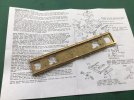
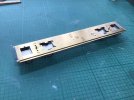
    Posed on the instructions is a floor/underframe. Construction was fairly straightforward. Most of it fitted without problems. It took me, including fettling the parts, a lot less time than I thought. Still to be fitted are the queen posts and truss rods. I don’t need vacuum cylinders or battery boxes, but I will need to work out how the new bogies will fit. The kit bogies may have been more than adequate for the job, but you know clients! The bogie detail castings will be used, of course.

    I can plough on with construction quite happily. The basic frames and bodies didn’t change an awful lot during these coaches' lives. The real things were built over about 15 years, in various lots, starting in the 1900s. They were intended for services from London to Norfolk, the so-called Norfolk Coast Express. Many survived into the 1950s, some ending their lives as departmental vans. As built, the majority of the coaches were lit by gas, steam heated and Westinghouse braked. Conversion to electric lighting and vacuum braking began in the 1930s, and was all done by the end of that decade. The question of longitudinal steps arises, aligned with steps on the bogies. All vehicles were built with these lower step boards, but it seems logical to me the boards may have been removed when the electrical fittings were installed. So, for the 1928 period, I shall fit the steps. I will confirm this with the client.

    So, what I really need is a clear image or drawing that shows the arrangement of brake rods for the Westinghouse system, as well as confirmation of where gas cylinders were fitted. That should keep me busy for a bit.
     
    And, lo! A body meets underframe
  • Heather Kay

    Western Thunderer
    37C47148-0218-451C-AEDB-59E5078112D0.jpeg

    Hello, what have we here? Chuffed with that. I’ve tacked the body together so I could see how it worked with the underframe. I have some questions about that, but they don’t need airing here. It is probable, lacking any form of tab/slot mechanism or holes for a bolt to pass through (yes, I could drill some) the body will end up glued in place once it’s painted. I also still need to fit the bottom hinges, and do some fettling around the body.

    Anyway, pleased with the progress. This exercise has given me a good idea how long a coach will take from scratch. I’ll carry on with underframe research, but I think a set of bogies should be next.
     
    Building an underframe
  • Heather Kay

    Western Thunderer
    As promised, here is a sequence to show how an underframe goes together.

    0CC14349-C728-43B5-A751-1070E04CCD83.jpeg

    First, here are the parts laid out after having had etched cusps and tags cleaned up. The solebars are made of an upright, with the row of slots in it where the step boards fit, and the bottom flange.

    9AEB349B-0949-41EF-997D-2001E73FA0BE.jpeg

    This time round, I folded the headstocks up before I started. There’s an overlay that goes on, seen in the first picture. I leave that until all the other bits are done.

    6F2E248F-771F-41BB-A037-AFD0B2BAE253.jpeg

    It is suggested the easiest way to make the solebars is to solder the bottom flange to the side first to make a T. Care must be taken to get the side part the right way up. The row of slots are not central on the side, and the part must be orientated so the slots are nearer the floor of the coach. The bottom flange also has various pegs, which go inside the frame.

    96D58F83-AF9B-4EEE-8724-88D6B009501F.jpeg

    I tack the flange to the side rather than attempt to run a bead. A bead not essential for a strong joint, and avoids heat stressing the parts. Enough tacks are used to hold things in place, as true as possible. This image also shows the side is longer than the flange, and you can just make out a slight recess at the end of the side. This slips under the headstock.

    BFDFE690-7D99-4100-BCD3-2342F9EB9229.jpeg

    The solebar assemblies can now be tack-soldered to the floor. There is a half-etched slot for them to sit in.

    98F4C15D-66CC-4D70-AFC0-D3394DF36F4C.jpeg

    The footboards are next, and are probably the fiddliest part. You can see on the board in front, waiting to be fitted, a series of tangs. The centre tangs are half-etched and designed fold down and become brackets to hold the steam heating pipe (and vacuum pipe if fitted) as they run down the outside of the solebar under the footboards. The other tangs fit into the slots in the solebar. The fiddly part is trying to get solder in under the inner lip of the bottom flange. It’s a bit messy, but is possible, and the joins don’t need to be all that strong. I realised I only need one set of the pipe brackets, but I always forget which side the steam pipe runs. I’ll nip the incorrect ones off later, when I come to fit the pipework and other underframe details.

    01959DBE-5D95-49B4-B5C4-1C125C2F7179.jpeg

    The headstock overlays are sweated on the ends, and the steps folded down. I dab a bit of solder in to reinforce the fold, otherwise the steps are accidentally bent back and forth and eventually would snap off.

    And that’s it. The fiddly details and mounting the bogies are all to come, but the next stage will be detailing up the sides and ends. I’ve decided to carry in and build up the carcasses for now, and probably clean up and assemble the original 12 part-assembled coaches so everything is at the same point.
     
    Tentative steps in bogie building
  • Heather Kay

    Western Thunderer
    Well, I took a bit of time out. Sorting stuff, collecting stuff, arranging stuff. There was a whole lot of stuff going on.

    Today, I took the metaphorical bull by the horns and started a pair of bogies. I know, shocking.

    498E82C6-E1E5-4E00-A253-A1247A3E0358.jpeg

    To be fair, in fairly short order, here is a pair of bogie frames. Next up is the bolster arrangements. Although I’ve read the instructions, I’m still a bit hazy about the next stages. I’m sure they’ll make more sense once I just get stuck into them.

    BD0323C1-247D-43B4-8FC8-0CF6FF4A5064.jpeg

    While a lot smaller than my usual fare, I’m very impressed with the design so far. Things fold nicely, things fit as they should, minimal tidying needed. I particularly liked the way the step board brackets are formed. This set of coaches will have the full complement of steps.

    I need to spend some time sorting and clearing more stuff, pending a visitor on Wednesday, and the installation of a new front door being imminent. I will try and get some more work done on the bogies during the next day or so. I’m not doing a blow-by-blow account on this pair. I shall probably do a better job on the next pair. I just want to work through the first pair in my own time before I bog myself down trying to document things.
     
    Last edited:
    Will it run?
  • Heather Kay

    Western Thunderer
    I’m afraid the mojo wandered off. Nothing of consequence has been achieved all week.

    Then, today, Mrs Mojo made a tentative appearance and I decided to try and work out how to fit the bogies to the underframe.

    16E9596D-A8C5-4B4D-B0E4-F6866CC24602.jpeg

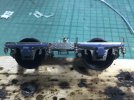
    There are always compromises involved mixing and matching parts from different places. The coach kits come with their own bogie kits, which are designed - I think - to be built in the "traditional" wobbly at one end and fixed at the other manner. The R/M bogies have their own mounting plates and parts which don’t match the D&S setup in any meaningful way. I ended up deciding to drill a single hole centrally in the coach floor to take a suitable bolt. The R/M upper bolster part was folded up and mounting tabs files away so it would sit flat against the coach floor, and this was temporarily held in place with a nut, to be soldered in place once I was happy the setup worked. The bogies dropped over the bolt, and everything seemed to be working as planned.

    A quick whizz up and down the test track showed bogie swing was adequate, but there did need to be more weight. That’s the wooden blocks. I’ll find a better setup eventually, but the wooden blocks seem to provide the required deflection of the axlebox springs, and I can weigh them and replace with suitable ballast later. I’ve now fitted a bolt underneath the bogies, which allows me to "wind up" the bolster springing to better match the ride height I see in photos. Another whizz up and down shows things still work well. I shall call that progress.

    In other news, a large scale drawing of a brake third has appeared. This is proving entertaining and illuminating. More on that in due course,
     
    Firming up fitting bogies
  • Heather Kay

    Western Thunderer
    After what seemed like an age, and having six pairs of bogies essentially constructed, I thought it might be an idea to figure out the best method of attaching them to the chassis.

    7338E9BC-C758-405F-8339-062899792348.jpeg

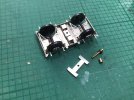
    Half the raw materials. The H-shaped plate is from the Miscellany/Rumney fret. Initially, I’ve opened the central hole to accept a 10BA bolt. The D&S kit provided some rather nice brass bearings which have been tapped 10BA down the centre. If I could find a way to use those it would save fitting nuts and having to file them down for clearance.

    AC0C140F-CA7C-488E-B6B7-5347F430ED9F.jpeg

    I had already worked out the location of the bogie pivot in my earlier experiments, so it was a case of drilling out to take the 10BA bolt. This would act as a clamp to hold the H-plate securely while I tacked it in place on the underside of the floor. With that done, the central holes were drilled through again to clear the bearing. This was fitted from underneath and also tacked in place.

    802CFDBD-D41E-496B-B60E-7226146C826D.jpeg

    My stock of bolts proved either too short or too long, but unlike Goldilocks I couldn’t find anything "just right". The longer bolts were used, passing up through the bogie central pivot hole with a washer. Gauging the ride height settled on screwing the bolt down to the fullest extent, compressing the bolster springs, then loosening it a half-turn. Enough slack for free rotation on the pivot, and leaving some movement on the bolster. I’ll have to trim the bolts short later, if required. A drop of superglue or even some Copydex should be enough to prevent the bolt working loose over time.

    4A88E838-5E06-458B-8C95-9B2431B935A1.jpeg

    Being intended for P4, the total swing required isn’t all that large. Here you can make out the maximum available with the wheels touching the insides of the solebars. I will, of course, need to work out if this is likely to cause electrical shorting and take suitable remedial action. Each chassis was plonked on the test plank, ballast weight balanced amidships, and the ensemble given a poke down the track. Nice and smooth they are.

    Now, shall I carry on building more bogies, or shall I have a play and detail up the five chassis to see how that all works. Decisions, decisions.
     
    Assessing the rest of the task ahead
  • Heather Kay

    Western Thunderer
    88CE632F-2599-4E75-8868-A5C078CD39F1.jpeg

    Today, I have mostly been working my way through the previously built coaches, ensuring I have enough sides and ends to fit all the underframes, and the required quantities of the three diagrams match. I’m also cleaning up the now rather ancient soldering, noting things that are missing or damaged, and generally being rather daunted by the whole process.

    As ever, I may be some time.
     
    Adventures in three dimensions
  • Heather Kay

    Western Thunderer
    I guess it’s time for a sit-rep.

    Things have been chugging along here, but I’m afraid Mrs Mojo wandered off. A horrid cold made a nuisance of itself for a week or two, and other domestic nonsense kept getting in the way.

    Back in October, I received a small box from the Basingstoke area. In it was the first prototypes for bogie detailing. Having struggled to find any suitable springs or axleboxes from the trade, it had been suggested that Peter Beare, aka @Spike of this parish, might be able to help with his newfangled 3D print gadget. After some discussion, I prepped some 2D scale drawings of the required parts and sent them on.

    At this point it’s worth mentioning that the client and I had come to a realisation that the GER coaches under construction didn’t actually run on the Fox pattern bogies that had been acquired for the job. It was agreed this was a slightly silly error to have made, but things had progressed so far along the wrong route it really wasn’t worth attempting to change tack. At 4mm scale, the differences will not really be noticeable once all the various step boards and a layer of filth have been applied.

    322A00F0-41D7-4ED9-AEE5-7C95168576D6.jpeg

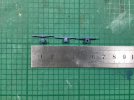
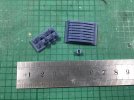
    These are the various parts that arrived in the box from Basingstoke. The axlebox and spring were printed separately, for various logistical reasons. The spring has a square peg that sits in a square slot in the top of the axlebox. On the right you can see the front and back of an assembled set. The rear of the axlebox has a slot intended to allow the wheel bearing cup to slide up and down. The ends of each spring had a dimple for me to drill out a hole to accept the Rumney kit parts for the dampers.

    Anyway, the box contents were hurriedly assembled on a pair of bogies. When I say "hurriedly" I mean the evening before the morning we were to set off for Somerset. Burning the midnight oil - well, nearly - resulted in a pair of bogies mostly like this:

    565A3FEB-1541-4349-B81F-EBB11489232E.jpeg

    To say I was tickled pink would be fair. Now, there were issues. Peter had reproduced my drawing perfectly, but I hadn’t thought things through. First, the leaf springs were to scale depth. This meant they stood off from the bogie side frame like the real ones do. The only points for fixing them in place were the square slot and the axlebox itself - and that was cyanoacrylate fixing the resin to nickel silver. Not exactly ideal because the small slot, while allowing the bearing cup to move up and down adequately for riding bumps, an excessive movement could ping the box off. I had quite a bit of breakage drilling out the ends of the springs, too, and the springs needed to be a gnat's crotchet longer overall. (The shoddy wire work was tidied after this image was taken.)

    After a very productive meeting with the Beare Clan at the ScaleSeven Mark meeting in Somerset, Peter went away and has reworked things.

    E8CD13D0-565C-49A4-BBE3-C370B9A1EF06.jpeg

    We decided the bearing slot may as well be open to the bottom of the box. This allows the axle full travel up and down, and ought to prevent the accidental pinging mentioned earlier. The springs have been widened so they contact the bogie frame, and they have been stretched by half a millimetre at each end. Peter has also managed to print the hole for the damper wire - or should that be not print the hole!

    Again, I am tickled pink with the results. I’m just about to try fitting the new prints. If it looks good, which I suspect it will, I’ll get the full set ordered from the Basingstoke Printworks.

    Meanwhile, Best Beloved and I spent a weekend away playing plastic planes up in Shropshire at the IPMS Scale Model World exhibition. As it happens, the client lives near Oswestry and foolishly offered us bed and board for a few days. Being able to spend time in comfy surroundings with excellent grub meant we could discuss the various coaching requirements. With some further research, it turns out these coaches most likely had electric lighting as built. This is useful because we haven’t been able to find out how gas lighting was installed - even the luminaries of the GER Society couldn’t help!

    So, that’s where we are. As I type, I have three more pairs of bogies to put together. Now we have suitable details for the running gear, I feel happier. Then I shall start working up the underframe details, and eventually work out jigs to aid body assembly and handrail forming. This build will slowly grind into motion again.
     
    Thinking about underframes
  • Heather Kay

    Western Thunderer
    Pending the arrival of bogie detail parts - currently stranded in the snow somewhere between Basingstoke and here, I expect - my thoughts turn to the rest of the underframe detailing.

    A feature if these carriages was pipe runs along the solebars below each full length footboard. In later years, this feature was on both sides. This is because the air-braked carriages were gradually converted to vacuum braking, and the steam heating went one side while the vac went the other. Logically, the steam pipework must run along the compartment side on all vehicles. So that’s that decided. Logic has little to do with GER carriage building, however. I will stick with my initial assessment, though.

    The next job is to work out which way round the bodies were generally orientated on the underframes. Since it has been decided the models are all electrically lighted, the need to find out what sort of gas storage installations were fitted doesn’t matter any more. From my experience, most railway companies constructed their carriages to some kind of pattern. You’d find dynamos under lavatory ends, cell boxes along one side or grouped both sides at one end, that sort of thing. I started reviewing the research material to find the pattern.

    What I found was the Great Eastern Railway didn’t have any truck with standardised installations!

    I have three diagrams under construction. The kit standard underframe dictates where the dynamo is fitted, and has guidelines indicating cell box locations. This should be easy, right? Well, according to my photo survey earlier, placement of cell boxes varied within a diagram, presumably depending on the lots and when they were built! To pin down which layout went under which carriage will need me to cross-reference running numbers with build dates, and that assumes I can find photos from different lots of each diagram.

    I rather think I shall be recommending to the client he lets me choose a "typical" layout for each diagram, with a few variations on a theme to spice things up a bit. I doubt very much anyone would be able to question my choices.

    Meanwhile, I found a photo that showed how gas storage was done under a first class carriage. The vehicle had been withdrawn from service in 1959, awaiting scrapping at Stratford, and still had gas lighting. There were paired cylinders, each pair adjacent to a bogie and fitted transversely. The cylinders also appeared to have dished ends. This matches typical catering vehicle layouts, but one standard passenger carriage doesn’t prove anything.

    Academic now, anyway, as we are building electrically lit coaches, as built by Stratford in the 1910s and '20s.

    So, that’s my morning spent. I still don’t really have a clue! :confused::))
     
    Underframe Detailing
  • Heather Kay

    Western Thunderer
    Today it was time to work out how all the underframe bits went together.

    B2B9E37F-3CF4-496E-95F6-752524F330EE.jpeg

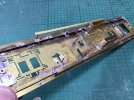
    So I made up some cell boxes, folded up and down the various parts to support brake equipment, made up the long footboards, and installed a bit of 0.9mm copper wire to make the steam pipe along the solebar. This is after a tidy up and deciding the hot soldering has been completed. This means I can think about soldering the whitemetal queen posts, air cylinder and dynamo.

    16FCA6B7-B07B-4322-AE13-1F245848F2A5.jpeg

    This is a slightly closer view of the mess. Having put one lot together, I think there is a different order of assembly that will make life easier. You can see one of the door window parts still in situ, but there’s no point removing it. The dynamo slack adjuster folds up from the floor. This one had snapped off at some stage, so I’ve cobbled a reinforcing part to hold it. Brackets for brake cross-shafts fold down and have inner ones fitted, and both cell boxes have been made up and attached at one end. This underframe is for a brake third.

    It was at this point that Present Me got caught out by Past Me, who hadn’t bothered to make a note about how the bodywork is to be attached. This will need me to have a good think about how to overcome this problem, which will save Future Me more headaches.
     
    On to bodywork
  • Heather Kay

    Western Thunderer
    With most of the underframe work complete, and still feeling a distraction from detailing the bogies is worth the effort, I turn to bodywork assembly.

    As you may recall, I had assembled sides and ends some time ago. Theoretically it would be possible to join corners with only the aid of a square or three. This may be okay for a couple of bodies, but I’ve got 16 of the blighters to blunder through. Some further help in the form of a basic jig seemed sensible.

    9345999D-C88F-4032-AA5A-DEFFCB0E912C.jpeg

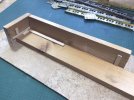
    I spent far longer thinking about a jig than it took me to cast around for scraps of hardboard and timber, plug in the hot glue gun and just build it! I think you should be able to work out how it operates. An end can be wedged in place, with the corresponding side likewise. Adjustment should be minimal, with just a smidge of wiggle room, and the parts held enough that a couple of quick dabs of solder can be applied to join things together.

    C29DF1BD-180B-40BC-9E33-0D4EE3C0A05E.jpeg

    Here’s an end. Of course, all the detail is in place on the ends. I don’t want to damage any of that, so the strips of wood at the bottom allow for the depth of the end steps and the turnunder. I have since modified the nearer upright to allow for sliding the second side in place. You’ll see what I mean in a bit.

    4AB76EB6-F7BE-4731-9583-AA7520168031.jpeg

    Add a side, tweak and adjust things along the joint by Eyeball, Human, Mark One - the end goes inside the side - drop of flux and in and out with the iron. I’ve taken to tack soldering. There doesn’t seem to be a need to run a seam, and tacking avoids the danger of overheating the relatively thin brass.

    What I found, with the first attempt, was the end steps still got damaged. This was mainly during the extraction process, because the fit is meant to be tight. To solve this, and to check I got the turnunder curve correct at the much earlier stage, I reinforce the steps from inside. The resulting blobs are not pretty, but they’re not going to be seen. I also find I need to deal with the occasional loose lamp bracket, which is annoying but unavoidable. One's soldering isn’t always as good as one would hope.

    0A0E2CD2-AC0A-41AE-906E-CE53440587DD.jpeg

    After joining an end and a side, I extract them from the jig and check for alignment. Sometimes, the end isn’t square - yes, even with my fancy-pants jig - so I lay the side flat on the bench and slap an engineer's square against the end. Some careful bending usually solves the problem. Sometimes, the end hasn’t seated neatly aligned with the side, so a bit of gentle persuasion against a flat surface and the application of the iron lets things click into place.

    My original scheme was to join a pair of ends-and-sides on the bench. I realised the jig would make this easier, with one sub-assembly wedged in place and the other offered up. It takes a bit of a fiddle sometimes, but It does work. There’s no point that I can see to adding any more woodwork to aid the process.

    469F1DC9-E3C9-420E-950A-D2C30B4EA2BF.jpeg

    And after a bit of obligatory cursing and singed fingers, three composite bodies are made. They’ve just had a bath to rinse flux off. One final check, once both halves are joined, is using the square to check the corners are within a gnat's semi-quaver of 90°.

    Now I know the jig works well enough, I can plough on with the other bodies. I think I’ll need to sort out storage again. In flat pack form storage was manageable. Now I’ve got 3D bodies to stack up.

    Anyway, I’ve had enough for today. More construction next week.
     
    Give us a hand - rail
  • Heather Kay

    Western Thunderer
    Truth be told, my heart's not been in this project for a while. To keep it going, with some vain hope it might one day be completed before either I or my client drop off our respective perches, I try to attack it in little pieces. There's a modern day business parable that fits, called "eating the frog".

    Every day, a worker gets in to work. Every day, they are confronted by a massive frog on their desk, as well as all the other work they have to do. Every day, they ignore the frog, and do the other work because it’s easier than dealing with the frog. Every day, the massive frog is still there. What they really should do is get the worst job - eating the massive frog - done first. Then every other task is easy. I need to learn to eat that frog.

    Anyway, today's little piece was handrails.

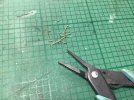
    These coaches have an annoying handrail. It’s basically straight, but has a tiny right-angled bend right at the top. Think of a very thin inverted L and you’ll know what I’m mean. I can’t go the easy way and simply fit straight handrails because the etched holes are offset. I pondered this task for far too long. I was sidetracked into thinking I really needed some clever gewgaw to aid bending to ensure each bit of brass wire was the same, and to make the job reasonably fast because I need dozens of the things.

    What I really needed was a pair of pliers.

    26C06B94-CA3B-4D2B-A6C5-20D2AD89BAF6.jpeg

    Inevitably, I ended up with a fair bit of wastage. These are failed handrails. They are too long, or bent the wrong way, or both.

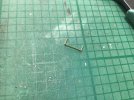
    D35049F8-559B-4069-87BF-A628219BFE24.jpeg

    Eventually, I got one bent the right way. It was still too long - not by much, but enough to be annoying. I saved this one to act as an aide memoire, because I’m a bit thick and will easily forget to bend the right way.

    9B28F644-3D71-4FEB-9ECC-36AC720C5BCC.jpeg

    After a bit of rude language, I got into something of a swing. I have managed four handrails. I decided to quit while I was ahead - I didn’t sleep all that well last night, and concentration is somewhat lacking. I will pile into the handrail manufacturing game tomorrow, aided by some loud music and strong coffee.

    Eating that frog. Ribbit.
     
    Last edited:
    Joining bodies to underframes
  • Heather Kay

    Western Thunderer
    After what seems like years, but in fact has only been weeks, I’ve stopped prevaricating and got on with things.

    The specific things in this instance being how to attach the bodies to their underframes.

    IMG_3133.jpeg

    The kits provide an etched spacer. This fits into slots in the bottom angle of the body. Holes match up, suitable for bolts to go through. Way back near the start of this odyssey I tried out how this worked and found it more or less did. Then a third party set of bogies made an appearance, with different mounting arrangements. I got a bit confused. I elected to not worry about it while other stuff got done, hoping a solution would arrive eventually. In the photo, I’ve shown how the spacer aligns with the underframe - it’s offset to show the various holes.

    IMG_3134.jpeg

    One of the problems I had was a lack of spacers. There are reasons, mainly that this project was begun many years ago, and parts were mislaid between then and the stuff arriving with me. Suffice to say, I was short of about half the spacers. I originally intended to replicate the etched parts, then the brain cell woke up and realised I really didn’t need to go to all that effort. I just needed a strip the right width, with suitable holes to align with the underframe.

    Suitable scrap etch was found, attacked with various implements to make it the right width to fit the coach bodies, then hacked into strips. A quick measurement sorted out the various holes. You can’t see them here, because at this point I’d only marked and punched for the central hole to clear the bogie mounting bearings.

    IMG_3136.jpeg

    Another issue the early fitting turned up was the body simply would not fit between those little tags on the headstocks. I fretted over this for far too long. I tried angling the tags out, I tried rebuilding the body, but all to no avail. I’ve no idea what the problem is, but my executive decision has been to just chop the blighters off. I doubt they’ll be missed at this scale. I know they had a purpose on the real coaches, but they’re just a plain nuisance for me.

    IMG_3138.jpeg
    A routine was soon worked out. Ideally, the spacers should be fitted to the body, which is then attached to the underframe. Obviously, because I’m building things, I had to allow for my usual dimensional upsets. By temporarily fitting the body and spacers to the underframe with bolts, adjustments could be made to ensure things were aligned as near as possible before committing to soldering the spacers in place. I also decided to use one kit spacer and one home-brew one per coach. There was a reason which escapes me. There will be one coach that ends up with all home-brew spacers.

    I got four coaches put together today. With more application, I could work more quickly. Still, they’ll get done soon enough. Interiors can be considered then. I suppose I should begin detailing bogies at some point. If that doesn’t tip me over the edge, I don’t know what will!

    IMG_3139.jpeg

    A sight that’s not been seen on the bench for a while: organised chaos. I have to say, it does feel quite good to be somewhat productive again. I hope it lasts.
     
    Roofs and pondering details
  • Heather Kay

    Western Thunderer
    Things creep forward slowly, slowly.


    IMG_3400.jpeg

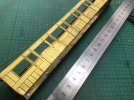
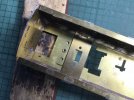
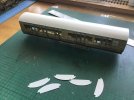
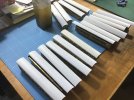
    I am starting to work on the roofs. Inside, the brass partitions are assembled, but need tidying. I’ve cut down the plastic seats (delivered a while back) to fit each compartment. I have to work out how to fit some kind of flooring, even if it’s just blocking holes left in the brass floor during construction.

    We come now to questions of the GER Hive Mind:
    • What colour were the seats. The instructions mention brown in passing. Was that for both classes?
    • The handrail on the corridor sides: brass or wood? I can’t tell from the black and white photos of coaches right at the end of their lives.
    • How were smoking and non-smoking compartments arranged? Does this have a bearing on the weird way the roof vents are laid out?
    Any comments in those directions will be most welcome.
     
    Back to bogies - adding detail
  • Heather Kay

    Western Thunderer
    Sorry for the gap in comms. You can guess why. :confused::oops:

    Anyway, thanks for all the input on the grab rails. I think I’ll go with fixing the wire rails in place before painting gets started, then just paint them a sort of darkish brownish sort of colour and be done.

    Meanwhile…

    IMG_3461.jpeg

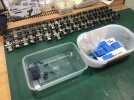
    I have begun to face down the daunting task of detailing these beggars. So far, it’s soldering in the whitemetal castings for the bolster springs. Next, I think it’s opening all the spring damper bracket holes a gnat's crotchet. After that, carefully separating the printed parts and just getting down to gluing them together.

    No doubt, I shall be some time. :))
     
    Top