7mm Martin Finney 7mm Duchess

Steph Dale

Western Thunderer
On my German stuff, which has PLUMBING, rather than just a few odd pipes, ;) I used to assemble the piping in runs and fit it after painting. It was the only way I could be certain to get a decent paint finish on the main panels and things like boiler cladding.

This meant I pretty quickly cottoned onto the idea of terminating the locations of the ends of wires and various small fittings with small bore tubing. A simple trick which massively increases the bond area when gluing small vulnerable components into models.

Steph
 

adrian

Flying Squad
I made all my footplate furniture separate so I could line the splashers. The next one I do will not be lined by me ;-)

Now being cack-handed (i.e. left handed) I have a tendency to approach these problems from a different perspective (not always right - just different!) - given the complexity of the plumbing and footplate furniture etc. I would consider making the splasher removable for painting and lining.
 

Cliff Williams

Western Thunderer
That is another way Adrian. Sun Jin in Korea ( and others) use that method on Masterpiece locos with a thin overlay, the splasher substructure has holes to allow glue bonding.

Neat and makes for tidy lining.
 

Dikitriki

Flying Squad
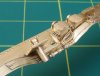
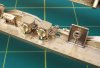
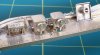
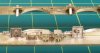
Stage 3 lubricator fitting

On to the second of the Silvertown lubricators, and the pipework is getting very busy:)

A couple of pics from the back, to see the pipe runs better:

P1010601a.jpg

P1010602a.jpg

The 2 runs of 4 fork on top of the leading splasher as there is a clamp across all 8, with a tightening bolt in the middle. It's also a convenient place to split the run. From there to the drop off at the smokebox end can now be done separately.

P1010603a.jpg

P1010604a.jpg

And one of the full extent so far.

P1010599b.jpg

Richard
 

OzzyO

Western Thunderer
Some nice work on the pipe work going on the Duchess, a small bit of info. the front Lube. box that has the pipes at the bottom is for the cylinders. The small pipes are for steam to help warm up the cylinder oil before it is pumped to the valves and the cylinders.

IIRC, the rear Lube. box was for the axle boxes, with the small footplate lube. boxes for the horn guide cheeks.

OzzyO.
 

Dog Star

Western Thunderer
The clip on top of the splasher is a cut down clip from the Finney7 accessory etch E7/50 small pipe fixing brackets. (... for modellers who like to clip pipes down is a must have ...)
Definitely.

Please consider putting details of what "extras" are available in the 'Sundries" part of the F7 website :thumbs: .
 

markjj

Western Thunderer
Why don't you just add an options to the kit on the website so you can buy all the bits as one package to make the kit as you have....
 

Dikitriki

Flying Squad
Stage 4 lubricator fitting

Thanks for the comments/likes, it is appreciated.

I've now completed the one side - hurrah!

This is the front displacement lubricator, just behind the smokebox - another super-cruel closeup. Note there is no pad that the pipes go over this time. I don't know why.

P1010613a.jpg

P1010615a.jpg

The clip is just some half etch scrap cut and bent to shape with a rivet punched in the ends.

P1010624.JPG

P1010626.JPG

This is the leading splasher with the continuation of the 8 pipe run from stage 3. The clamp has a Scale Hardware retaining bolt through the middle and there's another half etch clamp behind the sand box filler.

P1010611a.jpg

And the full extent of the pipework.

P1010622a.jpg

I've now got the other side to do, which is pretty identical to the first. There does appear to be some variation at the smokebox end, but I think that is a later affectation that I might ignore.

The pipework has been based where possible on that of City of Birmingham, with assistance from Duchess of Hamilton (pics provided courtesy of Cliff Williams - thank you) and Duchess of Sutherland.

Richard
 
Last edited:

Dikitriki

Flying Squad
Hi,

A couple of you asked how I made the unions: just a couple of pieces of tube and some time!

The smaller tube is 0.45mm inside and 0.85mm outside diameter, the larger tube is 0.9mm inside and 1.2mm outside diameter.

I cut two slices approximately 0.6mm long from the larger tube and solder them on the smaller tube so:

P1010627.JPG

I file by eye some flats (hopefully 6, but maybe 5 :) ) on the 2 slices of larger tube to resemble nuts.
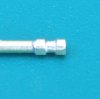
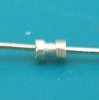
P1010629.JPG

Then I cut off the union from the smaller tube, clean up the ends and run some wire through with bent ends so I don't lose it.

P1010636.JPG

Sorry for the quality of the photos, but it's at the limit of what I can focus on. We are talking about something less than 2mm long and 1mm wide. Bear in mind that 2/3 of it won't be seen, so you can solder it in place with the best aspect showing.

The eye catches the flats and is fooled into thinking nuts....which is where the men in white coats come in.

Cheers

Richard
 

JimG

Western Thunderer
I file by eye some flats (hopefully 6, but maybe 5 :) ) on the 2 slices of larger tube to resemble nuts.

Richard,

A tip I got from the late Colin Binnie many years ago for making hex fittings was to use a pin vice with a hexagonal body to hold the material when shaping when the hex body gives you an easy indicator of the hex sides. If your pin chuck has a round body, find a nut that will slip over the round body and glue it behind the chuck end.

Jim.
 
Top