7mm Manning Wardle Old Class i: a self-designed 'kit'

John Baker

Western Thunderer
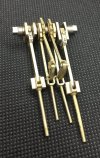
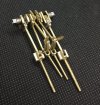
Righty, now the Easter holidays are here I’ve finally managed to do the rest of the wiggly bits for the motion…. Now to fit them into the chassis and see if it still moves.

I’ll also see if I can replace some of the photos in the thread when I get time. Being inherently lazy, I tended to copy each post from where I’d originally written it on RMWeb. Unfortunately (not that it ever crossed my mind) it seems the photos here are only linked from there. Having had a fairly catastrophic server failure when nothing from the last year or so has been backed up, all the photos from this thread have been lost.

F86C6F64-C221-46B3-B657-CB5A0CF949C9.jpeg

996E707D-0119-4623-85FE-21C422141221.jpeg

95E1606B-316F-4604-AB8F-3F8DD8333653.jpeg
 

AdeMoore

Western Thunderer
Great work John, I did the same re copying across from RMWeb but not always so only have a few posts with missing photos. Keep your updates comin.
Cheers
Ade
 

John Baker

Western Thunderer
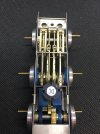
After an evening of fiddling, I finally persuaded the motion into it's new home. It's fair to say it's a tight fit! It needs some fettling up as it's a bit sticky at the moment, but it rotates and wiggles and jiggles in just about the right places. Still need to add balance weights.....

IMG_5290.JPG

Just hand-turned at the moment, but it gives you an idea at least...
 

John Baker

Western Thunderer
The motion is on hold temporarily....It turns, but binds slightly in one place. When I put it together, I deliberately made it quite loose - I wouldn't go as far as saying sloppy, but I think I've perhaps introduced too much slop. The theory was that it had a better chance of turning if things weren't micron-perfect, but I think I went a bit too far. If anyone has put an inside motion together previously and knows a magic cure, let me know. Otherwise I'm going to tighten the tolerances on the CAD models, print and re-cast them for version 2.

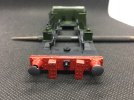
So with that, I added the brake blocks and linkages. These are to be the final soldered parts on the model, so represents something of a landmark in the project. The prototype I've based this model on only had brakes on the front and rear axels, not the middle, which I think adds to the charm of this diminutive little loco. Next, the chassis will get a good clean, ready for primer - hopefully this weekend.

IMG_5341.JPG

IMG_5347.JPG

IMG_5348.JPG
 

Ian@StEnochs

Western Thunderer
John,

Same problem here.

I have just assembled two sets of gear for my 4-4-0s. Both had binds once the gear was in the frames Each of the moving parts were individually fitted and kept in their pairs. Connecting and valve rods were fitted to the crank pin or eccentric so that they always fell to vertical under their own weight and the cross heads slid under their own weigh if upended.

However once all assembled there were problems, quite noticeable on the rolling road with stutter and change of sound. It took quite a while of tinkering to discover where I had introduced the problem. In my case it was the eccentric rods and their connection with the expansion link which was the source of additional friction. I found that a bit of twist had got into the rods such that the pins at the small end were not quite parallel with the eccentrics. This caused a tight spot when the rods were in one particular position.

My rods are fabricated with the little ends silver soldered on, leaving the rods annealed and quite soft. The solution was to twist the offending rods but it took quite a number of dismantling/assembling sessions to get everything sweet.

You may have something similar and the only way to find out is just to keep fiddling. I know from experience that when it comes to the final assembly, after painting, there could well be another sticky bit. The joys of modelling!

Ian.
 

John Baker

Western Thunderer
John,

Same problem here.

I have just assembled two sets of gear for my 4-4-0s. Both had binds once the gear was in the frames Each of the moving parts were individually fitted and kept in their pairs. Connecting and valve rods were fitted to the crank pin or eccentric so that they always fell to vertical under their own weight and the cross heads slid under their own weigh if upended.

However once all assembled there were problems, quite noticeable on the rolling road with stutter and change of sound. It took quite a while of tinkering to discover where I had introduced the problem. In my case it was the eccentric rods and their connection with the expansion link which was the source of additional friction. I found that a bit of twist had got into the rods such that the pins at the small end were not quite parallel with the eccentrics. This caused a tight spot when the rods were in one particular position.

My rods are fabricated with the little ends silver soldered on, leaving the rods annealed and quite soft. The solution was to twist the offending rods but it took quite a number of dismantling/assembling sessions to get everything sweet.

You may have something similar and the only way to find out is just to keep fiddling. I know from experience that when it comes to the final assembly, after painting, there could well be another sticky bit. The joys of modelling!

Ian.

I think the twisting you refer to is my problem too, however my twist, I think, is coming from a different source. the eccentric sheaves are wider than the eccentric rod clasp around them, allowing for a bit (too much) sideways movement. As they slide (probable not much more than half a mm), this causes the expansion link to 'wobble' vertically, and I suspect this is where the problem lays. Before I start altering my CAD drawings, I'm going to try and fit some packing pieces on the eccentrics to try and reduce that movement and see if that help. I might try using some thicker wire as pins holding everything together at the expansion link end too, just to try and make that end a bit less loose too. I've only soft soldered everything, so a bit easier to take apart :)
 

Ian@StEnochs

Western Thunderer
I think the twisting you refer to is my problem too, however my twist, I think, is coming from a different source. the eccentric sheaves are wider than the eccentric rod clasp around them, allowing for a bit (too much) sideways movement. As they slide (probable not much more than half a mm), this causes the expansion link to 'wobble' vertically, and I suspect this is where the problem lays. Before I start altering my CAD drawings, I'm going to try and fit some packing pieces on the eccentrics to try and reduce that movement and see if that help. I might try using some thicker wire as pins holding everything together at the expansion link end too, just to try and make that end a bit less loose too. I've only soft soldered everything, so a bit easier to take apart :)

Hi John,

Yes that could be where the trouble lies. I made the eccentrics and the straps the same width. My eccentrics are plain with no flanges and the four straps keep each other in line. When I assembled the straps, with 16BA screws, I rubbed each side on Emery paper to ensure the joints were smooth and to give a bit of running clearance.

1/2 mm is quite a bit but you could try a temporary washer from a twist of wire to see if that cures the bind. If that works you can make it permanent with a proper washer but you may have difficulty fitting it. Two half C shaped washers could be clipped over and soldered together, hot iron low melt solder quick,

Ian.
 

John Baker

Western Thunderer
Hi John,

Yes that could be where the trouble lies. I made the eccentrics and the straps the same width. My eccentrics are plain with no flanges and the four straps keep each other in line. When I assembled the straps, with 16BA screws, I rubbed each side on Emery paper to ensure the joints were smooth and to give a bit of running clearance.

1/2 mm is quite a bit but you could try a temporary washer from a twist of wire to see if that cures the bind. If that works you can make it permanent with a proper washer but you may have difficulty fitting it. Two half C shaped washers could be clipped over and soldered together, hot iron low melt solder quick,

Ian.
The washer idea is where I was heading. Having got everything in primer, I think I'm going to paint everything as the next job - more as a change of scenery more than anything. I'll get back to the motion after that.
John
 

John Baker

Western Thunderer
I'm not sure if this is a 'dumb' question or not, so I'll ask it anyway...... Were there occasions where old industrials would have been fitted with dumb buffers as well as standard buffers? I quite like the look of both together (just propped up in the photo below), but don't want to add them if they wouldn't have existed together. Part of me says it's a Manning Wardle and therefore pretty much anything could go, I defer to your superior knowledge!
IMG_5708.JPG
 

Martin Shaw

Western Thunderer
Sudbrook was from memory Severn Tunnel way so was the MW used during construction of the subterranean bore? More importantly very nice model John.
Martin
 

PhilH

Western Thunderer
Sudbrook was from memory Severn Tunnel way so was the MW used during construction of the subterranean bore? More importantly very nice model John.
Martin

Manning Wardle works no.891 was ex works 29/5/1883 to T.Nelson & Co., contractors for the Roath Dock construction, Cardiff, as their "No.16". On completion of that contract it was sold to T.A.Walker for the Severn Tunnel contract and named "SUDBROOK". After completion of the tunnel it was used on T.A.Walker's Manchester Ship Canal contract.
 
Top