Ian_C
Western Thunderer
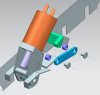
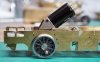
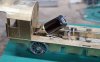
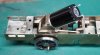
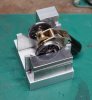
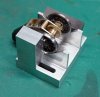
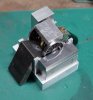
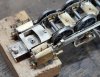
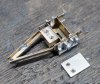
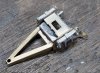
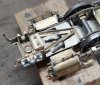
One small design change was required before I headed off to the workshop. I asked Mr High Level to confirm the diameter of the motor spigot and the size of the fixing screws. Answer - diameter 5mm , and M1.4 screws. The original design had assumed a spigot diameter of about 4mm, and 5mm diameter spigot took the mounting hole right to the edge of the mounting block. The block was increased in width by 0.5mm, and the fixing screw holes were counterbored, along with complementary changes to other components. Still fits into the chassis and body though, but with a little less clearance. Should be OK.
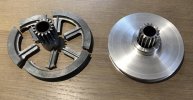
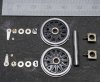
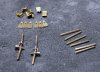
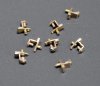
Here are the parts for the gearbox, including the Gibson rear drivers bored and bushed and running true (see earlier post on how the sanitise your Gibsons).
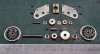
All routine machining, but at a small scale. A few workshop tips worth passing on for this kind of work...
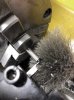
When parting off really small things in the lathe they do have a habit of launching at a tangent and finding their parabolic way to either the lathe's chip tray or the workshop floor. Then you have to decide whether it's quicker and less frustrating to just make another part or to carry out a search. Parting off with an old paint brush in the works pretty much eliminates that. Usually the part just pops off and is caught in the oily bristles. Worst case, at least you know it's in the brush somewhere. This shows the work held in a 3 jaw chuck, and care his needed to avoid a fight between chuck and brush, but for small work I usually use an ER16 collet, and then there's also space to place a small plastic tray on the cross slide under the tool. The brush catches 99% of the parts though. The brush is just an old 1 inch paint brush that I use to clear chips and swarf. It's got a bit sticky and spread out over time, which makes is it ideal for this. For a sense of scale the parting tool is 0.8mm wide.
Tapping very small threads without breaking the (expensive) tap and keeping the tap aligned to the hole can be a challenge. If I've drilled the hole on the mill or the lathe, this is how I follow up with the tap.
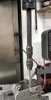
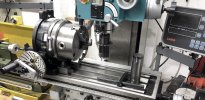
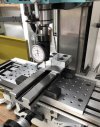
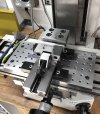
In this case it's a M1 x 0.25 tap into a 0.75mm hole. These are the holes in the sides of the motor mounting block. The tap is held in a pin vice. The top of the pin vice handle is held loosely in a collet in the mill spindle. The collet isn't tightened to the vice, just squeezed up to a loose fit.
There's no spring pressure on the tap like you'd get with traditional tap follower. Just the weight of the pin vice and whatever pressure you choose to exert with finger and thumb. As the tap advances into the work the spindle fine feed is adjusted to follow it down. This way you get a direct feel for how the tap is cutting. In the lathe, the pin vice is guided by a collet held in the tailstock, and the tailstock is wound out to follow the vice handle. It's helpful to turn a short section of plain diameter on the end of the pin chuck if it doesn't already have one.
Here are the parts for the gearbox, including the Gibson rear drivers bored and bushed and running true (see earlier post on how the sanitise your Gibsons).
All routine machining, but at a small scale. A few workshop tips worth passing on for this kind of work...
When parting off really small things in the lathe they do have a habit of launching at a tangent and finding their parabolic way to either the lathe's chip tray or the workshop floor. Then you have to decide whether it's quicker and less frustrating to just make another part or to carry out a search. Parting off with an old paint brush in the works pretty much eliminates that. Usually the part just pops off and is caught in the oily bristles. Worst case, at least you know it's in the brush somewhere. This shows the work held in a 3 jaw chuck, and care his needed to avoid a fight between chuck and brush, but for small work I usually use an ER16 collet, and then there's also space to place a small plastic tray on the cross slide under the tool. The brush catches 99% of the parts though. The brush is just an old 1 inch paint brush that I use to clear chips and swarf. It's got a bit sticky and spread out over time, which makes is it ideal for this. For a sense of scale the parting tool is 0.8mm wide.
Tapping very small threads without breaking the (expensive) tap and keeping the tap aligned to the hole can be a challenge. If I've drilled the hole on the mill or the lathe, this is how I follow up with the tap.
In this case it's a M1 x 0.25 tap into a 0.75mm hole. These are the holes in the sides of the motor mounting block. The tap is held in a pin vice. The top of the pin vice handle is held loosely in a collet in the mill spindle. The collet isn't tightened to the vice, just squeezed up to a loose fit.
There's no spring pressure on the tap like you'd get with traditional tap follower. Just the weight of the pin vice and whatever pressure you choose to exert with finger and thumb. As the tap advances into the work the spindle fine feed is adjusted to follow it down. This way you get a direct feel for how the tap is cutting. In the lathe, the pin vice is guided by a collet held in the tailstock, and the tailstock is wound out to follow the vice handle. It's helpful to turn a short section of plain diameter on the end of the pin chuck if it doesn't already have one.
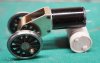










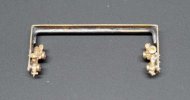
 . Not sure I'm in the mood for making eight of these from scratch at the moment.