Ian_C's workbench - P4 and S7 allsorts

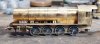
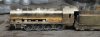
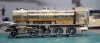
More 8F photos I'm afraid
  • Ian_C

    Western Thunderer
    For Mr Adrian Flying Squad, the pliers did their thing...
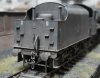
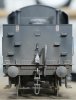
    Tender rear WT size 1.jpg
    The paint didn't enjoy it, but the joggle's there now in the guard irons. Thanks for pointing that out.

    I was able to make a sortie out to the garden earlier. The light was good for some loco portraiture. Pale grey overcast and very diffuse. Hard to replicate that lighting indoors - where can you buy a giant pale grey light bulb eh? A load of photos were taken before the rain set in, and when uploaded to the Mac, whaddaya know? Cab roof not sat quite straight and a couple of dog hairs attached. So almost all of the shots taken of the RH side of the loco were rubbish. Amazing what you see on a photo that you don't see in reality isn't it? One day it'll stop raining, and I'll have another go.

    Loco tender LH side col 1 WT size.jpg
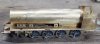
    The LH full broadside photo is straight from the camera, just resized for posting here. The colouring came out as I'd hoped in daylight, which tells me that my workbench and workshop lighting is about the right colour temperature.

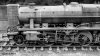
    Loco LH front BW 1 WT sizejpg.jpg
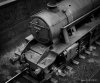
    Lower shot was messed with in Lightroom to get a Rose Grove 1968 feel to it (minus piles of char, coal, discarded tools and the famous junked wheelbarrows) . Taking and developing the photos is almost as much fun as building the loco. I really ought to make a shed diorama with some depth to it for photography. This narrow scenic plank does limit your options.

    I'll post a few more when I get some decent shots of the other side.
     
    What's next? Another 2-8-0. Bradwell WD in P4
  • Ian_C

    Western Thunderer
    This goes back to 1998. A Dave Bradwell WD kit that was started and then put to one side. Goes back to the days before children and dogs, and when modelling was done on the kitchen table. In fact that was all that was done on the kitchen table back then. The workbench clutter spread out and stayed there for months at a time. Basic tools only in those days. No lathe or mill. I'd just built a Gibson 04 kit in EM, converted it to S4 and thought I'd nailed the kit building thing. Not lacking ambition, I thought the WD would be a good next project. In truth it was a bit beyond me. I struggled to a powered rolling chassis, built the tender body because it looked easy-ish, then a bit of footplate, and then...it gathered dust while house renovation took up my time. Today I dug it out from under the bed and opened the box for the first time in 22 years...
    Build resumes Feb 2021.jpg
    ...all pretty much as I remembered it. Brass somewhat tarnished, but no rust on the wheels or axles, which surprised me. Reams of instructions and loads of handwritten notes. I'll have to read through the lot to see where I got to. No Wild Swan book of drawings for this project, but a lot more photos available now than there were back then. More towards the model making end of the spectrum than the model engineering end. First job is to clean it up in the ultrasonic tank.
     
    Back in business - the boiler
  • Ian_C

    Western Thunderer
    The plan was to put a large Mashima in tender and drive a gearbox on the rear axle through a driveshaft. I think the small gearbox is an Exactoscale specimen. The electrical collection was to be American (I think it's called?) style, with loco live to one rail and tender to the other, and drawbar insulated. To that end I'd shorted out the drivers on one side with fuse wire, and defeated the insulation on one side of the tender wheels with silver conductive paint. Surprisingly it worked - well it did 22 years ago. I remember a huge amount of messing around with the drive shaft. Starting with a variety of rubber tube type couplings that didn't work well, and ending up with a UJ type shaft (Exactoscale again I think) that had to be arranged almost straight between motor shaft and gearbox input. I might re-engineer the driveline, but for now I'll make a start on the loco body.

    A lot of reading instructions, looking at diagrams and checking what had been removed from etches to figure out where I'd got to. First job was to fit the front buffer beam and associated parts. The basic cab was next, to serve as a location for the back of the firebox. Having spent so long working on the 7mm 8F I'd forgotten quite how small some 4mm parts are. The cab roof in particular was a fiddle. It took a while to recalibrate from 7mm to 4mm.

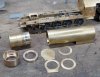
    Boiler and firebox next. The boiler and firebox is built up as a basic shell with overlays...well...overlaid. The smokebox is built up as a separate unit with an overlay added over a length of brass tube. The smokebox was easy enough. The boiler and firebox were not so easy.

    boiler forming.jpg
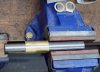
    Since the boiler barrel and firebox are from one etched part, the boiler can't be rolled. It was formed by hand around lengths of 7/8" and 3/4" bar held in the big vice. I can't ever get a perfectly round boiler shell this way, so it does rely on being pulled up tight onto the internal formers before soldering.

    boiler formers.jpg
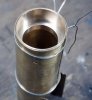
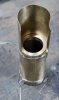
    The kit has two etched round formers for the boiler, and two for the firebox. They're quite thin and it's not really possible to pull the boiler shell tight around them. They're also prone to flip out with much pressure on them before they can be tacked in position . The other challenge is that the smokebox slides inside the front of the boiler, so the first boiler former has to be a way back from the front edge, and the smoke box to the rear of the overlay has to be built up in diameter to fit inside the boiler and represent the step in diameter on the prototype. The kit has a couple of etched strips that are to be wrapped around the rear of the smoke box to make up the diameter. I couldn't see that going well, and I did want a good fit of smoke box to boiler. I turned some more robust formers from brass bar. The rear former is simply a ring. The front former combines a ring to form the boiler and a thinner extension that the smoke box slides into.

    front former.jpg
    Here's the front former in place with the boiler shell pulled up tight with twisted wire. The smoke box slides into this end.

    rear former.jpg
    Here's the rear boiler former in position. The wire tension was cranked up a bit more before soldering to close the gap you can see at the top of the boiler. The frontmost firebox former sits up against this boiler former which helps to keep it in position as the firebox is formed.

    boiler shell.jpg
    The rearmost firebox former was remade in thicker material, from a scrap of 1/16" brass sheet. Once the fit and location of the cab , boiler and smoke box had been checked, the boiler was soldered up. The boiler's a great heat sink and the turned formers have some mass, but the 100W soldering iron makes it quick and easy.

    The kit provides a boiler barrel overlay, and two alternative overlays for the firebox depending on which arrangement of boiler washout plugs the loco had. Earlier boilers have a straight handrail, whereas later boilers have the upper washout plugs so positioned to necessitate a cranked handrail and ejector exhaust pipe. Therefore it's at this point you have to decide which loco you're modelling. Usually I like to model locos with some kind of local connection, but the 8Fs kept the WDs away from Midland lines for the most part, although photos show the odd WD made it as far as the mighty Toton on occasion. After browsing 'The Book of the WD 2-8-0s and 2-10-0s' (Irwell Press - ISBN 1-903266-96-3), I decided on 90361. It was at Wakefield in 1966 before moving on the a last posting at Sunderland. The Irwell book shows the earlier firebox type in 1952, but another photo taken at Wakefield in 1966 shows that by then it had a boiler with a later pattern firebox.

    boiler w overlays.jpg
    Here's where it gets tricky. If the boiler and firebox shell does not end up as geometrically perfect the overlays won't conform fully to the shell at all points. I thought I'd done a pretty good job, but even so, the firebox wrapper had a couple of small areas that didn't want to sit on the shell. It was rather like chasing air bubbles around under wet pasted wallpaper. In the end I had to nick the edges of the overlay in two places with a scalpel and let them overlap to relive the wrinkles. When soldered over, the tiny overlaps were smoothed out with a file and some wet & dry. We'll see how that looks under a coat of primer - at some time in the distant future. The boiler overlay was straightforward by comparison. Cleaned up in the ultrasonic tank, and that'll do for today.

    Decent progress considering that my conscience made me go and do some gardening this afternoon as well.
     
    Bradwell WD 2-8-0 in S4 - boiler fittings, oil boxes and the wrong tender wheels
  • Ian_C

    Western Thunderer
    Chipping away at my usual pace. Glaciation happens faster. Thought I 'd dress up the boiler a little. It always feels like progress when the boiler fittings are on.

    The top feed is a lovely little brass casting. It looked a little squat to me. The top feed on the WD did stick up a bit. I turned a small disc to represent the fitting flange and raise it up a bit. The disc was silver soldered to the casting and blended in with a needle file.
    top feed.jpg


    There's a hole etched in the boiler overlay to show the top feed position. There are also a couple of holes in the boiler shell, beneath the overlay that can be used to locate where the top feed pipes enter and exit the cladding. Except they're now buried by the turned former. Planning ahead is so over rated. The holes had to be estimated from photos, marked and drilled.
    top feed holes.jpg

    Safety valves, dome, snifting valve and chimney were located and sweated on...
    progress 6 -3-21.jpg
    I wonder if the top feed is a bit too sticky uppy now? I feel more able to take a few more dimensional liberties in 4mm than 7mm, even so I really ought to check it against the drawing. Looks a bit Super D like this. It needs the cylinder wrappers and the pony truck to balance it up. Maybe they're next. I think Webb might have appreciated the WD, but I can't imagine what language Samuel Johnson would have used if he'd lived to see one!

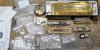
    In passing , here are the oil boxes that are scattered along both sides of the foot plate.
    oil boxes 1.jpg
    I did wonder if it was worth fitting the oil pipes. I soldered one box in position with no pipes. They're not very visible tucked away under the curve of the boiler, but you do notice the empty space beneath where the pipes should be. There's no chance of drilling out the unions on these tiny castings. Instead I filed the back of the unions flat to about half the diameter, and soldered copper wire looted from domestic flex to the flat. Very much of a fiddle & faff. Soldering them in place on the footplate brackets was tricky. Linger too long with the iron and the pipes become unsoldered. A couple of them had to be removed and done all over again. Also fitted the sand fillers while I was there.

    After the last episode I realised that the tender and pony truck wheels were too large. I'd bought 3'8" wheels back in the day instead of 3'2" wheels. Goodness knows why. Fortunately Alan Gibson Workshop had 3'2" wheels in stock, so I can re-wheel the tender now.
     
    Bradwell WD 2-8-0 in S4 - tender wheels onto axles
  • Ian_C

    Western Thunderer
    Very much an example of humans as the ultimate tool using creature. Clever as they are, chimps, crows and dolphins couldn't have successfully mounted Gibson wheels on the axles and got the B-B perfect and no wobble. Previously, getting wheels like this onto axles in the correct position was a stressy struggle, and usually ended up with a little wobble and a loose/tight B-B. And the more you twist and tweak and adjust, the lower your odds of success.Doing it this way takes a little effort initially, but you end up with consistent B-B and no discernible wobble. The conclusion I draw is that the process of pushing the axle into the plastic wheel centre very much determines the quality of the outcome. Perhaps no surprise. Here's a way of doing it...

    Tender wheel story board.jpg

    1. Do your sums if you only want to press the wheel on once with no adjustment. The Gibson wheels measure 2.11 mm over tyres. At 25.93 mm the axle is damn near a standard 26mm pinpoint. If I take 17.7 as the B-B then it follows that I need 2.00mm (near as makes no odds) of axle projecting from the front face of the tyre on each side. An odd end of brass bar was faced parallel and a flat bottomed 2.00 mm hole was sunk into one face with an end mill. The usual small run out on the mill gives a clearance size for the axle. Sure, the pinpoint of the steel axle will indent the brass slightly, but not enough worry about.
    2. The pressing block was set up on parallels in the mill vice (itself set perpendicular to the spindle). The table was positioned so the spindle centre was directly over the hole in the pressing block.
    3. Wheel placed face down (!) on the block and approximately over the hole. The pinpoint on the axle will centre it. The axle is gripped in a 2mm collet (or should that be Collet on WT?) in the ER11 collet holder. I should add that the wheels were rubbed gently both sides on wet & dry on a flat surface to remove any plastic flash that would prevent the wheel sitting flat on the block or the B-B gauge.
    4. Bring the quill down gently (chimps please note) to press the axle through the wheel until resistance is felt. The axle can be carefully released from the collet. Bring all the axles to the same stage.
    5. Wheel and axle placed back on the pressing block, and the B-B gauge is balanced on the back of the tyre, having made sure wheel tyre and gauge are free of gubbins.
    6. Place the other wheel over the axle pin point, approximately level.
    7. Bring the quill down again to centre and press the wheel on until it contacts the B-B gauge.
    8. That's job done. It's really quick and consistent once the tool is made. I won't be doing this by hand and eyeball any more.
    You could do similar if you have a small drill press, or a mini arbor press. That said, if the job had required flippers and echo location I'd have struggled, although if food was involved I'd place a small bet on Grey Squirrels working this out.
     
    Slidebars and crossheads and jewellery
  • Ian_C

    Western Thunderer
    This has been the most demanding stage of construction so far. A lot of small parts, and a requirement for some accuracy in the fit of moving parts. The order of doing things is a bit mixed up in the photos, but a thousand words is worth a picture so hopefully I can make some sense of proceedings.

    slidebar crosshead 2.jpg
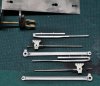
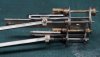
    I think I'll start here. The sliders themselves are made up from a number of laminations from the nickel silver valve gear and motion etch. There are dimples etched in the parts that are to be drilled through 0.45mm so that wire pins can be used to align the parts. It's a good idea and it does make things easier. As you can see there are a several sub-assemblies that need to be soldered together to make up the crosshead /piston rod and slider assemblies. The challenge is to solder it all together without unsoldering the sub-assemblies. If you ever bought a step soldering kit or a temperature controlled soldering iron, now would be the time to use it. I managed the job with silver solder (about 630), 224, 179 and 145 degree solders.

    I spent some time looking through the kit contents for the crosshead castings. Without success naturally, because there are no crosshead castings! The crosshead is fabricated from etched parts, a casting (except not really, discussed later) and some rod. Start the whole job by folding up the crosshead etch. In spite of the target dimensions given in the instructions, the etch will fold up how it jolly well likes and the gap between the crosshead cheeks is what ever you end up with. It's easier to fettle the slidebars to fit the crosshead than vice versa. The etch parts for the cross head were put together with 179 solder.

    I opted to silver solder the slidebar laminations together so that they're solder proof later in the game, and so they can be polished up to a higher level than soft solder. You can see the assembly of slidebar laminations being pinned together top right of photo. An excess of silver solder was built up on the laminated edges to fill any gaps. It all gets filed and polished off later. Silver slidebars eh? A bit flash for a WD.

    The lower slidebar is supposed to be 1.6mm wide, but for me, to match the crosshead, it came down to 1.5mm for a comfortable sliding fit. There's bit of careful filing to create the tapers. Files, wet & dry and down through the grades of micro abrasive pads to end up with a final polish with 12,000 grit (well, dust).

    The connecting rod is a simple lamination. It's necessary to reduce the radius around the end of the little end to make sure it clears the back of the piston road socket in the crosshead.


    slidebar crosshead 1.jpg
    The piston rods are 3 -1/4" in real life, near enough to 1.0mm in 4mm scale. The instructions don't specify what's to be used for the piston rod, but there's some 1.0mm N/S rod in the box so I'm assuming that's it. There are some tiny brass castings (centre of photo above) for the socket in the crosshead where the piston rod end is secured. The problem with these is that they're really difficult to clean up neatly, and you have to drill them out to fit the rod (better than hole too big I guess). I managed to drill through not quite along the centre so they sat a little squiffy on the rod. Hmmm....would anybody notice? Nah...not right is it? So replacement sockets were turned from brass, and the hole goes true through the centre. Tiny flats were milled on the end to fit inside the crosshead cheeks. The rods were silver soldered to the sockets and the rear ends cleaned up to make sure they clear the little end of the connecting rod.

    slidebar crosshead 3.jpg
    The slidebars were partly assembled by soldering the tiny spacer laminations at the rear end. To do that the slide bars were clamped together with a spacer between them, carefully aligned, the spacer laminations fiddled into position, and the end soldered up with 224 solder. Worth noting here that Mr Bradwell reckons the gap between slidebars should be 0.75mm. With the little spacer blocks in place the gap practically ends up after soldering at about 0.9mm. That matches the top slider of the crosshead very well with sufficient clearance to slide nicely. In any event you can tweak the clearances with a fine file if necessary. You can also just make out the little end pins in the photo. They are made from a length of 0.8mm brass wire, a tiny turned washer (see upper left of first photo) and a 16BA brass nut drilled through 0.8mm. The five nuts holding the cross head together are made from short lengths of 0.45mm brass wire soldered in the holes (145 solder, and be quick about it!) and filed down to about 1xD in height.

    slidebar crosshead 4.jpg
    Once loosely assembled to the cylinder frames like this, the alignment of the piston rod and slidebars can be established and the turned brass sockets and rods can be soldered to the crosshead in situ with 145 solder, being very careful not to let any solder stray onto the slidebars themselves. Here it is with the connecting rods in place and retained by the little end pins. What I've not dared to do yet is fit the spacers between the front of the slidebars. When they're in place the crosshead is trapped and it would be difficult to get them out again (the slidebars are silver soldered, so maybe it wouldn't be a disaster). I'll get the slidebar supports fitted to the chassis and all aligned with cylinders etc before I do that.

    WD earrings.jpg
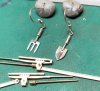
    As it happens it was my partner's birthday this weekend. She's a keen gardener, so I thought I'd make her a pair of gardening themed earrings. Small pieces of sterling silver are really quite cheap (but don't let on please). Same tools, same skills, similar materials, different result. Not sure I'd like to scratch build in annealed jewellery silver though, soft and gummy stuff.

    In other news, I had my first covid vaccination today. Had to drive a little way to get to the place. Probably the furthest I've been from home in the best part of a year. Driving home along empty roads in the spring sunshine, indestructible with 0.5ml of Astra Zeneca in my arm, was quite ... uplifting. Maybe there's light at the end of the tunnel (or it's a class 8 head lamp coming straight at me).
     
    Last edited:
    Bradwell WD 2-8-0 - more cylinders and motion brackets
  • Ian_C

    Western Thunderer
    To get the slidebars installed you really need the motion bracket in place, since it supports the rear end of the slidebars and sets them at the correct angle. The whole episode took all weekend and was far from straightforward.

    WD 280 cyl motion brkt story copy.jpg
    1 - The instructions say that you may need to cut away some of the motion base plate to enable access to the spring adjusting screws on the front two axles. I can confirm that there's no doubt about it! You have to make cut outs to clear them.

    2 - The motion brackets themselves were faffy little assemblies, and the instructions were not abundantly clear on a few points. There are some small tabs that are etched to make a double fold, but it's not clear what purpose they serve or which way they fold, etch line inside or out. When you try and assemble the motion brackets the penny drops, and naturally I'd guessed wrong, so the tabs had to be re-bent the other way. Fortunately I managed that without snapping them off at the etch line. The pivot centres for the expansion link are located by passing a length of (straight!) 0.8mm wire through the brackets and straight through etched holes in the chassis side plates. Clever! Once that's done the cylinder base plate can be screwed to the chassis, the motion bracket assembly slotted into the chassis, and the two soldered together. Then the relationship between cylinders and motion bracket is set and the slidebars can be fitted.

    3 - It was at this point I decided to look ahead and check that the cylinder wrappers were the same width as the front and rear cylinder ends. Well, not quite. I found that the cylinder ends were not quite parallel, slightly closer together at the bottom than the top., an error I'd made when I originally made the cylinders up in...errr...1998. It was possible to tweak them to the correct dimension, and to keep them there I elected to pass a length of 1.0mm wire right through for the cylinder relief valves and use it as a soldered in spacer. I kind of expected there to be relief valve castings in brass, but apparently not. Bradwell suggests wire, and I didn't fancy making cylinder relief valves from scratch, so wire it was.

    4 - The covers were added to the front of the cylinders. Again a bit of a fiddle making them from two laminated etched parts, getting them round and with etch cusps filled and filed smooth, and getting them soldered to the cylinders with out them becoming misaligned. The cylinder relief valve wire helps keep them in position.

    5 and 6 - Finally the fitting of the slidebars. I should add that there was a tricky, sweary little interlude where I fitted the spacers to the front of the slidebars, and with that the crossheads were trapped for good. You need to make sure there's no twist between the motion brackets and the cylinders, otherwise the rear ends of the slidebars are at the wrong height and they look wonky relative to the cylinders. After a lot of fettling and squinting they're correctly positioned and can be soldered to motion bracket and front of cylinder.

    There's a potential problem though. The fit of crossheads in slidebars was very good and allowed an easy sliding fit - until...you solder them in position! It seems to be a quirk of geometry and friction that makes the crossheads prone to lock solid if they're not pushed in exactly the right direction. Any off-axis force locks them solid on the slide bar, even though there's a slight clearance at all points. Lubrication helps, a little. I'll need to fit the connecting rods to the cross heads and the driving axle and see if the connecting rod motion causes them to lock. Not sure what I'll do if that's a problem.

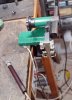
    Here's something that I've discovered. If I connect the instrument maker's vice device to the RSU ground I can use it to hold things in the right place to apply the RSU probe. It's more versatile then soldering everything on the clomping great RSU steel baseplate. You can see the RSU ground lug trapped between the bench and the vice base casting. I might tap an extra hole in the casting so I can screw the ground lug on when I need it. In this photo it's being used to zap on the cylinder front covers.
    RSU set up 1.jpg

    If you have 15 minutes, this is worth a watch... Zen and the Art of Model Making
    Not much to do with Tang dynasty Mahayana Bhuddism, but about Philip Reed, a most remarkable model ship maker. The ship counterpart of Beeson, Miller or Reynalds. Once you're hooked, he also has a few commentaries on specific ship models on You Tube. There's something to aspire to; to achieve the model railway equivalent of Philip Reed's ships.
     
    Bradwell WD 2-8-0 - the pony truck
  • Ian_C

    Western Thunderer
    The pony truck was reasonably straightforward. The etched parts, although fiddly, went together well. I did make a few small changes as I built it up and worked out the installation.

    pony truck 1.jpg
    As designed, the axle passes through slots in the etched frame, and you'd have to assemble the wheels to the axle and get them to gauge in situ. Also they'd be there for clean up and paint, which isn't ideal. I slotted the frames to the bottom edge so the axle can be removed when required. I'll solder or cyano a small keeper wire across the open end of the slot when I'm closer to completion.

    Once the etched parts are soldered together , there are white metal castings to apply to the sides, although you'll not see much of them behind the solid wheels. If nothing else, they add a bit of mass to the truck.

    The wheels are Gibson. They're sort of correct in so far as they're disc wheels and of the correct diameter. The prototype pony truck wheels were actually iron castings. Even the tyre was cast integrally in iron. For that reason there's no separate tyre shrunk onto the wheel and the rim looks finer in reality than these it does on these wheels. I can't see an easy way to fix that without risking damage to the wheels, so I'll stick with what I have. Also the cast boss was quite thick, presumably to resist cracking as the axle was pressed in. On the Gibson wheels there's almost no boss. I might turn up some small collars and see if I can blend them in with the moulded wheel centres. Bit of a signature item on the WD I think. May get away with this in 4mm, but you'd have too get its right in 7mm (which means the Roxey/Snowhill kit is prodding at the frontal lobe again).

    pony truck 2.jpg
    With the castings epoxied on, the spacer washers to control the wheel side play can be calculated and turned from brass. They're 0.5mm thick on this model. The wheels were assembled on the milling machine, similar to the tender wheels on an earlier post. Incidentally, the axle works out about 0.3mm too long when the wheels are to P4 gauge, so it was filed back flush with tyres. The pony truck frame pivot is a 14BA screw. I opened out the hole in the frame to 1.5mm and made a small bush to solder to the screw to provide a tightening stop and retain the frame.

    pony truck 3.jpg
    The Bradwell ethos is to have all axles sprung, and the pony truck's no exception. That's done by some springs made from phosphor bronze wire. They pass through a slot in the rear frame crossmember and bear on the top of the axle. One of the springs is traced in red in the photo above. Needless to say, a right faff to get all the bends in the right place and two springs approximately the same. But they do work rather well.


    pony truck 4.jpg
    With the wheels dropped in and the axle resting on the springs. You can see the springs a little more clearly in this photo.

    pony truck 5.jpg
    Pony truck fitted to the chassis. So far as I can tell the idea is that the pedestal thingy on the front of the chassis rests in contact with the top of the pony truck frame and the pony truck springs effectively push the truck frame up into contact. That means the pony truck should carry some weight. I'll have to see how it all works out when it's properly wheeled and the ride height adjusted. The stiffness of the springs could be changed by changing the free length of the wire. Bradwell suggests 15mm is about right, so that's where I've started. There is a suggestion for side control springs, also from phosphor bronze wire, but I can't make sense of the instructions, so I'll step past that complication for now. I'll bend the guard irons out to the right position when I get the rolling chassis back on rails. Altogether the pony truck's taken an inefficient day's work to get to this point.

    There's very little on line about this kit. I guess it's a bit vintage, so most of the ones that were built pre-dated posting on the web. I'm finding that it's quite a challenge to build, and I'd love to know how many actually got finished before the Bachmann WD came along. If any WT'ers have one, and are willing to post a photo, I'd be happy to see them.
     
    Bradwell WD 2-8-0 - coming together
  • Ian_C

    Western Thunderer
    The cylinder wrappers were a challenge. It was really hard to get them aligned all the way round the cylinder formers. The front and rear formers being not entirely parallel was the cause. Next time I do something like this I'll machine some spacers to assemble the cylinder formers to guarantee parallel. A small amount of fettling was necessary in the end. It doesn't show really, so I got away with that. The drain cocks are beautiful little brass castings. Roughly put together, and it feels like progress. Completing the valve gear is the next step I guess.

    assy 3 April 21 -1.jpg
    assy 3 April 21 - 2-2.jpg
     
    Bradwell WD 2-8-0 - chassis measurement and analysis
  • Ian_C

    Western Thunderer
    Back in the day I vaguely remember test running the rolling chassis with the coupling rods on. Even more vaguely I seem to remember that it ran OK. Older me has little faith in the ability of younger me, and back then I don't think I had any measuring device more sophisticated than a 6 inch steel ruler. Just out of curiosity I thought I'd measure how accurate the axle and rods centres are. I think I set the axle centres from the rod centres using those dummy axles with a spigot on the end over which the rods are dropped. I think there were springs involved to stop the axle bearing guides from flopping about, and probably a flint axe.

    How to measure something like this? I have the usual selection of edge finders and a Haimer for the milling machine, but they're not much use on features this size. I'm sure I read somewhere that Swindon was using optical methods for cylinder alignment when the rest were using bits of wood and string. Hate to admit it, but I'll follow Mr Churcward's lead on this. A couple of years ago I made an optical centring microscope for the mill. It was from a Hemingway kit. Took some time and head scratching, and in the end I had to modify the optics before I was happy with it. Not sure what magnification I ended up with, something like 40x or 50x. Having got it set up and centred properly, I've not found much use for it...until now!
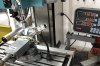
    chassis measure 1.jpg
    The chassis was set on a parallel in the milling vice and just nudged up to put the straight top edge against the rear jaw of the vice. The focus was set using the fine feed on the quill. The depth of field is tiny, so it's a really useful way of adjusting focus. It's OK in workshop ambient light, but an extra light source from one side helps to see the edges clearly. Using the DRO turns it into a low rent co-ordinate measuring machine.
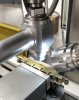
    chassis measure 2.jpg
    I set the X zero as the rear edge of the chassis side plate, and Y zero as halfway up the horn guide gap, roughly where the axle centre should be. Then, working from rear to front, I found and recorded the inside edge of the horn guide bearing faces. At this magnification the brass looks like the surface of the moon, and your tidiest work looks like a ploughed field. I'd rounded the edges of the plates making up the bearing faces to prevent the bearing blocks binding, so some fiddling with focus was needed to find the actual faces. Flipped the chassis over and did the other side.
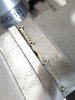
    coupling rod measure 1.jpg
    I did the coupling rods in a similar way. This time I just laid them on the vice jaws, roughly lined up with the edge of a parallel. Because they're articulated I centred on the crankpin holes (the graticule has crosshairs and concentric rings so that's easy). I took the leading crankpin hole as zero datum and took X and Y measurements for the other holes. The distance between centres can be calculated from the X and Y differences between adjacent holes. Yes, those nice neat holes look like shell holes at his magnification - ugly!

    The measurements were dropped into a spreadsheet to find the results. Axle centres from the chassis first...Bradwell WD axle ctrs.png

    The horn guide gaps I guess are meant to be nominally 4mm. They vary between a slightly tight 3.89mm to a clearance of 4.10mm. Not bad for etch fold ups and manual soldered assembly.

    The effective axle centres calculated from this vary from the exact scales dimension by no more than 0.07mm (and that's about 5mm on the prototype!), and most are closer than that. And the difference between axles centres between the LH and RH sides is no greater than 0.13mm.

    I have to say I was surprised that it was so accurate. Just shows what you can achieve using basic tools and techniques if you're careful and follow a logical process.

    The coupling rods next, and if I set the axles from the coupling rods you'd not expect them to be much different.

    Bradwell WD rod ctrs.png

    Once again the centres don't deviate from nominal by more than 0.07mm. The interesting thing about this is that the rod centres are really set by the etching artwork and process, and you have to conclude that Mr Bradwell and his etcher did a good job here.

    Comparing rod centres with the corresponding axles centres shows a maximum deviation of o.13mm, and mostly a lot less.

    The DRO measures to 0.005mm allegedly. There will be small errors in finding the hornguide edge positions. I've rounded to the nearest 0.01mm which is probably appropriate.

    What I've not attempted to do is measure how perpendicular the axles are to the chassis centre line. The chassis could be slightly trapezoidal in plan and still give good centre distances. It probably has less impact on smooth running than matching axle and rod centre distances. Also what's not taken into account here are mechanical clearances; between bearing blocks and horn guides, and between axles and bearing blocks. I do have the bearings and axles marked so they always go back in the same position. Other variables are the crank throw of the wheels and the crankpin to rod clearances and the quartering.

    Overall I'm surprised how accurate everything is. I'd expected much worse. Bit of an eye opener. Could I actually do much better now I have better tools and measuring equipment? Probably not, but I was younger then with better eyesight and a steadier hand!

    When you start to add up tolerances like this it seems like a miracle that eight coupled models of this size actually manage to run at all. Then again the WDs were notoriously slack mechanically, hence the clanking. I recall an anecdote, maybe Keith Miles in BRILL back in the day, about getting a set of WD rod bearings machined to the 'correct' size to demonstrate to the shed fitters than there was no need for the clank. Naturally , when they were offered up they wouldn't fit. Eyes were rolled and toldyousos muttered from under cloth caps, and back they went to the machine shop to be bored out to a size that allowed them to be 'thrown' onto the crankpins.
     
    Diversion - some remarkable modelling in France
  • Ian_C

    Western Thunderer
    I guess, like many of us, I tend to be UK centred when it comes to railway modelling. While searching for something else, I came across this French fellow producing models and components in 1/43.5ème , Benoit Semblat. Something to aspire to, hein?
     
    Bradwell WD 2-8-0 - the valve gear - part 1
  • Ian_C

    Western Thunderer
    Bullet bitten, and all the valve gear components are made. Laid out roughly in order below....
    WD 280 valve gear 1.jpg
    Tiny components like these take a disproportionate amount of time. A couple of weekends work , plus plenty of odd hours after work to get this far.

    There are a lot of tiny forked joints to fabricate from equally tiny etched parts. This is how I've approached the job...
    forked joint 1.jpg
    A spacer is made from something that won't solder and won't disintegrate at soldering temperatures. I used a scrap of copper clad sleeper, with the copper filed off, and the thickness filed down to the width of the forked joint. A hole is drilled near the end of the spacer for the alignment pin to pass through. All of the etched parts have the pivot holes drilled to the final size, 0.55mm in this case. The parts are assembled on a suitable alignment pin. I show a o.55mm brass lace pin in this shot, but I've found a steel drill bit of the correct diameter to be much more solder proof, particularly if it has a black coating. It's easy after soldering to clamp the drill bit in a pin vice and twist it out. The pinned assembly is either held in the end of the toolmaker's clamp device (as in photo), or laid on a soldering block where the pin can be inserted in a pre-drilled hole. Pay attention to making left hand and right hand versions of each part, although Dave Bradwell has designed the etched components in a 'handed' way , so it's easy to avoid that mistake. The whole joint is flooded with solder, which is cleaned up and sculpted later. Lots of fiddly work with files and scraps of wet & dry to finish all of the components. Of course that's only the start. The whole shebang now has to be fitted together and made to work with adequate articulation, and probably some very tight clearances. Don't hold your breath for part 2.
     
    Bradwell WD 2-8-0 - crankpin knack, and victory in the War of Gibson's Wheel
  • Ian_C

    Western Thunderer
    Crankpins first. The clearance between the back of the crosshead assembly and the leading crankpin on the prototype was small, maybe half an inch. That's about 0.15mm at this scale, or, because of the perverse way the world works, nothing. Or minus nothing when my accumulated modelling errors are accounted for, plus more side play on the leading axle than is necessary. I didn't think about it earlier, and Mr Bradwell doesn't draw attention to the challenge. I'm thinking about it now though. I can reduce the height of the leading crankpins with some chicanery (probably next episode), but I certainly need to reduce the side play of the leading axle. Some of that side play is between the bearings and the horn guides, and there's not much I can do about that, but most of it is between the inside of the driving wheels and the face of the bearings. To address that it is necessary to take at least one wheel off the axle to add some washers. I contemplated this with a heavy heart, because I remember how much of a pain it was to get the original wheels to gauge, quartered and with an acceptably small wobble. In the non linear fashion of a Tarantino movie, we'll leave the crankpins here and flash back to an earlier time...

    When I first joined E4um (Scalefour Society online forum back in the day), I joined in the middle of an energetic thread about the merits or otherwise of Gibson wheels. This was known as The War of Gibson's Wheel (after The War of Jenkins' Ear - look it up, WT broadens your horizons doesn't it?). The warring factions were divided over whether the unavoidable wobbliness of an assembled Gibson wheel set was inherent in the design and manufacture of the wheel, or was down to the ineptitude of the assembler. The body count was kept to a modest level by the moderators, but I don't think a conclusion was ever reached. I guess it's continued as a low intensity conflict ever since. Fast forward again to Saturday 1st May...

    With The War of Gibson's Wheel in mind, I thought that before I took a wheel off the leading axle, I'd better try pressing an axle into a new wheel using the method described in an earlier post. That had worked really well on the tender wheels and I hoped it would work equally well on a 1/8" axle into a driving wheel. It didn't. The end of an axle was slightly radiused and polished to ease entry to the wheel, but as soon as the axle centered and started to press into the wheel it was apparent that the plane of the wheel wanted to be anything but perpendicular to the axle. Just by spinning the axle between my fingers made the wheel wobble shockingly. When I put the axle in a collet and measured the wheel tyre run out it was about 0.25mm radial (doesn't sound much but looks awful), and the axial wobble was...a lot... builders of my acquaintance work to the nearest half breeze block, so something of that order. How to proceed?

    Straightforward engineering approach, but somewhat of an a*se at this scale. About 15,000 words worth of pictures coming up- and then a lot of words.
    gibson wheel upgrade story.jpg
    1. A lump of something (an odd end of aluminium bar in this case) is held in a 3 jaw chuck in the lathe and a recess is made that is exactly the diameter of the driving wheels over the flange. It pays to measure all of the wheels you're planning to do, because chances are they'll all be slightly different. I measured ten P4 Gibson WD wheels of this type and they ranged from 18.95mm to 19.01 mm. Since I was only wanting to experiment with one pair I was able to choose two wheels exactly the same at 18.98mm. If I needed to do the lot I suppose I'd bore the recess to the smallest size first and then rebore it to accommodate the progressively larger wheels, finishing up with the largest. The depth of the recess was 1.5mm, which leaves 0.5mm of the tyre proud of the turning fixture to clamp the wheel. Of course now you have a means of holding the wheel tyre that is perfectly true to the axis of the lathe, you can't remove the fixture from the chuck without destroying the accuracy of the whole operation. This calls for some thinking ahead. You have to make any features for the wheel holding before the bar goes in the lathe. In this case I'd worked out exactly where to drill and tap M3 threaded holes to enable the head of an M3 cap screw to just pinch the edge of the tyre. It was easy enough to find the centre of the bar on the mill and make the holes in the right place. The bar won't centre perfectly in the chuck, but the holes don't have to be that accurate. There's a 5mm diameter hole drilled straight through to clear the drilling and boring tools used later.
    2. Another smaller recess is turned to clear both the crankpin boss when the wheel is held face to fixture, and the boss on the inside of the wheel when it is held back to fixture. In this case diameter 8mm x 1mm deep. If I was doing this again I'd calculate the depth of this recess carefully, for reasons that will become apparent around step 12 (don't skip ahead, you'll ruin the story).
    3. The first job is to hold the wheel face to fixture and machine off the moulded boss on the back. The cap screws don't need to be any tighter than snug. Hands go up at the front of the class and point out that if the tyre is not in the recess then the wheel can't be centred. True, but we don't care about concentricity at this point. Just centre the wheel by eye and it'll be good enough. We're working on the plastic insert now so we want cutting forces to be small. I use small tools with effectively no nose radius sharpened to an almost mirror finish on a diamond wheel. Light cuts and high speed get the job done without distressing the plastic centre. Just watch out for the tool contacting the whizzing and invisible cap screw heads. Already there are some clues to the root of our problem. The boss doesn't quite clean up to the back of the moulded wheel. It's flush on one side and still slightly proud on the other.. you might be able to see this if you zoom in on the photo. Not out by much, but I know from reading Colin Seymour's assembly notes on the wheels on the Alan Gibson Workshop website, the plastic centres are moulded separately and pressed into the steel tyres. That's an operation that has some margin for error, and I'm assuming that's why the plastic centres aren't quite in the same plane as the tyres. The axle hole is also moulded in and that therefore must be slightly off axis as well.
    4. Brutal stuff now. The wheel is turned round to locate the flange in the recess and reclamped. It's gratifying to see the tyre spinning perfectly with no run out. The axle hole is drilled out to diameter 4.0mm. Again, use a sharp drill and feed slowly. I have two sets of drills. One cheap set, all gold coated and shiny. Maybe from India or China and drilling approximately to size. They're used for rough drilling. And a set of genuine Presto HSS drills, that are kept for best. They cost more, but they're perfectly ground and very sharp when new, and for accurate work they're worth the money.
    5. The drilled hole is carefully opened out to diameter 4.5mm with a small carbide boring bar. Unlike a drill, which has some tendency to wander off centre and make holes slightly bigger than the drill, a boring bar cuts true to the spindle axis. At this point we're not too bothered about concentricity, but we need to size the hole accurately. The hole is opened out to be a slight press fit for the brass plugs described next.
    6. This is where I can claim some credit for thinking ahead. Doesn't happen very often. I'd made some brass plugs for the wheel centres before I made the turning fixture. The plugs are diameter 4.5mm to match the hole in the wheel, and they have a diameter 6.5mm x 0.5mm thick flange on the back. That flange replaces the moulded boss we scraped off back in step 3. They also provide some extra gluing area. Countersink the back of the hole very gently to ensure the flange sits against the back of the wheel. Remove the wheel from the fixture.
    7. Here you can see that the plug is proud of the front face of the wheel and the flange on the plug replaces the moulded boss. An virgin wheel is shown on the left for comparison. The parts were degreased with IPA and pressed together with Loctite high strength retainer. Titus the dog was walked while the retainer cured.
    8. Wheels back in the turning fixture, and the first job is to face off the brass plug flush to the crankpin boss. Actually I took a very shallow skim across the lot to level up. Bit of a funny tool set up to get in between the cap screw heads. It was easier to run the lathe in reverse and feed from back to centre. Again a very sharp tool and light cuts is best.
    9. Here's the facing op with motion blur for dramatic effect.
    10. That's the plug faced flush, and we're ready to bore the new axle hole.
    11. Tiny 0.5mm centre drill fed in gently.
    12. I started to make the axle hole with a new and very sharp 2.5mm drill. That found it's way through the plug without any drama. I had planned to open up the hole with a series of drills to around 3.0mm and bore to size, but this is the point where I discovered that the retainer hadn't fully cured. I'd wondered why the dog had wanted a longer walk. A 2.7mm drill started to push the brass plug back through the wheel. The wheel was removed and the plug cleaned up and re-fitted with low viscosity cyano. Rather than risk further movement of the plug, I elected to complete the work from this point by boring. Worth noting that If I'd faced the flange side of the plug to a known dimension , and calculated the depth of the small recess in the turning fixture accurately, I could have the back of the flange in contact with the fixture when I carried out the drilling and boring operation. Then it wouldn't be able to push through if the cutting forces were too high.
    13. That's the smallest boring bar that I possess. It's capable of starting in a hole of just 2.0mm diameter. The advantage of boring to size rather than drilling or reaming is that the cutting forces are tiny and don't risk dislodging the brass plug. I'm pretty sure a 1/8" reamer would have broken out the brass plug from the plastic wheel centre. Also the boring bar cuts true to the spindle axis and has no tendency to wander, unlike a drill. If the drill is a little off then mostly the reamer follows it. I used the shank of drills to gauge the size of the hole up to 3mm, there's no way you can accurately measure a hole of this size without some very expensive equipment. From 3mm to final size I used the axle to gauge the bore. Cuts were tiny towards the end, with only a trace of brass dust being removed. One nice thing with small, sharp tools like this is that the cutting forces are so small that there's almost nothing taken out of the bore on a spring pass. Patience, and creeping up on it with infinitesimal nudges of the cross slide, and eventually the axle can just be pushed in with a slight resistance and no discernible clearance.
    14. Both the wheels now have brass axle bushes dead to size and perfectly (well not really perfect, but to very close limits) concentric to the wheel tread (OK, actually concentric to the flange but it's turned in the same op as the tread, so practically the same). What's interesting is that the brass bush is clearly not central in the plastic wheel boss, which explains the radial run out measured on the original push fitted axle.
    15. The almost final product, with the wheels just slid onto the axle ends. I have to say I'm really pleased with the result. They roll across a flat surface with no discernible wobble or run out at all. They're every bit as good as your aristocratic Ultrascales, plus they cost less, you don't have to wait 6 months (or more), and there's a wider range to choose from. Finally The War of Gibson's Wheel has been won (by me at least). I'm sure this approach would also work on Slaters 7mm wheels.
    Next it'll be front axle apart to measure up for side play and washers. It has to be easier to gauge and quarter the wheels when they're free to slide on the axle like this than when you're trying press them on, keep them straight and pay attention to the quartering at the same time.
     
    Last edited:
    The taper
  • Ian_C

    Western Thunderer
    Hi Ian,

    I do something similar, but to assist mounting wheels squarely on axles, use a matching taper fit applied to both components. The taper is barely at any sort of angle :), being set to alter the diameter of wheel bore by only about 1 thou over its short length. The lathe top slide is adjusted using a dial indicator traversed over a longer (calculated) length.
    After boring wheels, with the tool positioned as per photo below, the same (matching) angle can be applied to axle ends by using the tool from the far side with the lathe running in reverse.

    Ian: > I use small tools with effectively no nose radius sharpened to an almost mirror finish on a diamond wheel.

    Yes, the use of a fine grained diamond wheel has really improved my turning, no end. I have a 100mm dia, 600 grit cup wheel permanently fitted to a dedicated grinder. I'm loath to take it off, as once running true it's best left that way. (Use it only to breath a final sharp edge onto tools.)

    These wheels, and discs suitable for Dremel type tools, can be obtained at very reasonable cost from
    thk.hk

    View attachment 142654
    View attachment 142656

    That's interesting. I can see the benefit of a taper on axle ends and wheel bores in order to get a zero clearance fit, and guaranteed alignment. But then the gauge of the wheels becomes a machining variable, and if the taper is shallow the gauge will be very sensitive to the amount of material removed. I'm not doubting that you can make it work, but I'd be interested to know how you measure and control the tapers to arrive at gauge.
     
    Bradwell WD 2-8-0 - epic diversions, and crankpins again - wheel form tools
  • Ian_C

    Western Thunderer
    I was just about to complete the turning of a reduced height crankpin for the leading axle when...nothing. The smell of fireworks, and no lathe motor. Advice is to reduce the speed when parting off, but by turning the spindle by hand?

    I always thought that motor had run on the hot side of OK. A blessing in the unheated workshop in winter maybe. Naturally there was nothing for it but to strip the lathe and extract the motor. And sure enough, when the motor was taken apart the insulation on one end of the stator coils was cooked. This was an unusual motor. Basically a single phase 0.55kW induction motor, B34 face mounted, of frame size 71, but with a reduced outside profile and of a Dahlander pole changing configuration (2 pole/4 poles). Fat chance of getting a spare one of those off the shelf. Didn't fancy ordering a replacement from Germany with a wait of weeks and about a billion Euros. I decided to reinvent the drive with a bog standard 3 phase motor and a variable frequency drive (a.k.a. an inverter drive). They're all standard industrial parts. Affordable and easy to obtain. Some of the motor body had to be machined down to match the original and some modification of the headstock casting was required to make enough clearance to fit the motor and get the electrical terminals in an accessible location. The opportunity was taken to add an E-stop and a potentiometer for variable speed control. The new motor has a thermistor planted in the body and that's connected to the VFD which is programmed to trip before the motor gets too hot. There's also an external fan controlled manually from the VFD enclosure that can be switched on if the motor warms up during low speed running. The variable speed has mostly eliminated the need to move drive belts between pulleys. All new technology to me, but it all worked out nicely in the end. The crankpin? I managed to lose that somewhere between workshop and workbench...

    At that point a week's leave and some decent weather gave me the 'opportunity' to take on another project - running an electrical supply to the far end of the garden. 2 days work I thought. About 40 metres of cable underground, through damned hard subsoil through a retaining wall and under a couple of immovable obstacles. Took 5 days of hard labour in the end.

    Eventually order was restored, and I made another pair of leading crankpins. I didn't like the design that relied on the small screw effectively self tapping into the plastic wheel centre. A 'mark 2' design was made that's slightly unorthodox but founded on better engineering principles.
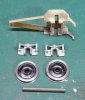
    laed crankpin bushes 1.jpg
    It's a flanged steel bush that's inserted from the inside of the wheel. It has an external diameter that matches the coupling rod, and it's threaded M1 x 0.25. The rod is secured by a M1 x 0.25 cheese head screw ('get it tomorrow', thank you Amazon, by the way it's 15:09 and they still haven't turned up) , the head of which may have to be slightly reduced to sit in the rod counterbore and clear the back of the slidebars.

    laed crankpin bushes 2.jpg
    The crankpin hole in the wheel was drilled through 1.6mm and the crankpin pressed in with a bit of medium viscosity cyano for good measure. The back of the pin flange sits below the flange of the brass axle bush, so it should clear everything when the wheel rotates.

    All of this messing about with wheels has rekindled the urge to make my own. I'm now the owner of a pair of HSS wheel form tools in P4 and S7 from Mark Wood Wheels. Brian, I do like the look of your wheels (posted above), and I might have to pick your brains a little as I work out how to make my own.

    And I still haven't got a running chassis yet!
     
    Stop press - leading crankpins clear crosshead!
  • Ian_C

    Western Thunderer
    The desired end result of all this faff has finally been achieved, the leading crankpins now clear the inside of the crossheads. Just.

    frame shims.jpg
    Even with careful (I thought) measuring I still ended up with more side play on the leading axle than was healthy. It was clear that the side play needed to be reduced to the workable minimum. I didn't fancy removing a wheel from the axle and adding washers, so I opted to shim the chassis to to move the axleboxes out towards the wheels. Some 0.12mm brass shim was sweated onto the chassis and filed back to the horn guide opening. After that it was a case of carefully rubbing it down evenly on each side of the chassis until a working clearance was just obtained. The shims must have ended up a little less than 0.1mm thick on each side.

    lead crankpin 2.jpg
    The height of the crankpin bushes was gradually reduced by filing until they just stood proud of the base of the counterbore in the coupling rod. The crankpin screw is a M1 x 0.25 cheesehead screw with the head turned down so that it is flush with the outer face of the coupling rod when screwed into the crankpin. There's no room for a washer of any thickness between the coupling rod and the wheel boss.

    lead crankpin 1.jpg
    That's what you end up with. A very low profile crankpin.

    crankpin crosshead gap.jpg
    And here's the clearance that results. There's a few molecules over 0.1mm between the back of the crosshead and the face of the crankpin screw and coupling rod with the wheel across to the maximum extent. It's about the same on the opposite side. Next time I take on a job like this in Scalefour I'd plan it out carefully beforehand, and maybe cheat and shift the cylinders outboard by 0.5mm or so.

    Before I get to test the chassis under power I need to persuade it to negotiate a 3 ft radius curve. I need the tender to do likewise and interestingly the tender wheel base is nearly the same as the coupled wheelbase on the locomotive.
     
    Bradwell WD 2-8-0 - getting round the bend
  • Ian_C

    Western Thunderer
    Motivation's been hard to come by recently. Thought I'd sit at the workbench today rather than contemplate sitting at it. And posting something here tends to create a sense of obligation to get on with things.

    Picking up where I left off, the first thing was to temporarily fit the pony truck and carry out some running trials with temporary power on length of straight track.
    drive test 7-21.jpg
    It works OK. The quartering of the front drivers matches the others closely enough, with only a very slight opening out of the leading crankpin holes in the coupling rods necessary to obtain steady slow speed running. The tender springing is too heavy and causes the tender to sit higher than ideal, which in turn reduces the drawbar articulation and puts a slight angle into the driveshaft. That'll need to be corrected before moving on. There are no springs on the loco yet, it's just weighted here with a steel parallel to make it behave and provoke some traction. So far, so relatively encouraging.

    Next was the 3 foot radius test on a section of P4 test track.
    3 ft rad 1.jpg
    3 ft rad 2.jpg
    It does sit, all wheels correct, on the curve. There's still a tiny amount of side play left so hopefully it won't go solid and cause the leading flanges to climb the rail when under power. Mercifully there's good clearance around the pony truck wheels, just have to watch behind the front steps when the body's on. What's most noticeable is the throw over at rear end of the chassis, and the position of cab relative to tender. A new drawbar had to be made to provide adequate working clearance to the tender under these conditions. As noted in the previous post (was it really over a month ago?) the tender wheelbase also caused some problems, and the pinpoints were flattened slightly on number 2 and 3 axles to give them enough side play.
    Next job will be to clear the accumulated clutter off the test track and clean it, arrange temporary pick ups from loco and tender, and see how it runs under its own power in close to normal operating conditions, including the 3 foot curve. If I was going to equip it with DCC and sound I'd be getting good value out of the flange squeal button.

    COVID cases on the rise again, Richard Branson about to launch a first passenger service into 'space', England in the Euro 2020 final - strange times for sure.
     
    Bradwell WD 2-8-0 - A problem, and time for a re-think
  • Ian_C

    Western Thunderer
    The test track was cleared and possession handed over to the Test & Development crew. The motor connections were temporarily made to tender and loco chassis, and trial running commenced. On the straight everything ran quite well. The problem arose on the curved section, not one that I'd anticipated, but not surprising in retrospect. Travelling in the forward direction, once the loco and tender were all on the 3 ft radius curve (no transition by the way, directly from straight to radius) the outside leading wheel of the tender almost always climbed over the rail and the tender derailed. After a lot of close observation I've concluded that this is down to the tender drive arrangement. The motor is a Mashima 1833, running quite slowly and driving a 30:1 (-ish, I think) gearbox. It so happens that when the loco and tender are both on the curve the resistance to travel is increased and the torque required of the motor increases. The torque reaction on the tender reduces the weight on the outside tender wheels and increases the weight on the inside wheels. Hence the tendency of the leading outside wheel to climb the rail. Adding weight to the tender only helped slightly. Once I'd got to a maximum sensible weight on the tender and still hadn't eliminated the derailing, there wasn't much point proceeding further along those lines. Lesson learned - a big motor and a limited reduction ratio may not be the best idea for this drive layout.
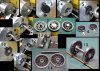
    The 100% guaranteed way of avoiding the problem is to go back to a conventional motor in loco arrangement. Better to bite that bullet at this stage. Over the years I've accumulated a fair number of gearbox bits and bobs - Branchlines, Porter's Cap (remember them?), High Level, some odd MJT Portescap conversion etches. I even have an original Portescap RG4 that I may find a use for one day (I mean, it must fit something surely?). After much measuring and pondering none of these seemed to be a viable solution. The limited width inside the Bradwell chassis and the confines of the narrow firebox scuppered all those plans. I do have a selection of Ultrascale gears that I bought a long time ago for...well I don't know what for. They just seemed like something that might be useful one day. You can see where this is heading - design your own gearbox!

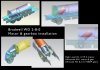
    The relevant parts of the loco chassis and body were modelled in CAD, along with the family of Ultrascale gears. I figured I'd aim for about 60:1 reduction which would enable the use of a smaller motor. Here's how it worked out (no prizes for spotting the spelling mistake).
    WD gearbox design 1.jpg
    I'd considered driving the 3rd axle instead of the rear, but as the chassis seemed to run OK driven on the 4th axle, and it would need some chassis modifications to drive the 3rd, I decided to drive the 4th axle. The biggest constraint was the size of the motor and the fitting of the body over it. The width of the firebox at the bottom doesn't give you much choice of motors, and the way I'd made the front firebox former meant that it would be difficult to arrange for the motor to project forward into the boiler. After a lot of googling I found that High Level have a range of motors now, including some handy looking and affordable coreless types. I opted to go with the 1219 size since it just fits diagonally into the firebox and can be slightly offset from the loco centre line and still pass through the opening in the bottom of the firebox.

    Here's the detail.
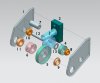
    CAD explode 1 WT.jpg
    It is just possible to get a 2 stage reduction final drive to fit between the spring supports inside the Bradwell chassis, but that requires the motor to be offset slightly, which is why a 12mm diameter motor was chosen. You'd think a 1219 motor was undercooked for a loco like this, but apparently the coreless type packs quite a punch for its size, and considering my layout constraints, the loco isn't likely to end up on a 40+brake coal drag. By numbers -
    1. Side plates are 1mm brass or N/S sheet. They're screwed to the motor mounting block so that the whole shebang can be dismantled for maintenance. Also this approach enables the intermediate gears to be fixed permanently to their shaft which simplifies things.
    2. The motor mounting block is machined from brass. The motor spigot and the motor fixing screws are not detailed on the High Level web page so they'll be decided once I have a motor to measure. In passing I note that High Level / Chris Gibbon is due to resume trading on 2nd August once he's unfurloughed himself, so I'll be first in the online ordering queue for a motor! You can see the slight offset of the motor in the block. The other design consideration here is that you need the worm gear out of the way to access the lower motor fixing screw. The Ultrascale worm looks like it'll pass through the motor spigot hole.
    3. 30:1 Ultrascale worm and gear set, the gear on a 2mm shaft.
    4. 21 tooth Ultrascale 100DP gear. 100DP seemed like a good idea back in the day, but the teeth are very small and you need to get the centre distances spot on. Plus they're more vulnerable to tight spots due to dirt on the gears. I'd choose a bigger tooth these days. I see Ultrascale also have a range of 0.4 module gears, which is about 63DP.
    5. 42 tooth Ultrascale 100DP gear with 1/8" bore onto 4th axle. Note that if you calculate gear centres for the 21t and 42t gears from the DP and the tooth count you'll end up with a 'tight' mesh. Better to add 0.1mm to the centre distance to give more tooth clearance and some working tolerance.
    6. The locking boss for the axle. I wouldn't need this if I had the type of Ultrascale gear with a boss! This will be turned from brass and soldered to the 42t gear . The cross hole is threaded M1.6 for a locking grubscrew.
    7. Spacer bar to control the distance between the far end of the side plates accurately. A length of 3mm brass rod faced and threaded for M1 x 0.25 screws. I'm gradually changing over from BA small threads to metric. It's possible to buy small metric screws of the type used in electronic assemblies (laptops, disk drives etc) very economically. I can buy a bag of 100 M1 x 0.25 x 8 screws for peanuts on Ebay, whereas 16 BA or 14BA screws are much more expensive. It's also easier to buy metric taps than small BA now, but they're not much cheaper! The side plates are fixed to the motor block by M1 x 0.25 screws as well.
    8. Phosphor bronze bush for the 2mm intermediate shaft. The bushes have the flange inside the side plate to save width. Since I'm turning my own bushes I can choose the flange width to control the lateral location of the gears. You can see the wider flange on the opposite bush.
    9. Phosphor bronze bush for the 4th axle, drilled and reamed to 1/8".
    10. Phosphor bronze bush for the 2mm intermediate shaft.
    11. Phosphor bronze bush for the axle.
    12. 2mm diameter intermediate shaft from 2mm silver steel. The gears will be loctited in position on this shaft.
    13. Small spacer washer turned from brass, to prevent side contact between the 42t gear and the worm gear when the 42t gear is aligned with the 21t gear.
    Thirteen parts. There's no place for superstition in engineering, fingers crossed. Well that's the plan, next I have to make the darned thing.
     
    Top