Hobbyhorse Three Green Boxes, Chip and Sound fitting.

Hobbyhorse

Western Thunderer
Simon,

Not necessarily! I have just sent what I hope is the last revision of the etches for the F7 GWR 2000G tender to PPD. The design is based on Martin's GAs.
SimonT
That’s interesting, what sort of time scale for releasing it.

Simon
 

SimonT

Western Thunderer
At best...... 4-6 Weeks for the test etches, 4 weeks for test build and polishing the instructions, production etches 4-6 weeks. Shall we chat off-line?
Simon
 

Bulldog3444

Western Thunderer
Great to see these locomotives coming together, and I am particularly interested in the 2000 gallon tender as I will need to do a couple of these, in 4mm, to run with 3521 class 4-4-0s No. 3529 and 3547 which were seen on the Barnstaple branch in the 1920s.

I have a question relating to the artwork for the 2000 gallon tenders, and that is the width of the water filler 'coffin' at the rear of the tender top. I'm not aware of a GWR drawing which shows this, and earlier kits exhibit differing dimensions.

The Mallard/ Blacksmith kit in 4mm introduced by Fred Blackman in the 1970s, and now available again from Mark Seward has a width which scales at 1'4", which looks too narrow to me, while the Warren Shepherd 7mm kit has a width which scales at 2'3". The Martin Finney designed kit for the 2500 gallon tender has a 'coffin' which scales at 2'6" width.

Ian
 

SimonT

Western Thunderer
Ian,
while there are GA drawings in Russell Vol I that show the coffin, none of them have dimensions for the coffin. For the 2000G I have the Swindon GA and Martin's CAD. They all agree on 16mm over the lid, which looks to me like 2'3" over the side plates. The 2500, 3000 and 3500 look like 18mm over the lid which suggest 2'6" over the side plates.
In the absence of an erecting draawing for the coffin, this may be the best we can do.
SimonT
 

Phil O

Western Thunderer
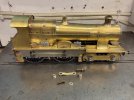
I've been working on the few remaining bits on the Bulldog chassis this week, inside motion bits, brake rigging, motor fixing and all those little bits that take forever to do, well worth the effort in the end.
The back plate has had a test fitting of the castings, these won't be fixed until the loco has been painted and the remaining details added, all fit OK but a bit more research needed for a couple of pipe runs.
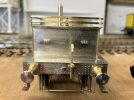
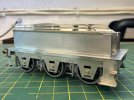
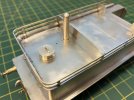
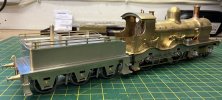
With the three loco's basically at the same stage it's time to look at the tenders, I'm probably going to start with the 2000gal for the Duke as it's scratch build.

Simon

View attachment 235951
View attachment 235952
View attachment 235953

I've got a Duke and 3 Bulldogs in the stash, yet to be started and when I do get there, I only hope that I can get close to the excellence that you have attained.
 

Hobbyhorse

Western Thunderer
Great to see these locomotives coming together, and I am particularly interested in the 2000 gallon tender as I will need to do a couple of these, in 4mm, to run with 3521 class 4-4-0s No. 3529 and 3547 which were seen on the Barnstaple branch in the 1920s.

I have a question relating to the artwork for the 2000 gallon tenders, and that is the width of the water filler 'coffin' at the rear of the tender top. I'm not aware of a GWR drawing which shows this, and earlier kits exhibit differing dimensions.

The Mallard/ Blacksmith kit in 4mm introduced by Fred Blackman in the 1970s, and now available again from Mark Seward has a width which scales at 1'4", which looks too narrow to me, while the Warren Shepherd 7mm kit has a width which scales at 2'3". The Martin Finney designed kit for the 2500 gallon tender has a 'coffin' which scales at 2'6" width.

Ian
Ian,
I’ll have to do a bit of investigating this as my drawing shows circular water filler, your quite correct with the Finney 2500 gal which I have one.

Simon
 

Bulldog3444

Western Thunderer
Hi Simon,

Thanks - I guess a key factor may be what period you are modelling.

I see from the pictures of the Duke you posted in 2022 that the locomotive has a round top firebox. I think that the last Duke to have such a boiler (No. 3279 Tor Bay) received a Belpaire boiler in 1917.

According the the drawing of diagram A24/25 2000 gallon tenders in Russell 1 they were originally fitted with a circular (cylindrical) water filler, and coal rails. At some time later the coal rails were filled in with sheeting, and subsequently replaced with more modern fenders and the coffin type water filler.

As ever, it helps if one has a photograph or two of the locomotive one is modelling, at one's chosen period. There seemed to be subtle differences between each locomotive in the Great Western's older locomotive classes.

Good luck!
Ian
 

Hobbyhorse

Western Thunderer
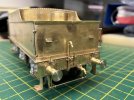
It’s strange how things fall into place, as in my last post I said that the next bit of the build was to scratch build the Dean 2000 gal tender, having obtained the drawings and as many photo that are available. Simon Thompson kindly offered the opportunity to test build the forthcoming Finney7 2000 gallon tender.
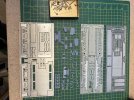
Looking at the kit when it arrived it’s clear that quite a few design changes have been made from the original Martin Finney tenders. All the etches are Nickel Silver which is a good move, inside bearings on the wheels and the skin in three sections, a selection of lost wax and resin castings. For me the inside bearings was what I was going to build into my model, but with this on the kit doing away with the outside bearings and removable side frames it makes the assembly much simpler.
YsFQL09.jpg
I’ve assembled the kit following the instructions as that’s part of the test, but have deviated in places to suit my personal preference, these I will indicate as the build processes. I would say that as this is a test build things could be different on the kit when released.
One change I’m making is to model the earlier coal rail variant, so this will involve making them parts as the kit is based on the coal fender type.

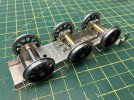
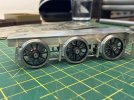
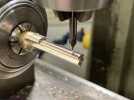
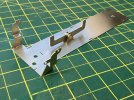
Starting with the well tank and frames, the rear axle is fix with the front two using beam suspension, the design uses 3/16” axles but as my wheels have 5/32” I machined some inserts to going into the bearings supplied, plus some tubes with an outside diameter of 3/16” to fit onto the axles on the beam. The wheels used are temporary as this model will have the early wooden insert type fitted a bit latter.
ZGqwfmk.jpg
O2zfOtf.jpg


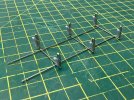
As the brake rigging is removable 14ba bolts have been added and soldered into the frames, the kit is designed with these fixed.
On the brake hangers I’ve added some packing bushes to space them which allows no damage when removing the whole assembly from the frames.
The resin brake shoes fit neatly between the hangers and are free to move allowing a more prototype apperance. Once assembled with the pull rods these sits into the linkage on the cross shaft, held in place with some push fit wire pins.
sujA4ZG.jpg
atOuJ8o.jpg
S7RFLbi.jpg


On the running plate I added some brass bushes to locate the axle boxes and fitted my own buffers.
hKHjcZW.jpg
HlV5v5W.jpg

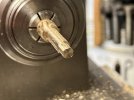
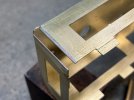
The tank body is based around an inner frame, top plate ,three skin sections and the resin corners, with frame soldered to the running plate and all the other bits added afterwards, I’ve changed assembling the frame and skins off the running plate as I’ve added brass corners which have been machined following the design and size of the resin version, again this is to my own preference, the resin ones fit. Having the skin in three sections makes forming the curves much easier, from the single piece skins on the older kits.
I used a small folding press to form the curves, care being taken as these a quite thin especially around the drop section with the beading, some packing card the same thickness of the beading on the skin prevented any distortion when forming curve.
W11D0mt.jpg
ZI3CI0M.jpg
G9RHM63.jpg
CaWw2eK.jpg
EO1uTQq.jpg
DAQVQvb.jpg


Simon
 

Hobbyhorse

Western Thunderer
The work on the coal rails starts with making new fender division and front coal plates, working from the drawings these appear to be lower in height, also checking from the available photos, these are easily made in nickel silver, and soldered into place.
thZ2fwT.jpg

The coal rails used a spare etch from a 2500 gallon kit, although longer and with incorrect fixing brackets for this tender. The plan is to use the additional brackets supplied in the kit and space these correctly working from the drawing and pictures again. So with the etch cut in half and the bottom of the fixing brackets removed, and the new brackets soldered into place on the flares of the side skins. It was and easy job to fix the coal rails starting at the front on both sides and work around until meeting on the middle of the rear, cutting both and fixing to the bracket, the tricky bit was removing the original bracket bits that kept the rails evenly spaced, for this I used a small slitting disk working very slowly.
B3bdqwB.jpg
KAAJqDI.jpg
ky2AFkJ.jpg


The water filler and Overflow pipe fountain are brass tunings that I’ve produced.
MHgEBQH.jpg

The Duke looks good with the tender.
8sg5Ibq.jpg

Simon
 

SimonT

Western Thunderer
Simon,
thank you for the care and skill you have devoted to this build. The feedback and cock-up trapping that we have discussed off line is of immense help.
There are some small changes to come and the timing of the release is yet to be settled but I shall announce all that on my Western End of F7 thread.

Many thanks Simon

SimonT
 

Hobbyhorse

Western Thunderer
Simon,
thank you for the care and skill you have devoted to this build. The feedback and cock-up trapping that we have discussed off line is of immense help.
There are some small changes to come and the timing of the release is yet to be settled but I shall announce all that on my Western End of F7 thread.

Many thanks Simon

SimonT
Hi Simon,

Thank you for the offer, I definitely enjoyed the build and glad it has helped.
It’s got me thinking about the older Finney kits needed for the other two locos in this build, I’ll certainly carry over some of the ideas onto them.

Simon
 

Hobbyhorse

Western Thunderer
A few of the smaller details completed, starting with the handrails front and rear, the rear used the supplied handrail knobs and wire. For the front I used some tapered nickel silver pins and turned up some bushes for the top and bottom, fitted with the small etch for the top and fitted into the hole at the bottom. The hand brake column fits in front of the handrail and is connected to the hand rail at the top.
The water feed valve fitted into the resin casting, with the supports soldered onto the tank top.
I replaced the etched fire lyre with one of my own castings and turned up some intermediate buffers
I’m researching the plumbing below the footplate, my GA drawing is useful but only gives limited detail, looking for a pipe and rod drawing which would give all those details, but It’s a difficult one to track down.
Added some very simple pickups.
VMOTQk2.jpg
wV4kqhX.jpg
gurcHt0.jpg
S4x0Pwx.jpg

Simon
 

Hobbyhorse

Western Thunderer
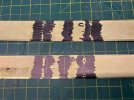
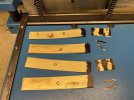
Only small bit done on tender this week, as I was waiting on the arrival of the axle boxes. Not much more to add but one thing I’m taking from this tender is too incorporate some of the elements into the other two tenders needed for the Flower and Bulldog.

Simon
IMG_0169.jpegIMG_0167.jpeg
 

Hobbyhorse

Western Thunderer
After working on my 16mm locos it’s back to work on the remaining two tenders, a Dean 3000 and Churchward 3500.
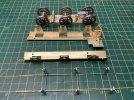
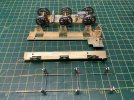
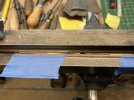
I’ll build them together as both have similarities starting with the chassis’s. As I’m using Harris wheels a separate set of frames are need to allow for inside bearings, this system I have used on all the Finney tenders I’ve built over the years and works well. The compensation beams are used with the axles running in brass tubes, this provides less drag than the two single points of contact from the beams. A few modifications are needed with the method of joining the inner frames, outer frames and tanks frames, the photos are self explanatory.
Next is the two tanks bodies, and I’m going to use the same method with separate machined corners , so it off to make brass swarf.

Simon
me1Ljtj.jpg
hj8SJxI.jpg
3MqxVJX.jpg
PMZ1fuN.jpg
3FVzXwI.jpg
 

Hobbyhorse

Western Thunderer
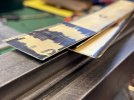
So using the dimensions from the corner pieces I did for the 2000 gallon tender, and slightly lengthening them all worked out well on them, one additional thing I did do was to drill the hand rail positions whilst still on the mill.
On the inner frame work some small strips have been added so as to allow the corners to fit.
Slicing the sides into three sections was carefully done after much checking but thankfully all fitted without any issues, one of the benefits to this is the ease of forming the top flares, done on my small folding press.
Probably the longest job is the filling and shaping the the top corners, but definitely better overall than the single piece side with the fingers for the tops.

Simon
PTy3vZ1.jpg
YkzrziS.jpg
97DVLfW.jpg
VJtKfoj.jpg
RZULuiH.jpg
eDQyxrx.jpg
pH6KaKe.jpg
WigOrLU.jpg
1SUPvmH.jpg
VJkUJbs.jpg
 

Hobbyhorse

Western Thunderer
Most of the bits and bobs have been added to the Churchward tender without any issues, and a final couple of small bits to add then a good clean up.
A couple of mods to facilitate the removal of the new internal frames, firstly keeping the left and right frames removable and separate, and the other is the removable brakes and rigging which was made easier with the addition of some turned spacers.
gLyy2gJ.jpg
TUYJPhK.jpg
aGqOgRE.jpg
O1YGmQP.jpg
PbwjIIE.jpg


Couldn’t resist a photo with the loco.
ODhHWOF.jpg
Next attention turns to the Dean Tender.

Simon
 

Hobbyhorse

Western Thunderer
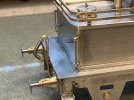
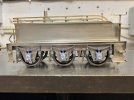
Good progress with the last Tender most of the bits are now on.
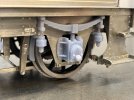
I’ve not built this Dean version before and did have a bit of a problem with the springs not fitting between the valance and the frames. After double checking the instructions it became clear that the only solution was to move the frames inwards as much as possible, but still leaving some clearance for the middle wheels to have some sideways movement. I added some plastic patches to give some insulation as it’s quite close to the bosses. With thinning the springs down it isn’t that noticeable when fitted. In hindsight if I do another one moving the valance out a bit as well would enable the springs to fit without any issues.
I’ve made up all the drawbars, with various turnings to suit the individual tender/locos.
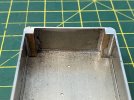
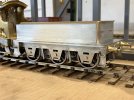
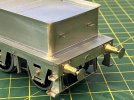
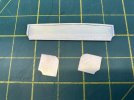
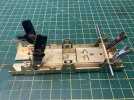
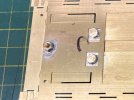
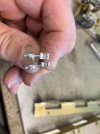
Next job is to have a look at the DCC chips, so the lump of plastic taped to the motor this is the maximum size available when looking at the chip sizes.

Simon
aGqOgRE.jpg
b7JdB3V.jpg
SjFBMtQ.jpg
SCbe9Zd.jpg
BBkttz6.jpg
8B33Zvk.jpg
yTPA0a1.jpg
 
Top