7mm Heybridge Basin

RichardG

Western Thunderer
Presumably there is a range of brightness from “too dull to see the detail” to “west end theatrical overload”, and presumably there is a range of acceptability dependent on the viewer

The best I can hope for is a bright overcast day. If I want to have shadows then I need a spotlight far enough away to keep them all pointing in the same direction. The layout does depict the south-facing aspect of Heybridge Basin, so shadows could at least be pointing in the right sort of direction.

I did this on my very first lighting rig, which was an array of small fluorescent tubes with an incandescent spot lamp in one corner. This was suspended from the ceiling above the layout, and the effect looked good. A bit of a challenge for a portable scheme.
 

Yorkshire Dave

Western Thunderer
Having a somewhat Teutonic mind when it comes to design I'd be inclined to mount a small project box at either end of the lighting bar to conceal the connections with two plugs and/or sockets in the ends. Of course by using two different types connectors it also makes the setting up foolproof. (When I used to build exhibition layouts I used multiple types of connectors - which avoided the need to label them - and made sure they could only be connected one way so anyone could set up the layout).

This would also give the lighting bar a degree of flexibility by being able to power it from either end depending upon the location of the power source.

Light.jpg
 

Yorkshire Dave

Western Thunderer
The best I can hope for is a bright overcast day. If I want to have shadows then I need a spotlight far enough away to keep them all pointing in the same direction. The layout does depict the south-facing aspect of Heybridge Basin, so shadows could at least be pointing in the right sort of direction.

Naturally, to do it properly you would require a sidereal drive to rotate the spotlight in order to reflect the time of day....:)
 

RichardG

Western Thunderer
Having a somewhat Teutonic mind when it comes to design I'd be inclined to mount a small project box at either end of the lighting bar to conceal the connections with two plugs and/or sockets in the ends.

The project box is a wonderful idea and I would be searching for one right now if I hadn't tidied up the cabling this morning :thumbs:

DSC_9282.jpeg
At least the cabling is black, and with the controller strapped up here there is only one cable to take off the rig.

DSC_9287.jpeg
Maybe I won't lose the remote if I make a home for it.

To be honest, the warm/cool buttons aren't labelled. So if the connections to the lighting bar get transposed, everything will still work.

I put the connections onto the lighting bar at this end so I can take some of the surplus DC power to a light above the fiddle yard. Eventually! I'm not so sure about duplicating the connections at both ends. I spent twenty years with an employer that insisted on building in "expansion features" which never got used. Something I never ever did after I started working for myself.

I am quite proud of this construction because it has a mildly "designed" look about it even though I made it up as I went along.
 
Last edited:

RichardG

Western Thunderer
Having a somewhat Teutonic mind when it comes to design I'd be inclined to mount a small project box at either end of the lighting bar to conceal the connections with two plugs and/or sockets in the ends.

I have bought five small project boxes. The surplus LED tape is going above the kitchen worktops (drivers have arrived) so two boxes for the kitchen to contain terminal blocks, two boxes for the rig and a spare.
 

RichardG

Western Thunderer
Presumably there is a range of brightness from “too dull to see the detail” to “west end theatrical overload”, and presumably there is a range of acceptability which will be very much dependent on the viewer, I know my vision improved when I had my cataract op, but it had been declining slowly from my youth anyway. I certainly need brighter modelling lights now than even five years ago.

Yes - very variable.

The output from my light bar does have a noticeable 'blue' element just like every other so-called white LED. I think this is something I have got to live with. I have my last remaining incandescent daylight simulation bulb in the celing pendant and when this blows the only incandescent bulb left in the room will be in the anglepoise lamp for the lathe. I will then be LED-only in the room.

But in truth, the blueness is only apparent when I darken the room and illuminate the layout with just the rig. In any normal environment, with the ceiling lights and even some daylight present, the effect of the rig is good. I don't have the look of mist and depth achieved by Gordon Gravett on Arun Quay, nor the gentle pastel shades of Trevor Nunn; but much of their work is in the modelling as much as the lighting.

At this time of the year, direct sunlight passes through the doorway and onto the layout, and this casts unwanted shadows onto the backdrop. Nevertheless, if I close the landing curtains (so some diffused daylight still comes in though the doorway) and return to the model, the layout looks much the same as before but without the shadows. So the rig tunes well to match the light of a sunny day but without suitably model-like shadows. The rig tunes down to look like an overcast day too.

DSC_9291.jpeg
On a freezing and foggy morning today, the double glazing separates the warm and cool parts of the rig. I have no idea how this is happening!

Still - I have probably achieved all I can hope for without going down the RGB route to do sunrise and sunset effects as well as daylight. I didn't try for these because I don't think I would use them much.

The adjustments of brightness and of colour temperature go beyond what I can enjoy using, and the quality of the light is good enough to show up the details and colours in the models without being conspicuous in its own right. The rig has completed a 24 hour soak test and it is still working, so I'll call this complete until I get the project boxes and tidy up the wiring.
 

magmouse

Western Thunderer
On a freezing and foggy morning today, the double glazing separates the warm and cool parts of the rig. I have no idea how this is happening!

My take is: each pane in the double glazing produces its own reflection, so if you are looking at an angle to the window, you will see two. The difference in colour will be to do with a slight tint to the window glass, which one reflection passes through and the other doesn't. The weather is only relevant to this in that it provides light conditions outside such that the reflections of the LED strip show up strongly and you have noticed them.

Thanks for updating us on this and sharing your experiences - very useful, especially as I am in the midst of experimenting with lighting myself.

Nick.
 

RichardG

Western Thunderer
Thanks for updating us on this and sharing your experiences - very useful, especially as I am in the midst of experimenting with lighting myself.

I have studied umpteen lighting rigs at shows. Some look really professional, some are pretty much half-baked.

We cannot go out and buy a RTR lighting rig, so the thing has to be home-made. I suppose, the choice of materials reduces to woods, metals and plastics.

At one extreme you can build something bespoke from "raw components" like perforated steel strip with fabricated brackets. I have seen this looking good on a large 7 mm layout; it is what it is so to speak and you immediately look away from the rig and back to the modelling.

At the other extreme you can lash something up with spot lamps clamped onto a bar or even (gulp) the backdrop. This might be the right thing if you only need the rig at shows and you rarely do shows.

I have seen the miniature rainwater goods sold for garden sheds used really well to build a floor-standing rig. I mean, it looked really good and I took a double-take when I realised what it was built from. I have seen the same products used really badly, where the result looked as though the same products were the only thing the builder could think of to use.

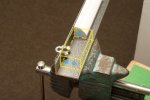
I suppose I have tried to find a middle ground where the supports are actual lighting equipment somewhat re-arranged for the task, and the lighting bar is bespoke. I like the slender look of the aluminium section. The aluminium is 30 x 20 x 2 mm and supplied ready-painted from Wickes. It is strong enough to let me have the supports near the ends, and I need to do this because the space for the supports is near the ends of the layout.

I do know, the thin-walled aluminium tubing will collapse if you try to bend it. So if you use this, you have to go down the route of clamps or suspension components (e.g. chain) to change direction. Steel tubing from something like an old gazebo is more likely to survive in a pipe bender.
 

simond

Western Thunderer
dependent on budget, musicians' / stage / disco light stands and bars are another possibility

a quick google found this which would probably be cheaper than some of the lash-ups that are seen around the shows. And it's designed to be portable. I'm sure there are many others.

BeamZ Lighting Truss Bridge Stand 3m wide, £160.

If that's too heavy-duty, they have tall tripods at ~ £60 and you could make your own crossbar
 

RichardG

Western Thunderer
The main thing for me is, the rig has become a part of the furniture. It is not pretty but it doesn’t look dreadfully out of place. Also it works; and so I can see the layout properly without carrying chunks outdoors into the garden. So it can stay, and I feel suitably encouraged to try for the farrier or blacksmith’s building and other scenery.

Then I would go for a very dark brown - almost black, but softer and less ‘dead’ than a true black. With a satin sheen, again, a soft finish (visually).

I have had a year to ponder the edge colour. I suppose I could go for a grey to match the lighting bar but somehow, I think a dark brown is better. I have “a layout” and “a lighting rig” and, although the rig stands on the layout, the two are separate things.

I am thinking, a brown to match up with the rails, or a darker brown to still tone with then.

These things take time!
 

PhilH

Western Thunderer
I have had a year to ponder the edge colour. I suppose I could go for a grey to match the lighting bar but somehow, I think a dark brown is better. I have “a layout” and “a lighting rig” and, although the rig stands on the layout, the two are separate things.

I am thinking, a brown to match up with the rails, or a darker brown to still tone with then.

These things take time!

Errr......didn't somebody in the distant past (I forget who) recommend - Dulux Weathershield Satin Conker, which gives a fairly dark brown colour, or Dulux Weathershield Satin Hazlenut Truffle which gives a slightly brighter shade of brown. The satin gives a good non glossy but serviceable finish.

Might be worth considering :)
 

RichardG

Western Thunderer
Going back to LED tapes for a moment . . . I bought an overlong tape for Heybridge Basin in case I needed to double it up to get enough light. This proved unnecessary so I am now using up the offcuts above my kitchen worktops.

The offcuts, by their nature, need wires attaching. This subject cropped up in conversation and can be quite fiddly.

DSC_9298.jpeg
I salvaged these two connector assemblies from some unwanted tapes I bought years ago. I don’t know what the connectors are called, but they do allow connecting up without soldering. The one in the foreground needs to be prised open before inserting the tape.

DSC_9302.jpeg
There are some tiny teeth inside the connector (just to the right of the pivot pin) which dig into the copper pads on the tape. These connectors are vastly easier to deal with than soldering.

While I am here, I am starting to think it is best to standardise on 24 volt tapes around the home. Simply because the LEDs draw half the current for the same brightness, so wiring is thinner and easier; and there is an opportunity to run double the length of tape.
 
Last edited:

RichardG

Western Thunderer
Morning, Richard,

I’m not really sure what a lumen looks like, and whilst I understand all the words, I’m not sure Wikipedia is a whole lot of use either.


if the output of the led strip is 700 lumens per metre, presumably that is per metre of length, and the light is evenly spread over the semicylinder on the lit side of the strip.

if your led strip is 0.65m from the layout, which is 400mm wide.
At that distance the semicylinder area would be 0.65 pi =~ 2m^2 per metre length

average illuminance would therefore be 700/2 = 350 lux.

I’ve no idea what that looks like either.

I guess there is a way, get an illuminance meter, and then with the curtains open on a sunny day, and with the room lights off at night, and various levels in between, measure at various brightness settings of your dimmer control, and see what seems about right, and then make a note of the settings depending on the ambient light. Lux meters are available from Amazon for just shy of £30, but there is at least half a dozen free iPhone apps, and I guess also for Android.

You could also use a camera light meter, but bearing in mind that the 350lux would only be reflected by the 0.4m depth of your baseboard, plus your backscene height. The rest of the light would be lost, illuminating your legs etc.

Presumably there is a range of brightness from “too dull to see the detail” to “west end theatrical overload”, and presumably there is a range of acceptability which will be very much dependent on the viewer, I know my vision improved when I had my cataract op, but it had been declining slowly from my youth anyway. I certainly need brighter modelling lights now than even five years ago.

I can foresee roving WTers sneaking up to exhibition layouts and measuring their brightness…

atb
Simon

I have found my light meter. I knew I had one but I wondered if it had gone to a charity shop.

Tonight, with the room blacked out, the rig projects a maximum of 150 lux onto the baseboard. This is immediately below the rig. Other readings are 140 lux at the back of the passenger platform and 110 lux at the front of the layout at the ends. These numbers are 14, 13 and 10 foot-candles for the metrically-impaired.

These figures are consistent across the warm to cool spectrum, although the warmer end looks subjectively brighter as I expected.

More usefully, if I turn on the general lighting in the room and turn down the brightness of the rig a few notches, I see 300, 180 and 150 lux in the same locations. A bigger spread, but the layout still looks (subjectively) well- and evenly-lit.

I have rounded all of these readings to two significant figures.

Something between 150 and 300 lux on the baseboard seems to make for comfortable viewing at the usual distance of around 0.6 to 0.8 metres.
 
Last edited:

Alan

Western Thunderer
I seem to remember Iain Rice suggested having lights at the back of the layout to kill shadows on the backscene and a light outside the front edge of the layout so that objects at the front of the layout were not back lit and if necessary lights down the middle of the layout.
 

RichardG

Western Thunderer
I seem to remember Iain Rice suggested having lights at the back of the layout to kill shadows on the backscene and a light outside the front edge of the layout so that objects at the front of the layout were not back lit and if necessary lights down the middle of the layout.

To be honest @Alan I think I have the shadows under control. The rig is well forward so its light catches the fronts of the baseboards, and the spread of light from front to back is very even - it looks good to me. The individual LEDs usually erase shadows from their neighbours.

DSC_9307.jpeg
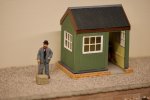
This is one of the worst shadows on Heybridge Basin. I have ideas to pop a white LED behind the shelter but the shadow may be less obrusive when the backdrop has some sort of illustration on it. Conversely I think the shadow inside the doorway is realistic; the location of the rig is good.

I don't know the circumstances which Iain Rice was describing. I have a near-cameo shelf layout (it has a roof but only one enclosed end) and I don't have any unwanted shadows here at all. The light from its LED tape goes directly onto the model and indirectly too by bouncing off the underneath of the roof.
 

magmouse

Western Thunderer
This is one of the worst shadows on Heybridge Basin.

Perhaps worth pointing out something that may not be immediately apparent - the edge of the shadow is quite hard at the top, and soft at the sides. This is because your light source is a line. The smaller the source, the harder the shadow, and in the case of an LED strip you have a source that is small on one axis (the width of the strip) and large on the other (the length of the strip). This type of shadow is very un-natural, so it is hard to make natural-looking light with LED tape or other linear sources such as fluorescent tubes. They are very practical, though.

I don't know the circumstances which Iain Rice was describing.

Remember Iain was writing at a time when the choice was filament lamps (small source) or fluorescents (ugly colour rendering). He used spotlights with filament lamps, which create hard shadows - that's why he put thought and care into minimising those shadows.

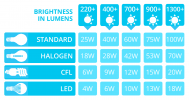
Lux, lumens and wattage of bulbs...I found this chart quite helpful during the household transition to new bulbs.

Yes, very useful - just be aware that the brightness of what is being lit will also depend on the distribution of the light. If the same total amount of light comes out equally in all directions, it will illuminate an area more dimly than if the same amount of light is focused onto that area only.

It is frustrating that LED tape specifications often don't give any indication of the angle of the light emitted - we know it will be no more (or very little more) than 180 degrees, since the light comes from one side of the flat tape, but after that, the specs often leave us, er..., in the dark.

it packs down into four normal sized artics…

Four trailers? Light-weights and dilettantes - proper rock and roll tours have far more than that!

Nick.
 

RichardG

Western Thunderer
Perhaps worth pointing out something that may not be immediately apparent - the edge of the shadow is quite hard at the top, and soft at the sides. This is because your light source is a line. The smaller the source, the harder the shadow, and in the case of an LED strip you have a source that is small on one axis (the width of the strip) and large on the other (the length of the strip). This type of shadow is very un-natural, so it is hard to make natural-looking light with LED tape or other linear sources such as fluorescent tubes. They are very practical, though.

PXL_20250307_120021403~3.jpg
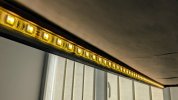
This is the bicolour strip on my shelf layout. A great deal of the light gets reflected from the roof down onto the layout, and there are no shadows.

I lined the roof with paper to set the colour of the reflector and this arrangement has always looked good. It is now on its second tape, the first one was cool white with every third LED painted with amber headlamp paint. Now I can adjust the temperature and the brightness.
 
Top