The summer of 1975 was a good opportunity to explore the railway byways of SW County Durham, and especially the further reaches of the Stockton and Darlington Railway network. Much of the media and enthusiast interest was focused then, as recently, on the central section of this line, and its true origins at Witton Park and Etherley, to the west, were overlooked. When the S and D's 'problem child', the Stanhope and Tyne Railway, is added to the picture, the true scale of this most famous of the early undertakings becomes apparent.
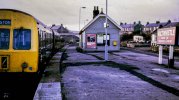
The sequence of pictures below was taken in July 1975 at Bishop Auckland Station, SE of Witton Park. The decline of what had once been a major railway junction with its notable and irreplaceable architecture was evident. The sensitivity that operators, NR, the RHT and rail partnerships now bring to bear on sites of this significance would come too late for the structures seen in these pictures.
In 1975, the footprint of the NER station remained intact. The platforms were located within a triangular junction serving routes to NW, W and E Durham, all these lines carrying heavy coal, mineral and quarry traffic, and the products of foundries and brickworks. The NW Durham coalfield produced high quality coking coal to the end. The OS 'Six Inch' sheet Durham XLII.NW of 1899 shows the station area to advantage and underlines its importance. it may be viewed at maps.nls.uk/view/10100227.
The first picture looks E from the platform end on the side of the triangle served by lines entering from Darlington and Barnard Castle (and from E Cumberland via Kirkby Stephen East and the famous Bleath Gill Cutting). These lines meet at a junction just beyond the road bridge in the R distance. The magnificent single-road glazed train shed for passenger services on these routes is accessed via a loop from the double-track freight avoiding lines seen on the far R. The platform road is seen in disuse, with the loop cut off to provide a storage siding. The original track layour reflected the priority given to freight and mineral traffic, for the lines on the R are heading for Wear Valley Junction, where they divide to serve iron and steel works, coal mines and quarries on the hilly route to Tow Law and Consett, and the Wear Valley line via Wolsingham and Eastgate to Wearhead.
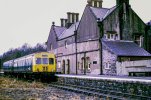
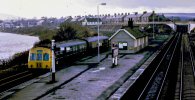
The second picture looks N from the platform on the second side of the triangle, served on this occasion by a DMU from Darlington, but the platform was originally the destination of services from Durham, via Relly Mill Junction, Brandon, Brancepeth and Willington. Passenger access is by means of a covered ramp to the forecourt at the road level of the bridge seen just beyond the DMU.
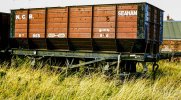
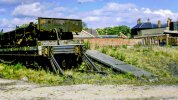
The third picture looks NE from the trackbed on the third side of the triangle, where lifting of lines has taken place. Here, another pair of goods avoiding lines enabled through freight trains from Durham to reach Wear Valley Junction and vice versa. Although the photo appears to show a platform ramp, this is a goods loading bay. There was a splay of sidings here, on what appears to be a bolster wagon is carrying the remains of another vehicle: others will be able to interpret this far more expertly than me. The stop block has been used to truncate the one-time loop siding, now only accessible from a stub at the N end. The principal goods facility at Bishop Auckland was located at the N end of the station, off the Durham 'main line'.
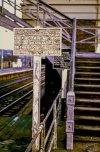
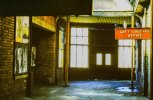
The fourth picture shows the fine porch on the station forecourt at the entry to the covered ramp down to the platform at which the DMU is standing in picture 2. An original NER structure, its glazing, ornamental brickwork and ornate gas lamp bracket, with still-operating gas mantle, are worthy of note. The fifth picture depicts the interior of the covered ramp, looking up to the porch: the NER glazed tiles and the structure of the glazed roof are evident. While this entrance was still very much in use, the next picture shows the former principal ticket office entry, which was clearly not: it merely reinforced a general air of desperation and decay. The sign has retained its BR (NER) paintwork and is now a pigeon perch.
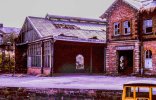
The seventh picture is taken from the sole operational platform and shows the N end of the train shed on the Wear Valley Junction line and its attached- and once grand- main station building. No trace of this impressive piece of railway history, at the hub of a dense network of industrial lines, survives. The yellow Pway vehicle was involved in the lifting of the very few remaining sidings and stubs: the only working lines from Bishop Auckland that July were those to Darlington and Eastgate. All others had been lifted.
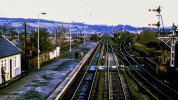
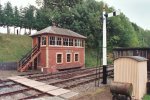
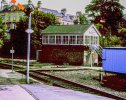
The final picture shows the substantial Bishop Auckland East signal box, now controlling the goods avoiding line behind it to Wear Valley Junction; the siding into the train shed; and the platform line from Darlington.
I hope there's something in the photo set below of value to NER modellers, or to those seeking to recreate a similar scene on a BR backwater in the 1970s.



The sequence of pictures below was taken in July 1975 at Bishop Auckland Station, SE of Witton Park. The decline of what had once been a major railway junction with its notable and irreplaceable architecture was evident. The sensitivity that operators, NR, the RHT and rail partnerships now bring to bear on sites of this significance would come too late for the structures seen in these pictures.
In 1975, the footprint of the NER station remained intact. The platforms were located within a triangular junction serving routes to NW, W and E Durham, all these lines carrying heavy coal, mineral and quarry traffic, and the products of foundries and brickworks. The NW Durham coalfield produced high quality coking coal to the end. The OS 'Six Inch' sheet Durham XLII.NW of 1899 shows the station area to advantage and underlines its importance. it may be viewed at maps.nls.uk/view/10100227.
The first picture looks E from the platform end on the side of the triangle served by lines entering from Darlington and Barnard Castle (and from E Cumberland via Kirkby Stephen East and the famous Bleath Gill Cutting). These lines meet at a junction just beyond the road bridge in the R distance. The magnificent single-road glazed train shed for passenger services on these routes is accessed via a loop from the double-track freight avoiding lines seen on the far R. The platform road is seen in disuse, with the loop cut off to provide a storage siding. The original track layour reflected the priority given to freight and mineral traffic, for the lines on the R are heading for Wear Valley Junction, where they divide to serve iron and steel works, coal mines and quarries on the hilly route to Tow Law and Consett, and the Wear Valley line via Wolsingham and Eastgate to Wearhead.
The second picture looks N from the platform on the second side of the triangle, served on this occasion by a DMU from Darlington, but the platform was originally the destination of services from Durham, via Relly Mill Junction, Brandon, Brancepeth and Willington. Passenger access is by means of a covered ramp to the forecourt at the road level of the bridge seen just beyond the DMU.
The third picture looks NE from the trackbed on the third side of the triangle, where lifting of lines has taken place. Here, another pair of goods avoiding lines enabled through freight trains from Durham to reach Wear Valley Junction and vice versa. Although the photo appears to show a platform ramp, this is a goods loading bay. There was a splay of sidings here, on what appears to be a bolster wagon is carrying the remains of another vehicle: others will be able to interpret this far more expertly than me. The stop block has been used to truncate the one-time loop siding, now only accessible from a stub at the N end. The principal goods facility at Bishop Auckland was located at the N end of the station, off the Durham 'main line'.
The fourth picture shows the fine porch on the station forecourt at the entry to the covered ramp down to the platform at which the DMU is standing in picture 2. An original NER structure, its glazing, ornamental brickwork and ornate gas lamp bracket, with still-operating gas mantle, are worthy of note. The fifth picture depicts the interior of the covered ramp, looking up to the porch: the NER glazed tiles and the structure of the glazed roof are evident. While this entrance was still very much in use, the next picture shows the former principal ticket office entry, which was clearly not: it merely reinforced a general air of desperation and decay. The sign has retained its BR (NER) paintwork and is now a pigeon perch.
The seventh picture is taken from the sole operational platform and shows the N end of the train shed on the Wear Valley Junction line and its attached- and once grand- main station building. No trace of this impressive piece of railway history, at the hub of a dense network of industrial lines, survives. The yellow Pway vehicle was involved in the lifting of the very few remaining sidings and stubs: the only working lines from Bishop Auckland that July were those to Darlington and Eastgate. All others had been lifted.
The final picture shows the substantial Bishop Auckland East signal box, now controlling the goods avoiding line behind it to Wear Valley Junction; the siding into the train shed; and the platform line from Darlington.
I hope there's something in the photo set below of value to NER modellers, or to those seeking to recreate a similar scene on a BR backwater in the 1970s.