HDSmith's Photos

HDSmith

Member
I much appreciated the kind welcome to Western Thunder. By way of thanks, I've started this thread of a selection of my personal photographs that I hope may be of historical and/or modelling interest. They're all copyrighted to me, but if you'd like to reproduce them elsewhere, please PM me. I'll add to the thread at intervals.

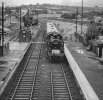
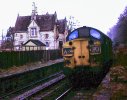
Today's contribution is a picture taken in (I believe) August of 1968 at Defiance Platform, Wearde, on the Cornwall main line just west of Saltash. The large signal box was in the process of demolition, with the interior littered with old copies of the Weekly Notices. On the right is the large water tank for the supply of the water column still in place in the loop siding behind the photographer (me). Wearde was a turn-back point for Plymouth area auto-trains services, and the platforms here (1 March 1905 to 27 October 1930) were principally used by RN personnel based at the training vessel HMS Defiance. The platform structures and access stairs from the adjacent road bridge over the line were still extant when the picture was taken.

The location was especially vulnerable in WW2, being a short distance across the Hamoaze from major RN installations, and the signalbox occupants took shelter during air raids in an old level of Wheal Harrison, a trial for antimony, with its shaft and lower levels on Wearde Quay below. The construction of the Cornwall Railway here, and the subsequent GWR widening and diversion inland, had cut through Wheal Harrison's workings, and left the inner end of the shallowest level exposed in the cutting side opposite the Box.

Hidden by the Box is the access to the carriage siding that reached down to the very edge of a wide tidal creek. This was actually the stub of the lifted broad-gauge coastal route of the CR to St Germans, and was actually the approach to the former Forder timber viaduct, demolished when the GWR opened the new inland route in 1908.

I'm sure there's much more to pick over in the view, especially for admirers of BR (W) diesel traction.1968 Defiance Halt, Wearde1.jpg
 

HDSmith

Member
Thank you for your kind appreciation of the Defiance Halt photo.

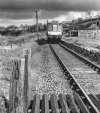
Today's picture was taken in late October 1966, and shows a Plymouth Division 2-car DMU passing the site of the long-closed Sevenstones Halt on the Callington to Gunnislake section of the Bere Alston-Callington branch line. The train is moving away from the camera and is en route to Chilsworthy Halt efore reaching Gunnislake, the principal intermediate station.

The permanent way is in excellent order as the line had only recently been relaid, but a week after I took this photograph, the Gunnislake to Callington section of the line was closed and lifted. Although it may not be immediately obvious, this was a line that had served an intensely industrial environment, in two phases of its life. Firstly, as the 3'6" gauge East Cornwall Minerals Railway (1872) running from the Quays at Calstock- a commercial and Packet port on the Tamar- through the Gunnislake mining and quarrying district to the mines at Kelly Bray, outside Callington; secondly, as the Bere Alston and Callington Railway (1908-1966), converted to standard gauge and via a connecting deviation across the new concrete Calstock Viaduct to the main line at Bere Alston. in 1966, there was evidence of the line's operation by the PDSWJR, the LSWR, and the SR in many quiet trackside spots, this location being one.

Immediately to the left and right of the DMU, in the distance, are the buildings of the Greenhill Arsenic Works (1875-1925), with its landmark tall stack. The works processed crushed arsenic ores from nearby mines using burning and smelting equipment, and was served by an ECMR/BAC siding. The refined arsenic was packed into casks there and loaded into open rail wagons bound for Calstock Quay via the original ECMR Incline or, after gauge conversion, by means of a wagon lift adjoining the new viaduct. From Calstock, the arsenic was shipped to Greece and South America for use in insecticide and sheep dips; an exceptionally pure form was produced at Greenhill for the British drug industry. The works chimney stack survived intact until 1989, when it was struck by lightning and greatly reduced in height.

Sevenstones Halt, whose platform face is seen in the picture, opened in June 1910 to serve the Phoenix Pleasure Grounds, much visited by Sunday School parties from Plymouth. Alongside the Pleasure Grounds was the Phoenix Brick and Tile Works, again rail-served, which exported tiles to Russia in the 1870s. A quarter-mile up the line towards Callington was the Plymouth Brick and Tile Works, with its huge 1919-built circular kiln and associated clay pit with narrow-gauge tramway. In September 1917, in the depths of WW1, the Phoenix Pleasure Grounds ceased business and Sevenstones Halt, its raison d'etre gone, closed for ever.

As with all of the road crossings on the line between Callington and Calstock, the Sevenstones crossing where this picture was taken was ungated, protected only by cast-iron signs from the LSWR era, as I recall, with the letters 'L' and 'W' painted out. In the driving rain and beneath low cloud, this was 1966 Sevenstones Halt with DMU for Bere Alston-2.jpga haunting location.
 

HDSmith

Member
This is Minions Goods Depot (GWR Station Number 2161) at the head of the Caradon Branch from Moorswater, in SE Cornwall, and amid the Caradon mining and quarrying district. My picture was taken on a February morning in 2008. Minions (or Rillaton) Depot was operated by the LIskeard and Caradon Railway (1844-1909), the Liskeard and Looe Railway (1860-1923) and the GWR (1909-1931 with some land ownership maintained to 1948).

The Depot, whose foundations are seen RC, was built in around 1880 as the earlier 1844 and 1885 lines down from Cheesewring Quarry and the Kilmar Tor quarries were rationalised. Cheesewring Siding enters from the L to terminate on the low stone embankment RC. Immediately behind this embankment is a grass-covered mound of demolition debris: this is all that remains of the stone-built Depot building, which had a slate roof and a short timber-built lineside platform. Wagons were loaded/unloaded at the platform, the goods then being transhipped through sliding doors onto what was the first floor of the building. The ground floor was accessible to carts at the lower rear, these arriving and departing via a turning circle and cart track still visible on the open ground falling away to the L of the picture.

LC is an earlier stone-built low platform, typical of those used to load rail wagons with moorstone.

Rail connection with the 'main' Caradon branch is complex here, but a kickback spur, out of frame L, linked the Depot to a hgeadshunt on the remaining stub of the Kilmar Railway from Minions to Sharptor Depot on moorland edge. A reversal, with Stop Board, at this headshunt enabled trains to follow the 1860 Kilmar Junction route round Caradon Hill (L background) by crossing the Upton Cross road on Rillaton Bridge (GWR Bridge Number 22 and demolished 1 April 1945 by the Royal Engineers).

The last GWR WTT for services to Minions expired in October 1916 (one train daily T W Th, run as required) and tracklifting for the War Effort began almost immediately from here in appalling weather. By November 1916 lifting had already reached St Cleer Depot. By February 1917, the Plymouth Division CE's Lengthsmen who, in 1909-1913 had completely relaid the life-expired L & CR track from Moorswater to Minions with standard GWR bullhead rail and timber sleepers, check-railed the notoriously tight curves, and installed a loop siding at St Cleer, had lifted it all again. These men were then laid off.

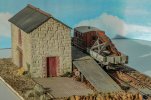
In 1923, Felix Pole, GWR General Manager, discreetly informed the Company's Chief Engineer, J C Lloyd, that there were no plans to relay the Caradon Branch. Official Abandonment followed in the 1931 GWR Act. Minions Depot remained largely intact until at least 1946. My inadequate attempt to capture its spirit in 4mm scale some years ago is attached herewith- photo by courtesy of the late Dave Bushell.

A 1934 photograph of MInions Depot by D S Barrie, then recently appointed to the Publicity Staff of the LMS, may be found on p67 of Railways of Looe and Caradon by Tolson, Roose and Whetmath (1974) or on p119 of Caradon and Looe- the Canal, Railways and Mines by Messenger (2001).Photo21_17A-2.jpgD30_7661c-2-2.jpg
 

HDSmith

Member
Despite the weather, it is July 1965, and the centenary of the opening of the SDR/GWR Tavistock to Launceston line. The oncoming train is a Great Western Society special to mark the occasion, and it is approaching Lydford on the LSWR/SR main line from Okehampton. The later 1890 LSWR station here lies alongside the GWR station, sharing one common platform on the W and out of frame L).

The train has had to access Lydford on the former SR system as the WR branch from Marsh Mills via Tavistock (S) as far as the 19m 11ch point immediately S of the WR/SR crossover beyond the station platforms had been lifted the previous year. It will come to a stand at the Down platform (R), passengers will detrain, and the empty stock will be moved forward to negotiate the crossover onto GW metals. The train will then be propelled into the GW platform road, where 41283 will run round. Passengers will then board the special, which will set off northwards then westwards on the remaining stub of the branch to Launceston, another joint station. This onward journey to Launceston is possible because the GW line has been retained from Lydford as a goods-only facility to serve principally the Ambrosia factory at Lifton.

It can be argued that events in WW2 also made it possible for the GWS to operate this train, as the passenger-rated crossover S of the station was installed in May 1943 to allow wartime re-routing to and from Plymouth in the event of enemy action.; the crossover at St Budeaux between the same routes is contemporary. Also visible in my photo- taken from the passenger footbridge- is the WW2 fan of sidings installed on the Down side for the use of the US Army prior to D Day. A further such array was laid at the same time between the SR and GWR lines immediately S of the wartime crossover.

In the upper L of the view is the common goods yard at Lydford. By negotiating six sets of points - very carefully- in this yard, it was possible prior to 1943 to transfer between the GWR and SR lines, but one guesses very rarely and certainly not with passenger stock.

41283, built at Crewe in 1950, survived only a matter of months after this photo was taken. Withdrawn from Templecombe in March 1966, she was cut up at Cohens yard in Swansea on 31 May that year.Lydford 1965e-2.jpg
 

HDSmith

Member
Thank you for your continued interest in the thread.

In the first week of June 2005, and with special permission, I photographed the remaining military railway infrastructure of what was once the Central Engineer Park of the Royal Engineers at Long Marston, in Warwickshire. Established in 1940 on a greenfield site adjacent to the GWR Honeybourne to Stratford main line at Long Marston Station, the CEP developed three specific roles: the holding in readiness of the MoD's reserves of bridging, plant and Engineer stores; the repair and maintenance of Engineer materiel; and acting as a Centre of Engineer training and practice.

At its maximum, the CEP occupied 487 acres and was served by 45 miles of railway track (sidings and main service routes). This internal network was linked to the GWR/BR(W) main line via exchange sidings immediately E of Long Marston Station. Residential quarters and admin buildings constituted what was virtually a small town, together with huge storage buildings, workshops and a power station. The site is remembered for its stock of Bailey Bridges, supplied in number for D-Day and subsequently, and the further involvement in the Falklands and Gulf War conflicts. A long kick-back internal branch line served the civilian Bird's Scrap Metal facility on a redundant part of the CEP, where both BR and Army motive power and rolling stock met their ends.

CEP Long Marston was decommissioned in 1999 and had been cleared of its contents when I visited in 2005. The exchange sidings and a portion of the RE rail system now form Porterbrook's Rail Innovation Centre, linked to the surviving stub of the Stratford line from Honeybourne. The remainder of the site has been transformed by St Modwen Developments to create Meon Vale, a new mixed business, storage and residential centre with sensitive and imaginative landscaping.

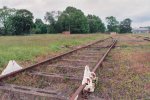
The June 2005 view was taken a short distance N of the Gatehouse to the CEP and shows the open LC where the principal orbital rail route crossed one of many internal roads. All the LCs on site were signed and designed to this pattern. Out of frame L is Warehouse 37 and the open storage ground for Bailey Bridge components. The end of what was once a pair of sidings may be seen behind the white Give Way to Trains sign: this was the destination of VIP passenger trains. R, behind the security fence line and row of trees, is the Sports Ground, equipped with a pavilion.

My March 2026 view is taken at approximately the same location on what is now Bailey Avenue in Meon Vale. Only the tall tree N of the modern lamp standard, the curvature of the road and the line of the low wooden barrier mark this as the site of the LC. However, the Sports Ground survives as the community recreation field, complete with the Pavilion - albeit the latter is a new construction on the same site, where it accommodates a community cafe and meeting space, open to the public from Tues-Sat weekly. Buses turn where once trains crossed, and a large Primary School, out of frame L, stands in the place of Warehouse 37.

My full record of Central Engineer Park captured some settings of modelling and operational interest, and I will add these to the thread soon.

I am grateful to King Sturge, agents for Defence Estates, and to St Modwen Developments for their full assistance in 2005. The 2026 photograph has had personally identifiable imagery digitally removed.008_5A.jpg_DSC0001_4707.jpg
 

HDSmith

Member
To complete the posting on CEP Long Marston, I've added a few detailed views below. I hope the narrative matches the sequence- if not, apologies for my own lack of skill!

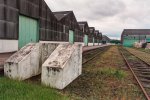
The first photo shows a trap (or should that be 'catch'?) point on the siding running downwards to Shed 33 on the S of the CEP. The gradient, compared with the lines running to Sheds 39-41, is marked. The mechanism was intact and functional on the occasion of my visit. The photo has been digitally adjusted to remove some identifiable background.

The second photo looks NE towards what I believe to be Shed 37 and shows a pair of hinged scotches bolted to a running line. These could be found elsewhere on the CEP where they had been used to prevent rolling stock over-running towards the closed roller doors of rail-served Sheds. Of interest here are the lightweight cast concrete sleepers and the bolted clips used to secure the FB rail to them. In the L distance is a substantial end-loading ramp for military vehicles and the mast and transmitter hut for the site RT system. The area is one of the extensive stacking yards.

The third picture shows Sheds 31 and 32, looking SW. The massive reinforced concrete stop block at the end of the associated siding may be of interest to modellers. This set of buildings was constructed in around 1951 during an expansion of the facility: earlier phases had slightly different, though equally robust, designs.

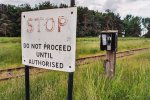
The fourth photo shows the movement control system for the 487-acre site. Train movements between yards and to and from the exchange sidings were managed by means of the Plessey telephone boxes, one of which is shown here, and the official plan of the site marks the zones where telephone permissions for movements are required. The site phones were connected to the two-storey Control Office at the Exchange Sidings, which is still extant, although now considerably modernised for use by Porterbrook. The Linesmen's Room was on the ground floor.

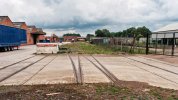
The last photo looks NE between Sheds 21-23 and 59-63 and shows some excellent inset track at a crossover between sidings. The alterations here - the stop block is clearly not in its original location- represent RE adjustments to the layout rather than the later changes resulting from the site's transfer to private ownership as a secure storage facility.

Finally, and not shown on any of these views is the RE practice of marking the fouling points on the approaches to switches by painting the relevant sleepers white. Given the stabling of long rakes of wagons, this was a useful technique, and one I borrowed for my own garden railway.017_14B-2.jpg025_22A.jpg026_23A.jpg019_16B.jpg011_8B.jpg
 
Last edited:

PhilH

Western Thunderer
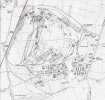
A plan of the depot was posted in my industrial railway thread, which may be of use in identifying the location of some of these photos, although unfortunately not all the shed numbers mentioned are shown:

Long Marston Map B.jpg

The plan was supplied during one of the two visits organised by the Industrial Railway Society in 1972 and 1977, photos from which are posted here:
Prototype - PhilH's Industrial Railway Photos Posts #26 and #29
 

HDSmith

Member
Thanks, Phil, that's very helpful. My official plan and full set of pictures are with Warwickshire County Record Office and I used an annotated OS 1:25 000 Map when I visited the site to protect the original.
 

HDSmith

Member
Thank you for the link and for the interest, Paul. It's becoming harder by the day to judge the sheer scale of the rail operation at CEP and rolling stock/motive power audits of the site like yours are invaluable. At the moment, only the road names at Meon Vale commemorate the role of the RE there and as the new housing and other developments - very well-designed though they are - occupy more of the site, one feels that a suitable plaque might be in order. Less well-known is the occupation of the NE area of the CEP by corps of the Polish Army and their families in Nissen hutments at the end of WW2: the very special church they created from a Nissen hut here has long vanished.
 

hrmspaul

Western Thunderer
I know I am going OT and political but I have been "amused" by the recent suggestions that the UK should suddenly step up domestic production of munitions, have naval ships suddenly ready for war etc. I only went to a few RoF and MoD sites, but I suspect few of where I went are still extant.

Certainly the huge RoF site at Bishopton which was capable of manufacturing various precursor chemicals as well as doing shell filling etc when we visited is now a vast housing estate, (much to be developed if Google maps is correct and wildlife parks). There is even the report on the internet of how to redevelop this site. It had a huge station which the guy taking us around (he had worked there for 40 years) claimed he had never seen. IIRC it was 10 sq. miles and they claimed there was a golden eagle nest on the site - although I didn't believe this. I drove 10 miles within the site. Royal Ordnance Factory Bishopton [other sites in Internal User & revenue Wagons at Private sites])

Paul - and apologies and I expect this will be removed.
 

HDSmith

Member
It is the late evening of Sunday, 5 May 1968, in what are the final hours of passenger services on the SR main line from Plymouth to Okehampton. The picture below was taken at a few seconds' notice at Bridestowe Station, a short distance S of Meldon Viaduct on the Tavistock (North) to Okehampton section of the line.

A brief piece in the 'Western Morning News' during the previous week persuaded my father and I to make the long trip to Bridestowe to see the last passenger train go through one of our favourite locations. We arrived early in decent evening light and I took some final pictures, but this final service was running late, and the sun was setting quickly, when we heard tyhe train approaching from the Tavistock direction. We both fully expected it to stop. It didn't, and as can be seen from the exhaust, it was wasting no time. All I could do was turn, press the shutter release, and hope for the best. I did all my own darkroom processing at that time and the picture below is the result.

We were the only people present. The station is on the slopes of N Dartmoor, two-and-a-half miles SE of the village it served via Station Road, seen crossing the line on the stone bridge behind the Exmouth Junction concrete footbridge. Opened with the line in 1874, the station possessed a goods yard (closed 1961), a signal box (closed 1964) and, via a private siding, a junction with the Rattlebrook Peat Tramway, which reached deep into the Moor to serve industrial-scale peat ties and a processing works until 1932. We had often walked the trackbed of the Tramway on our Moorland explorations. The station house is typical of the substantial buildings still found at Brentor, Tavistock North, Bere Alston, Bere Ferrers and Tamerton Foliot. By the time of our evening farewell, Bridestowe was an unstaffed Halt, but retained evidence of its LSWR, SR and BR(S) heritage.

Perhaps the final indignity for the train in the picture was that it had not commenced at Plymouth (Friary) and travelled through the joint station at North Road to reach Devonport (Kings Road) and Ford to St Budeaux (Victoria Road) and beyond. It had instead left North Road, travelling via the GWR route to the wartime crossover at St Budeaux, where it accessed the SR's former main line station on Victoria Road.

Back to school for me the following morning.
Bridestowe 1966 Last Train.jpg
 

HDSmith

Member
It is early in September, 1964, and I am a passenger with hundreds of other 'O' Level pupils, on an Excursion train organised by Cornwall County Eduction Committee to see Othello at the RSC in Stratford-on-Avon, as the play was set on the English Literature sy;labus that year. The train had picked up school groups from the main line stations in Cornwall in the early morning and proceeded non-stop via Bristol (Temple Meads), Cheltenham Lansdown Junction, Cheltenham (Racecourse), Honeybourne Junction and Long Marston to Stratford. As this was a rare opportunity I had my camera with me, and I pressed it up against the carriage window as we passed slowly through Stoke Gifford, N of Temple Meads, to capture a rarity on the WR. Ex-GWR Pannier 4666 was shunting Conflats in the extensive sidings there. And then we were gone, moving on eastwards.

Although we arrived in Stratford in good time to see the play, the journey was operated at a slow pace all the way there and back by (I think) a Class 45 diesel: one interminable wait at an adverse signal approaching Cornwood Viaduct, between Plymouth and Ivybridge, remains in the mind. I also recall dereliction at every station between Cheltenham and Stratford. It would be 40 years before I renewed my acquaintance with this route by walking along a section of it, in its life as a Greenway from Long Marston to Stratford, with my wife and our children.

The picture poses a question. 4666, whose claim to fame would be her reincarnation as a 4mm-scale Bachmann Branchline model, was built in December 1943 for the GWR. From 1959, she was allocated to Exmouth Juntion - in actuality Wadebridge- to work Bodmin (North) to Padstow services on the ex-LSWR routes. One account has her withdrawn from service in July 1964. She clearly wasn't, as here she is working at Stoke Gifford in September of that year. Another resource records her being cut up on 28 July 1965 at Ward's in Briton Ferry. What, I wonder, is the truth?

1964 Stoke Gifford Loco 4666.jpg
 

HDSmith

Member
Your photo tells the truth!. BR condemnation records, for both locos and stock are not 100% reliable.

Paul
Thank you, Paul. I've double-checked my travel date as far as possible and I definitely travelled (slowly) through in September 1964. For those who aren't aware, Stoke Gifford sidings are now occupied by Bristol (Parkway) Station. Thanks again.
 

daifly

Western Thunderer
4666 was still going strong in February 1965. Here she is on an LCGB Railtour on 28th Feb 1965:
East Devon (No.1)
A photo in my collection shows that the loco had an 83D plate (Exmouth Junction or a sub-shed) on that day.
Dave
 

HDSmith

Member
Dave, thank you- it's good to know 4666 continued in service for a while longer after I saw her at Stoke Gifford. She was nothing if not versatile, it seems!
 

HDSmith

Member
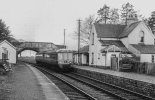
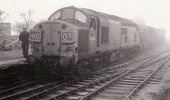
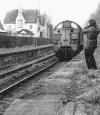
It is the half-term break in February 1975 in County Durham, and we have driven in our Minivan early one morning to witness the weekly pick-up goods arriving at Eastgate Station in Weardale. It is literally freezing cold, with dense fog filling the valley, and it is around eight am when the train appears out of the murk. We've been welcomed by the residents of the station house as we waited. 'English Electric' 37 036 is based at Thornaby and was built as D6736 at the Vulcan Foundry works in 1961. She will later be named Hartlepool Pipe Mill , and long after she parts company with us at Eastgate, will work out her days in East Anglia.

The travelling Shunter on the platform is about to uncouple 37 036 from her short train so that she can collect a single wagon of foundry sand from a stub siding accessed from the loop seen in the photograph.

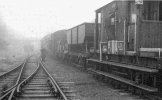
The second photograph is taken in the tiny goods yard at Eastgate. Walking back towards his van is the Goods Guard, who will secure his train prior to 37 036 (dimly seen at the head) running forward, then reversing into the loop to enter the siding seen diverging L. A deposit of foundry sand had been exploited here for decades: Wolsingham, down the line from us, had a long-established Iron and Steelworks that utilised local coal, limestone, ganister and foundry sand for casting, all rail-supplied. by 1975, one load of this sand, tipped by lorry into an open wagon standing at a loading ramp on this siding is sufficient to meet demand.

Eastgate was not the original railhead of the Weardale Branch from Bishop Auckland. The line, opened by the NER in 1895, terminated at the remote settlement of Wearhead at the western end of the dale. Throughout its length, sidings, inclined planes and aerial ropeways connected it with lead mines, fluorspar workings, and limestone and ganister quarries With a sparse population to serve, it is no surprise that passenger services were withdrawn in 1953, and by 1968 the line had been cut back to Eastgate. The opening of the huge Eastgate Cement Works, which extracted local limestone, was the saving grace of the remainder of the Weardale Branch, with a short stretch of the line being reinstated to serve the new plant with bulk cement trains.

The third picture was taken at Wolsingham Station, a little later in the morning. It was however still cold and foggy. The family who had moved into the station house came out to meet us and invited us in for a cooked breakfast, typical of the welcome and generosity we received that day. After breakfast, we enjoyed a tour of the signal box. There was much on view for the NER modeller, with the box constructed as a lean-to structure against the retaining wall of the cutting. Note the very tall brick chimney to gain some draught for the box's coal stove, and the NER cast iron trespass sign.

The fourth picture shows the substantial station building at Wolsingham, which was the principal station on the line. Mrs HDSmith is capturing the arrival of another EE '37', running light engine up to the Cement Works. Her picture, taken on her Kodak 110 cassette camera , is in colour.

The final picture is taken from the cab of the unidentified '37' seen arriving to collect the token for the line up to Eastgate Cement Works. The Shunter, who travelled in the rear cab, is opening the gates at what I believe to be Broadwood Crossing, near Frosterley, where there were once huge quarries.

It was a day to remember. 37 036, met with in the fog at Eastgate, survived until 2023, when she was scrapped at Allsop's of Colwick. Reputedly, parts of her survive as spares. Eastgate Cement Works ceased production in 1993 and the bulk cement trains became a thing of the recent past. The line from Eastgate to Stanhope is mothballed but 'heritage' services from Bishop Auckland to the latter station are operated by the Weardale Railway, itself part of an effective regeneration programme for Bishop Auckland that has reinvigorated earler efforts to secure the line. The atmosphere and practice seen in these photos is however long gone.


1975 Feb Eastgate Pickup gds1.jpg1975 Feb Eastgate Pickup gds2.jpg1975 Feb Wolsingham Station.jpg1975 Feb Wolsingham Cement empties1.jpg2011-10-02_12.jpg1975 Feb Wolsingham Cement empties2.jpg
 
Last edited:
Top