Grahame's N/2mm London Bridge train set

grahame

Western Thunderer
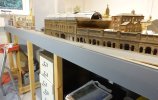
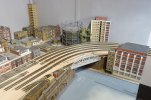
I seem to be revitalised and keen to get on with some constructive modelling although I've got to go to the hospital today. However, I've started on undertaking a little development on the layout. I've added a some details, basically a back wall, to the end building of demolition site at the front of the layout as I was a little concerned that the terrace end wall appeared very dangerous and unsupported, as well as some skips. I need to do a little more detailing here but compare with the pic above of the same scene taken from a similar viewpoint;

DSC08493red.jpg

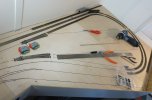
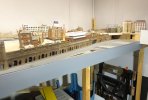
I've also cleared the off-scene area which will be the east end fiddle-yard and return loops. This is to enable planning and track laying. I've purchased some small flange head screws to hold down the track by clamping down on the sleeper ends. Here's a pic of the area although nothing is fixed. The two return loops are Peco radius 3 and 4 (11.75" and 13" - double that for a 4mm/OO equivalent). That's the largest radii for their setrack curves.

DSC08492red.jpg
 

grahame

Western Thunderer
Yesterday I painted the front fascia of the layout with a grey primer/undercoat and gave that a protective coat of satin varnish. It was only a small job but one I'd been planning to do for a while. The buildings and structures near the front edge were piled up on the viaduct making it look rather messy.

DSC08498red.jpg

DSC08499red.jpg

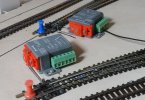
My plan is to use the MTB MP1 slow action servo point motors for point operation on the layout, analogue controlled by SPDT switches. They have a built in switch which I'll use for powering the frog. The motors and switches are small and can operate on DC or AC.

DSC05328cr.jpg

For the off-scene return loop/fiddle-yards they'll be surface mounted while the on-scene ones will, hopefully be located under the track-bed baseboard which are all on the viaduct. The points will be grouped on sections that are removeable for any maintenance/repairs. This morning I've made a start on some of the return loops/fiddle-yard track and points planning.

DSC08501red.jpg
 

grahame

Western Thunderer
I've managed to get some more track roughly laid but I'm out of track pins and have had to order some to be able to get the track fixed accurately in place. Consequently I can't progress track laying until they arrive.

DSC08503red.jpg

However, I've located all my electrical wire spools and have transferred them to a drawer in the shed ready for quick and easy access when needed for soldering track feeds. I've also set up a pack of six MP1 point motors for 3mm throws (to make them suitable for N gauge). You need to remove the baseplate and slider, them move the tiny actuating pin to a new location, and reassemble. It looks and sounds trickier and fiddlier than it actually was.
 

grahame

Western Thunderer
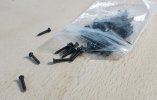
As well as track pins, I also ordered some 8mm track screws which arrived at lunchtime yesterday (but not the pins). They are tiny but quite suitable for N gauge track in the fiddle-yard. Obviously the heads show, so they wouldn't be appropriate on the scenic area, but it does allows for easy repositioning if required.

DSC08505red.jpg

To accept the screws I 'drilled' a hole in the sleepers using the pointed end of a scalpel with a 10a blade fitted (see below).

DSC08506red.jpg

I've now got all the track down in that east end fiddle-yard/return loops area, including the sidings, with just long lengths of track from the scenic area, across the curved section of viaduct, to lay and join up. But being on the scenic section I need track pins to lay the track which haven't turned up yet.

However, while in the shed it started snowing. Initially I thought it wouldn't settle as it had been raining and the ground was very wet, but it started coming down heavier and thicker and started to settle. I didn't fancy traipsing through the snow in my house slippers so I've come indoors. Typically, since then, it's stopped snowing and has all melted although I've not yet gone back out. The trials and tribulations of being a track ganger!
 

grahame

Western Thunderer
Yesterday I managed to get the only three point motors for the off-scene east end fiddle-yard return loops installed and tested with a temporary electric wiring lash up. They are surface mounted, and I also need to add the frog switching wiring but it shouldn't be a problem. The majority of points giving various routes to and from the fiddle yard will mainly be located on the scenic section, which will have the motors installed below making their installation more fiddly.

DSC08510red.jpg

The motors are MTB MP1 slow action servos. They are neat and relatively unobtrusive and a lot smaller and less bulky than the cobalt motors we're using on another layout that I'm also helping build. They should fit under the removeable viaduct track boards.

The missing sections of track (in the pic below) will be long lengths of plain track that curve around after leaving the fiddle-yard, entering the scenic area and joining the station throat - hence why they are not yet laid as they'll probably be tricky to lay.

DSC08509red.jpg
 

grahame

Western Thunderer
A little more tracklaying undertaken this morning, including locating the first point on the scenic section although it's not fixed as the motor will need to be installed underneath. Below is a pic of the tracklaying effort today. But it's slow progress and I've come indoors now for a cuppa.

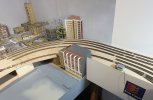
Obviously I've temporarily removed the buildings at the front of the layout while tracklaying. The scenic area is basically the left half of the snap up to the end of the grey painted wall. To the right is the return loops and fiddle-yard storage sidings. The curve in the viaduct is not prototypical as in reality it goes straight ahead but is necessary to fit in the shed. Fortunately the curves are fairly generous for N/2mm scale and partially hidden by the Bermondsey biscuit factory building.

DSC08550red.jpg
 
Last edited:

grahame

Western Thunderer
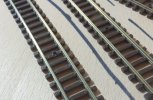
I'm planning on using code 40 rail and already have some (although I'll need to get more). The Peco track running rail I'm using is code 55 for comparison.
 

grahame

Western Thunderer
A little more tracklaying done this morning and I've now got five of the six curving viaduct lines down. The three furthest lines are the down ones from London with the furthest one becoming a siding in the fiddle-yard. The other two are the ones that loop around and return as the up line for the fourth and fifth lines (5th one not yet laid). The nearest, sixth, line is basically the South London Line (and reversible for my purposes).

DSC08552red.jpg

(I hope I'm not boring people with these updates)
 

Yorkshire Dave

Western Thunderer
A little more tracklaying done this morning and I've now got five of the six curving viaduct lines down. The three furthest lines are the down ones from London with the furthest one becoming a siding in the fiddle-yard. The other two are the ones that loop around and return as the up line for the fourth and fifth lines (5th one not yet laid). The nearest, sixth, line is basically the South London Line (and reversible for my purposes).

Once laid, ballasted and the third rail installed it'll look impressive. Only just over half the number of tracks of the real approach - eleven.
 

David B

Western Thunderer
Boring? You must be joking Grahame…..I’ve been loving the way you capture that unique S.London third rail atmosphere for more than 20 years, ever since I saw Hedges Hill Cutting. Plus (like some other WT-ers) I spent a fair chunk of my professional career based just off Tooley Street - watching you painstakingly recreate the scenes I remember from the days of EPBs and Networkers is just magic. Your selective compression of a vast area into an entirely credible layout is really clever. Please keep the updates coming.
 

grahame

Western Thunderer
All six lines on the curved section of the viaduct are now in place. Fortunately is that each are just one piece of track (on the scenic section) so don't need electrical feeds, just links to the next track sections off-scene in the fiddle-yard. The tightest radius for the on-scene curve is 13" (26" equiv in 4mm/OO) which is very acceptable in N/2mm (not sure about 4mm/OO) and 'obsons in the case of the compression required on this layout. Overall I'm pleased with recent progress.

Next is to test running and make and add the bridge trusses/beams that go over the road along with the viaduct brick divider for the SLL. And then progress to the station throat - which will involve points and installing motor under the board. That'll be more testing and challenging for me.

DSC08553red.jpg
 
Last edited:

Stephen Freeman

Western Thunderer
As well as track pins, I also ordered some 8mm track screws which arrived at lunchtime yesterday (but not the pins). They are tiny but quite suitable for N gauge track in the fiddle-yard. Obviously the heads show, so they wouldn't be appropriate on the scenic area, but it does allows for easy repositioning if required.

View attachment 251678

To accept the screws I 'drilled' a hole in the sleepers using the pointed end of a scalpel with a 10a blade fitted (see below).

View attachment 251681

I've now got all the track down in that east end fiddle-yard/return loops area, including the sidings, with just long lengths of track from the scenic area, across the curved section of viaduct, to lay and join up. But being on the scenic section I need track pins to lay the track which haven't turned up yet.

However, while in the shed it started snowing. Initially I thought it wouldn't settle as it had been raining and the ground was very wet, but it started coming down heavier and thicker and started to settle. I didn't fancy traipsing through the snow in my house slippers so I've come indoors. Typically, since then, it's stopped snowing and has all melted although I've not yet gone back out. The trials and tribulations of being a track ganger!
Not sure I like the idea of drilling sleepers in any scale. Th esrtwhile Hornby Dublo had a better idea in my opinion. Obviously only really suitable in 4mm scales and above and only for non-scenic areas. Basically it was a small plate with a hole. The plate located over two sleepers, there was a slight bend in both ends to aid location over the sleepers, the plate was secured with a screw, it held the track securely but without damaging the sleepers. I don't remember seeing much about it at the time as I think they may have been introduced just before their demise. Just seems like a good idea. I believe Hornby have done a plastic version which is similar in concept and might be better, code 100 only of course.
 
Last edited:

Grahame Hedges

Western Thunderer
Interesting but this layout is N/2mm gauge/scale so anything from Hornby would be 'O'rribly 'O'versized. And anything proud in the four foot in N gauge can often cause obstructions and catch on couplings if it is protruding too high. Being in the off-scene fiddle-yard it is not really a problem to have drilled sleepers, these screw heads (which are tiny) and even any missing sleepers where track is joined as space is required for the metal joiners to slide on the rails. Being code 55 track the sleepers need removing at these joins - Peco does supply single dummy ones to put in place to maintain correct sleeper spacing although these are really only required for the scenic sections.
 

Grahame Hedges

Western Thunderer
Once laid, ballasted and the third rail installed it'll look impressive. Only just over half the number of tracks of the real approach - eleven.

Thanks. I'm hoping I can do it justice and get it looking acceptable, despite progress being slow and fitful. And the thought of wiring, ballasting and adding third rail is quite an anathema although overall the development of the layout so far has been enjoyable.

The reduced number of tracks is due to space constraints and necessary compression - there's also a reduced number of through and terminating platforms on the model for the station but hopefully it still captures the look and atmosphere. I did count the 11 approach roads many years back when planning the layout and unfortunately realised then that I couldn't have anywhere near that number and still fit it all in the shed, even in N/2mm. A lot of simplification and reduction was required. But hopefully (fingers crossed) it will give the impression of a busy station throat and the real location when nearer completion.
 

grahame

Western Thunderer
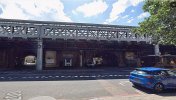
A little modelling effort this morning has seen me make and add the viaduct parapet walls for the diverging SLL, a plate girder bridge support and for the far side the open truss web girders for the main lines. In real life these basically support a section of the railway over an under-croft as here:

girder.jpg

I appreciate they should be straight but, of space restriction necessity, the model viaduct has to curve to get off-scene and fit in. Plus the geography is a little muddled here. I also need to add the cable toughing that runs along the top of the truss girders. Here's my, as yet incomplete, efforts. It's slow progress but I might get it completed by the next millennium;

DSC08568shperred.jpg
 

grahame

Western Thunderer
I've been meaning to make the hoarding boards that were on the roof of Dominion House for some time now. They're obviously meant to be seen from trains in the station on the viaduct. They can be seen in this pic dated 1980: Dominion House in Tooley Street There is a later photo on the RIBA site dated 1982 but it's from a very low position and anything on the roof can't be seen. I'm under the impression the building was demolished in the late 80s as part of the 'More London' development.

It was originally shipping offices and presumably behind the frontage there was substantial warehousing backing on to the Thames. Sometime before the early 1930s it became a 'doss' house for homeless men. George Orwell stayed there as part of his research in to 'common lodging houses', an article for the New Statesman, and his book 'Down and out in Paris and London'.

Yesterday I got around to knocking the hoardings up. And here's the result. They're a bit chunky but are still quite fragile and are made from styrene sheet and strip:

DSC08576percr.jpg
 

Grahame Hedges

Western Thunderer
I've been spending time recently (out in the shed) working out the pointwork plan for the throat of the east end of the station which includes access to the terminus platforms as well as the through ones. The other (west) end approaches are already fixed in my mind although they do need to be laid.

The main part, in front of the large area control signal box, is quite fiddly with restricted space and with a lot of lines and platforms to service. I've not been able to ensure that all platforms can be accessed and exit to all lines but I think I've managed to settle on the best option. However I've needed to order a single slip and will probably need to bash (Andy Calvert style) some of the points to fit and ensure the track flows neatly.

Also, unfortunately, I've needed to use some medium radius points despite wanting to use all large radius ones. But I guess it's 'obsons with the limited space and the need for compression and simplification despite being N/2mm.
 
Top