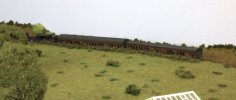
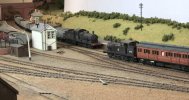
Elmham Market in EM

James Spooner

Western Thunderer
Nigel
Lovely bucolic scenes, a real flashback to my youth in what was then unspoilt Essex.
My recollection is that most of the dairy cattle were Friesians, ie black and white. Also the pastures were long established and usually had drinking troughs plumbed in. The surface was liberally spotted with the cow pats, usually densely enough to require careful navigation by a younger me and the areas around the gates and drinking troughs were usually very muddy.
The exGER train is lovely, I have an F5,F6 and a first/third coach in 7mm, your images have spurred me to build the brk/3rd to finish the train.
I always look forward to new posts on this thread.
Bob
Hi Bob

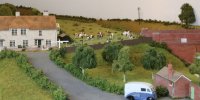
Many thanks for your kind comments. My uncle (and more recently cousins) farm in East Anglia and their view is that Friesians started to come in during the 1950s, replacing Red Poll, shorthorn and British Whites. To be honest, I’m not sure my cows currently match any of those breeds and I might just have to paint them all over brown to make them resemble red polls… There is a drinking trough in place, at the foot of the slope for the bridge. I have looked at some aerial photos of Lavenham station and it’s environs and it isn’t a million miles out but I’ll leave the cow pats to your imagination!

Nigel
 

James Spooner

Western Thunderer
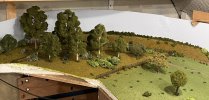
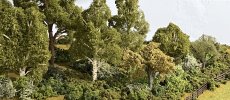
I’ve spent some more time in the attic today (modelling will come to a halt for a short while as the memsahib is celebrating a significant birthday) and have given the woodland area at the extreme left of the layout an initial going over, with fences, shaggy grass bushes and trees. I will leave this for a while as I mull over whether I need to add more, take some out, generally modify, etc. but at the moment it does serve its main purpose of hiding the trains disappearing off stage left… Some photos attached.

Nigel

IMG_9846.jpegIMG_9845.jpegIMG_9844.jpeg
 

40057

Western Thunderer
I’ve spent some more time in the attic today (modelling will come to a halt for a short while as the memsahib is celebrating a significant birthday) and have given the woodland area at the extreme left of the layout an initial going over, with fences, shaggy grass bushes and trees. I will leave this for a while as I mull over whether I need to add more, take some out, generally modify, etc. but at the moment it does serve its main purpose of hiding the trains disappearing off stage left… Some photos attached.

Nigel

View attachment 251291View attachment 251292View attachment 251293
I do like your layout very much and would be delighted if I could produce anything half as good. So I am reluctant to venture anything that looks like a criticism. There’s a prototype for everything, so your vegetation is not ‘wrong’, but in one respect could be more typical perhaps. Hence, an observation on your woodland. I would say, you need to add more ‘shaggy grass, bushes and trees’. At the moment, the herb or field layer in your woodland looks too much like the adjacent managed grassland. Woodland is sometimes used to regularly graze stock, in which case it may well have a grassy field layer. More often, the field layer is unmanaged (not grazed or mown) and it will have a completely different character. An example photo found on the web:

D8DE6075-BB8F-40AD-904A-F715BDB0533A.jpeg

Meadow (i.e. mown) grassland to the left and a sharp line where the managed grassland stops and the woodland field layer begins.

My suggestion would be more trees and more bushes. In our climate, in the absence or grazing or mowing, closed canopy forest is the vegetation type that will develop in most places. You have fence around your woodland and most likely management stops there.

I hope this is helpful!
 

James Spooner

Western Thunderer
I do like your layout very much and would be delighted if I could produce anything half as good. So I am reluctant to venture anything that looks like a criticism. There’s a prototype for everything, so your vegetation is not ‘wrong’, but in one respect could be more typical perhaps. Hence, an observation on your woodland. I would say, you need to add more ‘shaggy grass, bushes and trees’. At the moment, the herb or field layer in your woodland looks too much like the adjacent managed grassland. Woodland is sometimes used to regularly graze stock, in which case it may well have a grassy field layer. More often, the field layer is unmanaged (not grazed or mown) and it will have a completely different character. An example photo found on the web:

View attachment 251297

Meadow (i.e. mown) grassland to the left and a sharp line where the managed grassland stops and the woodland field layer begins.

My suggestion would be more trees and more bushes. In our climate, in the absence or grazing or mowing, closed canopy forest is the vegetation type that will develop in most places. You have fence around your woodland and most likely management stops there.

I hope this is helpful!
Hi Martin

Many thanks for your observations and comments, which are very helpful. The photo you show does indeed illustrate a much higher density of herbage than I have modelled and I have been looking through my photo collection for some shots that I have taken of our local wooded common land, but to no avail. I will take some on my walk across the commons tomorrow and post them up, but they will show a lower density of growth than in your photo. I suspect an element of that is down to soil quality; here in the Surrey heathland the soil is quite sandy and so less fertile (which I guess is one reason why it is still common land and not intensively farmed). The countryside in Suffolk varies, with some being incredibly rich and productive farmland (one reason why East Anglia is the bread basket of Britain), but other bits being sandy heathland, much like parts of Surrey. I will ponder this question a bit more before taking any action…

Nigel
 

40057

Western Thunderer
Hi Martin

Many thanks for your observations and comments, which are very helpful. The photo you show does indeed illustrate a much higher density of herbage than I have modelled and I have been looking through my photo collection for some shots that I have taken of our local wooded common land, but to no avail. I will take some on my walk across the commons tomorrow and post them up, but they will show a lower density of growth than in your photo. I suspect an element of that is down to soil quality; here in the Surrey heathland the soil is quite sandy and so less fertile (which I guess is one reason why it is still common land and not intensively farmed). The countryside in Suffolk varies, with some being incredibly rich and productive farmland (one reason why East Anglia is the bread basket of Britain), but other bits being sandy heathland, much like parts of Surrey. I will ponder this question a bit more before taking any action…

Nigel
It all comes down to the underlying geology. The managed grasslands will have had their nutrient status and probably pH altered (additions of fertiliser and lime) so will be pretty similar wherever you are. The semi-natural woodland will have different species depending on whether the soil is acid, neutral or lime-rich. So what the semi-natural vegetation looks like will be determined by location.

Martin
 

James Spooner

Western Thunderer
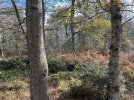
Following on from Martin’s observations yesterday, as promised I have taken some photos on my daily constitutional around the village and attach a selection below. I think it is fair to say there is quite a variation in the depth of vegetation even within the relatively small area I was walking around. Mostly, though, where the tree cover is greatest there tends to be less undergrowth (unless there is an invasion of shade loving plants) and I suspect the wildlife (we have quite a few wild deer in our parts) do their bit in keeping vegetation down. At the moment though, I’m not convinced I should add too much more vegetation. I would be interested in others views…

Nigel

IMG_9864.jpegIMG_9859.jpegIMG_9868.jpegIMG_9860.jpegIMG_9861.jpeg
 

40057

Western Thunderer
Following on from Martin’s observations yesterday, as promised I have taken some photos on my daily constitutional around the village and attach a selection below. I think it is fair to say there is quite a variation in the depth of vegetation even within the relatively small area I was walking around. Mostly, though, where the tree cover is greatest there tends to be less undergrowth (unless there is an invasion of shade loving plants) and I suspect the wildlife (we have quite a few wild deer in our parts) do their bit in keeping vegetation down. At the moment though, I’m not convinced I should add too much more vegetation. I would be interested in others views…

Nigel

View attachment 251329View attachment 251331View attachment 251332View attachment 251333View attachment 251330
Hi Nigel

Interesting photos.

Photos 1,2,4 and 5 are similar. Photo 3 is different.

Leaving aside photo 3, some nice mixed woodland, with oaks as the principal trees. Some holly and gorse as a shrub layer, then visible are bracken and brambles in the field layer. Not visible now, but very likely bluebells in spring? Neutral pH. I’m guessing clay.

Photo 3. An acid soil. Greensand? So the ground vegetation is sparse and has areas of acid-loving dwarf shrubs — heather.

The observation I would make is that the low-growing vegetation under the trees looks nothing like a managed grass field. That would be the adjustment I would suggest you make to your woodland area — whether your wood is on acid or neutral soil.

Martin
 

James Spooner

Western Thunderer
Hi Nigel

Interesting photos.

Photos 1,2,4 and 5 are similar. Photo 3 is different.

Leaving aside photo 3, some nice mixed woodland, with oaks as the principal trees. Some holly and gorse as a shrub layer, then visible are bracken and brambles in the field layer. Not visible now, but very likely bluebells in spring? Neutral pH. I’m guessing clay.

Photo 3. An acid soil. Greensand? So the ground vegetation is sparse and has areas of acid-loving dwarf shrubs — heather.

The observation I would make is that the low-growing vegetation under the trees looks nothing like a managed grass field. That would be the adjustment I would suggest you make to your woodland area — whether your wood is on acid or neutral soil.

Martin
Hi Martin

Many thanks and interesting observations. All of the photos were taken this morning within a few hundred yards of each other and I have just been on the geological survey maps to see what the underlying and surface strata are. The whole area has underlying sandstone rocks and, as you note, there are clay deposits in some areas. Sadly the map is silent on the other area but it is shaded a different green so is probably, as you note, a different soil type. The static grass is used is mostly 6mm in there, or 18” if scaled up. To be honest, I think that is longer than the grass I was seeing on my walk, but I agree with you in that I think it is missing that middle foliage layer, in some places marked by bracken and in others by shrubs and bushes of different varieties. More pondering but I am currently inclined to see how I can add something of that variety. Thanks for your help and input Martin; much appreciated.

Nigel
 

James Spooner

Western Thunderer
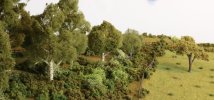
I did ponder in moments between celebrating a milestone birthday for the memsahib with the offspring and their partners and offspring in Aldeburgh over the weekend… As a result, this morning I hailed myself down to Alton Models and purchased some more scenic materials and have been experimenting during the day. I have put a lot more ground cover in the woodland area as well as adding an extra layer of longer static grasses on the grazing pasture. It does look better and I will reflect further before making any more changes. I dug out my trusty Canon camera and took some photos of the current state of play.

Nigel

IMG_0449.jpegIMG_0454.jpegIMG_0456.jpegIMG_0467.jpeg

IMG_0464.jpegIMG_0463.jpeg
 

James Spooner

Western Thunderer
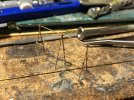
In making up a Woodland Scenic tree I found I had some leafy netting left over and wondered how I might use it. I also had some space left in the vegetable patch in Mr and Mrs Skinner’s garden. I have decided to combine the elements and make up a bamboo framework for some runner beans, then clad it with the left over tree netting and add a few orangey red dots to represent runner bean blossom. The trial frame has now been soldered together from brass wire, primed and painted. The foliage will have to wait for another day…

Nigel

IMG_0040.jpeg
 

James Spooner

Western Thunderer
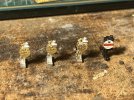
A long weekend seeing more family in Yorkshire has put a pause on modelling but back home now so have added some imaginary runner bean plants to the bamboo canes and planted them. I have also dug out another Woodland Scenics tree, finished making that and planted it too. A few photos attached.

I’m hoping for some progress on 3D printing the restaurant car tables and will then be able to finish that off. In the meantime I have dug out some ex LNER MSE ground signals and will attempt to construct some (I think I will need five) and get them working…

Nigel

IMG_0071.jpegIMG_0073.jpegIMG_0074.jpeg
 

James Spooner

Western Thunderer
Definitely a move from the more artistic end of modelling to the very fiddly! I am making progress with the first MSE ground signal but I’m not sure to what extent these were designed to be operational models. The lower part of the balance lever fouls the cast whitemetal base (which then needed cutting back) and the instructions recommend drilling holes at 0.4mm but I couldn’t get anything larger than a 0.35mm bit to go in without removing too much brass and creating a U shape instead of an o. Next task is to solder the blinder onto the back and then attempt to connect the blinder to the balance weight. That’s all for tomorrow though, I’m not sure I can keep the concentration up this evening.

I still have to work out the linkage to drive these signals. Some ideas are forming in my mind but I thought I would test them on the first signal before getting a production line running.

Nigel

IMG_0076.jpeg
 

James Spooner

Western Thunderer
So, after a cup of tea I took another look at the ground signal and decided to see if I could make some more progress this evening. I now have an operational signal and just need to design a mount into the baseboard as well as some sort of mechanism to drive it. A short video of the test is attached.

Nigel


James Spooner

Western Thunderer
Flow line production of ground signals is now under way. The first one has been painted, second one finished bar painting and the third and fourth only need balance weights to be fitted… I’m working on a scheme to transfer movement to under the baseboard and then thinking of some sort of servo motors to operate them.

Nigel

IMG_0092.jpeg
 

Attachments

  • IMG_0092.jpeg
    IMG_0092.jpeg
    395.9 KB · Views: 2

James Spooner

Western Thunderer
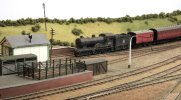
It was very wet and gloomy in Surrey this morning but the sun always shines in Elmham Market and fortunately there were some photographers present to capture some of the trains passing through the station. First up was a Claud on a local passenger service…
IMG_0478.jpeg
The Claud had to wait to cross the push pull from Stratford St James which duly came in propelled by a G5…
IMG_0476.jpeg
Before the Claud departed, such a daily scene ignored by the locals…
IMG_0485.jpeg
Later the daily pick up goods arrives behind a grimy J17, where it passes another local train hauled by an F6…
IMG_0491.jpeg

IMG_0496.jpeg
I suppose I ought to return to reality and finish off those ground signals now…

Nigel
 
Last edited:

James Spooner

Western Thunderer
Back at the workbench I have now constructed the six ground signals I need and have been working on a mount to transfer the horizontal action into vertical motion to be driven by a servo motor under the baseboard. I think I have now achieved that and the short clip below demonstrates that much better than I could in words…

Nigel

 
Top