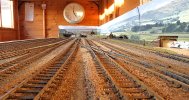
4mm Llanfair

LarryG

Western Thunderer
I spent the afternoon dismantling the working steering from a plastic bus while attempting to fit it on an EFE Leyland TD1. Disaster, so the TD1 got binned and I set about constructing a renewed history for the Birmingham bus.

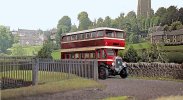
Legend says it was a Leyland PD2/12 demonstrator sent to Birmingham in the early 1950's. Birmingham asked for several changes to be made to the specification before placing an order, and this rendered the demonstrator non-standard when hundreds of similar buses were purchased with Crossley, Guy and Daimler engines. It was sold in 1954 to Newtown Motors for a knockdown price. Seen parked at Llanfair station while the crew drank tea in the station café.
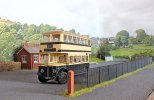
WEB Llanfair26 4T.jpg

Reversing to the setting off point behind the bufferstops. A single decker was normally used, but this decker was substituting for the rail service between Llanfair and Welshpool during upgrading of the branch...
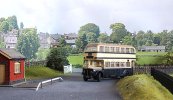
WEB Llanfair26 4U.jpg
 
Last edited:

LarryG

Western Thunderer
After hacking the chassis of a Leyland TD1 bus to no avail, I decided to rebuild the chassis today using 80thou black plastikard including forming the dumb irons either side of the number plate that separate the TD1 from theTD2. Pictured laying over outside the station...
WEB Llanfair26 4V.jpg
 

LarryG

Western Thunderer
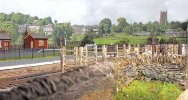
A lot of work was going on behind the scenes while waiting for some new acrylic colours to arrive. I would normally avoid acrylic, but i am sick of Humbrol enamel matt paint drying glossy and finding other enamel paints almost solid in their tins since they were last used. Acrylic will be used on scenery but definitely not models. The extended sheep & cattle pens have been bedded in place....
WEB Llanfair26 4W.jpg

PVA and static grass will hold the pens in position when dry...
WEB Llanfair26 4Z.jpg
 
Last edited:

LarryG

Western Thunderer
I think that the other buildings and the platform would benefit from a bit of weathering. With that I would have been hard pressed to identify the photos as a model.
David
Hi David, I'm working my way down the layout bit by bit. The station will be a project all of its own with platform seats, flower beds, gas lights and posters etc.

I decided against putting concrete decking around the cattle pens. It's a much used siding and the track would have needed periodical maintenance and renewal. Its got plenty of dead grass and straw around it instead...
WEB Llanfair26 4Y.jpg
 
Last edited:

LarryG

Western Thunderer
Thanks for the comments.

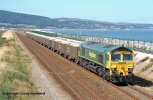
Regarding ballasting, I always use a mix of fine grey and fine dark brown ballast (for 00) to give a clean-ish mottled grey. Then I add the rust with a spraygun. Its quite realistic this way as the rust run-off can be varied from quite newly ballasted track where the rust is mainly just below the rails to rust right across the ballast. This picture of real ballast can be easily emulated with a spraygun. Incidentally, this was one of my early Fuji Finepix digital photos from 2001...
WEB Abergele 66514 copy.jpg
 

Mikemill

Western Thunderer
Larry
As a dyed in the wool GWR man and a fan of branch line modelling your layout is one of the best I have seen over the years. The addition of the backing brings the whole scene together an emulates the real railway feel.

Excellent job, keep up the good work

Mike
 

LarryG

Western Thunderer
I leave the local roads to the tourists Bank holidays, so in between sunbathing, I sprayed and weathered the circular tank water crane...
WEB Llanfair26 5F.jpg

Regarding the main colours, I followed information in 'GWR Structure Colours' by R. North. Detail weathering came from photos taken in the steam-era. Heritage railways appear to have followed their own ideas and mainly used GWR Nos 2 and 3. The base of the column up to around 5 feet was usually painted No. 4, but evidence suggests that black was the norm in the 1930's. The painter at Llanfair carried on using No.4.....
WEB Llanfair26 5K.jpg
 
Last edited:

paulc

Western Thunderer
That water tank crane certainly fits in well Larry and as you said , doesn't 'overpower the layout' unlike the original tower . The whole layout is coming together nicely.
 

LarryG

Western Thunderer
No prizes for guessing where I am definitely not! The shed was already 85 degrees when I opened the door at 8am. Some of us spend all winter dreaming of hot sunny days, then when it arrives, it's the wrong kind haha....

I was looking back at my early layout beginnings and was surprised to see that by 2009 I had already established a few basic norms. Like I D Backscenes, gluing & ballasting track in one go although there was a false start using Peco Code 100...

The big mistake was building a busy multi-track Diggle Junction. The bullhead track with a mineral wagon on it had been ballasted using the eye-dropper method and was a complete pudding. The three Code 100 tracks on the right were glued and ballasted in one go...

WEB Diggle 4.jpg

In short, the layout was too complex and too wide. It never got beyond the shed wall, which was a good job seeing as there was no room on the window wall for a fiddle yard. The baseboards were built with a curving slope as at the real Diggle Junction, but free-rolling wagons would not stay in the sidings...
WEB Diggle 5.jpg

Amongst my locos was a Fowler 7F 0-8-0, so typical of the Standedge line before the Austerity 2-8-0's took over in 1957. After this, I went in the opposite direction and built Moorgate Halt, a simple wooden platform affair about a mile west of Diggle and ended up building Delph. After that, it was a case of small layouts rule.....
WEB Diggle 6.jpg
 
Last edited:

LarryG

Western Thunderer
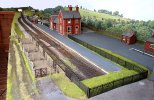
Local councils hereabouts always seem to find reasons to close major rat runs once the tourist seasons starts and so after struggling to get back home, I glued some 2mm static-grass in place with the aid of a vacuum cleaner hose before the day got too hot. Did a bit more tonight. The circular water tanks and bits were fixed permanently in place too...
WEB Llanfair26 5N.jpg
 
Top