The Heybridge Railway, 1889 to 1913

RichardG

Western Thunderer
@simond The phrase we want is "live springing". From the Guild Knowledge Base (which I really must look at more often):

"For spring suspension to work properly the vehicle must ride on the springs (‘live’ springing) such that when pressed down the body will compress the springs further and when lifted slightly the wheels will still remain in contact with the rail. A total movement of about 1 mm is more than sufficient to cope with the most irregular track faults. Experiments have determined that about 65 g (2.5 oz) per axle is a good figure to aim for but some whitemetal wagons weigh considerably more than this so stronger springs need to be fitted".

What this advice does not address is, of course, the case of an open wagon with and without a load. For the machinery wagon, the load could be quite substantial e.g. a traction engine made from white metal. I reckon, if a wagon is made fairly heavy and the springs are chosen to suit, then the effect of adding such a load will be minimised.

The GER machinery wagon is 180 mm long over headstocks. If I follow the usual guideline of 1 gram per millimetre (or 1 oz per inch) of length, I expect the springs will compress too much. I will add some lead evenly along the model so the springs at the one end are at their mid-point, and take it from there.

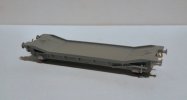
DSC_2195.jpeg
For the record, here is the model without any ballast weights.
 

Ian@StEnochs

Western Thunderer
My experience with live springs, ie the body weight is suspended on the springs and axles can move above as well as below datum, are that they glide over track irregularities and are quieter in operation. Compensated ones still keep the track but lurch and clunk at the slightest bump like a raised rail joint.

This works for coach bogies and six wheelers too and one gets the added advantage of not having to ensure the vehicle is exactly free of twist. One of the most difficult things to achieve in a build is getting everything dead square. Another advantage is that over time some models may twist and distort, 3D prints appear to be prone to that, so building in flexibility to the wheels will compensate for that.

I build the model but don’t finally fit the springs until its final weight is known. Where ever possible I use little coil springs, buffer ones from Slaters usually, and adjust the compression by adding shims of brass or plastic card until the ride height is correct. If using wire ‘finger’ springs you can either change the gauge if wire, not always possible, bend the spring or fit an adjuster wedge where the spring is attached to the body.

The same is true with locomotives and it is a joy to see a loco sail over a bit of rough trackwork with the wheels moving up and down underneath. I always try to have all my wheelsets, certainly all the drivers live sprung where possible. The exception is in short wheelbase four wheelers which suffer from ‘nodding dog’ tendencies especially if the start or stop is not very gradual. The ones I built live sprung have now been converted to dead springs, ie riding on a stop with spring pushing wheel down into hollows. They still ‘clunk’ when meeting a bump. However short wheelbase four wheelers tend to be slow moving so the clunk is less obvious. Any new four wheeler builds I have taken the easy way and used 3 point suspension with the driven axle rigid and the other pivoted at its centre.
 

76043

Western Thunderer
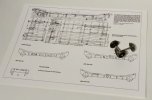
Richard, I really don't mean to add to your wagon woes after the Serpent, but according to the GERS journal drawings the top planking is all lengthways on a GE version dia 25.

Below is a printout from the journal when I was attempting to make my own version. Happy to be corrected if I have the wrong version as the drawing below does say there were detail differences between the three diagrams. Hopefully the other two had different planking styles.
Tony

original_76204b91-2c1e-405a-884b-6c805b0f9139_IMG_20201101_094730.jpgimage.jpg
 
Last edited:

RichardG

Western Thunderer
Richard, I really don't mean to add to your wagon woes after the Serpent, but according to the GERS journal drawings the top planking is all lengthways on a GE version dia 25.

Yes Tony I have a print of the article beside me. I want to let this one go. Partly because I want to build the kit as the designer intended; and also because the model is already resembling the GER prototype. Whereas the Serpent kit is so wrong the result does not look like a Serpent.

Looking at the table of build dates in the article, a wagon from diagram D50 (1899 on) would suit my motor car traffic. So your challenge now, if you possibly have the information to hand, is to tell me how the deck planking looked on a D50. Though perhaps this is your model in your second photo!

I'm a long way from adding the running number :)
 

76043

Western Thunderer
Hi Richard,
I certainly can check the Journal archive. The photo of mine is the Airfix / Dapol 4mm BR version which has a completely different pattern to your one, so it does at least rule out the pattern being the BR version. Paul Bartlett's photos show the BR version.
Tony
 
( Diversion : a traction engine as a load for a wagon ) New

RichardG

Western Thunderer
DSC_2195.jpeg

For the record, here is the model without any ballast weights.

Going back to the suspension . . . I can add some pieces of sheet lead underneath the model, perhaps 80 grams or so. This will give me live springing on an unloaded wagon.

But! A white metal model of a traction engine is going to weigh most of 300 grams (thanks to @Osgood for this depressing fact!); and even the static boiler I built a while ago weighs 150 grams. Either of these loads is going to make the suspension bottom out; but if I remove the sheet lead and arrange the boiler with care, I can retain the live springing.

And so, my thoughts turn to making the lead weights removable. Perhaps a turnbutton to hold them in. The trouble is, I have never heard of anyone doing this before. When I "invent" something, I usually find that either everyone else already does this or it isn't terribly useful. I know I can do this, but I do welcome thoughts on whether it is sensible.
 

simond

Western Thunderer
What you want is a brass magnet…

more reasonably, you could stick or solder a bit of tinplate under your wagon, and use a couple of the tiny magnets stuck to or embedded within the lead weights.

or alternatively, try to get a plastic (3DP) traction engine?
 

Ian@StEnochs

Western Thunderer
Going back to the suspension . . . I can add some pieces of sheet lead underneath the model, perhaps 80 grams or so. This will give me live springing on an unloaded wagon.

But! A white metal model of a traction engine is going to weigh most of 300 grams (thanks to @Osgood for this depressing fact!); and even the static boiler I built a while ago weighs 150 grams. Either of these loads is going to make the suspension bottom out; but if I remove the sheet lead and arrange the boiler with care, I can retain the live springing.

And so, my thoughts turn to making the lead weights removable. Perhaps a turnbutton to hold them in. The trouble is, I have never heard of anyone doing this before. When I "invent" something, I usually find that either everyone else already does this or it isn't terribly useful. I know I can do this, but I do welcome thoughts on whether it is sensible.

Presumably you will be chocking the wheels and tying the traction engine down. So how often are you likely to be unloading/loading the wagon?
 

RichardG

Western Thunderer
or alternatively, try to get a plastic (3DP) traction engine?

So how often are you likely to be unloading/loading the wagon?

Well, I don't really know what the traction engine will be, except it is something for the future. So I think the idea of removable ballast weights is legitimate, and I have started to make something to suit.

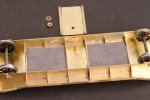
DSC_2197.jpeg
Two of the cross-members under the well are partial (I guess to fit the kit onto a half sheet) and I can exploit the spaces they make to insert two blocks of lead. And I want a ground stud on the model to let me use the RSU to add some detail parts.

So I have made a cover to hold the lead blocks into place. I need to construct some pockets to hold the outer edges of the two lead blocks.

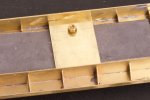
DSC_2200.jpeg
The cover is retained by a nut on the ground stud.

The stud is a bit short because I added it to the model before I thought of the cover but it shows the idea can work.
 

Phil O

Western Thunderer
My experience with live springs, ie the body weight is suspended on the springs and axles can move above as well as below datum, are that they glide over track irregularities and are quieter in operation. Compensated ones still keep the track but lurch and clunk at the slightest bump like a raised rail joint.

This works for coach bogies and six wheelers too and one gets the added advantage of not having to ensure the vehicle is exactly free of twist. One of the most difficult things to achieve in a build is getting everything dead square. Another advantage is that over time some models may twist and distort, 3D prints appear to be prone to that, so building in flexibility to the wheels will compensate for that.

I build the model but don’t finally fit the springs until its final weight is known. Where ever possible I use little coil springs, buffer ones from Slaters usually, and adjust the compression by adding shims of brass or plastic card until the ride height is correct. If using wire ‘finger’ springs you can either change the gauge if wire, not always possible, bend the spring or fit an adjuster wedge where the spring is attached to the body.

The same is true with locomotives and it is a joy to see a loco sail over a bit of rough trackwork with the wheels moving up and down underneath. I always try to have all my wheelsets, certainly all the drivers live sprung where possible. The exception is in short wheelbase four wheelers which suffer from ‘nodding dog’ tendencies especially if the start or stop is not very gradual. The ones I built live sprung have now been converted to dead springs, ie riding on a stop with spring pushing wheel down into hollows. They still ‘clunk’ when meeting a bump. However short wheelbase four wheelers tend to be slow moving so the clunk is less obvious. Any new four wheeler builds I have taken the easy way and used 3 point suspension with the driven axle rigid and the other pivoted at its centre.

In 4mm we use guitar strings for csb suspension, the CLAG website has spreadsheets for calculating the required gauge, I was wondering whether it might be worth trying guitar string rather than piano wire.
 

RichardG

Western Thunderer
. . . the CLAG website has spreadsheets for calculating the required gauge . . .

I thought of CSBs too late, while I was installing the wheelsets. The frames would have hidden the beams, and the beams could have been swapped around for different gauges for different payloads. Perhaps the geometry is just too difficult, but it could have been a first attempt at CSBs.
 

RichardG

Western Thunderer
or alternatively, try to get a plastic (3DP) traction engine?

Corgi do a 1905 Fowler showman's engine in 1:50 scale. Traction engines came in different sizes and I don't think this will look out of place. A diecast model with plastic parts with be lighter than an entirely white metal model too.

The downside for all of these flat and low deck wagons for Heybridge Basin is, of course, the site needs an end loading dock for anything more than one or two tons. End loading is planned for Heybridge (future layout) not Heybridge Basin. It's doable here but the only space is beside the sea lock. I might be better to imagine the end loading is off-scene, from a siding upstream along the navigation. Rather a lot of this railway is in my imagination.
 

Ian@StEnochs

Western Thunderer
In 4mm we use guitar strings for csb suspension, the CLAG website has spreadsheets for calculating the required gauge, I was wondering whether it might be worth trying guitar string rather than piano wire.

What puts me off CSBs, in S7, is the difficulty of predicting the final weight distribution and problem getting the correct ride height. A screw adjustment on a coil spring over each axlebox or a slip of shim between the spring and box is a relatively simple way of adjustment.

Having said that I have a couple of 4 coupled engines with piano wire springs between the driving axles and another pair on the bogie. Perhaps not true CSB as I have them held in buckles at the beam centres. Doing this they act as compensation to load each wheel pair equally but because the wire is springy also carry the body weight.
 

Phil O

Western Thunderer
What puts me off CSBs, in S7, is the difficulty of predicting the final weight distribution and problem getting the correct ride height. A screw adjustment on a coil spring over each axlebox or a slip of shim between the spring and box is a relatively simple way of adjustment.

Having said that I have a couple of 4 coupled engines with piano wire springs between the driving axles and another pair on the bogie. Perhaps not true CSB as I have them held in buckles at the beam centres. Doing this they act as compensation to load each wheel pair equally but because the wire is springy also carry the body weight.

I don't worry too much about the weight until the loco is complete and weighed and then put the weight into the CSB maestros (Will L's) spreadsheet Continuous springy beams Select Will Lichfields spreadsheet, I find this to be the best one.


RichardG

Western Thunderer
Select Will Lichfields spreadsheet, I find this to be the best one.

Will seems to have a grasp of the practicalities of CSBs. I am intrigued by his recommendations for adjusting buffer heights by 0.1 mm, and I suppose this says lots for the finesse of the skilled P4 modeller. I could settle for quite a bit more than this (in 7mm) as long as the model ends up sitting level. I've never thought of putting shims between chassis and body - it is all a bit obvious now. Allow the springs to let the chassis sit a tiny bit low, and then shim up the body to suit. I ought to stop worrying and start modelling!
 

RichardG

Western Thunderer
I have now added all of the etched brass parts (except the brake lever - later) and I want to record here, everything has fitted really well. So although the kit got off to a bad start with the holes for the wheel bearings, it has very much redeemed itself during the build.

DSC_2204.jpeg
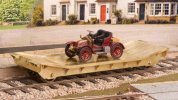
I now have a 105 gram wagon carrying 75 grams of lead; and the length over headstocks is 180 mm. Just what the guidelines for weighting say. The springs are holding the live axle mid-way in its slots, with and without this 30 gram motor car. If I want a heavier load, I can remove the weights.

The car is freshly imported from France. I guess the GER sent a low deck wagon because they weren't quite sure what to expect :)
 

RichardG

Western Thunderer
To finish off the springing . . .

DSC_2207.jpeg
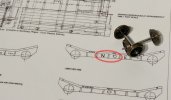
Yesterday was the first time I really thought about the axle box castings. It looks like they are designed to hold a wheel bearing and to locate it in the oversize holes in the frames, though only at the unsprung end :rolleyes:. In my defence, the castings get no mention in the instructions.
The springs are a tiny bit askew but their arms have straightened up on the model.

DSC_2219.jpeg
The bearings at the sprung end will benefit from something to hold them inwards, so the axle doesn’t slide from side to side. I drilled upwards into the axle boxes and soldered in some n/s wire to do this. The result works fine but I tidied it all up before I remembered to take a photo.

This is my first wagon with a sprung axle and it seems to work. The model still negotiates my Setrack point, though I can feel and hear the protests from the wheel flanges. This is a 20 ft (140 mm) wheelbase.
 

RichardG

Western Thunderer
Presumably you will be chocking the wheels and tying the traction engine down. So how often are you likely to be unloading/loading the wagon?

Really, I want to "play trains" and I am probably happier to begin with if the traction engine or motor car or whatever is free to be picked up and swapped for something else.

Fowler engines 9 Sep 1909.jpg
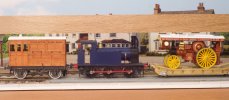
Here are two long-wheelbase ploughing engines photographed on similar 14-ton wagons on 9 September 1909.

From GER Journal no.90, the wheels of the engines are held against the ramps, chocked by blocks nailed down onto the wooden floor. There would also have been steel shackles anchoring the bottom of the engine onto fixing rings on the floor. This explains the lack of chains in the photo.

I am thinking, the floor of the D&S kit is almost certainly wrong. I have the drawing showing longitudinal planks across the width of the wagon, and photographs showing transverse planks across the width of the wagon. There is as yet no evidence of the steel plates replicated on the model. I cannot appear to "nail" wooden chocks through steel plates, although I can still place some.

A while ago, I established there are no kits in 7mm scale for a ploughing engine, and probably only one kit for an agricultural engine. This being an Aveling Porter from Duncan Models. On the bright side, Corgi do a 1:50 scale showman's engine and one of these has just arrived.

DSC_2230.jpeg
The top of the chimney is a scale 13 ft 5 in above rail level - right on the limit of the loading gauge. Yet the model is 15% undersize.

I notice how the two heavy ploughing engines consume the space on the deck, and their chimneys have been removed to fit the loading gauge.

If the same article in GER journal no.90 is to be believed, a showman's engine would be sheeted over to protect its paint finish from the smuts for the locomotive. This won't look very interesting. So I might cut away the roof and the electrical generator to make the model look more like an agricultural engine. Engines came in different sizes so I think the model ought to look believable.

If I do this, I must decide whether to remove the chimney and stow it beside the engine. I suspect I should. And also decide whether I can accept the smooth road wheels, when an agricultural engine would have slatted treads.

Incidentally, the Corgi model currently weighs 300 grams, much the same as the kit from Duncan Models.
 

simond

Western Thunderer
The agricultural engine would not have the big generator/dynamo mounted ahead of the chimney, nor indeed the rather fancy barleytwist poles, but I guess they’d come off with the roof.

I’m a little puzzled by the thing at the back over the coal space?

there are some prototype photos in Brian’s “Tim Mills’ Photos” thread.
 
Top