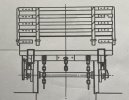
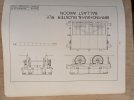
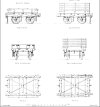
Birmingham & Gloster Rly, Slatted Wagon (my title)

Jon Nazareth

Western Thunderer
I’m putting together some bits and pieces to make up this strangely built goods wagon. Some of you will have noticed that it has 10 spoke wheels. Before you say anything, Mike, no I’m not going to have made up some ten spoke wheels to go with it. It will sport some of those nine spoke wheels talked about in another G3 thread. :)

To scale it, I enlarged the wheels to a scale 3’ and measured straight off the drawing as best I could taking into consideration the fact that some of the ‘pencil’ lines measured over 1mm thick.

JonIMG_5548.jpegIMG_5547.jpegIMG_0493.jpeg
 
Last edited:

Jon Nazareth

Western Thunderer
Going over this drawing again. I’ve measured that wide plank and it comes out at some 15”. I don’t know much about railway practices but that seems like a very wide plank to me. At that width, I would expect it to cup across its width. I do realise that trees in that era when cut were found to be very slow grown and maybe less likely to cup but, I still think that 15” is pushing it. Any thoughts, anyone?
Also, if two planks were used instead of the one, then surely there would be two brackets holding each upright I.e., one on each plank. Just thinking.

Jon
 

cctransuk

Western Thunderer
Going over this drawing again. I’ve measured that wide plank and it comes out at some 15”. I don’t know much about railway practices but that seems like a very wide plank to me. At that width, I would expect it to cup across its width. I do realise that trees in that era when cut were found to be very slow grown and maybe less likely to cup but, I still think that 15” is pushing it. Any thoughts, anyone?
Also, if two planks were used instead of the one, then surely there would be two brackets holding each upright I.e., one on each plank. Just thinking.

Jon
Could the bottom element be iron plate?

John Isherwood.
 

Jon Nazareth

Western Thunderer
John
You could be right. The drawing simply says, Goods Wagon. Was iron/steel used on early wagons? I don’t know.

Jon
 

Overseer

Western Thunderer
Were the wheels 3 foot? Smaller wheels were common on very early railways. If they were around 33 inches (as continued in the US) the wagon would be smaller overall and the plank a bit narrower. The extra blocks on top of the extended solebars suggest the solebars were lower than normal, and buffer height started out closer to 3’ than 3’6”. Just a thought.
 

Jon Nazareth

Western Thunderer
Fraser
As mentioned above, I enlarged the drawing so that the wheels came out at 3’ and scaled straight off the drawing. Yes, as far as I can make out, the sole bars come out at about 8.5” wide. When I start the build I will most probably make the side plank width somewhere in the region of between 8-12”. Early days as yet.

Jon
 

adrian

Flying Squad
The upper structure has the appearance of being detachable / an addition.

Could this be a shallow, iron-bodied wagon which has been adapted for something like fodder or livestock traffic?

John Isherwood.
I had a quick flick through the book I have on the Birmingham and Gloucester Railway. There are scant few pages on the wagon stock but it did say the vast majority of the wagons were the ballast wagons used during the line construction and that once the railway was running they were slowly repurposed and modified as required for the traffic they were carrying.
 

Jon Nazareth

Western Thunderer
Adrian
That’s very interesting, I’ll go for wooden sides then but, if it was a ballast wagon however, it seems strange that it didn’t have drop sides.

Jon
 

WM&CQR

Member
Adrian
That’s very interesting, I’ll go for wooden sides then but, if it was a ballast wagon however, it seems strange that it didn’t have drop sides.

Jon
I seem to remember (no references, sorry) there were plenty of single sided ballast wagons early on, so no need for drop sides. the add on sides later make it into a goods wagon for lighter stuff. Also lots of early wagons were iron..
 

Bigjohn

Western Thunderer
I had thoughts on detachability but the wooden end framing suggests not

Could the wide plank be two planks with sheet metal covering..?????.

Big J
 

Mike W

Western Thunderer
Regarding sheet metal on early wagons. Henson's London and Birmingham Rly wagons as reproduced in Clark's "Railway Machinery" were mainly made of iron sheets and his paper on the subject was 1854 or 1855 - can't remember which.
Mike
 

Jon Nazareth

Western Thunderer
What about two sheets of steel sandwiching a timber filling? That may give some credence to only one bracket per upright, who knows.

Jon
 

Jon Nazareth

Western Thunderer
I’ve started putting together some of the metalwork for this wagon. The idea for connecting the wagons seems a little strange to me. One end is a ring the other I’m not sure. The drawing seems to show a different sort of ring and maybe even a hook.
It may be that Royal Mail has mislaid the packet of wheel inserts sent last Friday week. I can’t do anything without them or should I say the wheels proper. I need them so that I can decide on the positions of the brake block hanger, the brake lever bracket and the cross bracing for the underframe.., heigh ho.

Jon

IMG_5550.jpeg
 

Tim Birch

Western Thunderer
Adrian
That’s very interesting, I’ll go for wooden sides then but, if it was a ballast wagon however, it seems strange that it didn’t have drop sides.

Jon
Jon,
I think that the drawing you are using was published originally in the HMRS Journal Vol 6 No 7 in July 1969 when D J Sanger is noted as the draughtsman. In that volume it states 'the drawings have been prepared from the engravings published by Wishaw* in 1842" (plate1000025439.jpg1000025440.jpg 14). The basic dimensions of the wagons were 10'3" long by 7'9" wide, with a wheelbase of 4'9". Wheels were 3' diameter. The drawings in the article have a scale marked on them. This article was a follow up by one in Vol 6 No 5 (January 1969) which states that there were two types of wagon on the Birmingham and Gloucester - ballast and goods. The former had sides 17" high in the body and the latter were 3'5" high. Unfortunately the description says no more that 'bottom plank' for the item in question! Drawings in the HMRS cover both variants.

* Wishaw F., 'Railways of Great Britain and Ireland Practically Described and Illustrated'.
 

Jon Nazareth

Western Thunderer
Tim
Thank you for taking the trouble to go into such depth. I did look on the HMRS website but couldn’t find anything under, Birmingham and Gloster. I’ll try again though.

Jon
 

Jon Nazareth

Western Thunderer
Tim,
That would be very kind of you, thank you.
I did look on HMRS just now in fact but couldn’t find anything.

Jon
 
Top