
You are using an out of date browser. It may not display this or other websites correctly.
You should upgrade or use an alternative browser.
You should upgrade or use an alternative browser.
Birmingham & Gloster Rly, Slatted Wagon (my title)
- Thread starter Jon Nazareth
- Start date


Jon, it sounds as if Rob has found the source.Tim,
That would be very kind of you, thank you.
I did look on HMRS just now in fact but couldn’t find anything.
Jon
Are you aware of the series of articles in Vol 20 of the HMRS Journal on wagons of the 1840s? All the past volumes are in the members' section accessible through the website. I have recently been going through some of these volumes and there really is a huge amount of researched information there.

Jon Nazareth
Western Thunderer
Tim
Thank you, I had a quick look just now but, they are all out of stock. Without flicking through though, it's a job to know what's in them.
Jon
Thank you, I had a quick look just now but, they are all out of stock. Without flicking through though, it's a job to know what's in them.
Jon
Jon Nazareth
Western Thunderer
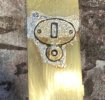
I want to make some brake lever brackets as per drawing. After a bit of deep thought, I came up with this idea to make a pattern. I need four so, I thought it worth the effort. I’ve soldered a draw hook plate and a washer onto a piece of brass. My cunning plan is to file/cut away the waste and shape the junction between the two soldered items with a round file. I can then draw around the finished shape, cut out and file or, bolt the shape to four pieces of sheet and shape them all at once. Watch this space, as they say.
Jon

Jon
Jon Nazareth
Western Thunderer
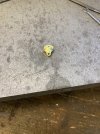
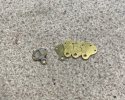
Here they are filed up as a block and separated. They aren’t quite concentric but that won’t notice once the brake lever is fitted l.e., it’ll hide that oddness.
Jon
Jon
Jon Nazareth
Western Thunderer
I made a bit of a cock up with the co-ordinates for machining the rebates for the cross beams which meant a scraped sole plate. However, as Fred Astaire once sang, ‘Pick yourself up, dust yourself off and start all over again’. I’ve made another solebar, complete with all necessary holes, and worked out the co-ordinates again. I’ve double checked them and they are correct. Mind you, I double checked the others and they were wrong. Still, I’m going to have a dummy run using the defunct solebar to make sure.
Jon
P.S. There are more rebates here as I was using it to check on cutter widths after the failure.

Jon
P.S. There are more rebates here as I was using it to check on cutter widths after the failure.

Brian McKenzie
Western Thunderer
Have just done something similar.
"I cut it twice, and it was still too short".
-Brian McK.
"I cut it twice, and it was still too short".
-Brian McK.
Jon Nazareth
Western Thunderer
Said in a cheerful way. I know nothing about railways nor their practices but, it would have been fun getting sheep into this wagon as it has no drop sides.
Jon
Jon
Jon Nazareth
Western Thunderer
Mike
Not sure if you’ve missed it but, there are ten spokes on these wheels.
Jon
Not sure if you’ve missed it but, there are ten spokes on these wheels.
Jon
Said in an equally cheerful way, the Highland Railway used specially made ramps for their double deck sheep wagons. You're quite right, loading livestock would have been a pain and the wagons would have been used for all types of load. Then again if it's all you've got and there is a demand to move livestock that's what you'll use. As you'll know the alternative in that era was droving. I have a 1951 book, 'Wales in Maps', University of Wales Press, that tells how a cattle drove from Llyn to London would take two months so perhaps they were used for livestock until the development of a wider range of rolling stock.
Your beautiful models illustrate a time of tremendous change.
Your beautiful models illustrate a time of tremendous change.
Last edited:
Jon Nazareth
Western Thunderer
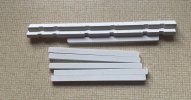
The rebating went okay and here are the completed sole bars complete with the cross beams.
Jon
Jon
Jon Nazareth
Western Thunderer
This is the strangest underframe that I’ve ever made. I’m almost certain that I’ve interpreted the drawing properly but it doesn’t compare at to a conventional frame.
Here I’ve made a start on putting it together. I machined up this oblong of brass to act as a spacer as I couldn’t find anything else that would suit.

An end view of the buffer beam. Note that it’s not the same height as the sole bars but it is a lot deeper. This can be seen in the first picture.
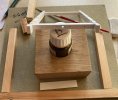
Next will be locating and fixing in the cross beams.
Jon
Here I’ve made a start on putting it together. I machined up this oblong of brass to act as a spacer as I couldn’t find anything else that would suit.
An end view of the buffer beam. Note that it’s not the same height as the sole bars but it is a lot deeper. This can be seen in the first picture.
Next will be locating and fixing in the cross beams.
Jon
Jon Nazareth
Western Thunderer
The cross bars in place on the sole bars ready to be fixed. I machined up a styrene spacer to keep the bars equidistant across the sole bars. This can be seen on the inside of the jig. There is also a simple spacer mid-way to stop the sole bars bowing inwards.
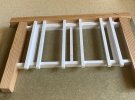
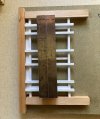
The second picture showing a nice bit of weight to keep all flat while the mek-pak sets.
Jon
The second picture showing a nice bit of weight to keep all flat while the mek-pak sets.
Jon
Last edited:
Jon Nazareth
Western Thunderer
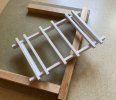
Cross bars nicely fixed in place.
I now need to give some thought to the sides and ends and how I’m going to make them up. There are two diagonal fixings per slat per upright which may turn into just the one. I may be some time.
Jon
I now need to give some thought to the sides and ends and how I’m going to make them up. There are two diagonal fixings per slat per upright which may turn into just the one. I may be some time.
Jon

michael mott
Western Thunderer
Hi Jon, just read through the entire thread, I do enjoy your attention to detail and the want of getting it correct. Have you considered using wood for the wood parts? the model shipbuilding community has some good strip and sheet stock in very fine grained woods.
Michael
Michael
Jon Nazareth
Western Thunderer
Michael
A good idea but I can’t cut straight to save my life. When in a previous life, I did make, I think, a single sided wagon of the LBSCR, sold on to make room for other stock on my display shelf. If I did have some decent machinery, I may have given it another go. I like working with styrene. It can be a bit of a pain if it starts to bow but on the whole it behaves itself. Most of the components I can machine on my milling machine which makes scratch building a lot easier for me.
Jon
A good idea but I can’t cut straight to save my life. When in a previous life, I did make, I think, a single sided wagon of the LBSCR, sold on to make room for other stock on my display shelf. If I did have some decent machinery, I may have given it another go. I like working with styrene. It can be a bit of a pain if it starts to bow but on the whole it behaves itself. Most of the components I can machine on my milling machine which makes scratch building a lot easier for me.
Jon
Jon Nazareth
Western Thunderer
Apart from the anomaly of not really knowing how the solid sides are made up, I’ve spotted another. The slatted sides seem to be frozen in the air! There is no stop showing beneath the uprights to keep the sides in the position as shown in the drawing. Instead of those brackets, I could have fixings through the base of the uprights which would be easier from a construction point of view.
Jon

Jon
Jon Nazareth
Western Thunderer
I’ve shortened the original jig by gluing in a wooden piece so that the jig can accommodate the sides. I’ve also glued in a brass strip at the centre point for the middle vertical support to butt up against. The picture shows the completed side with a styrene spacer still in place. Very small amounts of solvent were used so as not to glue in the spacer as well. Once all is firm, I’ll add more solvent off the jig.
If anyone thinks that I’m teaching you all to suck eggs, just say and, I’ll keep the posts shorter.
Jon
If anyone thinks that I’m teaching you all to suck eggs, just say and, I’ll keep the posts shorter.
Jon
There is no stop showing beneath the uprights to keep the sides in the position .....
Tapered ends to the posts fitting into 'U' brackets?
A not uncommon way of attaching side posts.
John Isherwood.