
You are using an out of date browser. It may not display this or other websites correctly.
You should upgrade or use an alternative browser.
You should upgrade or use an alternative browser.
Threadmarks
View all 197 threadmarks
Reader mode
Reader mode
Recent threadmarks
Cassette-based fiddle yard . . part 4 new base module with shelf Fowler road locomotive - chimney folded part 2 ( Diversion : herding sheep at Spetchbury Halt ) NER class H2 . . named as 'Quintus' New . . at NEEGOG (9 May) New ( Diversion : wheel flanges ) New . . battery endurance New NER class H2 . . charging New

RichardG
Western Thunderer
I arranged it so that turning it on requires a fingernail, turning it off is easier.
We write very little about usability of model railway items. I have seen layouts with incredibly complicated control panels with absolutely no consideration paid to the users.
Functionality and placement of controls is important, but seems to get overlooked. The Micron r/c system has excellent performance, but the configuration menus are a purely engineering interface and really quite user-hostile. It was rather cheering to see the factory default settings for motor control are just right for the coreless motor in the Slater's SG38.
The tiny toggle switch also came from Micron. I think it is perfect for this application. Most likely I will be able to operate it with a finger tip, but only with a deliberate action. The model won't get switched on accidentally, nor will people have to go searching for the switch.
You could always follow the example of Giles [of many parishes, it seems?] and put in a driver who can wave at you when the loco is ''switched on?''
Sounds rather a long way beyond my abilities. Perhaps a servo to rotate the driver from looking out of the doorway (off) to looking straight ahead (on)? But on a future model, a larger one!
. . superstructure
RichardG
Western Thunderer
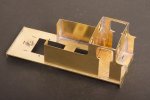
I have added the cab and side tanks to the model. I tacked the four main parts into place first, shuffled things around as needed, and then soldered everything solid.
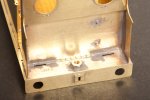
I took about 0.5 mm off the bottom of the cab back so it could stand on top of the footplate and not behind it. This is the first significant correction I have made to any of the etched parts.
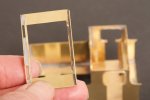
The model has a supporting frame for the cab roof, to allow the roof to be lifted off the finished model.

The fit of this frame into the cab is testament to the design of this kit. I haven’t adjusted anything here to make it fit.
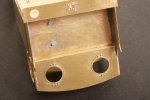
Outer corners dressed. The Z-fold is the last part of the cab to be soldered up, to allow small adjustments to the location of the rear spectacle plate.
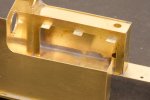
The fit of the etched parts (except the bottom of the cab back) has been spot-on. This is a hand-drawn kit from 1989.

I have made a false floor for the coal bunker so the loco can have a partial load of fuel. The bunker back is waiting until I have sorted out the rear lamp irons.
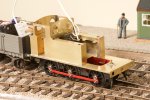
So far so good! This gentleman watches every new arrival at Heybridge Basin. Perhaps he should be rotated by some kind of mechanism so his gaze is always following the trains.
I am hoping to take the loco to the get-together at British Sugar in Bury St Edmunds tomorrow, so do say hello if you go along and see it. I hardly know what anyone here looks like.
RichardG
Western Thunderer
I am hoping to take the loco to the get-together at British Sugar in Bury St Edmunds tomorrow, so do say hello if you go along and see it. I hardly know what anyone here looks like.
Bury St Edmunds was a fine day out. Sorry no photos because I spent almost the whole time talking.
The main take-away is the chassis for the H2 is sorted. Simply because it runs so well, whether across a row of cardboard boxes, a table top or especially on the test/demo track of the Norfolk Mardlers. The final running test will be on the track at NEEGOG, but I do think I have nailed this one. The controllability is as good as the best models I have owned and seen.
The loco received a sort of survivability test when someone decided to show it off, and opened the box upside-down. The loco dangled from its wagon and the control gear dangled from the loco, but cries for help were well-suppressed and only a little pride was dented. We have agreed, I will do the unboxing in future.
The subject of LiPo batteries came up in relation to r/c models, this time with an account of a loco where the battery started to smoulder and onlookers imagined it had a smoke unit. The loco was saved but I have had enough of the scare stories. 'Lady Marion' is now without her own LiPo battery, I am going to try plain vanilla alkaline batteries instead for peace of mind.
RichardG
Western Thunderer
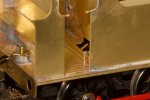
I have just realised, my photo on Saturday shows how close the gearbox is to the footplate and cab front. The motor has ended up about a millimetre in front of the cab front, so really the SG38 is just the right size here. I also forgot to mention, the cab steps are going to fit (and not foul the crankpins), though the steps will go on near the end of the build.
Anyway, I have had a go at the buffers while I wait for the batteries to arrive. I bought a set of GER buffers for the model, these are from Walsall Model Industries.
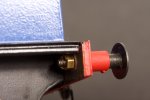
I used the same design on Nellie the crane tank.
Unfortunately there is nowhere near as much space on the H2 for the stems to move - the sandboxes get in the way.

After a false start using scraps of concentric tube to retain the springs, I worked out a solution. The rearmost part of the spigot behind the stock is removed and set aside. This offcut contains a rebate to retain the spring. The rest of the spigot is then removed, and the stock counterbored to hold the offcut.
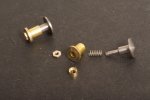
The offcut is soldered into the stock (additional offcut in the foreground here), the buffer stem is cut the length, the spring is shortened and the retaining nut is thinned down.

Then I made three more.
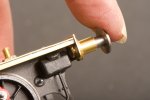
Going back to the H2, much of the nut will be hidden inside the thickness of the buffer beam. There is free space for the front buffers to compress, and there is a little more free space at the back of the model. I will leave the buffers off the model for now.
The lathe is not vital but it does help me to resolve some details as I go along. An alternative would be to arrange something with small washers instead of the offcut, or buy some different buffers. Or omit the springing.

RichardG
Western Thunderer
roxey mouldings do a self contained buffer for terriets [not the markits one]
4 bolt fixing style
Thanks Ken.
I already have a Terrier for the railway, loco no.4 'Heybridge'. This has (of course) Terrier-style buffers, so I'd like to stay with the Walsall GER ones for the H2. They will help the loco appear to belong because they are the same pattern as those on Nellie the crane tank. When the retaining nuts are blackened they will all but disappear into the gloom behind the buffer beams.
Another useful thing to come from Bury St Edmunds yesterday was a name for the H2. It is going to be 'Quintus'. This name was later used for a loco on the NG railway on the Isle of Purbeck. It has a period sort of ring to it, and it will be the fifth and final loco owned by the Heybridge Railway. Thank you to Tony @Osgood for this idea.
Light Railway Stores have re-opened their custom nameplate etching service


RichardG
Western Thunderer
What about DAIFLY, Richard? View attachment 249053
Pronunciation is not obvious.
I like the idea of names with a Roman origin. When Bovis Homes had bought up the land at Elms Farm (between Crescent Road and the Heybridge bypass), excavations found signs of a Roman town there.
Last edited:

Osgood
Western Thunderer
The NG Pecketts of the Southam Cement Co were named after geological eras (edit: periods - oops) such as Liassic, Triassic, Mesozoic etc.
Roman? You can go a lot further back than that round these parts.
As our quarry crept back into the hillside at the head of three valleys we uncovered traces of a Roman lookout post for the local camp.
But more excitingly that lookout post was built right on top of a dwelling occupied by the Beaker People, who came over from Europe between the Neolithic and Bronze Ages - they had a distinctive style of decorating their pots.
Their claim to fame being their pots, which were the first to be capable of withstanding the direct heat of a fire - up until then stones had to be heated up in the fire and dropped into water filled pots to boil water and cook food that couldn't be grilled.
For an idea of what the Beaker people looked like, the Muppets have it covered:

Roman? You can go a lot further back than that round these parts.
As our quarry crept back into the hillside at the head of three valleys we uncovered traces of a Roman lookout post for the local camp.
But more excitingly that lookout post was built right on top of a dwelling occupied by the Beaker People, who came over from Europe between the Neolithic and Bronze Ages - they had a distinctive style of decorating their pots.
Their claim to fame being their pots, which were the first to be capable of withstanding the direct heat of a fire - up until then stones had to be heated up in the fire and dropped into water filled pots to boil water and cook food that couldn't be grilled.
For an idea of what the Beaker people looked like, the Muppets have it covered:
Last edited:
RichardG
Western Thunderer

The batteries have arrived and I have convinced myself there is enough space to take two of them in each side tank. The file represents the free space available for heatshrink sleeving.
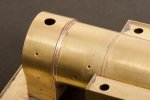
So I have proceeded to fix the boiler onto the smokebox, and then secure them onto the model.
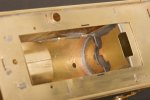
There are some small tags along the tops of the inner tank sides. I have folded the tags inside the boiler to maximise the space available for the control gear, and make sure they cannot chafe on the wiring.
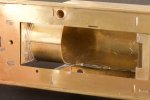
With the tags crimping the boiler onto the tanks, I have soldered up the whole length of these joins. This assembly is now extremely strong.
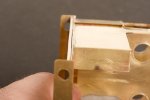
I put in a ripple here when the hanging bar went on. It looked a bit bad, so I took it off and straightened it. This is my second attempt, photographed to make it look as grim as I can. For the record, this is what happens if you have the workpiece resting on kitchen foil on a sheet of cardboard on the RSU baseplate, and you are pushing down too hard "trying to keep everything flat".
I think this sort of wobble is representative of damage incurred during a rough shunt or even a minor collision. I suspect it will all but disappear under the paint and a little dust.
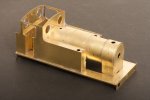
On to a more gentle viewpoint. I cannot imagine a better fit for the boiler/smokebox assembly. The only adjustment I had to make was to widen one slot in the running board below the smokebox. The important thing was to leave a full 28 mm gap between the fronts of the tanks.
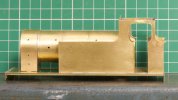
Another photograph trying to be as self-critical as I can. The boiler is sloping downwards towards the cab, but not by much; and this hanging bar is turning upwards at the front. I reckon, neither will scream at me when the model is in a more normal setting on a layout.
I do feel I am reaching a sort of plateau with my modelling, especially with the alignment of the boiler. I mean, I won't get much better than this however hard I try. I remain extremely grateful for the numerous 'likes' and the advice people are giving me here, you really are encouraging me along.

spikey faz
Western Thunderer
All looks neat to me Richard. 
If your 'plateau' is the equivalent to the top of K2, then I'm still at base-camp!
Keep on posting your builds Richard: always something new for me learn from 'em.
Mike
If your 'plateau' is the equivalent to the top of K2, then I'm still at base-camp!
Keep on posting your builds Richard: always something new for me learn from 'em.
Mike
RichardG
Western Thunderer
I do feel I am reaching a sort of plateau with my modelling, especially with the alignment of the boiler. I mean, I won't get much better than this however hard I try.
If your 'plateau' is the equivalent to the top of K2, then I'm still at base-camp!
I keep on being careful with details whilst overlooking the big picture. I am so wrapped up in getting things done "neatly" and "just right" I overlook the general view. For example when I started the door beading for the second cab side, I put it on inside-out. It was quite neat too!
I know where the boiler went wrong. There are two formers, front and rear. I did the rear one first, because I thought it would be easier. The former was a shade too large, so I opened out the boiler with my fingers to make it fit. Wrong!! Doing this made the boiler a shade wider (not a problem) but also a shade flatter. This is seen in the dip just before the front of the cab. When I fitted the front spacer, this one being inside a cylindrical end of the boiler, I had to file it down to let it go into the space. If I had fitted the front former first, I would have filed down the rear former to match.
I woke up this morning thinking about the holes for the clack valves. The kit gives you some freedom in the fore/aft location of the boiler and smokebox. I chose to shove the boiler hard against the cab front so I could shim out the cylinder cover. This would hide another gap at the front. Now, if I had done a better job of the running board I might well have decided to decided to have the gap at the other end, and hidden it under a boiler band.
What I should have been doing was to install the boiler so the holes for the clack valves are one directly above the other.
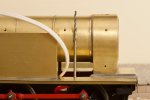
As it happens, they are; but I need to be aiming for this through my own efforts, and not ending up with success by good fortune.
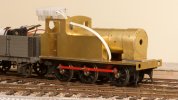
I want to see this stay on the track at NEEGOG. I am optimistic it will, but I will get some peace of mind when I see it happen.
RichardG
Western Thunderer
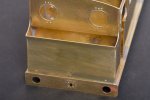
After a few frustrations this week, the bunker back was completely straightforward. My approach is to anneal the top of the part and then tape it along its uppermost edge to the shank of a drill bit. Clamp both the part and the bit in the vice and bend to shape.
I got the two top corners lined up, then everything else fell into place.
 These are the major etched parts I haven’t used in the build.
- Frame spacers, because I made wider ones
- Hanging bars, because I used something closer to scale height
- Representative boiler band, because I used some shim stock instead
- Couplings and gearbox, because I bought some upmarket ones
- Two hand wheels, because the kit provides more than you need
The bunker back is the final “structural” part of the model. This leaves detailing, painting, and building-in the control gear.
RichardG
Western Thunderer
I want to see this stay on the track at NEEGOG. I am optimistic it will, but I will get some peace of mind when I see it happen.

The loco ran perfectly at NEEGOG. A weight in the cab and another out of Mad Max 2 are representing the weight of the battery packs and putting the CofG over the middle axle.
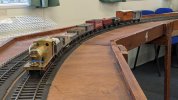
This all kept running without any drama, perhaps a little slowing on the uphill parts. The train looks good on this radius of curve but I need a new house to have this sort of space.

The 17 mph maximum speed looks a bit feeble on a large track. The final battery installation will give me more volts and this should help.
I am having doubts about painting the model loco black. I need something brighter if I am going to see it at any distance on a garden railway.
RichardG
Western Thunderer
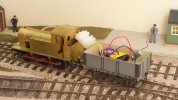
I have tried a 9 volt battery with the Micron MR601.
Increasing the battery voltage by 20% increases the model's maximum speed by 50%. This has got to be useful most of everywhere except at home so I want to try to squeeze in all eight NiMh batteries (9.6 volts) when the time comes.
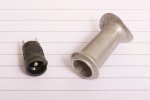
The bracket for the charging socket had to go, it was going to make battery installation almost impossible. The new plan is to put the socket into the chimney. This socket is a standard coaxial power connector, slimmed down to fit.

If I carve away any more of the underneath I will have to ask for a new one.
There are about 55 detail parts to go onto the model so it is now dismantled to let me start adding these.
. . detailing
RichardG
Western Thunderer
The detail parts for the superstructure begin with the buffer stocks and some pieces of brass sheet and wire.
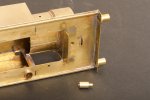
When I modified the buffer stocks, I removed the bosses which would locate them in the buffer beams. The brass dowel in the foreground has a small diameter to go into the back of a buffer stock and large diameter to go into a buffer beam. The dowel makes aligning the buffer stocks a whole lot easier.
The panel below the smokebox is here to hint at the backs of the cylinders being present.
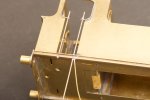
A while ago, I drilled some holes in the running board to accept the cab handrails. Three holes were in the right place, one was adrift. So I opened up the wonky hole from underneath and packed out the space with more wire.

All of the prototype photos I have show the coal rails to be plated over. But I think they look better in their original state so I have left them unmodified. This is the last etched part bar the lamp irons.

The cab footsteps ended up tight against the tube I used for the hanging bars . . .
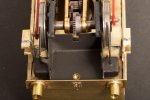
. . . and I have just enough room to spare in front of the crankpins. Thank you to @Rob Pulham for warning me about this before I started.
The RSU provides a very localised heat but I still wrapped the footstep assemblies in soggy wet paper towel when I soldered them onto the model

The handle on the valve cover is a veneer pin with a 16BA washer. I quite enjoy adding this sort of thing but there is isn't much scope for any more.

The long handrail extends into the cab so I can add a control wheel for the blower valve.
The RSU makes adding the handrail knobs so much easier, but do put a bit of wire through the hole before pressing down with the probe. I didn't do this on one knob, crushed the part and now I am waiting for a replacement.
When I modified the buffer stocks, I removed the bosses which would locate them in the buffer beams. The brass dowel in the foreground has a small diameter to go into the back of a buffer stock and large diameter to go into a buffer beam. The dowel makes aligning the buffer stocks a whole lot easier.
The panel below the smokebox is here to hint at the backs of the cylinders being present.
A while ago, I drilled some holes in the running board to accept the cab handrails. Three holes were in the right place, one was adrift. So I opened up the wonky hole from underneath and packed out the space with more wire.
All of the prototype photos I have show the coal rails to be plated over. But I think they look better in their original state so I have left them unmodified. This is the last etched part bar the lamp irons.
The cab footsteps ended up tight against the tube I used for the hanging bars . . .
. . . and I have just enough room to spare in front of the crankpins. Thank you to @Rob Pulham for warning me about this before I started.
The RSU provides a very localised heat but I still wrapped the footstep assemblies in soggy wet paper towel when I soldered them onto the model
The handle on the valve cover is a veneer pin with a 16BA washer. I quite enjoy adding this sort of thing but there is isn't much scope for any more.
The long handrail extends into the cab so I can add a control wheel for the blower valve.
The RSU makes adding the handrail knobs so much easier, but do put a bit of wire through the hole before pressing down with the probe. I didn't do this on one knob, crushed the part and now I am waiting for a replacement.
RichardG
Western Thunderer
I asked Jim McGeown if he could supply some extra handrail knobs to replace the one I ruined and another one I lost, and these arrived over the weekend. I have thanked him but I’ll add another thank you here because this level of customer service really does help a great deal. Without it I might have been buying knobs elsewhere and found myself replacing the first ones to get them all to match.

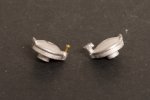
The final etched parts to go onto the body are the lamp irons. I find these difficult (too small to hold and to see what I am doing at the same time) so the model got just one at the front and these two at the back. Enough for a light railway loco anyway.
Then I moved on to the castings. I put some pins into the tank fillers in place of the cast handles, I think this looks better.
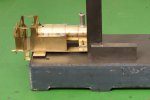
If the chimney is crooked this is not from a lack of trying.

I reckon I will never get another chimney skirt this thin, well not a whitemetal one anyway.
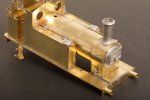
I used epoxy glue to fix the smokebox door and the chimney, everything else is soldered.
The safety valve cover, clack valves and a few minor castings will be best glued on after painting.
The final etched parts to go onto the body are the lamp irons. I find these difficult (too small to hold and to see what I am doing at the same time) so the model got just one at the front and these two at the back. Enough for a light railway loco anyway.
Then I moved on to the castings. I put some pins into the tank fillers in place of the cast handles, I think this looks better.
If the chimney is crooked this is not from a lack of trying.
I reckon I will never get another chimney skirt this thin, well not a whitemetal one anyway.
I used epoxy glue to fix the smokebox door and the chimney, everything else is soldered.
The safety valve cover, clack valves and a few minor castings will be best glued on after painting.
Last edited:
Threadmarks
View all 197 threadmarks
Reader mode
Reader mode