The Heybridge Railway, 1889 to 1913

Simon H

Western Thunderer
Ah ha! Mention of Hesperus takes me to these photos. I was rather attracted to the model of Ebdon Lane Halt. It seemed like the sort of model I could build for myself, maybe keep in the living room to display my latest wagon or whatever. So I took a few photos . . .

View attachment 247274

View attachment 247272

View attachment 247273

View attachment 247275

View attachment 247276
(The lamp is a ghost reflection from outside the display case)

View attachment 247277
The model is still in perfect condition, no obvious dust or fading.

I am rather sorry to say, I was so taken with this diorama I walked away thinking about possibilities for my Heybridge Railway and so I didn't take photos of the models nearby.
Although I've seen it before when I've visited, I'd forgotten what a lovely diorama this is.
I remember building a length of 0 gauge track with light flat-bottom rail, probably in the early 1990s when I had a brief flirtation with the scale, largely inspired by the then still extant (is it still there?) bit of FB track, presumably ex-RVR, in a siding at Bodiam.
 

RichardG

Western Thunderer
the then still extant (is it still there?) bit of FB track, presumably ex-RVR, in a siding at Bodiam.

We visted the cafe (three times), the craft fair and the museum. There wasn't really time for a ride on the train as well, this will have to wait for another day.

Tenterden station always seems beautiful to me, it says "light railway" everywhere.
 
. . smokebox

RichardG

Western Thunderer
Things have gone wrong but I have a chance of putting them right thanks to Jim McGeown.

To be brief, I tacked my completed smokebox onto the front of the boiler, soldered everything solid, and then realised the smokebox was offset about 0.2 mm to one side. Just enough to notice. I stuffed the smokebox full of soggy paper towel, applied the cook's torch to remove it and the whole assembly sprang apart. Difficult to reassemble because the outer corners are filed down to give a radius.

View attachment 177695
Well, I put the smokebox back together but the outer wrapper revealed I had put a slight twist onto the assembly.

At this point I tried cutting through the wrapper and fixing the two parts flush onto the inner wrapper. This did not work, not in any form, so the wrapper was spoilt.

View attachment 177696
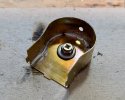
A second rebuild of the smokebox followed, minus the outer wrapper. The result (see below) stands up to casual inspection but it is still skewed; the wrapper is not orthogonal to the front and back. So it looks awful on the loco.

View attachment 177697
And now the good bit.

I phoned Jim McGeown, the proprietor of Connoisseur Models. He has two gash frets from this kit. One was already robbed for its smokebox parts, and now the second one is robbed too. Jim has posted the parts to me and they arrived today. No pressure then :confused:

The smokebox for my Y14 was a bit of a disaster, and Jim had to send me some fresh parts to let me build a second one. I had to do better for the H2.

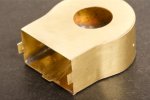
This time, I put the main radius onto the wrapper in the rolling bars. Then I annealed the lower sections of the wrapper to help me put the reverse curves onto them when the time came.

2025-09-10 15.06.23.jpeg
The smokebox front is screwed down onto a piece of board, with some sacrificial cardboard to reduce the scorch marks on the board. I reflowed the solder after I took this photo.

I fixed both the front and the back ever so slightly behind the edges of the wrapper. Then I filed down the wrapper to make it flush.

DSC_0642.jpeg
There is a tiny error in the alignment of the wrapper. I’m not sure if this is the kit or my build, but it will disappear below the top cover of the cylinders.

I have removed the tab on the back of the smokebox (uppermost here) so I can extend this surface downwards towards the cylinders.

DSC_0654.jpeg
A dummy run to show how well the smokebox, cylinder cover and running board all fit together. I had to file about 0.05 mm off each side of the wrapper (0.1 mm in all) to make it a snug fit into the cylinder cover. Everyone says these kits go together, and indeed they do.

DSC_0657.jpeg
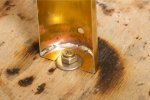
The two holes for the front handrail were rather large (I think they were intended for split pins) so I have sleeved them with brass tube.
 
. . boiler

RichardG

Western Thunderer
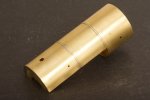
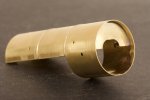
The boiler arrives pre-rolled so there is little work to do.

DSC_0659.jpeg
The boiler is rolled too tight and sprung onto place around this semi-circular former. The edge of the boiler sank into the sacrificial bit of cardboard and this put things at a wonky angle, so I have a fresh scorch mark on my sheet of board. Sometimes I think scorch marks are unavoidable. I start a new piece of board every year or so.

DSC_0662.jpeg
I struggled with the boiler bands supplied in the kit, so I used some 1 x 0.2 mm brass strip instead. This is overlength, so it is easy to pull taught and clamp at both ends. Then sweat into place and trim the ends flush.

I have rubbed down the boiler bands to reduce their thickness. The primer is self-levelling so I think they will look okay in the end. There is a trick of the light here, I really have drilled out both holes for the handrail knobs.

DSC_0660.jpeg
Finally some short tubes to hold the clack valves. I can glue the clack valves into the tubes after painting the model.

The former at this end of the boiler is a bit skewed, this is not a trick of the light. I will leave this alone, so I can show it to people who tell me I am a perfectionist :D
 

Rob Pulham

Western Thunderer
I always solder on a piece of toughened glass (a shelf from an old fridge is ideal). Not thick enough to cause a problem by being a massive heat sink but it doesn't scorch and it's easy to clean if you feel the need.

I recently acquired a glass sheet bed from a scanner which is even thinner but I haven't needed to try it out for soldering yet.
 

simond

Western Thunderer
I always solder on a piece of toughened glass (a shelf from an old fridge is ideal). Not thick enough to cause a problem by being a massive heat sink but it doesn't scorch and it's easy to clean if you feel the need.

I recently acquired a glass sheet bed from a scanner which is even thinner but I haven't needed to try it out for soldering yet.
I’d be a bit wary of that, Rob. Toughened glass is tough because the inside is under tension and that puts the skin under compression, which prevents cracks growing.

I have no idea how big or how hot a hot spot would need to be (or even if it’s possible) for it to stop being a sheet of toughened glass and become a lot of “sugar” but it’s likely to be exciting if you find out. It’s probably fine but…

I use half a marble tile left over from DIY in the bathroom years ago. The advantage is that you can drill holes in it to hold stuff.

atb
Simon
 

Rob Pulham

Western Thunderer
I’d be a bit wary of that, Rob. Toughened glass is tough because the inside is under tension and that puts the skin under compression, which prevents cracks growing.

I have no idea how big or how hot a hot spot would need to be (or even if it’s possible) for it to stop being a sheet of toughened glass and become a lot of “sugar” but it’s likely to be exciting if you find out. It’s probably fine but…

I use half a marble tile left over from DIY in the bathroom years ago. The advantage is that you can drill holes in it to hold stuff.

atb
Simon
Hi Simon,

I hear you but I have been soldering on the same piece for at least 15 years. If it goes pop I will just use another piece. In that time I have used an 80 watt iron, my RSU and microflame without ill effect. Perhaps it's because it's laid on two thicknesses of 12mm ply (at my old house is was on a piece of 40mm oak worktop) and that helps even out the heat. I will be honest, I dunno but it works for me.
 

RichardG

Western Thunderer
I use half a marble tile left over from DIY in the bathroom years ago. The advantage is that you can drill holes in it to hold stuff.

I am about half way through the first side of my piece of ply. This is my last such piece of ply, I can look out for a marble tile while I consume the rest of it.
 
. . locations for cab handrails

RichardG

Western Thunderer
DSC_0680.jpeg
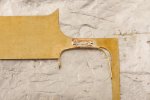
I have spent the last 3+ hours tackling the cab beading on the H2. This must be one of the most awkward things I have ever tried to do with brass. The photo is my third attempt . . . I gave up trying to arrange a single strip and I now have two pieces with a join near the middle.

The black background shows up the asymmetry between the handrails (quite exasperating really!) but I can put this right with a file on the mounting holes.

This is my first loco with an enclosed cab, and right now I hope it will be my last. I am saving the second cab side for another day.
 
Last edited:

RichardG

Western Thunderer
I always add them once the sides are soldered onto the footplate . I am presuming there are etched on this kits footplate .
This is what I did for Nellie the crane tank and my Y14. I found both of these fairly straightforward, certainly I didn't need spare parts. But the design of the Y14 leaves the handrails butt jointed onto the footplate, and while they have never broken off it is always going to be a weak point. I could not get a drill bit into the corner to make a hole in the footplate. So this time I want to find the positions of the tops of the handrails and then drill holes in the footplate to suit, before assembling the model.

The H2 cab side has tighter curves and less room for error. I don't think I will ever have the ability to put the beading onto a built model like this one, nor to do it in one continuous length. I need to keep on turning the cab/tank side around, to see how the job looks on both sides - and I keep on re-doing the job.

I have added the first piece of beading on the second side. I put it on three or four times, and I still needed to elongate the hole for the handrail. I will post photos when it is all done.
 

Ian@StEnochs

Western Thunderer
This is what I did for Nellie the crane tank and my Y14. I found both of these fairly straightforward, certainly I didn't need spare parts. But the design of the Y14 leaves the handrails butt jointed onto the footplate, and while they have never broken off it is always going to be a weak point. I could not get a drill bit into the corner to make a hole in the footplate. So this time I want to find the positions of the tops of the handrails and then drill holes in the footplate to suit, before assembling the model.

The H2 cab side has tighter curves and less room for error. I don't think I will ever have the ability to put the beading onto a built model like this one, nor to do it in one continuous length. I need to keep on turning the cab/tank side around, to see how the job looks on both sides - and I keep on re-doing the job.

I have added the first piece of beading on the second side. I put it on three or four times, and I still needed to elongate the hole for the handrail. I will post photos when it is all done.

If there are no holes provided, and it’s difficult to drill same, a small washer or slice of brass tube, will increase the soldered area, and strength, plus reproduce the flange at the bottom of the rail.

At the top there could also be a nut or ferrule under the support and sometimes a ball on top. This can be formed from a handrail knob with the stanchion cut off.

Ian.
 

RichardG

Western Thunderer
DSC_0680.jpeg

I have spent the last 3+ hours tackling the cab beading on the H2. This must be one of the most awkward things I have ever tried to do with brass. The photo is my third attempt

I was going to say “it gets easier with practice” but I’m not at all sure that it does…

I am relieved to say, assembly has been quicker for the second side - perhaps an hour and a half, including time taking some photos. So here is a sequence of photos showing how I went about fitting this second lot of cab beading, and drilling the footplate to accept the cab handrails . . .

DSC_0681.jpeg
It is fortunate, the kit provides three pairs of parts for the cab beading. So it is possible to cut some pieces into two, and add the beading in two parts.

DSC_0683.jpeg
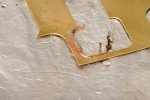
The first piece of beading is removed and reattached in a better place. I found with the first side, if solder gets into the groove around a curve it is impossible to remove it for a second attempt.

DSC_0684.jpeg
The beading is fixed at the bottom. All soldering is on the inside.

DSC_0685.jpeg
The beading is fixed along its top.

DSC_0692.jpeg
After all this (and with some exasperation!), the hole for the handrail is elongated to move the handrail closer to the cab side.

DSC_0694.jpeg
The first piece of beading is cleaned up, and the second piece is pre-formed and tacked into position.

DSC_0696.jpeg
The beading is trimmed to length and soldered solid.

DSC_0706.jpeg
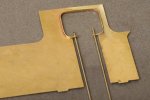
The alignment of the handrails is checked for symmetry. The gaps for the crew's fingers are rather small (barely a scale 60 mm) but resemble those on the prototypes.

DSC_0709.jpeg
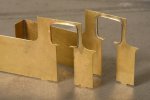
Both sets of beading are cleaned up and declared complete; and the tank fronts are folded to shape.

DSC_0712.jpeg
Each cab/tank side is clamped onto the running board to find the locations for the bottoms of the handrails.

DSC_0713.jpeg
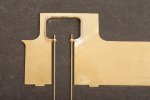
Finally, the running board is drilled to be ready to accept the handrails. The four holes are outside the edges of the footplate, and so if I align the hanging bars carefully I will be able to open out the holes from underneath if necessary.

Obviously this is my way of doing things; and I emphasise this is my first attempt where the beading has to hold two handrails. I am sure there are better and indeed quicker ways. A friend has suggested, forming the entire length of beading to its final shape before reaching for the soldering iron . . . maybe next time.
 

RichardG

Western Thunderer

Drilling the fresh holes in the running board takes me back to where I started work on the kit.

DSC_0720.jpeg
I now have a collection of subassemblies and some new and modified parts . . .

DSC_0726.jpeg
. . . and a much smaller quantity of untouched parts.

The instructions have been excellent so far. Yes I have danced around them from one topic to another seemingly at random, but the methods suggested have held true and useful throughout.

In a way I have arrived at a new kit, one with fewer but more complex parts. When I have put a dozen or so of these parts together, I ought to have something resembling an H2 :)
 
Top