
You are using an out of date browser. It may not display this or other websites correctly.
You should upgrade or use an alternative browser.
You should upgrade or use an alternative browser.
Rivermead Central
- Thread starter 40057
- Start date

76043
Western Thunderer
I've never seen any footage, but I wouldn't say anyone who has heard of the Sherwood Section by Norman Eagles would be dismissive of clockwork power. As we know he ran to a timetable, something that alleged finescale etched brass rivet counters can't even do today at exhibition!
The layouts look great but there's no clue as to what is going on at 99% of exhibition layouts. I can't see the point of getting all that detail right in places you can't see only to run it like a toy train.
Tony
The layouts look great but there's no clue as to what is going on at 99% of exhibition layouts. I can't see the point of getting all that detail right in places you can't see only to run it like a toy train.
Tony
Last edited:
I installed the Benham’s office building on the layout this afternoon. Again, as with the factory and the warehouse, a tricky job working at arm’s length. But no significant problems. Just a minor touch up required to the blue wall paint. And the building fits. Because installation is so difficult, and carries some risk of damage, I don’t do a test fit. Everything has been measured and I know the building ought to fit. Until it’s actually put in place though, a little bit of anxiety in case it isn’t right.
So here is the complete range of buildings that make up the Benham’s works:
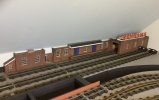
Left to right, site maintenance (with the sloping roof), main office, warehouse (with external un/loading platform and canopy) and last the factory (with internal un/loading bay). In total, around 5’ 6” long.
Here’s the office fixed in position:
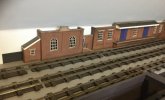
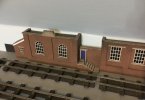
As can be seen, I painted a dark grey rectangle on the wall before I installed the office. The reason being that there will be a small gap, perhaps an inch, between the office and the next building to the south. I didn’t want the ‘sky’ going right down to ground level. So the grey rectangle represents some sort of further away building part of the silhouette of which will just be visible in the gap.
The office building is fixed in place by a single 1/2” countersunk wood screw through the bottom step. Since the building is against the wall, one screw stops it moving in any direction. The screw will pass as a drain cover if it is noticed at all.
I’m very pleased with the overall look of the Benham’s works. The jumble of roof profiles and building styles I think manages to create a city/industrial backdrop in a minimal depth.
As it happens, today is the second anniversary of me starting this thread. So nearly two years for these three buildings and five and a half feet of wall covered. I will have to speed up. In fairness to myself, much of the back wall of the layout will be covered with a representation just of a boundary wall. So much quicker to make than the Benham’s buildings. Going back to my first post in this thread, I said I was aiming to build impressionistic, not detailed, buildings finished in a muted palette of browns and greys. The purpose of the buildings being to provide a context for the vintage trains. I’m happy with the way the Benham’s works buildings have turned out — according to plan.
I would like to thank those who have shown an interest in this thread over the past two years and especially readers who have taken the trouble to post ‘likes’, ask or answer questions, or make contributions.
So here is the complete range of buildings that make up the Benham’s works:
Left to right, site maintenance (with the sloping roof), main office, warehouse (with external un/loading platform and canopy) and last the factory (with internal un/loading bay). In total, around 5’ 6” long.
Here’s the office fixed in position:
As can be seen, I painted a dark grey rectangle on the wall before I installed the office. The reason being that there will be a small gap, perhaps an inch, between the office and the next building to the south. I didn’t want the ‘sky’ going right down to ground level. So the grey rectangle represents some sort of further away building part of the silhouette of which will just be visible in the gap.
The office building is fixed in place by a single 1/2” countersunk wood screw through the bottom step. Since the building is against the wall, one screw stops it moving in any direction. The screw will pass as a drain cover if it is noticed at all.
I’m very pleased with the overall look of the Benham’s works. The jumble of roof profiles and building styles I think manages to create a city/industrial backdrop in a minimal depth.
As it happens, today is the second anniversary of me starting this thread. So nearly two years for these three buildings and five and a half feet of wall covered. I will have to speed up. In fairness to myself, much of the back wall of the layout will be covered with a representation just of a boundary wall. So much quicker to make than the Benham’s buildings. Going back to my first post in this thread, I said I was aiming to build impressionistic, not detailed, buildings finished in a muted palette of browns and greys. The purpose of the buildings being to provide a context for the vintage trains. I’m happy with the way the Benham’s works buildings have turned out — according to plan.
I would like to thank those who have shown an interest in this thread over the past two years and especially readers who have taken the trouble to post ‘likes’, ask or answer questions, or make contributions.

magmouse
Western Thunderer
I’m happy with the way the Benham’s works buildings have turned out
As well you might be - the buildings are excellent models in their own right, with the bonus of a style that fits beautifully with the vintage train look. I have also been impressed with your approach to repairing the stock and track - sensitive, but also practical and realistic about what can be done. It's a pleasure to follow the thread, especially as this isn't something I would ever do - I get to enjoy watching you do it instead!
Nick.
Wow! Thank you very much!As well you might be - the buildings are excellent models in their own right, with the bonus of a style that fits beautifully with the vintage train look. I have also been impressed with your approach to repairing the stock and track - sensitive, but also practical and realistic about what can be done. It's a pleasure to follow the thread, especially as this isn't something I would ever do - I get to enjoy watching you do it instead!
Nick.

Roger Pound
Western Thunderer
The late Jack Ray also ran his Crewchester layout with clockwork power for many years too, although he did eventually change to electric power. With his clockwork motors he used telephone dial mechanisms as governors with great success apparently. I regret my understanding of the finer points of controlling clockwork mechanisms is nil, but I do recall his methods being recorded in his writings.I've never seen any footage, but I wouldn't say anyone who has heard of the Sherwood Section by Norman Eagles would be dismissive of clockwork power. As we know he ran to a timetable, something that alleged finescale etched brass rivet counters can't even do today at exhibition!
The layouts look great but there's no clue as to what is going on at 99% of exhibition layouts. I can't see the point of getting all that detail right in places you can't see only to run it like a toy train.
Tony
Apropos Benhams - a brilliant piece of work!
Roger
And from what I can see they don't care that they don't know how to run it properly.I can't see the point of getting all that detail right in places you can't see only to run it like a toy train.
Fitting the governor from a telephone dial in place of the traditional governor is generally transformative to the performance of clockwork locomotive mechanisms. Speed is reduced, power delivery evened out over the length of run, haulage capacity increased. Also the motor runs almost silently, instead of the normal noisy rattle. I don’t know who had the idea but it originated in the 1950s and was indeed used in the Crewchester locomotives. The system is usually referred to as a ‘teleguv’. It wouldn’t be appropriate to alter a vintage locomotive, but I have two teleguv-fitted locomotives built by a friend (now sadly deceased) during the present century.The late Jack Ray also ran his Crewchester layout with clockwork power for many years too, although he did eventually change to electric power. With his clockwork motors he used telephone dial mechanisms as governors with great success apparently. I regret my understanding of the finer points of controlling clockwork mechanisms is nil, but I do recall his methods being recorded in his writings.
Apropos Benhams - a brilliant piece of work!
Roger
Actually, there’s a whole community of vintage telephone collectors and restorers and businesses offering spare parts. When I needed a 1950s telephone dial governor to put in a locomotive, I ‘phoned a business offering restored and reconditioned vintage ‘phones — not optimistic they would have what I needed. But no, the manner of the person answering the ‘phone suggested requests for 1950s dial governors was perfectly normal and routine. In response to my tentative request, the question was simply which model of ‘phone was the replacement governor for. I was offered replacement governors to suit half a dozen different makes of ‘phone. Not having any idea whether there was any material difference in terms of performance in a locomotive, I chose at random a type from a common model of ‘phone. Cost £3.00. It worked fine.It wouldn't be appropriate to alter a vintage telephone either these days!
Having completed work on the Benham’s buildings, time to decide what to do next. I will aim to make progress with the next buildings project, but I want to concentrate some effort on repairing and restoring rolling stock. I also need to complete at least two further Lowko Track turnouts so I can lay some more track.
Back in February last year (my posts #65 and #66), I reported commencing work on a Windsor Model Co. (= Leslie Forrest) coal wagon:
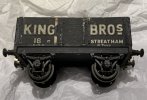
I didn’t get very far with it before laying it aside and getting on with other things. The wagon is a nice model and I am an admirer of Leslie Forrest’s work. As it came to me, the wagon was filthy all over and very oily underneath. There were a few old woodworm holes, some missing paint and much of the strapping was lifting from the body (with two parts missing). The coupling chains were a collection of poorly formed loops home-made from a variety of different wire.
A lot of work to put the wagon back in good order, but definitely worth doing.
I said last year I was very unsure of the age of this wagon. Since then, additional information has been added on the ‘Milbro Model Railways’ website stating that Leslie Forrest retired in 1958. My feeling is this wagon dates from the 1940s or ‘50s, not least because its cast-iron wheels are the type sold by Bassett-Lowke post-WW2. A probable construction date between 1945 and 1958 now seems most likely.
I have made a bit of progress during the last month with the repairs needed to the King Bros wagon. Further cleaning has been undertaken though there is more to do. I have attended to the strapping and corner plates where these were lifting off the wooden body:
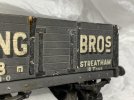
The lifting sections are now glued back down using diluted wood glue applied with a fine brush:
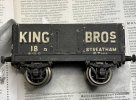
One length of strapping will need to be replaced. The strapping and corner plates are made of embossed, foil-covered card, as sold by Mills Bros (Milbro) of Sheffield. I have a small quantity of this material, unused:
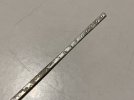
I’ll have to match the paint of course, but the missing strapping on the King Bros wagon will be replaced with identical original material.
However, yesterday and today, I decided to work on (and complete!) repairs to another Windsor Model Co. mineral wagon. This one is in excellent condition. As usual, some of the applied strapping and corner plates were lifting off the wooden body. So glue was applied to reattach the lifting sections. Some minor repairs were then needed to the black paint after gluing. A light clean and it’s done, ready for traffic:
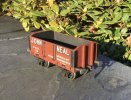
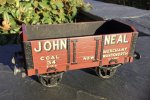
This wagon carries no trade mark or identification regarding manufacture. However, Leslie Forrest’s work is unmistakable, both the method of constructing the body and his excellent hand painting. The similarities with the King Bros wagon are obvious. This time however — and unusually for a Windsor wagon — there is applied sole-bar detailing. The wheels are again post-WW2 Bassett-Lowke cast-iron wagon wheels. On the John Neal wagon though the Bassett-Lowke wheel sets have been modified to a wider back-to-back (27.5 mm instead of 27.0 mm) and the wheels thinned (5.7 mm instead of 6.0 mm). The slightly finer wheels should be OK on my track. The wheel sets I am sure were altered before fitting at the time the wagon was made; it would show if any of the W-irons had ever been unscrewed to change the wheels. Both sole-bars on the Neal wagon have a hole drilled for fitting a brake-lever pin rack. Clearly though, brakes were never fitted. The unused holes suggest some sort of ‘mass-production’ of wagon components by Forrest. He certainly had a prodigious output of models given how often his work is offered for sale.
I was advised when I bought it that the John Neal wagon was from Norman Eagles’ famous railway, The Sherwood Section of the LMS. I’m inclined to think that it was indeed from the Sherwood layout. The wheel standard (27.5 mm b/b) is correct and the single-link couplings. Leslie Forrest built much of the rolling stock for the Sherwood railway. However, the John Neal wagon is not visible in any photo I have of Norman Eagles’ railway. So I am not certain as to the wagon’s provenance. What is not in doubt is that it was built by Leslie Forrest and is a fine model that I am pleased to have for Rivermead Central.
Back in February last year (my posts #65 and #66), I reported commencing work on a Windsor Model Co. (= Leslie Forrest) coal wagon:
I didn’t get very far with it before laying it aside and getting on with other things. The wagon is a nice model and I am an admirer of Leslie Forrest’s work. As it came to me, the wagon was filthy all over and very oily underneath. There were a few old woodworm holes, some missing paint and much of the strapping was lifting from the body (with two parts missing). The coupling chains were a collection of poorly formed loops home-made from a variety of different wire.
A lot of work to put the wagon back in good order, but definitely worth doing.
I said last year I was very unsure of the age of this wagon. Since then, additional information has been added on the ‘Milbro Model Railways’ website stating that Leslie Forrest retired in 1958. My feeling is this wagon dates from the 1940s or ‘50s, not least because its cast-iron wheels are the type sold by Bassett-Lowke post-WW2. A probable construction date between 1945 and 1958 now seems most likely.
I have made a bit of progress during the last month with the repairs needed to the King Bros wagon. Further cleaning has been undertaken though there is more to do. I have attended to the strapping and corner plates where these were lifting off the wooden body:
The lifting sections are now glued back down using diluted wood glue applied with a fine brush:
One length of strapping will need to be replaced. The strapping and corner plates are made of embossed, foil-covered card, as sold by Mills Bros (Milbro) of Sheffield. I have a small quantity of this material, unused:
I’ll have to match the paint of course, but the missing strapping on the King Bros wagon will be replaced with identical original material.
However, yesterday and today, I decided to work on (and complete!) repairs to another Windsor Model Co. mineral wagon. This one is in excellent condition. As usual, some of the applied strapping and corner plates were lifting off the wooden body. So glue was applied to reattach the lifting sections. Some minor repairs were then needed to the black paint after gluing. A light clean and it’s done, ready for traffic:
This wagon carries no trade mark or identification regarding manufacture. However, Leslie Forrest’s work is unmistakable, both the method of constructing the body and his excellent hand painting. The similarities with the King Bros wagon are obvious. This time however — and unusually for a Windsor wagon — there is applied sole-bar detailing. The wheels are again post-WW2 Bassett-Lowke cast-iron wagon wheels. On the John Neal wagon though the Bassett-Lowke wheel sets have been modified to a wider back-to-back (27.5 mm instead of 27.0 mm) and the wheels thinned (5.7 mm instead of 6.0 mm). The slightly finer wheels should be OK on my track. The wheel sets I am sure were altered before fitting at the time the wagon was made; it would show if any of the W-irons had ever been unscrewed to change the wheels. Both sole-bars on the Neal wagon have a hole drilled for fitting a brake-lever pin rack. Clearly though, brakes were never fitted. The unused holes suggest some sort of ‘mass-production’ of wagon components by Forrest. He certainly had a prodigious output of models given how often his work is offered for sale.
I was advised when I bought it that the John Neal wagon was from Norman Eagles’ famous railway, The Sherwood Section of the LMS. I’m inclined to think that it was indeed from the Sherwood layout. The wheel standard (27.5 mm b/b) is correct and the single-link couplings. Leslie Forrest built much of the rolling stock for the Sherwood railway. However, the John Neal wagon is not visible in any photo I have of Norman Eagles’ railway. So I am not certain as to the wagon’s provenance. What is not in doubt is that it was built by Leslie Forrest and is a fine model that I am pleased to have for Rivermead Central.

timbowales
Western Thunderer
Superb!
At first glance one doen’t notice the lack of brakes
At first glance one doen’t notice the lack of brakes
I'm glad to hear that. I have a couple of old telephone dial assemblies that I have been sizing up but holding back on, far better to just get a governor rather than sacrificing one. Who is the supplier?Actually, there’s a whole community of vintage telephone collectors and restorers and businesses offering spare parts. When I needed a 1950s telephone dial governor to put in a locomotive, I ‘phoned a business offering restored and reconditioned vintage ‘phones — not optimistic they would have what I needed. But no, the manner of the person answering the ‘phone suggested requests for 1950s dial governors was perfectly normal and routine. In response to my tentative request, the question was simply which model of ‘phone was the replacement governor for. I was offered replacement governors to suit half a dozen different makes of ‘phone. Not having any idea whether there was any material difference in terms of performance in a locomotive, I chose at random a type from a common model of ‘phone. Cost £3.00. It worked fine.
PieterI'm glad to hear that. I have a couple of old telephone dial assemblies that I have been sizing up but holding back on, far better to just get a governor rather than sacrificing one. Who is the supplier?
It’s getting on for twenty years ago I last bought some governors (I bought several, for stock). However, I would suggest you start here:
There are similar societies in the the US and UK, and businesses providing for collectors and restorers. Just like model trains, really. I assume beyond-repair ‘phones are used as spares donors.
Martin
Back in my post #271 I indicated the possibility of using some vintage colour light signals on the southern approach to Cairnie Junction station. Specifically, that if I was to do this, holes for wiring would need to be drilled in the new section of base-board due to be installed shortly. Also, putting in the wiring to the signal locations would have to be done before the retaining wall between the high- and low-level base-boards was fixed in place. So I need to establish if I have the signals I would need and if I do want to use colour-light signalling.
I only have the option of using colour-light signals because I bought a large quantity of 1930s Mills Bros (Milbro) signals in a local auction many years ago. The signals are mostly in terrible condition and I paid very little for them. But I thought they were worth getting because one day, perhaps, I might actually get my long-hoped-for vintage layout built. The batch of signals I bought was a particularly good find because the signals are not just the standard single-post two-aspect (red/green) signal listed in Milbro catalogues. Instead, I seem to have a collection of special-order signals almost certainly made for a particular layout — and a fairly elaborate one too. Here’s two examples, both for three-way junctions:
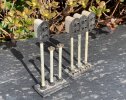
These are typical of the condition of most I have. No wiring at all left in the majority of them. But along with the complete or largely complete signals came various loose components — so I can replace the missing signal heads. This is the best condition example:
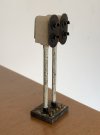
In this case, the wiring is intact and at least one bulb actually works.
Being Milbro, the signal heads are wood:
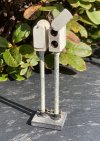
The rear cover, pivoted on a small nail for access to the works, is a light alloy. The rest of the metal parts are brass.
I have about ten signals that could be repaired, variously 2-, 3- or 4-way splitting signals with differing post heights to indicate the relative importance of the different routings. Given the distressed state of the models, I would be quite happy to swop around the taller and shorter posts to suit my track layout. I am also going to have to put in new wiring and bulbs (well, LEDs I suppose). In some ways, the current derelict state of the signals is a benefit in terms of not having to worry about conserving original material or preserving the items ‘as made’.
I do not know how the real railway provided ‘calling on’ signals in the early(ish) days of colour-lights. The above colour-light signals effectively mimic the arrangement of dolls on a traditional gantry. They would be fine for a junction out in the country, but my station approach definitely needs calling on signals for running round. Realistically though, full signalling of the layout is never going to be achievable. So I will need to work out if a reasonable ‘partial-signalling scheme’ is possible using the colour-lights I have.
I only have the option of using colour-light signals because I bought a large quantity of 1930s Mills Bros (Milbro) signals in a local auction many years ago. The signals are mostly in terrible condition and I paid very little for them. But I thought they were worth getting because one day, perhaps, I might actually get my long-hoped-for vintage layout built. The batch of signals I bought was a particularly good find because the signals are not just the standard single-post two-aspect (red/green) signal listed in Milbro catalogues. Instead, I seem to have a collection of special-order signals almost certainly made for a particular layout — and a fairly elaborate one too. Here’s two examples, both for three-way junctions:
These are typical of the condition of most I have. No wiring at all left in the majority of them. But along with the complete or largely complete signals came various loose components — so I can replace the missing signal heads. This is the best condition example:
In this case, the wiring is intact and at least one bulb actually works.
Being Milbro, the signal heads are wood:
The rear cover, pivoted on a small nail for access to the works, is a light alloy. The rest of the metal parts are brass.
I have about ten signals that could be repaired, variously 2-, 3- or 4-way splitting signals with differing post heights to indicate the relative importance of the different routings. Given the distressed state of the models, I would be quite happy to swop around the taller and shorter posts to suit my track layout. I am also going to have to put in new wiring and bulbs (well, LEDs I suppose). In some ways, the current derelict state of the signals is a benefit in terms of not having to worry about conserving original material or preserving the items ‘as made’.
I do not know how the real railway provided ‘calling on’ signals in the early(ish) days of colour-lights. The above colour-light signals effectively mimic the arrangement of dolls on a traditional gantry. They would be fine for a junction out in the country, but my station approach definitely needs calling on signals for running round. Realistically though, full signalling of the layout is never going to be achievable. So I will need to work out if a reasonable ‘partial-signalling scheme’ is possible using the colour-lights I have.
Some advice, please, if possible from those more knowledgeable than I about signalling.
The progress towards installing the ‘missing’ section of baseboard (as described in my post #271), and my last post above, has obliged me to give more detailed thought to signalling for the southern end of Cairnie Junction station.
I will never be able to fully signal my planned layout. I can live with incomplete signalling, but I can’t live with nonsense signalling. So I will aim for a reasonable representation, as complete as is possible using vintage equipment.
I can I am sure repair enough colour-light signals to cover the running lines at Cairnie Junction. I have the junction signals necessary and single-post Bassett-Lowke colour-light signals are easily found. Even if I don’t currently have all the single-post signals I need, obtaining the others required shouldn’t take too long or be expensive. But I have no colour-light signals for calling-on and shunting movements to sidings. I pretty sure such things were not made. And, actually, I don’t know what real-life practice was in this regard in the 1930s.
I have seen pictures where colour-light signals for running lines were accompanied by mechanical discs for shunting movements. Was this usual in the early days of colour lights? If prototypically correct, a combination of colour lights for running lines and mechanical shunting signals would be a good option for me.
Now, several types of shunting signal were available from model manufacturers in the 1930s. Further ignorance on my part, but which types of mechanical shunting signal could be used — realistically — in combination with colour-lights?
Bassett-Lowke Lowko Track points were fitted with point indicator lamps:
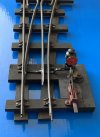
As seen above, the rotating lamp is operated by the point lever moving the switch blades. But Bassett-Lowke offered similar rotating lamps on stands to be operated independently of setting the points (ie. signals rather than point indicators). I have two of these. I could also pretend the point indicator lamps were ground signals.
Then there are these:
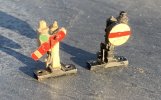
The type on the left corresponds to the picture in the Mills Bros (Milbro) catalogues in the 1930s. There is no trade mark or other identification on the model itself. It’s made up of soft metal, presumably lead alloy, castings — not usual for items manufactured by Mills Bros. Perhaps ‘sold by’ Mills, rather than ‘made by’? I have just two of these but they seem quite common items.
The disc signal on the right in the above picture is the only one I have ever seen of this type. I have not seen any catalogue entry corresponding to this model either. The main casting for the base+post+lamp is obviously similar to the main casting in the semaphore ground signal listed by Mills Bros. The disc itself is wood. That points very firmly to Mills Bros as the manufacturer. The rear indicator shade on this signal is missing, but I think that was probably wood too.
Bassett-Lowke also offered semaphore ground signals:
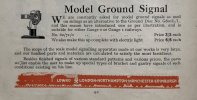
The catalogue illustration (summer, 1933 catalogue) is clearly different from the model shown in my photograph above.
For completeness, here is the catalogue entry for the ground disc corresponding to the point indicator lamp shown previously:
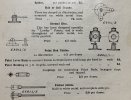
By this date (1933), manufactured in white metal. When first introduced, pre-WW1, made throughout in gunmetal and much more expensive.
Bassett-Lowke was not offering colour-light signals in 1933.
I would much appreciate any advice regarding the various questions above.
Thanks in advance for any assistance.
The progress towards installing the ‘missing’ section of baseboard (as described in my post #271), and my last post above, has obliged me to give more detailed thought to signalling for the southern end of Cairnie Junction station.
I will never be able to fully signal my planned layout. I can live with incomplete signalling, but I can’t live with nonsense signalling. So I will aim for a reasonable representation, as complete as is possible using vintage equipment.
I can I am sure repair enough colour-light signals to cover the running lines at Cairnie Junction. I have the junction signals necessary and single-post Bassett-Lowke colour-light signals are easily found. Even if I don’t currently have all the single-post signals I need, obtaining the others required shouldn’t take too long or be expensive. But I have no colour-light signals for calling-on and shunting movements to sidings. I pretty sure such things were not made. And, actually, I don’t know what real-life practice was in this regard in the 1930s.
I have seen pictures where colour-light signals for running lines were accompanied by mechanical discs for shunting movements. Was this usual in the early days of colour lights? If prototypically correct, a combination of colour lights for running lines and mechanical shunting signals would be a good option for me.
Now, several types of shunting signal were available from model manufacturers in the 1930s. Further ignorance on my part, but which types of mechanical shunting signal could be used — realistically — in combination with colour-lights?
Bassett-Lowke Lowko Track points were fitted with point indicator lamps:
As seen above, the rotating lamp is operated by the point lever moving the switch blades. But Bassett-Lowke offered similar rotating lamps on stands to be operated independently of setting the points (ie. signals rather than point indicators). I have two of these. I could also pretend the point indicator lamps were ground signals.
Then there are these:
The type on the left corresponds to the picture in the Mills Bros (Milbro) catalogues in the 1930s. There is no trade mark or other identification on the model itself. It’s made up of soft metal, presumably lead alloy, castings — not usual for items manufactured by Mills Bros. Perhaps ‘sold by’ Mills, rather than ‘made by’? I have just two of these but they seem quite common items.
The disc signal on the right in the above picture is the only one I have ever seen of this type. I have not seen any catalogue entry corresponding to this model either. The main casting for the base+post+lamp is obviously similar to the main casting in the semaphore ground signal listed by Mills Bros. The disc itself is wood. That points very firmly to Mills Bros as the manufacturer. The rear indicator shade on this signal is missing, but I think that was probably wood too.
Bassett-Lowke also offered semaphore ground signals:
The catalogue illustration (summer, 1933 catalogue) is clearly different from the model shown in my photograph above.
For completeness, here is the catalogue entry for the ground disc corresponding to the point indicator lamp shown previously:
By this date (1933), manufactured in white metal. When first introduced, pre-WW1, made throughout in gunmetal and much more expensive.
Bassett-Lowke was not offering colour-light signals in 1933.
I would much appreciate any advice regarding the various questions above.
Thanks in advance for any assistance.
Last edited:
magmouse
Western Thunderer
I am also going to have to put in new wiring and bulbs (well, LEDs I suppose).
I don‘t know what kind of bulb these signals took originally, but small filament bulbs are still available in a variety of types. Do have a look before changing to LEDs, as a filament bulb will give more historically accurate colour (and more pleasing, to my eye at least - LEDs generally produce colours that are too pure and ‘sharp’).
Nick.
John R Smith
Western Thunderer
Martin
I got the ground disc signals you can see here as a job lot from John Neale (of Stop the Drop auctions). I have no idea who made them, but they are nicely done, all brass and soldered construction, although obviously somewhat over scale. On my layout all the signals and turnouts are directly operated, and I have no lever frame or interlocking.
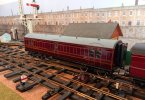
I have tried to correctly signal all shunting moves in addition to the main running line semaphores (which are pre-war Hornby lattice as you can see). This makes the layout more fun to operate, but I have to confess that I am guilty now and then of running a SPAD! I like your plan to use vintage colour light signals which will be different, but I must confess I have no idea when colour light ground signals were introduced. And I can see that calling on or shunt ahead colour lights would also be a problem. The other snag with colour lights is of course that you cannot see from the rear what aspect they are showing.
I shall continue to follow your postings with great interest.
John
I got the ground disc signals you can see here as a job lot from John Neale (of Stop the Drop auctions). I have no idea who made them, but they are nicely done, all brass and soldered construction, although obviously somewhat over scale. On my layout all the signals and turnouts are directly operated, and I have no lever frame or interlocking.
I have tried to correctly signal all shunting moves in addition to the main running line semaphores (which are pre-war Hornby lattice as you can see). This makes the layout more fun to operate, but I have to confess that I am guilty now and then of running a SPAD! I like your plan to use vintage colour light signals which will be different, but I must confess I have no idea when colour light ground signals were introduced. And I can see that calling on or shunt ahead colour lights would also be a problem. The other snag with colour lights is of course that you cannot see from the rear what aspect they are showing.
I shall continue to follow your postings with great interest.
John
Hi NickI don‘t know what kind of bulb these signals took originally, but small filament bulbs are still available in a variety of types. Do have a look before changing to LEDs, as a filament bulb will give more historically accurate colour (and more pleasing, to my eye at least - LEDs generally produce colours that are too pure and ‘sharp’).
Nick.
Thank you for that advice. I have, as yet, done very little ‘digging’ around the restoration and use of the colour light signals. I agree bulbs would be better. I only really started to think about what using the colour lights would involve about a month ago as I prepared the ‘missing’ section of base-board to fit — and realised provision for electrical supply to colour-lights had be installed now or never. The more I think, the more complicated using the colour lights seems to get. The Milbro signals, as made, have 2V bulbs. But I only have one single-post Milbro signal (the rest are all junction signals). I have a few Bassett-Lowke single-post colour-lights (2- and 3-aspect) and could I am sure find more. The appearance is close enough to the Milbro signals for mixing the two manufacturers to look OK. But the Bassett-Lowke signals (all in good original condition) have 3.5V bulbs. I don’t know how to address that. Am I using batteries hidden locally to power the signals? Can a modern transformer/controller be obtained that will supply power at the different voltages? I have no idea as yet. I have also now spotted a couple of other practical difficulties. Rivermead Central was never conceived as an electrically powered railway. After construction started, I decided to electrify the branch from Cairnie Junction to Rivermead Central. But there are no electrical sockets on the Cairnie Junction (west) side of the room. So colour-lights at Cairnie Junction will require very long wiring runs if powered, ultimately, off the mains. A further complication that I have now realised is finding a suitable location for a control panel. It’s difficult to see where that could go in the part of the layout with the low-level base-boards to the front.
I have more thinking and digging to do. However, I am tending now to the view that the southern approach to Cairnie Junction may be the wrong location to use the colour lights. I want to use them. I think they have a great ‘modern vintage’ look. But perhaps the very important terminus station Rivermead Central is a better candidate to have been re-signalled with state-of-the-art colour-lights at the time my layout is set. There’s an electrical socket right there, the underside of the base-board is mostly accessible, and the unusual/unique Milbro junction signals could be used to full effect.
Martin
Martin, do you have any examples of bulbs and bulbholders? Both screwed and bullet type were used, the smallest readily available size being the Edison 5.5mm thread (Edison Screw Liliput size E5 or LES- as used on Minic cars with electric lights) and a similar size non-threaded which is used by various people such as Marklin as well as in aircraft, power station and car instruments. Both still available in a variety of voltages. Cheap screw adjustable voltage regulators are available on Ebay to allow you to set lights to exactly the right level of rounded golden glow. By the way I think the "Southern" approach is the perfect place to use coloured lights, if you know what I mean....