
You are using an out of date browser. It may not display this or other websites correctly.
You should upgrade or use an alternative browser.
You should upgrade or use an alternative browser.
Winter in the Fens - Diddington and Upwell Drove
- Thread starter Alex W
- Start date
-
- Tags
- 1950s great eastern


Lyndhurstman
Western Thunderer


Alex W
Western Thunderer
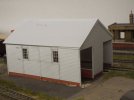
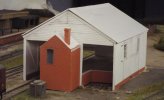
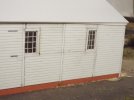
I've been working on a new station building for Diddington. The building is inspired by StIves (Hunts) but has been adapted to suit the site. St Ives station was a junction with three platform faces, Diddington is a terminus with only one platform face, so a model of the actual building at St Ives would not have been appropriate. Instead the model uses elements of St Ives, suitable rearranged.
Construction is mainly from styrene sheet, with Slaters embossed brickwork. The waiting room windows are cut down Wills round topped windows, the others are from York modelmaking.

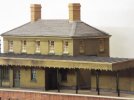


Construction is mainly from styrene sheet, with Slaters embossed brickwork. The waiting room windows are cut down Wills round topped windows, the others are from York modelmaking.


Kevin Johnson
Active Member
Alex fantastic work on the station building.


Alex W
Western Thunderer
I’m currently working on a backdrop for my Diddington layout.
I have in mind a section of scenery that starts as a 3d model in 4mm scale, and merges into a 2d backdrop. There is an element of perspective modelling where the 3d part merges into the 2d, to give the effect of the land stretching out into a flat flooded fen. I want the scene to have a cold, bright appearance so I have been experimenting with lighting using a mixture of warm white and ice white LED strips, as I have found that ice white on it’s own gives too stark an appearance.
There are two railway lines running across in the scene. At the back is the main line, which runs from Diddington station on the right to the fiddle yard (representing St Ives, March, Cambridge and the rest of the world) on the left. There is a level crossing at this point, and adjacent to it is an underpass for pedestrians, small cars and animals, to allow them to cross when the gates are closed, an arrangement typical of fenland. My crossing is based on that at Somersham, the first station north of St Ives on the way to March and the underpass itself is from Milton Road in Cambridge.
The layout of the scene on the backdrop influences the 3d part of the model, and vice versa, so the two have to be considered together. Completing one part of the model at a time runs the risk of visually compromising whatever part is finished second. I think the traditional approach would be to build the 3d part of the model first and arrange the backdrop to suit it, however I wanted to develop the two together. I started on the backdrop first. I’ve gone for a painted backdrop rather than using the photographic backscenes which seem to be gaining in popularity. To my mind they are too sharp in appearance. I’ve read of people gently over spraying them with white to tone them down, but I feel a painted backscene looks better. Mine will be painted in oils. I’ve never used oils before, and am still experimenting with colour, light and form, so the backdrop in the pictures is one of my learning pieces. I hope to make a start on the final version this week.
The layout is viewed and operated form the front, so I am able to use a high backscene. The backdrop is curved at the ends of the layout and round the angle of the “L”. I use wallpaper lining paper as the basis of the backdrop. On smaller layouts the backscene can be made as a single piece which avoids any vertical joins in the sky, but on Diddington the backdrop will be about 20 feet long, so it will be in two pieces for ease of handling. The joint will be behind the mill building, so only a small portion of backdrop will be visible where the two parts meet.
The wall paper lining paper is absorbent, so it soaks up the oil from the paint and dries very quickly and is totally matt.
The 3d part of the scene is built up from scrap card from various sources. The road, sides of the underpass and the land around the tracks is from sheets of card. It is blended into the existing scenery using my usual method of a lattice constructed from thin strips of card overlaid with paper soaked in pva followed by an earth mix of plaster, acrylic paint and dilute pva.
The resultant scenery is light and strong, but can easily be cut with a Stanley knife if it needs to be reworked. Normally, I’d do a lot of this work before the track is laid, but as Diddington is a rebuild, this wasn’t possible. However, the layout is of open frame construction, with the track bases supported on risers (except in the station area where there is a flat baseboard top), so reworking the old scenery and adding new elements is straightforward.
The pictures show the results so far. The next stage will be to start work on the painted back drop, which (Christmas permitting) I hope to get to next week.
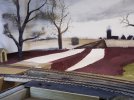

I have in mind a section of scenery that starts as a 3d model in 4mm scale, and merges into a 2d backdrop. There is an element of perspective modelling where the 3d part merges into the 2d, to give the effect of the land stretching out into a flat flooded fen. I want the scene to have a cold, bright appearance so I have been experimenting with lighting using a mixture of warm white and ice white LED strips, as I have found that ice white on it’s own gives too stark an appearance.
There are two railway lines running across in the scene. At the back is the main line, which runs from Diddington station on the right to the fiddle yard (representing St Ives, March, Cambridge and the rest of the world) on the left. There is a level crossing at this point, and adjacent to it is an underpass for pedestrians, small cars and animals, to allow them to cross when the gates are closed, an arrangement typical of fenland. My crossing is based on that at Somersham, the first station north of St Ives on the way to March and the underpass itself is from Milton Road in Cambridge.
The layout of the scene on the backdrop influences the 3d part of the model, and vice versa, so the two have to be considered together. Completing one part of the model at a time runs the risk of visually compromising whatever part is finished second. I think the traditional approach would be to build the 3d part of the model first and arrange the backdrop to suit it, however I wanted to develop the two together. I started on the backdrop first. I’ve gone for a painted backdrop rather than using the photographic backscenes which seem to be gaining in popularity. To my mind they are too sharp in appearance. I’ve read of people gently over spraying them with white to tone them down, but I feel a painted backscene looks better. Mine will be painted in oils. I’ve never used oils before, and am still experimenting with colour, light and form, so the backdrop in the pictures is one of my learning pieces. I hope to make a start on the final version this week.
The layout is viewed and operated form the front, so I am able to use a high backscene. The backdrop is curved at the ends of the layout and round the angle of the “L”. I use wallpaper lining paper as the basis of the backdrop. On smaller layouts the backscene can be made as a single piece which avoids any vertical joins in the sky, but on Diddington the backdrop will be about 20 feet long, so it will be in two pieces for ease of handling. The joint will be behind the mill building, so only a small portion of backdrop will be visible where the two parts meet.
The wall paper lining paper is absorbent, so it soaks up the oil from the paint and dries very quickly and is totally matt.
The 3d part of the scene is built up from scrap card from various sources. The road, sides of the underpass and the land around the tracks is from sheets of card. It is blended into the existing scenery using my usual method of a lattice constructed from thin strips of card overlaid with paper soaked in pva followed by an earth mix of plaster, acrylic paint and dilute pva.
The resultant scenery is light and strong, but can easily be cut with a Stanley knife if it needs to be reworked. Normally, I’d do a lot of this work before the track is laid, but as Diddington is a rebuild, this wasn’t possible. However, the layout is of open frame construction, with the track bases supported on risers (except in the station area where there is a flat baseboard top), so reworking the old scenery and adding new elements is straightforward.
The pictures show the results so far. The next stage will be to start work on the painted back drop, which (Christmas permitting) I hope to get to next week.

RichardG
Western Thunderer
LED controllers can be had to let you combine cool and warm white strips. I bought mine from Wholesale LED Lights, no connection except as a satisfied customer.I want the scene to have a cold, bright appearance so I have been experimenting with lighting using a mixture of warm white and ice white LED strips, as I have found that ice white on it’s own gives too stark an appearance.
Dual Colour LED Controllers With Special Discounts & Free Shipping

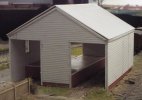
Milton Road, Cambridge underpass - for many years derelict and full of railway spoil.
I designed and supervised its clearance, refurbishment, drainage and conversion to a cycle / pedestrian underpass, around the end of the twentieth century.
Believe it or not, the original drainage consisted of a single, small diameter pipe which was supposed to convey rainwater, by natural fall, for over a mile to the River Cam! The reason for the frequent flooding of the subway became very apparent.
Automatic pumps (mostly) resolved that issue!
John Isherwood.
I designed and supervised its clearance, refurbishment, drainage and conversion to a cycle / pedestrian underpass, around the end of the twentieth century.
Believe it or not, the original drainage consisted of a single, small diameter pipe which was supposed to convey rainwater, by natural fall, for over a mile to the River Cam! The reason for the frequent flooding of the subway became very apparent.
Automatic pumps (mostly) resolved that issue!
John Isherwood.
Alex W
Western Thunderer
Thanks John. I'm using phots of Milton Road when building the model . With the layout being set in February my plan is to have a pool of ware under the bridge.Milton Road, Cambridge underpass - for many years derelict and full of railway spoil.
I designed and supervised its clearance, refurbishment, drainage and conversion to a cycle / pedestrian underpass, around the end of the twentieth century.
Believe it or not, the original drainage consisted of a single, small diameter pipe which was supposed to convey rainwater, by natural fall, for over a mile to the River Cam! The reason for the frequent flooding of the subway became very apparent.
Automatic pumps (mostly) resolved that issue!
John Isherwood.
Alex

