Very Little Gravitas Indeed*

adrian

Flying Squad
Given that the illustrations show how your metal working skills have achieved what I see as a decent result, can you start again (another kit maybe?) and photograph the steps from flat etch to final fold.... including the result of using the Hold and Fold?

Rgds, Graham
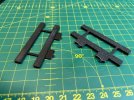
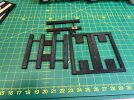
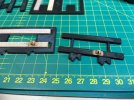
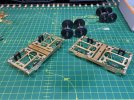
If I can remember to do so - there is a Ennis (Scorpio) Macaw in the to do pile - however the second photo above shows the result of the hold-and-fold on the sole bar channel. The clamping is okay at either end but in the middle it's insufficient to hold onto the thin strip - if you look closely it has failed to bend the solebar at all above the steel bar on the left hand side. This steel bar was held inside the U channel and the brass was hammered over this former using a raw hide mallet.
 

paulc

Western Thunderer
If I can remember to do so - there is a Ennis (Scorpio) Macaw in the to do pile - however the second photo above shows the result of the hold-and-fold on the sole bar channel. The clamping is okay at either end but in the middle it's insufficient to hold onto the thin strip - if you look closely it has failed to bend the solebar at all above the steel bar on the left hand side. This steel bar was held inside the U channel and the brass was hammered over this former using a raw hide mallet.
1764378775677530377215.jpg
 

adrian

Flying Squad
It was a bit like that - the brass sheet was quite thick at 18thou if I remember correctly which is always going to be a challenge to fold accurately along a 6-7" length even with the help of half etch lines.

On the plus side it does make a nice robust model. On the other end of the scale you have kits like MMP which uses a much thinner brass sheet so bends and folds are much easier to form but then you have issue of trying to minimise distortion when you solder it all together.
 

adrian

Flying Squad
I could have sworn I'd posted more updates during this build but it appears not. So it's all in one now.

In this kit the W irons, springs and axle boxes are all in one white metal cast lump so little if any option to make a sprung system. These have been replaced by Ambis etched W irons with wire springing.
Macaw-F - 3 (1).jpeg

Fortunately the white metal W irons could be hacked to pieces to extract the springs and axleboxes.

Macaw-F - 4 (1).jpeg

Attention then turned to the brakes - in the kit they are supplied as a couple of etched items all in one, push rods, brake shoes and hangars. These needed some modifications as I'm never really keen on metal brake shoes due to the potential of shorting if too close to the wheels, also as etched pieces they are really too thin and weedy. Fine in silhouette but no depth, so I 3D printed the brake shoes and I cut a few small strips from 1.5mm ply to pack out the push rods - the supplied etch was cut apart to provide the outer strips for the push rods.
Macaw-F - 5 (1).jpeg

Practising my very basic 3D drawing and printing skills I drew up the rocker bar the fits behind the W irons.
Macaw-F - 6 (1).jpeg

I even managed to include a small angular draft in the rocker arm because the bosses for the push rod pin are not parallel to the central boss. As can be seen below this introduces a small V angle on the assembled unit so the centre rocker is close to the W iron but then the push rods point towards the centre so that they align with the wheel.
Macaw-F - 7 (1).jpeg

and then assembled with safety loops, hand brake lever and shackles. fitted.

Macaw-F - 10.jpeg

With all the etched components fitted it was given a good clean up.

Macaw-F - 9.jpeg

Macaw-F - 8 (1).jpeg

Finally fitted the rest of the white metal fittings glued on, the buffers are a little ropey in places but I'll see what they look like after a coat of paint and replace them later if I'm not happy.

Macaw-F - 11.jpeg

Macaw-F - 12.jpeg

I've not folded the keeper plates at the bottom of the W irons yet so I can remove the wheels prior to painting. They will be finished off along with the coupleing hooks after painting - one more for the paint shop road.

Macaw-F - 13.jpeg
 

adrian

Flying Squad
Again too long since the previous posting, a fair bit of modelling has been progressing but little to report so far. I really enjoyed supporting Simon at the York Show and it was great to catch up with a few people and see some new faces. Having seen some of my stock and loco's running on his layout was extremely motivating.

I was hoping to support the Scale7 stand at the Wigan show and be able to show a few new things I have been working on. Unfortunately a couple of weeks before the show I managed to trap/inflame my sciatic nerve in my right leg. It has been extremely painful and also incapacitating. Concentrating on any modelling has been difficult and siting at the workbench nigh on impossible. Happily it's slowly clearing up now so getting back to the workbench.

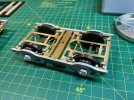
For various reasons I may expand on later I wanted to investigate how to build a coach bogie kit with miniature ball races and sprung suspension. I have done one previously using guitar wire springing over the axlebox. It works fine but it was fiddly to fit and maintain. I had some Pogopins for making some plunger pick-ups but thought that must be a way to use them for a suspension unit. A couple of test plates were made to see what sort of weights could be borne with the springs and after a few false starts this is where I'm at.

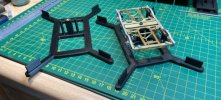
I'm using Peartree wheels with miniature ball races 1.5mm, 2mm width. I had to replace the axles but that's another story. I've then 3D printed a hornguide for the axlebox, this has a step top and bottom so that it clips onto the inside of the side etched bogie and locates the unit. In the top two small holes to insert the 6mm pogopins. Tests indicated one pogopin per corner will probably be fine for a wagon it wasn't going to be sufficient for a coach. Hence a "2-pin" solution.

Also the axle box on the left was the original attempt but when assembled the ride height was too low. Hence the axlebox on the right is extended in height a little to raise the ride height enough. In this photo the top surface of the hornguide is the surface stuck to the inside of etched bogie. This provides a channel which holds the axlebox in position.

Sideline-bogie - 2.jpeg

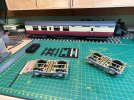
So these are the bogies fitted with the hornblocks - although they clip on over the etchthey do remain hidden once the whitemetal bogie sides are fitted. There is a small transverse hole drilled near the base of the hornguides so that I can insert a short length of wire across the guides and stop the axleboxes falling out when I turn over the bogie. One of the aims of this is to see if I can retrofit the springing to an existing built bogie. That's the next test but I reckon it's going to work.

Sideline-bogie - 1.jpeg

Naturally I had to have a quick play once I had a rolling bogie. I'll try to post an update once it's complete.

 
Top