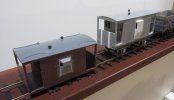
Toad B or Toad E? That is the question. A standard fix following.

Overseer

Western Thunderer
The Dornoch branch had a resident ex-LNER Toad B brake van from Nationalisation until closure. When the Parkside 7mm scale Toad E kit came out I purchased one and put the body together. I didn't get around to buying a Toad B kit before Peco took over and have been hesitating since due to the reduced ease of buying from outside the UK and the lack of ability to have the wheels changed to S7. It struck me yesterday that I am probably better starting with a Toad E kit anyway as the Dornoch van was one of the narrow plank version rather than the wide plank as modelled by Parkside. The narrow plank Toad B looks just like a Toad E with different duckets, some even had the same short angle iron end braces. I am not an expert on LNER brake vans so if anyone knows of any significant differences which would mess up the conversion let me know.

This is what I plan to end up with -
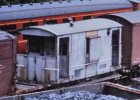
Toad B Dornoch.jpg
Does anyone know this vans number?

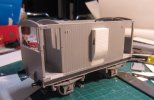
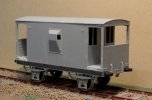
And this is where the kit is at present -
Toad E 2.jpgToad E 1.jpg

A fair bit more difficult to modify the sides with the kit assembled but at least I hadn't added any detail and the roof is loose. I have drawn the timber duckets for the Toad B and will make them from plastikard. The end braces will also be changed to the larger timber version, and the side planks should stop at a horizontal strip across the bottom. The van at Dornoch seems to have pre-RCH buffers which is a bit annoying, most had RCH buffers. It may have to stay as it is as once the ABS plastic buffer guides are glued in they aren't going anywhere. I think the conversion will be a better outcome than trying to modify the wide plank Toad B kit to a narrow plank version.

There is a plan for the Toad E duckets.
 

Overseer

Western Thunderer
No sign of the number but some nice views here......


Yes, the van appears in plenty of photos of trains along the line and in overall views at Dornoch but I can't recall seeing any detail views of it. The locos seem to grab all the attention, no wonder when they were pretty little Drummond Highland Railway 0-4-4T or a Standard 2 or a pair of 16xx panniers.
 

Rob R

Western Thunderer

Flaxfield

Western Thunderer
That building is rather nice, Rob.

I'm sure there must be similar station building further ( MUCH!!) South...........

Regarding the map, yes, you can do it digitally but I do like old maps and having one from 1913, pre-grouping as it were, really appeals.

Rob.
 

John Ross

Western Thunderer
The Dornoch branch had a resident ex-LNER Toad B brake van from Nationalisation until closure. When the Parkside 7mm scale Toad E kit came out I purchased one and put the body together. I didn't get around to buying a Toad B kit before Peco took over and have been hesitating since due to the reduced ease of buying from outside the UK and the lack of ability to have the wheels changed to S7. It struck me yesterday that I am probably better starting with a Toad E kit anyway as the Dornoch van was one of the narrow plank version rather than the wide plank as modelled by Parkside. The narrow plank Toad B looks just like a Toad E with different duckets, some even had the same short angle iron end braces. I am not an expert on LNER brake vans so if anyone knows of any significant differences which would mess up the conversion let me know.

This is what I plan to end up with -
View attachment 164287
Does anyone know this vans number?

And this is where the kit is at present -
View attachment 164289View attachment 164288

A fair bit more difficult to modify the sides with the kit assembled but at least I hadn't added any detail and the roof is loose. I have drawn the timber duckets for the Toad B and will make them from plastikard. The end braces will also be changed to the larger timber version, and the side planks should stop at a horizontal strip across the bottom. The van at Dornoch seems to have pre-RCH buffers which is a bit annoying, most had RCH buffers. It may have to stay as it is as once the ABS plastic buffer guides are glued in they aren't going anywhere. I think the conversion will be a better outcome than trying to modify the wide plank Toad B kit to a narrow plank version.

There is a plan for the Toad E duckets.
I have had a good rake through my photo archive, but sadly despite having a number of the Dornoch van pictures due either to the angle that the photographer was standing at or distance from the van I've failed to conform the number of this vehicle. However, if you want to move to the St Combs to Fraserburgh branch they ran a similar one that was numbered E12793. This photograph is copyright of the GNSRA and the notes that accompany this picture state that a similar van worked Gerorgemas to Thurso, sadly no record of that one's number. Worth noting that if you are sticking with the Dornoch one some of the photos I have looked at appear to carry a plate; again can't make out the details, but suspect it could say "To work between Mound to Dornoch". DSCF7593 (2).JPG

All the best

John
 

Gadgie

Western Thunderer
My take on Toad B vs Toad E, based on Peter Tatlow’s books and producing a few of both in 4mm, is that there was a progression of design features.

Early batches had wooden ducket, and wooden end posts. Plank width in these early batches seems to have been a bit random, but most seem to have had narrow planks. These were designated Toad B.

Later batches had narrow planks, steel dockets, and steel end irons. These were Toad E, but were dimensionally identical to Toad B.

The gradual transition, combined with replacement of duckets and end posts over time mean that all sorts of combinations are possible. But using a Toad D kit as a basis for a Toad B should be fine.

Cheers,

Richard
 

Overseer

Western Thunderer
Thanks for the replies. Toad work has progressed a little, one of the steel duckets has been successfully liberated from the van and experimentally relocated. More on that soon.

I am not planning to build Dornoch at present. While it is definitely modelogenic it presents problems with which era to portray it. Most of my Highland Railway models suit the 1870s but Dornoch didn’t open until 1900 so that wouldn’t work. It was built with flat bottom rails then relaid with bullhead by the LMS. 1950s would make sense as I now have most of the required stock built or started. But I have other layouts I would like to build first, when I get some time. Skelbo, one of the intermediate stations on the line, on the other hand has been drawn up and may well appear. A little more research is needed to confirm when the station building (grand title for a timber waiting room) was replaced with a similar but smaller one sometime around 1950. A short platform and a single siding won’t make for exciting operation.
 
Last edited:

Simon

Flying Squad
They are very attractive vans in either form I think. I'm sort of going in the opposite direction, I think this is a B with E modifications, ie the steel ducket.

285701830_2299932406821325_2234659635162034949_n.jpg

Apart from the fact that this type was definitely in the West Country in the early diesel era, being used on the Wenford Bridge line after the LSW "new van" type was withdrawn, I really like the visuals of the heavy timber end posts with the handrails turning the corner and finishing into them. It is is this particular feature that I next need to tackle on this slightly stalled model, pictured "on tour" at a shed in the West Country last Wednesday evening(!) I hand scribed the vertical planks with my Olfa tool and needless to say didn't get them all the same width as you can see, but it has passed into the "good enough" area of my mind's eye


I really like the sound of Skelbo, I wouldn't be worrying too much about operational interest myself...

Simon
 

Overseer

Western Thunderer
A reverse curve was fretted out from the edge of a piece of 0.25mm brass sheet to use to trace the curves at the bottom of the wooden duckets, The inner vertical end pieces have been cut out of 0.75mm styrene. There will also be outer pieces slightly larger made from 0.5 mm styrene to represent the beading visible at the ends of the horizontal cladding boards.

toadb1.jpg


With the Toad B started I had to see if the plan for the steel duckets removed from the Parkside kit would work. I presume it is common knowledge that the Slaters BR standard brake van has an error with the duckets. They match the drawing provided in the instructions but don't match any of the prototype vans I have seen photographs of. The duckets provided in the Slaters kit are an unusual injection moulded fold up design which would be fine except it is several mm too short vertically and has some spurious rivet detail. The bolt heads on the sides around the duckets are also chunky, it looks as if a different person worked on this part of the kit. The lack of height is made up for with a horizontal board on the side moulding which shouldn't be there. I am pretty sure the same steel pressings were used for the BR standard vans as the LNER Toad E and D. So fitting the correctly sized and detailed duckets removed from the Parkside Toad E kit solves the problem and results in a more prototypical appearance. If anyone is wondering why not buy the Dapol version instead, I think it looks a lot less refined than the Slaters kit and misses some of the characteristic features of the vans, the narrower strips in the planking either side of the duckets being one of them.

std1.jpg

I have had to use some filler as I was a bit heavy handed in cutting out the oversize 'rivets'.
 

Simon

Flying Squad
I think that's a great idea Fraser, the ducket is such a feature that it wants to be got right and what you are doing (on both vans) looks terrific. Mine is similar in that it "grew" from the duckets, being the very nice moulding from the NFS BR brake van kit.

And when all is said and done, you just can't have too many brake vans!

Simon
 

John Ross

Western Thunderer
Thanks for the replies. Toad work has progressed a little, one of the steel duckets has been successfully liberated from the van and experimentally relocated. More on that soon.

I am not planning to build Dornoch at present. While it is definitely modelogenic it presents problems with which era to portray it. Most of my Highland Railway models suit the 1870s but Dornoch didn’t open until 1900 so that wouldn’t work. It was built with flat bottom rails then relaid with bullhead by the LMS. 1950s would make sense as I now have most of the required stock built or started. But I have other layouts I would like to build first, when I get some time. Skelbo, one of the intermediate stations on the line, on the other hand has been drawn up and may well appear. A little more research is needed to confirm when the station building (grand title for a timber waiting room) was replaced with a similar but smaller one sometime around 1950. A short platform and a single siding won’t make for exciting operation.
Attached photos of Skelbo were taken in 2010, not certain what condition it is in now hope they are of some use.

All the best

John
PICT0517.JPG
PICT0518.JPG
 

Overseer

Western Thunderer
They are very attractive vans in either form I think. I'm sort of going in the opposite direction, I think this is a B with E modifications, ie the steel ducket.

View attachment 164417

Apart from the fact that this type was definitely in the West Country in the early diesel era, being used on the Wenford Bridge line after the LSW "new van" type was withdrawn, I really like the visuals of the heavy timber end posts with the handrails turning the corner and finishing into them. It is is this particular feature that I next need to tackle on this slightly stalled model, pictured "on tour" at a shed in the West Country last Wednesday evening(!) I hand scribed the vertical planks with my Olfa tool and needless to say didn't get them all the same width as you can see, but it has passed into the "good enough" area of my mind's eye


I really like the sound of Skelbo, I wouldn't be worrying too much about operational interest myself...

Simon
I am not in a position to argue whether it is a Toad B with steel duckets or a Toad E with timber end posts but it looks very like the portrait of E168048 on page 38 of Twilight of the Goods. Nothing wrong with the scribed planks that I can see.

One of the attractions of Skelbo is that the small lane with level crossing gates at the end of the platform is a Telford road. It was the main road to Wick and Thurso, leading to the pier at the south end of the Little Ferry, which carried the traffic across to Littleferry, until bypassed with the construction of The Mound which allowed Loch Fleet to be bridged. There is a small Telford drystone bridge under the road near the station which would make a nice little feature. Anyway the A9 no longer passes this way but there is a kink in the A9 showing where it diverted from the lane past Skelbo station, the rest of the road is now the C1103, not that it really needs a classification.

Skelbo Telford bridge full_291985.jpg
A borrowed photograph of the Telford bridge.

Skelbo goog.jpg
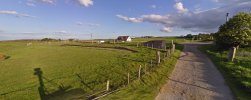
Skelbo platform and level crossing in 2011 thanks to Google street view. Dornoch to the left, The Mound to the right.
 

Overseer

Western Thunderer
Attached photos of Skelbo were taken in 2010, not certain what condition it is in now hope they are of some use.

All the best

John
View attachment 164504
View attachment 164505
Thanks for posting these John. It is good to have a straight on photo of the front. This little waiting room must have had quite a nomadic life. It doesn't look like it was new when it arrived at Skelbo, but I haven't found where it came from. Then it was moved from the platform soon after the line closed. There were a number of similar waiting rooms on the Highland Railway, on second platforms at crossing stations and at halts, so it probably came from one of the stations being rationalised at the time. Achterneed had a similar structure but with a steeper roof pitch, Attadale was more similar but not quite the same. I don't know what happened to the original building at Skelbo, it was similar but longer as it had a goods store as well as a fireplace. I think the remains of the brick chimney are still at the back of the platform.
 

Daddyman

Western Thunderer
Have now looked everywhere for a photo of this van with the number visible but no joy - the ones at Killin and Moffat, no problem. I did, though, turn up a photo in George C. O'Hara's Scottish Region Colour Album No.1 of one of these vans in bauxite at The Mound in 1955. It appears to have been there long enough to have been painted with "to work between" instructions. However, like all the photos in that book, it's printed far too small to be any use...
 

Overseer

Western Thunderer
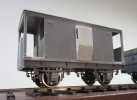
Toad B rebuild under way. One of the duckets is mostly made. Just sitting in position at present, needs a roof piece. Then assemble the parts for the other side.

toadb1.jpg
toadb2.jpg

I need to remember to drill the holes for the ducket window cleaning handles before fixing the ducket in place, and fill in the Toad E ducket window cleaning handle holes on the body.
 

MarkR

Western Thunderer
As Simon said, "you can't have too many brake vans!". This is approximately half my collection, with more planned! I think I need to try and break my habit of buying brake vans!
Mark20220611_122651.jpg
 

Overseer

Western Thunderer
The Toads are progressing slowly due to lack of spare time. Both duckets are made but still not fixed in place. Timber end verticals added and brake rigging fitted. I found that the kit buffers hadn't been glued in place so they have been pulled out for use elsewhere and some Slaters buffers substituted (but not in the photo yet) to match the prototype photo. I think I will fit the handrails before fitting the footboards to hopefully minimise damage.

The body of the BR brake has also been assembled to see how it looks, although the ends are still loose.

toadb5 IMG_6444.jpg
toadb6 IMG_6442.jpg
 
Top