Heather Kay
Western Thunderer
I thought was the ends of the coaches painted black!
The black ends were done away with when the blue-grey livery came in. I think it also had something to do with new paint formulations and better painting processes.

I thought was the ends of the coaches painted black!

The ‘racehorses’ came first in a continuation of LNER practice I believe, and as far as I dimly recall, were all based at Finsbury Park. The regiments came later, sometimes several years later.It’s always fun working out which Deltic is on show. It always amused me the the Haymarket locos were named after Scottish Regiments, the Gateshead ones after English Regiments but Finsbury Park had racehorses. Did it reflect local priorities?
Not so! I believe the black ends were dropped slightly before that. The reason as I understand it was the adoption of spray painting for coaches instead of brush painting. Southern Region green coaches were the first to have the ends the same colour as the body sides if I recall correctly.The black ends were done away with when the blue-grey livery came in. I think it also had something to do with new paint formulations and better painting processes.
Yes, according to the Deltic preservation site information, the racehorses got named at Doncaster once built. There were ceremonies for the others.The ‘racehorses’ came first in a continuation of LNER practice I believe, and as far as I dimly recall, were all based at Finsbury Park. The regiments came later, sometimes several years later.
Not so!


I think the top 47 is 47404. It appears to have the distinctive eth fittings found only on 47401–47420 (the first 47s with eth). With that knowledge, I think the number can just be deciphered as 47404. That batch of 47s were always ECML locos as far as I know.Thank you Heather, David, Mick and 40057 for the detail update. Such things are so easily forgotten and if nothing else Tim's archive brings such matters to the fore.
Holloway Road on 11th March 1977. I'm absolutely useless at identifying DMUs so help will be appreciated. Then I'll edit this description accordingly. Very few people bothered with photos of DMUs at this time and I'm grateful to Tim for taking the trouble! Judging by the tail lamp it's going away from the camera, either towards or away from Royston.
View attachment 190321
Two different but unidentified Class 47s at Holloway Road on 11th March 1977. The different front blinds are noticeable as is the temporary lifting barrier and the truck waiting to cross the line in the second shot.
View attachment 190322
View attachment 190323
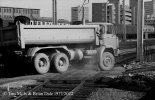
Finally, the trains having cleared the truck gets the OK to cross the line. Others will know better than me but from my memory I dredge up that it's a Bedford but I know little more. Location again Holloway Road on 11th March 1977.
View attachment 190326
Brian

Well really - Leyland Reiver......
Others will know better than me but from my memory I dredge up that it's a Bedford but I know little more. Location again Holloway Road on 11th March 1977.
View attachment 190326
Brian


I'm no expert on dmu's, but it looks like a pair of Cravens class 141 units in the first photograph.

Your are both correct in a way. It is what we would consider by sight a Craven 105 but the the classifications were split.I think they are Craven Class 105's; the Class 14x series were second generation DMU's. Further information here: DMU Types
, Roger, David, Alan and John. I have freely plagiarised all this information and corrected my entries against each of the photos. IMHO all this info is so important in providing as much detail as possible against each of the photos.
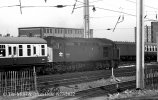
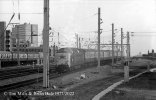
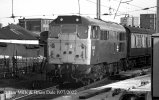


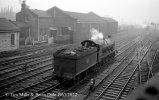

I'll wager heavily this is the same engine (059), first going into Kings X and then leaving. It may even be the same train given the square stickers on the windows but then I'm not sure how it would have been released to run around to get back on the front.I can't quite make out the number of this Class 40 but it's again at Holloway Road on 11th March 1977.
View attachment 190488
40059 at Holloway Road on 11th March 1977. This was previously D259 and was allocated to York North from where it was withdrawn in August 1977. It was scrapped at Doncaster Works in October 1978.
View attachment 190489
Brian

Looks like the crew were beyond caring, water filler lid open…As promised, a misty Southall on the same day and from the same film as pictures around post #2204. How this film became separated in to two parts is anyone's guess.
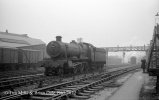
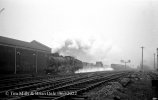
Two photos on 9th February 1963 of 47XX 2-8-0 No 4706 on an up freight at Southall. It had belonged to Southall Shed since October 1962 but moved to Old Oak Common in September 1963 where it was withdrawn in March 1964. (SLS). It went to Swindon Works where it was cut up in June 1964. (WHTS).
View attachment 190532
View attachment 190533
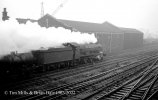
9th February 1963 with Castle 7006 Lydford Castle approaching Southall Station. This has been in these pages previously, in post #1185 and, photographed passing through Southall Station on the 9th February 1963 in post #2204. I'm trying to put the story together for this photo and the one in post #2204. Both show the loco with the reporting number "A03", although the "0" could well be a chalked decoration around the smokebox door dog. However, the "A" and the "3" both appear to be properly applied and not chalked. Furthermore the photo in post #2204 shows the loco in the up direction whereas this one shows it on a down train so it must have been turned in London - probably at Raneleigh Road. Perhaps the reporting number is spurious - it must be as far as at least one of the trains is concerned so I hope it didn't confuse the signalmen. Lydford Castle had been an Old Oak loco since March 1962, being withdrawn from there in mid December 1963. (SLS). It went to Bird's, Risca where it was scrapped in August 1964. (BR Database).
View attachment 190534
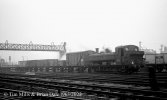
Two more of a 47XX 2-8-0, this time 4707 light engine again at Southall on 9th February 1963. It had been on the Southall allocation since December 1955 and moved to Old Oak Common in November 1963. (SLS). It went to King and Sons at Norwich for scrap where it was observed in July 1964. (WHTS).
View attachment 190535
View attachment 190536
Brian