

SimonT
Western Thunderer
That's the sound of a head down working!
I threaded my last chair onto a rail yesterday. Most of the track work was completed on Thursday but the line into the factory was causing problems slightly slowing the loco at some pinch spots. I decided to not have the short bit of straight in front of the doorway and so on Friday I lifted that piece of track to open up the arc. With 'some' gauge widening the new length works and the 64XX trundles around it smoothly.
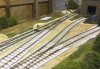
With no stock on the new track looks like this.
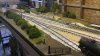
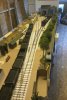
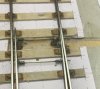
I mentioned earlier that the battery powered 64XX was proving rather useful for testing. I could run it over a crossing straight away with all the clutter of track laying, including my V blocks that provide weight to hold the rails down while the Butatnone does it's stuff. This has encouraged me to leave behind the world of powered track with all the pain it can bring - I can remember a large high profile layout, on it's first outing, shut down by a short for a day and a half at a two day show. I like to use the tiebar castings supplied by the S7 Group on my points. The trouble is that the insulation is provided by a length of 0.5mm double sided pcb strip that has to have insulation gaps cut on both sides and then to be solderd to the castings and to the rails. This needs about fifteen hands to accomplish and involves a large amount of Viking language. So, I cut some .4mm NS strip, made a rough jig to put the castings the correct amount apart and broke out the296C solder. Half and hour later I had six sets of tiebars. These were soldered into place, each one taking of the order of a minute to do.
So this is going to be a radio controlled layout. My nest thought (random, obs) was to point control. The Back End was a DCC layout with Lenz gear run using TouchCab on the mobile. An excellent way of doing things but there are getting to be a large number of transmitters on the few WiFi channels that are available. I did consider using this system to contol the points on Holme Lacy, but realised that as I wanted to have some signals, I would have to buy another two of the Lenz accessory jobies. So all this...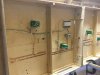 was removed. Each Tortoise now has just a pair of wires connected to a DPDT switch in a little plastic box. In due course I will build a cut down version of this...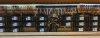
The full interlocking of the Aberbeeg signal box. This mornings job is to work out the circuitry, only four points and eight signals. Should be a breeze. Expect strong language.
I will return with views of the pretty bits soon. Stay Safe and Happy.
Simon
I threaded my last chair onto a rail yesterday. Most of the track work was completed on Thursday but the line into the factory was causing problems slightly slowing the loco at some pinch spots. I decided to not have the short bit of straight in front of the doorway and so on Friday I lifted that piece of track to open up the arc. With 'some'
gauge widening the new length works and the 64XX trundles around it smoothly.With no stock on the new track looks like this.
I mentioned earlier that the battery powered 64XX was proving rather useful for testing. I could run it over a crossing straight away with all the clutter of track laying, including my V blocks that provide weight to hold the rails down while the Butatnone does it's stuff. This has encouraged me to leave behind the world of powered track with all the pain it can bring - I can remember a large high profile layout, on it's first outing, shut down by a short for a day and a half at a two day show. I like to use the tiebar castings supplied by the S7 Group on my points. The trouble is that the insulation is provided by a length of 0.5mm double sided pcb strip that has to have insulation gaps cut on both sides and then to be solderd to the castings and to the rails. This needs about fifteen hands to accomplish and involves a large amount of Viking language. So, I cut some .4mm NS strip, made a rough jig to put the castings the correct amount apart and broke out the296C solder. Half and hour later I had six sets of tiebars. These were soldered into place, each one taking of the order of a minute to do.
So this is going to be a radio controlled layout. My nest thought (random, obs) was to point control. The Back End was a DCC layout with Lenz gear run using TouchCab on the mobile. An excellent way of doing things but there are getting to be a large number of transmitters on the few WiFi channels that are available. I did consider using this system to contol the points on Holme Lacy, but realised that as I wanted to have some signals, I would have to buy another two of the Lenz accessory jobies. So all this...
was removed. Each Tortoise now has just a pair of wires connected to a DPDT switch in a little plastic box. In due course I will build a cut down version of this...The full interlocking of the Aberbeeg signal box. This mornings job is to work out the circuitry, only four points and eight signals. Should be a breeze. Expect strong language.
I will return with views of the pretty bits soon. Stay Safe and Happy.
Simon