The Heybridge Railway, 1889 to 1913

RichardG

Western Thunderer
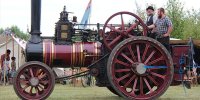
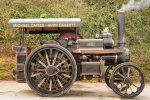
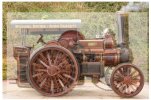
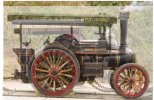
On a Fowler locomotive, the chimney was hinged rather than detachable at the flange. So if I model the chimney lowered rather than stowed separately this would be good. Like many things, a photo of a chimney in its lowered state would be helpful before starting.
 

AndyB

Western Thunderer
! So far, I know the number is the power output.
No, sorry, it isn't.
Fowler's classifications, on the face of it, don't have much logic to them and basic variations (such as single or compound cylinders) existed for the same classification.
The B6 engines are 10nhp.
As a dimensional check (data from Michael Lanes' book on Fowlers) , the flywheels are 4'6" dia x 6" wide at the rim, height to chimney top 12' 1 1/2", width 7' 6", length 18'7"

Scaling off a side-on photo, the chimney top should be approx 5' above the top of the smokebox.

Hope that helps.
Andy
 
Last edited:

RichardG

Western Thunderer
@mswjr yes the line of rivets is present along the side of the machine, just below footplate level and indeed around the back of the coal bunker.

@Dog Star I will try for YouTube this evening.

@AndyB sorry I read that a A7 is 7 nhp and jumped to the wrong conclusion.

If I view this 1:50 B6 as a smaller locomotive in 1:43.5 scale, these are the main dimensions:
hind wheel diameter 44 mm, 6 ft 3 in​
front wheel diameter 29 mm, 4ft 2 in​
flywheel diameter 28 mm, 4 ft​
width 48 mm, 6 ft 10 in​
length 112 mm, 16 ft measured to rear of bunker, excludes towing bracketry​
All dimensions rounded to the nearest mm and equivalent inch.

Height of chimney top 73 mm to ground, 29 mm to top of boiler. I'm sure, if I give the model a taller chimney then the model will resemble a smaller Fowler. Michael Lane's book sounds useful.
 

AndyB

Western Thunderer
Height of chimney top 73 mm to ground, 29 mm to top of boiler. I'm sure, if I give the model a taller chimney then the model will resemble a smaller Fowler. Michael Lane's book sounds useful.
It will be a compromise whichever way you go.
The wheels have too many spokes to be on a smaller engine.
From the nature of what they were built for, the big road engines were just massive in every respect. The smaller tractors were quite delicate in comparison.
Many people perhaps wouldn't spot the difference - I've just been around road steam and works drawings for too long, so apologies if I've come across as being negative or discouraging.
 
Top