The Heybridge Railway, 1889 to 1913

RichardG

Western Thunderer
For the avoidance of doubt, my horsebox goes "neigh".

I took the sound system out of a book called "The cow says Moo" and maybe this has mislead people. The book offered a selection of sounds, and I chose the sound of a horse for my horsebox, because it's a horsebox. Not a cow sound ;)
 

RichardG

Western Thunderer
I took the horse box along to Albury today, for the annual ScaleSeven Group meeting there.

What a good idea. No-one will have name badges but only one will have a horsebox with sound effects. I can identify myself with just a quick twist of the horsebox.

Well, with the model packed into the boot of the car I had had enough after eight miles. Stopped in a lay-by and placed the model on the seat beside me. Set off again, and amused myself deciding whether I wanted neighing on bends or under braking. One or the other was going to be obligatory. And pondered how many button presses a sound book survives before its batteries give up.

Nevertheless, the sound still worked after arrival, and at least two people had read about it here. So the idea was a good one.

Thank you to Nick @magmouse for a piece of bubble wrap to jam up the pendulum and give me silence for the trip back home.
 

RichardG

Western Thunderer
I looked at the prototype expecting to see something like a dog kennel hatch, but can only see this detail?

View attachment 238896

Tony, you beat me to it, I too wondered about a dog compartment.

The GER versions of these horse boxes, built by the Gloucester Wagon Company, had a dog box in this location. Photos show a small door with multiple ventilation slots. Dog boxes went out of use after a while, dogs being carried in converted third class coaches where they were free to move around.

In the case of the LT&SR horseboxes, I doubt I will ever know quite what is shown in the photo. I will guess this railway did not require dog boxes at all; and so Gloucester built the vehicles without them, and with a simple ventilator each side to allow some movement of air in the otherwise sealed-up space.

Thanks to Adrian @Buckjumper for showing me some photos to help explain this yesterday at Albury.
 

RichardG

Western Thunderer
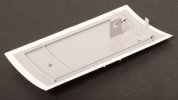
A member of WT I met at Albury kindly sent me the GA drawing of the horsebox. The drawing confirms the presence of two L-shaped ribs running across the width of the roof. These are barely visible in the the only prototype photo I have.

DSC_9597.jpeg
The ribs are 1 x 1 mm L from Albion Alloys. I soldered the two ribs together to make a T shape so they would go through the rolling bars without turning themselves over. Thanks to @Rob Pulham for this tip.

DSC_9601.jpeg
I glued the ribs onto the lens tissue roof covering, and then soldered wire pegs through at each end. So hopefully the ribs will stay put.

DSC_9605.jpeg
The model is now finally ready painting, though I‘m not so sure if I am ready to paint the model.
 

timbowales

Western Thunderer
A member of WT I met at Albury kindly sent me the GA drawing of the horsebox. The drawing confirms the presence of two L-shaped ribs running across the width of the roof. These are barely visible in the the only prototype photo I have.

View attachment 240101
The ribs are 1 x 1 mm L from Albion Alloys. I soldered the two ribs together to make a T shape so they would go through the rolling bars without turning themselves over. Thanks to @Rob Pulham for this tip.

View attachment 240103
I glued the ribs onto the lens tissue roof covering, and then soldered wire pegs through at each end. So hopefully the ribs will stay put.

View attachment 240102
The model is now finally ready painting, though I‘m not so sure if I am ready to paint the model.
It seems a shame to paint it :)
 

daifly

Western Thunderer
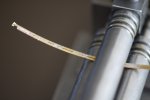
Just in case there's anyone who doesn't already know, the grooves in the rollers in Richard's post above will accommodate 4mm or 7mm rail on its side. With the merest whiff of pressure, the rail can be run through and will stay centred while a very gentle curve is introduced, Perfect for making handbuilt track and point work.

Dave
 

RichardG

Western Thunderer
With the merest whiff of pressure, the rail can be run through and will stay centred while a very gentle curve is introduced, Perfect for making handbuilt track and point work.
Thanks Dave. If I ever build a layout to represent Heybridge, it would look much better if I could use code 100 FB rail throughout. The ability to put curves into the rail could be very useful.

I used to think of rolling bars as a luxury but knowing they can form up rail and girders as well as boilers and van roofs I really should be looking out for a set of my own. I cannot borrow these ones from my mate forever.
 

RichardG

Western Thunderer
It seems a shame to paint it :)
Tim I know what you mean but these models do look better when painted, as long as the paint goes on like a layer of colour and not a layer of tar. I still have my GER ventilated van to paint (built in 2023) so perhaps I can do the two together. Kit-building is fairly stress-free (most of the time!) because I can stop and start at will, painting needs longer periods of concentration. I need to get in the right frame of mind to do painting.
 
Work surface for use with RSU

RichardG

Western Thunderer
We got talking about RSUs at last month's NEEGOG, and a member of the group has given me a piece of armour plate to make a work surface. It is strange what people have tucked away, I didn't ask how/why they had come by it.

DSC_9625.jpeg
I have cleaned up both sides (power sander), painted the underneath and added four feet. This is mild steel sheet c. 6 mm thick with four neatly-rounded corners.

DSC_9626.jpeg
The stud is M4 to match my lug connectors, the hole is M5 in case I need something more robust.

I have given this a trial run and I know it is going to work :)
 

RichardG

Western Thunderer
DSC_9643.jpeg
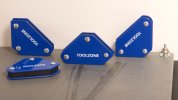
Four budget welding magnets arrived today. These are specified as 10 lb hold. For RSU work with the steel plate I probably need only one, two at the most. The set of four might help with assembling corners of model buildings.

If I had a bit more patience I could have waited and posted the pics of the plate today. Still, I think I am now as organised I can be for my next build :rolleyes:
 
LT&SR horse box (1878) . . part 7 painting

RichardG

Western Thunderer
I have started the painting of the LT&SR horse box with the primer, the roof and the interior.

DSC_9639.jpeg
It is good to see what the model really looks like without being distracted by the patches of tinning and discoloured brass. I am actually very happy with this.

DSC_9675.jpeg
I painted the underneath of the roof because bare brass looks so tired after it tarnishes. The tissue is now off-white.

DSC_9669.jpeg
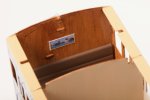
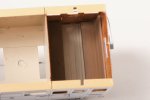
I have no idea what the inside of the groom’s compartment looked like. I suppose the walls would be painted or varnished wood; I went for the varnished look as a practice piece for the outside.

DSC_9655.jpeg
The seats are from Slater's and the floor is embossed styrene. The picture is from Connoisseur Models.

The varnished wood effect is Ronseal teak-coloured varnish brushed over Tamiya XF-15 "Flat Flesh". I did some test patches of the varnish over different underlying paint colours and this is the only one I liked. The Tamiya version of flesh is like a peach colour, the others e.g. Vallejo are paler and more yellowy. There are five really thin coats of the varnish, I painted them on as slowly and carefully as I could manage and the streaks appeared naturally as it dried.
 

Peter Insole

Western Thunderer
Third class carriages of this, and even later periods invariably had interiors boarded with "cheap", knotty deal or pine.

I believe it is safe to declare that such was always "scumbled" - or "grained" to look like a more expensive hardwood finish - commonly a yellowish, Oak shade!

Indeed, there is sufficient existing evidence to point out that even the "varnished Teak" on carriage exteriors had a relatively short, acceptable shelf-life in service, and were also similarly grained by very talented painters to maintain a more even appearance!

I found that Ronseal "Antique Pine" over a sand coloured base was a perfect match for genuine samples of GER, as well as GWR, (two shades) L&BR/LSWR/SR compartment interiors.

Hope this helps?

Pete.
 

RichardG

Western Thunderer
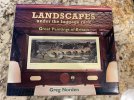
Is it my imagination, or are there some very futuristic-looking boats in that carriage print?
I can’t see the boats except in a photograph but I do now fear they are mid or late 20th century.

In my defence, I was pleased to find a picture with a maritime look (“Tilbury”, “Southend”) and quite delighted to get the thing glued on straight and in the middle without leaving splodges of UHU (dissolves Ronseal :eek:) all around it.

So I must rely on the limited view through the windows to hide my anachronism; unless of course a kindly person should offer a more authentic illustration for me to glue on top. Dimensions 13.5 x 6 mm including frame to match on all four sides.
 
Top