The Heybridge Railway, 1889 to 1913

RichardG

Western Thunderer
Axleboxes not perfectly aligned?

The digital caliper suggests both sides are spot-on; less than 0.02 mm indicated difference. This is what I would expect because I set up the bushes using extended axles and the side rods slipped over the ends; and anyway, the loco ran really well (if noisily) with its soldered-in fold-up gearbox.

I have turned my attention to the new motor/gearbox because this falls short of the standards I imagined I was buying.
  • Motor runs very hot indeed after a few minutes (loco connected to umbilical on bench)
  • Motor spindle has longitudinal movement, so for running in the two directions, different parts of the worm are meshing with the worm gear
  • Motor boss is a snug fit in gearbox frame so no sideways movement is possible here to adjust gear mesh
  • Motor mounting screws are one above the other not side by side, so even if you open up the hole around the boss you cannot twist the motor to adjust gear mesh
  • Worm gear obstructs access to lower motor mounting screw, so you have to remove the gear to adjust this screw . . . this means removing the side rods and the driven axle
  • Worm gear diameter varies by most of 0.1 mm (3 or 4 thou) measured at different locations around its circumference
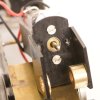
DSC_0309.jpeg
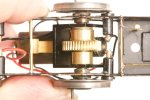
I have stripped the motor/gearbox and inserted a shim of kitchen foil - four layers measure about 4 thou before compressing down. This will lift the worm relative to the worm gear.

I have also slipped some plain washers over the motor spindle behind the worm, so the spindle has only enough longitudinal free play to let it spin freely. I have put everything else back together, and I think running is better but a little noisier. This is heading back to where I began! Still, I can live with this until NEEGOG. I am sure these roundy-roundys help mechanisms to bed in.
 

simond

Western Thunderer
Three separate issues;

motor gearbox worm to wheel mesh: needs to be sweet before attacking anything else. This is the key reason for not having the gearbox as part of the chassis, particularly if the chassis is sprung. Should be ok if using a commercial gearbox, but beware of sideplay in the wheel.
Not saying it can’t be done as part of the chassis, but it’s easier if separate.

axles in axleboxes. Depends on suspension. Canon axleboxes easier, otherwise spin a reamer engaged in both axleboxes in a power drill and ensure you cover the range of potential misalignments by sliding or angling the reamer up & down

Rods & crankpins. depends on good discipline during chassis build. NB it’s cheaper to replace crankpin bushes than connecting rods…

I do agree that a good run (whilst well lubricated) is a really good thing, and constraining the worm so any longitudinal play cannot cause binding is crucial.
 
Last edited:

RichardG

Western Thunderer
I do agree that a good run (whilst well lubricated) is a really good thing, and constraining the worm so any longitudinal play cannot cause binding is crucial.

DSC_0311.jpeg
I have a feeling, one side of the gearbox was tending to touch one of the axle bushes in the chassis.

I have managed to slip a 0.25 mm shim washer into the gearbox, next to the boss of the worm gear. So the gearbox is no longer sliding along the axle; and the contact patch between worm and worm gear is fixed. I have secured the worm gear so the gearbox sits firmly between the axle bushes and not touching either. Running is better, and the tight spot associated with the driven axle has gone.

This left a tight spot somewhere in the rest of the mechanism. After quite a lot of exasperation while failing to find anything remotely tight, I eventually realised there was resistance where one of the plunger pickups was going over a small area on the back of a tyre. I've sprinkled graphite onto the backs of all four tyres and running is a whole lot better, just like it was before I started this chassis rework.

This is perfect. Well, very good indeed.
 

RichardG

Western Thunderer
By way of a postscript, this is a brass chassis and removing the soldered-in gearbox has left the chassis more willing to twist longitudinally, especially near to the driven axle.

This is not a problem for Nellie, because the body holds the chassis rigid and I assembled the body on a flat surface. But I do know of one Starter Loco where the running board is not quite flat, and this pulls the chassis skew when the fixing screws are tightened up. In such a case, Simon’s suggestion of spinning a parallel reamer through each pair of axle holes might help. I would do this with the body fixed in place.

The wonderful thing about building a loco from a kit, even a simple kit, is all of the parts are industry-standard ones. I can take the chassis to pieces as often as I like, alter something and try again.

DSC_0334.jpeg
The loco pairs up well with the tender truck.

I think it is best to stop now and see how well the model can run at NEEGOG.
 

simond

Western Thunderer
But I do know of one Starter Loco where the running board is not quite flat, and this pulls the chassis skew when the fixing screws are tightened up.

I recall one rather lovely looking 9F that a pal had purchased - the chassis ran beautifully.

But fit the cab/boiler/footplate and the thing ran like the proverbial three-legged donkey.

It was a challenge to sort that out!
 

Ian@StEnochs

Western Thunderer
This is not a problem for Nellie, because the body holds the chassis rigid and I assembled the body on a flat surface. But I do know of one Starter Loco where the running board is not quite flat, and this pulls the chassis skew when the fixing screws are tightened up. In such a case, Simon’s suggestion of spinning a parallel reamer through each pair of axle holes might help. I would do this with the body fixed in place.

A prime case for compensating or springing the wheels! Making a chassis completely square with all wheels in the same plane is extremely difficult. Builders of rigid chassis only have one configuration where the wheels align. However if you build it flexible there an infinite number of possibilities and the compensation irons out the twist.
 
Floating motor/gearbox for GER Y14

RichardG

Western Thunderer
DSC_0224.jpeg
I took the MSC gearbox [for Nellie] from a future project so I have assembled the original motor and gears onto a fold-up gearbox [from Nellie] to compensate.

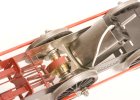
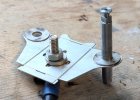
Jim Mcgeown (Connoisseur Models) offers two styles of fold-up gearbox: a wide version, designed to be soldered into the frames (like the one I cut out), and a narrow version, designed to make a floating motor/gearbox. For the narrow version, the modeller is left to make arrangements to hold the assembly in alignment on the axle. I used a 0.25 mm shim washer (left) and a slightly shortened Slater's axle bush (right).

The "Jim" gearbox has a big advantage over the MSC one in that you can reach the screws holding the motor without taking out the worm gear. This makes setting up the meshing a lot easier.

Sometimes it is nice to do a simple upgrade during a few hours. Especially when the upgrade makes a tangible improvement. Such was the new motor/gearbox in my GER Y14.

DSC_0338.jpeg
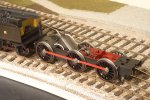
To recap, this is a rigid chassis with the drive to the centre axle. It is like this because I built the chassis according to the manufacturer's instructions. The centre wheels rarely touch the track because they sit about 0.2 mm above the other two. So really, traction is from four not six wheels. Wheel cleaning involves these four wheels not all six.

DSC_0339.jpeg
The gearbox is from the kit, and this fits snugly between the frames. I have a little sideplay on this axle to let the loco go through my Peco Setrack point. This sideplay means that every time the loco changes direction, the middle wheels kick sideways in response to the new torque reaction. In addition, the contact patch on the worm gear is a broad area rather than a single spot.

2025-07-30 15.37.26.jpg
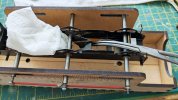
The chassis is back in the Poppy's box where I built it to unsolder the gearbox. The idea was to avoid moving the bushes for the centre axle, and I seem to have got away with this. Soggy paper towel protects inside motion parts from flame of gas torch.

DSC_0340.jpeg
This is the fold-up gearbox I wrote about on 20th July.

DSC_0343.jpeg
The gearbox frame, gearset and motor are all from Jim McGeown. The shim washers and 3/16 inch bush are from usual sources. I had to file down the insides of the axle bushes in the chassis to accomodate the sideplay on the axle.

DSC_0349.jpeg
The result ran really well straight away. I suppose the gears are already bedded in (I took them from Nellie) but this is excellent.

The floating gearbox is one subject I would never try to record on video. If you don't know how they position themselves during running, just try to imagine what happens. The comparisons are all too obvious . . .

DSC_0355.jpeg
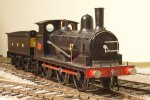
Reassembled for token portrait. Still pleased with the colour of the rails!
 
Last edited:
Floating motor/gearbox for future model

RichardG

Western Thunderer
I have used the gearset I removed from the Y14 to build a new gearbox. The other parts here are a fold-up gearbox from Connoisseur Models (Jim McGeown) and a secondhand Mashima 1830 motor I found on eBay.

The Mashima motors are still useful because, unlike the Canon CN22, their mounting holes line up with the holes in these gearbox etches.

2025-08-03 12.46.12.jpeg
My method of assembly here is completely different to that suggested in the instructions but I think it makes for a potentially more accurate job. I began by opening out the axle holes in the frame and the washers to let an axle pass through with a tight freehand push fit. The five-sided broach keeps things symmetrical.

Then I soldered the washers to the inside of the frame - I want to make the assembly as slender as I can. Temporary electrical connection for RSU.

2025-08-03 13.03.28.jpeg
The two sides of the gearbox are each folded up to a true right angle, one at a time, and secured using the angle strips supplied on the fret.

2025-08-03 14.37.33.jpeg
The ends of the gearbox are folded up and soldered along all edges, and the outside corners dressed.

With the gearbox as solid as it can be, the two axle holes are teased out (5-sided broach again) to give a decent running clearance for the axle. The axle is inserted and the worm gear located using some packing washers, a Slater's axle bush and the inevitable shim washer.

DSC_0365.jpeg
After a test fit of the motor, the two mounting slots are filed slightly longer to allow a closer mesh between the gears.

DSC_0366.jpeg
The motor is installed, the gears are meshed correctly (slacken one fixing screw and twist the motor) and the gearbox is test run. Everything is smooth and quiet, and I lubricated the gears and the holes where the axle passes through the gearbox.

The important thing is to make the angle beween the motor spindle and the axle as close to a right angle as you possibly can. If there is a skew here then the worm gear (being the softer of the two) will wear very quickly.

I am happy with this one, so I can put it aside for a future loco and I cannot lose the gears or the motor in the meantime :)
 
( Diversion : GER Y14 on SM32 garden railway )

RichardG

Western Thunderer
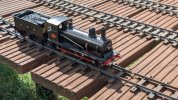
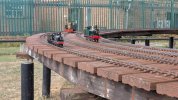
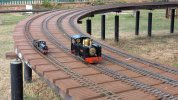
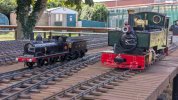
The Y14 had some test running at the model engineering club today to help the chassis to bed in:)

2025-08-05 10.55.49.jpeg
The track here is laid with nominal 2mm gaps between the rails but the repeated heating and cooling provokes them to move in different directions, closing up some gaps and opening up others. This does not affect the loco's performance!

2025-08-05 10.50.00.jpeg
Running with Gauge 1 and SM45? (LGB-ish size) locos.

2025-08-05 10.48.55.jpeg
Live steam nearby brings a wonderful smell, more evocative than sound to me.

2025-08-05 11.12.14.jpeg
Another strange juxtaposition.

2025-08-05 10.59.07.jpeg
All went really well - the loco is running better than ever.
 
Gearboxes especially 'dished' vs straight-cut worm wheels

Bob Essex

Western Thunderer
WRT to the MSC gearbox the big issue with these types is the way the gears are cut. This also applies to a lot of the gear sets produced under the Romford/Markits brands for 4mm. That is they use ‘dished’ worm wheels. This is good for transmission of heavy loads but the worm and wormwheel must be be extremely accurately meshed, there is no room for mesh adjustment, only that built-in by the machining standards they are made to, because the meshing is radial. If this doesn’t match then the two faces don’t match up anywhere. Added to this if the wormwheel is not precisely located at the axis of the worm the same applies. Both shaft axes must be dead right. This is why, historically, getting Romford gear sets to run well has been the bane of many 4mm modellers.

By contrast, the gears from Jim use ‘straight cut’ worm wheels. These only mesh at the axis of the worm, a vertical chord, so the transmission pressure is all located here, but the meshing distance can be varied to a degree while the wormwheel is free to move sideways without altering this basic meshing. These type are thus much more suited to model use where a degree of flexibility is allowed.

Both types of wormwheel can be hob cut. The dished by sinking the cutter into the wheel, as is the done to mesh the actual worm, the straight cut by running the cutter sideways across the wheel.

Hope this is of interest.

Bob
 

RichardG

Western Thunderer
That is they use ‘dished’ worm wheels. This is good for transmission of heavy loads but the worm and wormwheel must be be extremely accurately meshed, there is no room for mesh adjustment, only that built-in by the machining standards they are made to, because the meshing is radial. If this doesn’t match then the two faces don’t match up anywhere. Added to this if the wormwheel is not precisely located at the axis of the worm the same applies.

Bob this is all of great interest - thanks for posting.

By sheer coincidence, I bought some shim washers yesterday - 0.1 and 0.25 mm. I suppose, if I reduced the width of the MSC worm wheel perhaps 0.2 mm each side then I could experiment with the washers to move it sideways. But with a granularity of 0.1 mm i.e. 4 thou, perhaps the chances of getting a better mesh are rather small?
 

Bob Essex

Western Thunderer
It might work Richard, or not. That’s the difficulty with such worm gear sets. Sometimes it can just be purely a case of luck as much as anything else. The fact the motor initially got rather too hot suggests the gears were too tightly meshed but as said unless a degree of clearance had been allowed for altering it can solve one problem but raise another. But frankly anything is worth a try to see where the limits may lie. A modicum of vertical movement of the motor in the mount would be helpful. Then you could try and ‘feel’ the worm sitting down into the wheel to get it properly centered. It is a real case of nip & tuck. Just running in with such as grinding paste/toothpaste etc. sounds grim and extreme but may just produce enough clearance to overcome the issues.

It was this problem with lack of suitable gears in 7mm in the early ‘90’s that pushed me into tooling up and hob cutting my own, which were sold through such as Karlgarin for a few years. Basically the same as Jim provides now but which didn’t exist back then.

Bob
 

Ian@StEnochs

Western Thunderer
I am a big fan of the Ultrascale nylon worm/brass wheel gears. They will tolerate a bit of sideplay but it is best practice for them to always mesh in the same position. For that reason I prefer to make my own gearbox, that way I can taylor it to fit the model, make it as rigid as possible and control the sideplay without resorting to washers.

To get the best mesh with only enough running clearance use a slip of moistened, with thin oil, toilet paper sandwiched between the gears and pressed down Into the teeth. Once the screws are tight the paper can be removed, in bits usually but with perfect mesh.

With a nylon worm there is no need to bed in with abrasive though that does work with steel.

Ian.

B2226D3E-51C6-4E9B-ADA1-82D9ABC22230.jpeg
 

RichardG

Western Thunderer
For that reason I prefer to make my own gearbox, that way I can taylor it to fit the model, make it as rigid as possible and control the sideplay without resorting to washers.

My interests are in small, light-railway size locomotives hauling short, lightweight trains at about 20-25 mph.

The motor/gearboxes from High Level Models are really good for locos with 1/8 inch axles but there isn't enough material in the final drive gears to bore them out for 3/16 inch axles.

I suppose, the middle-market for motor/gearboxes is quite small, and so there aren't many products out there to buy. The high-end products with helical gears seem over-specified for my models, and so I want to try Ian's approach for my future gearboxes as long as I can make something which fits the space available.
 
NER class H2 (1907)

RichardG

Western Thunderer
DSC_0380.jpeg
It’s been a while since I built a loco and even longer since I bought this kit for a LNER J79 (NER H2) from Connoisseur Models. This kit has been the longest resident in my stash, bought from Jim in September 2022. This is an attractive prototype of the right size and proportions for my Heybridge Railway, with a bonus of having the Westinghouse brake as used by my nearby GER and LT&SR.

The loco I build might be on loan to the Heybridge Railway from the NER; or it might be a fictional extra member of the class, found to be surplus by the NER and quickly sold to the Heybridge operation. If the loco belongs to the railway then I can paint it black to match ‘Blackwater’ and ‘Heybridge’; if it is a NER loco it needs a pro paint job. Either way I can still make a start.

DSC_0377.jpeg
The parts were all beautifully packed into the box, as is the way with Jim’s kits. The boiler arrived pre-rolled.

The kit comes with a 32-page instruction book and additional pages of photographs, an illustrated parts list and advice on fitting some newer castings.

DSC_0385.jpeg
This a selection of the castings, they are all as clean and sharp as these ones.

DSC_0382.jpeg
There is a lot of attention to detail here - even a hole template to help the builder scribe a circle onto glazing material. This has all been put together by someone who expects you to build the kit successfully and to enjoy doing it.

DSC_0391.jpeg
The etches are over three years old so I have cleaned them with Barkeepers Friend, rinsed with tap water. They are too big to go into my ultrasonic bath.

DSC_0393.jpeg
The chassis is designed for motor drive to the middle axle. This axle is raised about 0.2 mm, so the loco effectively runs as an 0-4-0 like my Y14.

If I arrange drive to the rear axle I will make myself enough space for batteries and radio control equipment. Unfortunately this needs a two-stage gearbox to leave the cab clear, and this one (Slater’s) cost me nearly as much as the kit. There is no room for a flywheel but this is unnecessary with battery power.

The J79 is quite a simple kit by today's standards, so there is plenty of scope for customisation. I am reliably assured that the kit goes together (like all of Jim's kits really) so most of the problems I encounter will be of my own making . . .
 
. . preparations: running board and cab footsteps

RichardG

Western Thunderer
Received wisdom tells me, the running board hides the space between the frames where the inside motion would be (if it was modelled); and the clearances between the rear crankpins and the cab steps are extremely tight. Thank you @Rob Pulham.

DSC_0398.jpeg
After I lopped out the surplus running board I saw that one side of the running board was about 0.5 mm broader than the other. This photo isn’t very clear, but I marked out the discrepancy before I opened up the hole to make things symmetrical.

DSC_0403.jpeg
This means, the hole is now c.26.5 mm wide. So far so good, but the fold-up frames, by design, will be 25 mm apart. The tops of the frames will show through the hole.

I suspect this kit was drawn up to accept coarse scale wheels, hence the 25 mm across the frames. I can either live with this or fabricate new frame spacers. It's funny how one thing leads to another as soon as you make a start :rolleyes:

DSC_0410.jpeg
For the cab footsteps, I removed about a millimetre from the top flanges. This will let the assemblies sit further out, and hopefully clear the crankpins. The idea of the n/s wire is to strengthen the steps against unwanted bending, and allow a stronger fixing onto the underneath of the footplate. The two assemblies are handed, with the wire located away from the crankpins.

This deals with the “known problems” so to speak. I can now proceed and doubtless create some new ones of my own :cool:
 
Last edited:
Top