
You are using an out of date browser. It may not display this or other websites correctly.
You should upgrade or use an alternative browser.
You should upgrade or use an alternative browser.
Tales from The Room of Doom. Dipping a toe in various bucolic backwaters.
- Thread starter Flaxfield
- Start date

Flaxfield
Western Thunderer
Evening, all.
A flurry ( well, close enough ) of activity, this afternoon and into this evening, has seen the wiring tidied up and pretty much finished. There really isn't a lot of wiring and it shouldn't have taken that long but I wasn't really in the mood. But, I pressed on and now feel like I have achieved something, however small that may be.
I have therefore spent the last hour or so using a P Class to worry a couple of wagons and very therapeutic it has been.
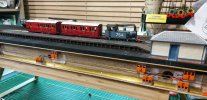
A view of the current state of affairs.

Still to finish, are the last feed to the station throat and to finalise the power in, hence the clipped on feed in the photo. Ideally, this will be for both DC and DCC, for which I have a cunning plan.......ish.
Rob
A flurry ( well, close enough ) of activity, this afternoon and into this evening, has seen the wiring tidied up and pretty much finished. There really isn't a lot of wiring and it shouldn't have taken that long but I wasn't really in the mood. But, I pressed on and now feel like I have achieved something, however small that may be.
I have therefore spent the last hour or so using a P Class to worry a couple of wagons and very therapeutic it has been.
A view of the current state of affairs.
Still to finish, are the last feed to the station throat and to finalise the power in, hence the clipped on feed in the photo. Ideally, this will be for both DC and DCC, for which I have a cunning plan.......ish.
Rob

Willl
Western Thunderer
That's very encouraging to see Rob (particularly with that lovely P).
I'm also in a bit of a modelling funk at the moment but have a cunning plan for a similar 110x20ish cameo as a means to get the mojo back. I'm undecided about whether to make it a proper layout or just a diorama, given the available space. Have you used small radius points on this one?
Will
I'm also in a bit of a modelling funk at the moment but have a cunning plan for a similar 110x20ish cameo as a means to get the mojo back. I'm undecided about whether to make it a proper layout or just a diorama, given the available space. Have you used small radius points on this one?
Will
Rob, years ago I adopted using 5DIN plugs and sockets for connecting up power supplies. This started out as a modular DC system using separate bits and it’s just one socket for power in and I can plug in whatever I choose, DC or DCC. The DCC system just sits in a RU box on the floor out of the way ( Z21 currently). Best is I can plug into whatever layout is out ( I have 5 small layouts in various scales to use). It also keeps mains power well away from any layout.
Bob
Bob
Flaxfield
Western Thunderer
Morning, Will.
Yes, small radius throughout. I've also stayed ( as you can see ) with code 75 streamline as I had them 'in stock'. As I mentioned on another thread, the bullhead equivalent occupies exactly the same footprint.
Now that the wiring is 80% complete, this layout can be picked up and popped on the dining table to tinker with, on the subject of which, I hope to have some tinkering time later.
Rob
Yes, small radius throughout. I've also stayed ( as you can see ) with code 75 streamline as I had them 'in stock'. As I mentioned on another thread, the bullhead equivalent occupies exactly the same footprint.
Now that the wiring is 80% complete, this layout can be picked up and popped on the dining table to tinker with, on the subject of which, I hope to have some tinkering time later.
Rob
Flaxfield
Western Thunderer
Rob, years ago I adopted using 5DIN plugs and sockets for connecting up power supplies. This started out as a modular DC system using separate bits and it’s just one socket for power in and I can plug in whatever I choose, DC or DCC. The DCC system just sits in a RU box on the floor out of the way ( Z21 currently). Best is I can plug into whatever layout is out ( I have 5 small layouts in various scales to use). It also keeps mains power well away from any layout.
Bob
Hi Bob.
Thank you. That echoes my own thoughts on powering the layout. I'm toying with the idea of popping the NCE panel into a box, leaving two wires to connect to the layout, as would the alternative combi.
The only thing stopping me with both is that I want a relatively 'clean ' appearance to the layout when exhibited/ in use at home, as in the minimum of wiring dangling.
If the NCE panel was in the layout itself then the only wires would be the power feed in from the back and the connection to the panel at the front. A Combi would be a little more untidy but I'm sure I can make it work.
More thought needed but, for now, I've slipped into playing mode.....
Flaxfield
Western Thunderer
Playing is ongoing. Despite not, as yet, having a fiddly yard, the 3D planning department is taking full advantage of the mobility offered by the newly installed wiring.
Limited shunting can be carried out.
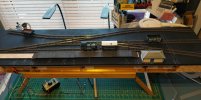
In addition, as you can gather from the above, a platform has been temporarily installed. I think I have previously mentioned the source of these wooden sections being from the N Gauge Bachmann/ Farish Scenecraft range. They are low but fine for a tramway coach with steps. However, I wondered if they would accommodate normal four or six wheel stock.
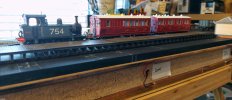
It appears that they will but I was still worried that they were too low. However, a flick through a couple of books brought forth this view of Blagdon, on the Wrington Vale Light Railway.

The platform is clearly low but in comparison to the steps on the coaches, perhaps not so low as to preclude their use.
Rob
Limited shunting can be carried out.
In addition, as you can gather from the above, a platform has been temporarily installed. I think I have previously mentioned the source of these wooden sections being from the N Gauge Bachmann/ Farish Scenecraft range. They are low but fine for a tramway coach with steps. However, I wondered if they would accommodate normal four or six wheel stock.
It appears that they will but I was still worried that they were too low. However, a flick through a couple of books brought forth this view of Blagdon, on the Wrington Vale Light Railway.
The platform is clearly low but in comparison to the steps on the coaches, perhaps not so low as to preclude their use.
Rob
I think it is possible that the station staff would have a wooden 'hop up' box which they could produce if they thought it was needed.
I only suggest this because of an experience I had on the Bluebell Railway some 25 years ago.
One of the platforms at Horsted Keynes used to be quite low. To be more accurate, it was the track that was high due to limited clearance over the subway roof.
I took my mother and her elderly friend on one of their Spring bluebell specials.
The train came in and we contemplated the high step. Out rushed one of the station staff with a wooden box like a foot stool and placed it in position for us.
I know that was in the preservation era but I can't imagine they invented the idea.
Rodney
I only suggest this because of an experience I had on the Bluebell Railway some 25 years ago.
One of the platforms at Horsted Keynes used to be quite low. To be more accurate, it was the track that was high due to limited clearance over the subway roof.
I took my mother and her elderly friend on one of their Spring bluebell specials.
The train came in and we contemplated the high step. Out rushed one of the station staff with a wooden box like a foot stool and placed it in position for us.
I know that was in the preservation era but I can't imagine they invented the idea.
Rodney
Hi Rob,
Just in case it helps form ideas you may have here's a few shots of my setup.
This is now using just the power-in lead from the DCC system. just the one socket. I don't need anything else as the throttle is wi-fi (a dedicated android phone). You can see the RU box (A4 size) on the floor with the leads going off to the power sockets ( I cut suitable holes in the RU box as needed). The Z21 needs two, one for the system, one for the separate router.

As you can see this is a tiny-teeny layout sat on top of a (just) slightly larger one.
The DC system uses this at the core. A distribution block to give it a name. Power in to the controller then out to the layout or whatever else might be needed. So still just the one lead to the layout, but it does mean the controller needs to be on a fairly long lead, a bit like wired DCC handsets. As this was home made this wasn't an issue. The output lead can of course be changed for another for other purposes. I often plug in a mini drill, so I can control both speed and direction. The controller uused is different as well, a cheap e-bay PWM one as the current draw in amps is quite a bit more than the usual 1.5amp limit of most controllers. But that's the advantage, it's a pick and mix system if you need. In the past the power was a 16vac transformer in a box into a 5DIN socket like the others but the power is currently a 12v DC wall wart so the socket was changed. Doesn't really give enough oomph to the controllers so a search is underway for a 16vac wall wart instead.
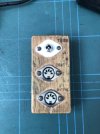

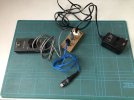

With regard to 'step-up' boxes they were quite common on exGE lines. I have seen many shots down the years of them being used at halts where there was either a low platform or basically no real one at all and used with ordinary carriages i.e. not ones with special low steps.
Bob
Just in case it helps form ideas you may have here's a few shots of my setup.
This is now using just the power-in lead from the DCC system. just the one socket. I don't need anything else as the throttle is wi-fi (a dedicated android phone). You can see the RU box (A4 size) on the floor with the leads going off to the power sockets ( I cut suitable holes in the RU box as needed). The Z21 needs two, one for the system, one for the separate router.
As you can see this is a tiny-teeny layout sat on top of a (just) slightly larger one.
The DC system uses this at the core. A distribution block to give it a name. Power in to the controller then out to the layout or whatever else might be needed. So still just the one lead to the layout, but it does mean the controller needs to be on a fairly long lead, a bit like wired DCC handsets. As this was home made this wasn't an issue. The output lead can of course be changed for another for other purposes. I often plug in a mini drill, so I can control both speed and direction. The controller uused is different as well, a cheap e-bay PWM one as the current draw in amps is quite a bit more than the usual 1.5amp limit of most controllers. But that's the advantage, it's a pick and mix system if you need. In the past the power was a 16vac transformer in a box into a 5DIN socket like the others but the power is currently a 12v DC wall wart so the socket was changed. Doesn't really give enough oomph to the controllers so a search is underway for a 16vac wall wart instead.
With regard to 'step-up' boxes they were quite common on exGE lines. I have seen many shots down the years of them being used at halts where there was either a low platform or basically no real one at all and used with ordinary carriages i.e. not ones with special low steps.
Bob

Phil O
Western Thunderer
Playing is ongoing. Despite not, as yet, having a fiddly yard, the 3D planning department is taking full advantage of the mobility offered by the newly installed wiring.
Limited shunting can be carried out.
View attachment 252122
In addition, as you can gather from the above, a platform has been temporarily installed. I think I have previously mentioned the source of these wooden sections being from the N Gauge Bachmann/ Farish Scenecraft range. They are low but fine for a tramway coach with steps. However, I wondered if they would accommodate normal four or six wheel stock.
View attachment 252123
It appears that they will but I was still worried that they were too low. However, a flick through a couple of books brought forth this view of Blagdon, on the Wrington Vale Light Railway.
View attachment 252124
The platform is clearly low but in comparison to the steps on the coaches, perhaps not so low as to preclude their use.
Rob
Hi Rob,
Unless there's been an upgrade, you need experience the platforms at Newton St Cyres on the Barnstaple line, especially if you've had a skinful in the Beer Engine.
Flaxfield
Western Thunderer
Well, I'm pretty happy with the platform height. I think it will work out okay, especially when the actual ground cover is added up to sleeper height using DAS.
I'm aware of the use of various steps and boxes etc. In parts of East Anglia, steps were carried in the guards compartment on some branches due to ground level ' platforms' so I think this will be fine, plus an opportunity to perhaps model a couple of these boxes.

You may note, I have tweaked the wiring slightly. This arrangement, using brass wire, may be unorthodox for some but it works, with no drop in voltage across the layout and is neat and tidy ( well, for me it is ! ). The three way WAGO connectors are a breeze to use.
Moving stock around can help to get a feel for the look of the final layout. Despite it's small size, it does look promising. Dropping in a 'backscene certainly helps and of course, it's fun to do.
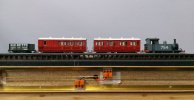
Perhaps it's worth noting that all of these photos are being taken from what was originally thought of as the back of the layout.
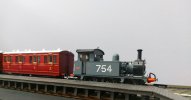
As has been noted by Mike Walker, there are shades of Old Parrock, flattering for sure but I see the similarities, as in a view, into the layout, over the back of the platform.

Whether or not I build the layout to be viewed this way around remains to be seen but it's an intriguing idea.
Rob
I'm aware of the use of various steps and boxes etc. In parts of East Anglia, steps were carried in the guards compartment on some branches due to ground level ' platforms' so I think this will be fine, plus an opportunity to perhaps model a couple of these boxes.
You may note, I have tweaked the wiring slightly. This arrangement, using brass wire, may be unorthodox for some but it works, with no drop in voltage across the layout and is neat and tidy ( well, for me it is ! ). The three way WAGO connectors are a breeze to use.
Moving stock around can help to get a feel for the look of the final layout. Despite it's small size, it does look promising. Dropping in a 'backscene certainly helps and of course, it's fun to do.
Perhaps it's worth noting that all of these photos are being taken from what was originally thought of as the back of the layout.
As has been noted by Mike Walker, there are shades of Old Parrock, flattering for sure but I see the similarities, as in a view, into the layout, over the back of the platform.
Whether or not I build the layout to be viewed this way around remains to be seen but it's an intriguing idea.
Rob



Yorkshire Dave
Western Thunderer
Whether or not I build the layout to be viewed this way around remains to be seen but it's an intriguing idea.
I would.
Make it viewable from both sides and if you have a 'drop in' scenic box you can them fool exhibition managers into thinking they've invited the 'wrong' layout whereas in reality it's the same one viewed from a different angle. It just means a fiddle yard exit in both end walls of the scenic box which can be easily disguised.
Yorkshire Dave
Western Thunderer
You may note, I have tweaked the wiring slightly. This arrangement, using brass wire, may be unorthodox for some but it works, with no drop in voltage across the layout and is neat and tidy ( well, for me it is ! ). The three way WAGO connectors are a breeze to use.
Moving stock around can help to get a feel for the look of the final layout. Despite it's small size, it does look promising. Dropping in a 'backscene certainly helps and of course, it's fun to do.

I would consider sheathing/sleeving the exposed brass wires, even if they will be boxed in, to prevent accidental shorting by foreign objects - especially if you're operating in DCC mode. 2mm and other sizes of PVC wire sheathing/sleeving is widely available.

Hi Rob,
I think your platform height looks fine.
The up platform at Ham Street, the ex-SER/SE&CR station in Kent where I worked until last year, has quite a pronounced slope from the current platform edge level down to the level of the doors to the booking hall.
Having spent many hours sweeping that bit of platform and occasionally dealing with flooding within the booking hall during heavy rain, I'm pretty certain that the platform wouldn't have sloped, so its height would have been similar to yours. This is borne out by photos in the Middleton Press book on the line that show the area to lack the slope.
Watching this with interest...and getting all nostalgic for Kent
Simon.
I think your platform height looks fine.
The up platform at Ham Street, the ex-SER/SE&CR station in Kent where I worked until last year, has quite a pronounced slope from the current platform edge level down to the level of the doors to the booking hall.
Having spent many hours sweeping that bit of platform and occasionally dealing with flooding within the booking hall during heavy rain, I'm pretty certain that the platform wouldn't have sloped, so its height would have been similar to yours. This is borne out by photos in the Middleton Press book on the line that show the area to lack the slope.
Watching this with interest...and getting all nostalgic for Kent
Simon.

simond
Western Thunderer
It’s currently blowing a hoolie, visibility is about half a mile, and it’s raining…getting all nostalgic for Kent
does that help?
