
You are using an out of date browser. It may not display this or other websites correctly.
You should upgrade or use an alternative browser.
You should upgrade or use an alternative browser.


simond
Western Thunderer
You could make it more complicated and with more potential inaccuracies, for example, by having pins and bushes etc., but I figured that having the block that locates the horns and the spigots as one printed part would probably be the least risky in terms of losing the reference.
Now soldering the horns to the frames was a doddle compared to soldering the frame spacers in place. The trouble is that the slots are a smidgen wider than the tags and it is rather challenging to get everything aligned, and what I should have done was to print a thing to hold it all in place with clips and clamps, so I could solder it “right first time”.
But that would take most of the day to print, and I’m impatient so…
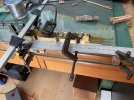
and the moral of the tale is that toolmakers clamps are just like pannier tanks. You just can’t have enough of them…
I’m sure it’ll look lots nicer when it’s had a scrub…
Now soldering the horns to the frames was a doddle compared to soldering the frame spacers in place. The trouble is that the slots are a smidgen wider than the tags and it is rather challenging to get everything aligned, and what I should have done was to print a thing to hold it all in place with clips and clamps, so I could solder it “right first time”.
But that would take most of the day to print, and I’m impatient so…
and the moral of the tale is that toolmakers clamps are just like pannier tanks. You just can’t have enough of them…
I’m sure it’ll look lots nicer when it’s had a scrub…

simond
Western Thunderer
Wheels degreased and metal blacked, a smarter man than I would have remembered to do the pony truck wheels at the same time…
anyway. Slaters wheels often have a counterbore for the head of the crankpin, but this batch doesn’t, so I attacked them with a (blunt) 6mm 3-flute end mill.

Before and after. note to self. Purchase new end mills.

10BA screws inserted from the rear of the wheel, a blob of 5-minute epoxy on the thread and under the head, and then screw in tight using a pin chuck on the exposed end. These will now be left til tomorrow as we’re doing the Valentine’s Day special on the RHDR. It takes us to that renowned romantic spot, Dungeness, where one can admire the only desert in Britain, a disused lighthouse, a used lighthouse, a nuclear power station in the process of being demolished, and a couple of pubs
anyway. Slaters wheels often have a counterbore for the head of the crankpin, but this batch doesn’t, so I attacked them with a (blunt) 6mm 3-flute end mill.
Before and after. note to self. Purchase new end mills.
10BA screws inserted from the rear of the wheel, a blob of 5-minute epoxy on the thread and under the head, and then screw in tight using a pin chuck on the exposed end. These will now be left til tomorrow as we’re doing the Valentine’s Day special on the RHDR. It takes us to that renowned romantic spot, Dungeness, where one can admire the only desert in Britain, a disused lighthouse, a used lighthouse, a nuclear power station in the process of being demolished, and a couple of pubs
Last edited:

adrian
Flying Squad
I'd have simply put the axleboxes in place in the hornguides, then used 3 x 12" lengths of 3/16" silver steel round bar through them - it's then very easy to use an engineers square to make sure that the axles will be a 90deg and square to the frames.Now soldering the horns to the frames was a doddle compared to soldering the frame spacers in place. The trouble is that the slots are a smidgen wider than the tags and it is rather challenging to get everything aligned, and what I should have done was to print a thing to hold it all in place with clips and clamps, so I could solder it “right first time”.

James
Western Thunderer
Sounds very civilised!we’re doing the Valentine’s Day special on the RHDR
I've been at work all day, playing trains admittedly!
simond
Western Thunderer
my traditional approach - normally I would assemble the frames square and parallel, then use dummy axles to set the hornguides in place, either lined up with a square or using graph paper. The problem I ran into this time was that I am shy an extra couple of hands to hold everything whilst the first joints were soldered.I'd have simply put the axleboxes in place in the hornguides, then used 3 x 12" lengths of 3/16" silver steel round bar through them - it's then very easy to use an engineers square to make sure that the axles will be a 90deg and square to the frames.
I think I approached it poorly. I tried to fit the centre spacer first, and that didn’t work well. The horizontal support for the pony truck sets the frames‘ alignment, and doing that first (maybe with a dummy axle or three in place) might have been easier.
its a learning exercise. Hopefully it’ll run tomorrow.
EDIT
Having slept on it (a very useful problem analysis technique) it would have been very easy to include cross-holes in the 3DP jigs, through which the dummy axles could be fed. This would allow the assembled frames to be located parallel to the jig/perpendicular to the axles and correctly aligned, whilst the spacers were soldered to them. I shall amend the printed jig design, thank you @adrian.
Once updated, I’ll add the print file to the resources, assuming STL files are permitted.
Last edited:
simond
Western Thunderer
Well,Sounds very civilised!
I've been at work all day, playing trains admittedly!
it was great fun, a memorable evening, arranged by Madame to celebrate my recent birthday, which was a Tuesday, and involved board meetings and other non-celebratory obligations.
We went by bus to New Romney, about 40 minutes on the 103 bus, arrived almost exactly an hour early for the train and the exhibition was closed, so nipped across the road to the Captain Howey for a pint, and caught the first part of the second half of the Calcutta cup match. We returned to the cafe for our complimentary glass of Prosecco, and boarded the train. It was not warm, but we (and everyone else) had our coats and woolly hats.
On arrival at Dungeness, we were told our table number, and found our tables already provided with drinks, smart move. The chicken goujons and salad were very nice, the cod & chips was acceptable if not outstanding, and the cheese platter was enormous! But it was not very warm, people were putting on their outdoor coats to eat their desserts…
We left Dungeness on time, by when a fresh, and very chilly South wester was whistling across the desert. Unfortunately, the train was 7 minutes late at New Romney and we missed the bus home - the last bus was an hour later, and so rather than frostbite and hypothermia, we endured the pub singer and his audience in the Captain Howie. Shall we say, “not my ideal pub”?
The last bus was uneventful despite “San and Tray” being rather vocal downstairs.
as promised, Dungeness holds some rare delights

the new lighthouse

the nuclear power station

the old lighthouse
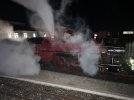
Sir Winston Churchill
and on the walk up from the bus stop, some curiously regimented clouds

Best
Simon

simond
Western Thunderer
Crank pin bushes, tapped 10BA as my normal practice and then flats milled on the flange
Posed photo
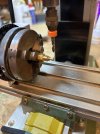
Emco dividing head with brass hex tapped 10BA, Bush screwed on and locked, whizz one way, flip the dividing head whizz the other and done - 70 seconds per bush including fitting them on the screw and taking them off.
Similar time for tapping.
I now have 8
All the bits to see if the chassis rolls first time…
Drum roll…
As Arnie said…
Posed photo
Emco dividing head with brass hex tapped 10BA, Bush screwed on and locked, whizz one way, flip the dividing head whizz the other and done - 70 seconds per bush including fitting them on the screw and taking them off.
Similar time for tapping.
I now have 8
All the bits to see if the chassis rolls first time…
Drum roll…
As Arnie said…
simond
Western Thunderer
Result!
With no adjustment at all, it rolls. There is a slight tight spot with the wheels at about 8 o’clock on this side, but it’s at the “that’ll go with running in” level.
Next up, cylinders etc, but no rush, there’s lunch and there’s rugby.
And I want to look back at @adrian approach to 3DP ball bearing hornblocks combined with CSB. But whilst that’s chewing around in the back of my head, I can get on with other stuff, knowing the foundations are right.
Happy with that

michael080
Western Thunderer
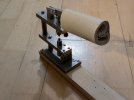
Thanks a lot. The handle knob will be printed tomorrow.STL files for the new improved Hornguide Jig and the Riveter Handle Knob (see post 2074 on page 104) are now in the resource section.
My solution maybe practical, but it lacks aesthetic finesse.
Michael

Matt.S.
Western Thunderer
Great little file Simon, thanks for sharing - I might upgrade my bit of hose pipe!
Always nice to see the RDHR given some screen time - my great Grandfather did a bit, we've got some great pics of the workshops and such with him talking with the Captain and Grandad playing with Laurel and Hardy... one day I'd like to build a couple of the locos he worked on.
Always nice to see the RDHR given some screen time - my great Grandfather did a bit, we've got some great pics of the workshops and such with him talking with the Captain and Grandad playing with Laurel and Hardy... one day I'd like to build a couple of the locos he worked on.
Up cycling in the finest traditionsMy solution maybe practical, but it lacks aesthetic finesse.


simond
Western Thunderer
Woe is me.
I purchased the Mogul kit some years ago, and, as is my habit, purchased the wheels, motor, rods and various other bits at the same time.
I have now realised that I have the wrong wheels. 5’6” diameter, 17 spoke, rather than 5’8” 18 spoke. These are for a BR Mogul, not a 43xx. I assume a misunderstanding at the Slaters stand, and I didn’t spot it until I came to do the balance weights.
This is something of a disappointment, and will cause a bit of wallet stress at Kettering. Actually, quite a lot as I have a JLTRT Saint for which a full set of wheels is also required.
I shall place the wheels I have on the For Sale section.
Anyway, onwards and upwards. I started to assemble the cylinders, and the clearances are a bit tight.

I had calculated the scale width for the slide bars, and fitted the G brackets accordingly, on the basis that the wheels are closer together than S7 so…
scale centres for the cylinders is 6’10” or 47.83mm, and the kit measures 47.8 so that’s a good start.
the slidebars are 2.85 wide, but actually the crossheads are the key here, they are slightly assymetric, the inner flange is thinner at around 0.35-0.4mm, and allow 0.1 clearance to the slide bars. So each side there is say 0.45 of crosshead and 2.85/2 = 1.43 of slidebar. Add a further 0,1 of clearance and you have 1.98, round up, 2mm from the centreline of the slidebars to the outside face of the crankpin. Maximum dimension over crankpins must therefore not exceed 43.8
B-t-B is 29.2. Wheel thickness at the hub is 4.43, Premier rods, 1.6, Flange of crankpin bush 0.5, allow 0.1 clearance, 6.63 per side 13.36 round up to 13.4, gives a total width over the crankpins of 42.6.
Hurrah! that leaves a little sideplay in the axle and a little more for clearance. I don't want to do more with the wheels, but I can get the cylinders built.
More soon…
I purchased the Mogul kit some years ago, and, as is my habit, purchased the wheels, motor, rods and various other bits at the same time.
I have now realised that I have the wrong wheels. 5’6” diameter, 17 spoke, rather than 5’8” 18 spoke. These are for a BR Mogul, not a 43xx. I assume a misunderstanding at the Slaters stand, and I didn’t spot it until I came to do the balance weights.
This is something of a disappointment, and will cause a bit of wallet stress at Kettering. Actually, quite a lot as I have a JLTRT Saint for which a full set of wheels is also required.
I shall place the wheels I have on the For Sale section.
Anyway, onwards and upwards. I started to assemble the cylinders, and the clearances are a bit tight.
I had calculated the scale width for the slide bars, and fitted the G brackets accordingly, on the basis that the wheels are closer together than S7 so…
scale centres for the cylinders is 6’10” or 47.83mm, and the kit measures 47.8 so that’s a good start.
the slidebars are 2.85 wide, but actually the crossheads are the key here, they are slightly assymetric, the inner flange is thinner at around 0.35-0.4mm, and allow 0.1 clearance to the slide bars. So each side there is say 0.45 of crosshead and 2.85/2 = 1.43 of slidebar. Add a further 0,1 of clearance and you have 1.98, round up, 2mm from the centreline of the slidebars to the outside face of the crankpin. Maximum dimension over crankpins must therefore not exceed 43.8
B-t-B is 29.2. Wheel thickness at the hub is 4.43, Premier rods, 1.6, Flange of crankpin bush 0.5, allow 0.1 clearance, 6.63 per side 13.36 round up to 13.4, gives a total width over the crankpins of 42.6.
Hurrah! that leaves a little sideplay in the axle and a little more for clearance. I don't want to do more with the wheels, but I can get the cylinders built.
More soon…
simond
Western Thunderer
Further investigation shows a) that I needed to count the spokes rather than assume, and b) the issue is “pin between” rather than “pin in line”.
The wheels I have are actually later pattern 5’8” 18 spoke Collett Prairie wheels. Still frustrating. I have a Warren Shepherd Prairie to build, and I have an unopened set of 5’8” PB wheels in that box. I could use these wheels for that, and if I had a set of IL wheels…
I wonder if Mr White would countenance a swap for a set of pin-in-line wheels. Phone call Monday. I shall ask nicely. Fingers crossed.
Meanwhile, back at the slide bars. I tried soldering them on “freehand”, and they’re not bad, but they’re not right, so they’re coming apart again.
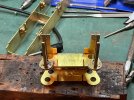
I’ll print a jig to locate everything square and true and resolder…
enough for tonight.
Simon
The wheels I have are actually later pattern 5’8” 18 spoke Collett Prairie wheels. Still frustrating. I have a Warren Shepherd Prairie to build, and I have an unopened set of 5’8” PB wheels in that box. I could use these wheels for that, and if I had a set of IL wheels…
I wonder if Mr White would countenance a swap for a set of pin-in-line wheels. Phone call Monday. I shall ask nicely. Fingers crossed.
Meanwhile, back at the slide bars. I tried soldering them on “freehand”, and they’re not bad, but they’re not right, so they’re coming apart again.
I’ll print a jig to locate everything square and true and resolder…
enough for tonight.
Simon
simond
Western Thunderer
Slide bar alignment jig designed and on the printer. It’ll not finish before bedtime, says six hours but it’ll take at least seven. And there’s all of tomorrow to play with!
I shall do some RCH wagon playing this evening. Having seen the FDM Minnow linked by @martin_wynne from the Templot forum, I thought I’d have a go, and started on a wagon body earlier in the week. @Andrew Thompson appears to have done a lot of the hard work on the chassis and I’ll download his models, I had also used some of those RCH drawings in my earlier printing experiments, so I’m sure I’ll have something printable if the work Bambus are not busy on Monday. I’ll be very interested to see what can be achieved with the right filament and an 0.2 mm nozzle.
I shall do some RCH wagon playing this evening. Having seen the FDM Minnow linked by @martin_wynne from the Templot forum, I thought I’d have a go, and started on a wagon body earlier in the week. @Andrew Thompson appears to have done a lot of the hard work on the chassis and I’ll download his models, I had also used some of those RCH drawings in my earlier printing experiments, so I’m sure I’ll have something printable if the work Bambus are not busy on Monday. I’ll be very interested to see what can be achieved with the right filament and an 0.2 mm nozzle.
Last edited:
simond
Western Thunderer
Back to Moguls.

Slide bar jig fresh out of the curing tank,
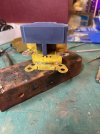
And snugly located on the cylinder former assy
And after a little judicious twisting, bending, filing and gentle pushing about, soldered up.
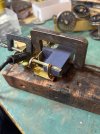

Now, moment of truth, can I get the jig out?
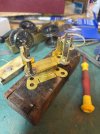
Well, it was tight but not a fight
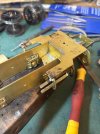
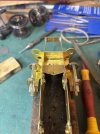
And still fits on the frames!
The G brackets are cast with two pins on top which would be great if the matching holes had been etched in the big u shaped plate, I drilled holes where my initial calculation suggested, but I got it wrong…. So the pins got cut off. There’s 7x5mm of solder joining each one to the plate, I reckon that’ll do.
If you’re following my footsteps, the G brackets seem to align with the outside edges of the plate, and their rear edge is about 1mm behind the back edge.
One other necessary mod is the rear cylinder former upper edge needs filing back to sit properly under the plate.
The jig will now get put in the Warren Shepherd prairie box for future use.
Next step is to finish the cylinder assemblies.
Then a massive clean up.
Slide bar jig fresh out of the curing tank,
And snugly located on the cylinder former assy
And after a little judicious twisting, bending, filing and gentle pushing about, soldered up.
Now, moment of truth, can I get the jig out?
Well, it was tight but not a fight
And still fits on the frames!
The G brackets are cast with two pins on top which would be great if the matching holes had been etched in the big u shaped plate, I drilled holes where my initial calculation suggested, but I got it wrong…. So the pins got cut off. There’s 7x5mm of solder joining each one to the plate, I reckon that’ll do.
If you’re following my footsteps, the G brackets seem to align with the outside edges of the plate, and their rear edge is about 1mm behind the back edge.
One other necessary mod is the rear cylinder former upper edge needs filing back to sit properly under the plate.
The jig will now get put in the Warren Shepherd prairie box for future use.
Next step is to finish the cylinder assemblies.
Then a massive clean up.
Last edited: