Rivermead Central

40057

Western Thunderer
Martin

That three-quarter view of 292 is glorious. The little handrail on the smokebox door catches my eye. Not knowing the prototype at all means that I am completely unaware of any missing details or rivets that you suggest may have been left out. You have managed to get an amazing amount of daylight below the boiler, so often a real problem with the B-L engines like the 4F.

Our discussion above got me thinking about my family's view of O Gauge back in the 1950s. My father was a very fine model engineer and also an accomplished railway modeller, in fact a leading light in the local club which had two extensive O gauge layouts, one indoors and one outdoors. As far as he was concerned there was tinplate (by which he meant Hornby on the carpet), O Gauge (which was basically Bassett-Lowke, Leeds, Milbro etc), and finescale, a term which he applied only to those wheels which would not run properly on the club track. I don't remember him ever using the term "coarse scale".

At that time (say the mid 1950s) I had never seen an example of finescale O gauge except for one GWR coach at the club. This was an object of contempt and derision from the clockwork and live steam gang, as it refused to run through our points and always fell off the track (no wonder, with 29mm B to B). Otherwise, my first awareness of finescale was the amazing feature on W S Norris' layout in the MRN for June 1957 (p143 et seq). Inspirational as it was, it in most respects seemed irrelevant to our efforts. But I suppose this was the moment that I began to view what had hitherto just been standard scale O gauge as "coarse" rather than "fine". In retrospect, it now does seem most unfortunate that those terms (fine and coarse) were adopted, with their somewhat judgemental implications.

John
Hi John

Both 292 and 828 are modelled in 1922 condition, based on photographs or information about general changes made to the class. Hence 828 has a steam heat connection on the tender (not the loco) which is most likely, but we didn’t have a dated photograph of the rear of 828’s tender to know for sure. In 1922, there would be hardly any visible rivets on either loco. The most obvious omission from 292 is the loco brakes. However, each side of each wheel there is either a footstep or a sandbox, so there is enough going on below the platform to look ‘busy’. If 292 was being built now, I probably would put brakes on the loco. Neither 292 or 828 have brake shoes on the tender on the grounds of these being hardly visible. We had an excellent dated photograph of 292 to work from which is why this particular loco was chosen, though in 1922 it was only a few years old so ‘as built’ was a reasonable surmise. In 1922, 828 was 23 years old and there certainly had been changes since it was new. However, the loco is well documented (a whole book about it) so I am confident the model is a very good representation of it as it was at the end of the Caledonian Railway’s independent existence.

Both Tom and Brian did an excellent job at hiding the motor. Of course, for 828 we had the benefit of Tom’s CAD process to test alternative motor positions. For 292, I was moving the motor about on top of an outline drawing photocopied to be exactly 7mm scale. The corollary of only a small projection of the motor under the boiler ahead of 292’s firebox is that the motor fills the lower part of the cab. But the cab design means that doesn’t show. And the large motor relative to the size of the loco has produced a really powerful engine. The other area where modelling has moved on between 2009 and 2025 is visible in the photo of 292’s tender. The tender axle-box + spring castings for 292 were cast from a pattern made by Brian, silver soldered in brass. For 828, 3D-printed waxes were used. Undoubtedly, the castings for 828 are far better. That’s not a criticism of Brian’s pattern-making skills, just the advance produced by the new technology. The tender axle-box + spring castings for both locos are brass and both sets were made by CSP models.

Martin
 

Roger Pound

Western Thunderer
Once again I am a little late to the party regarding the terminology but some years back I produced a small layout using Peco SM32 track to be able to run modern so-called coarse scale locos together with currently produced, shall we say, standard scale 0 gauge stock (e.g.:- Dapol). With a little work it made, even if I say so myself, a presentable little layout. The then Editor of the Gauge 0 Guild Gazette was kind enough to publish an illustrated article featuring my efforts.

My point is that it is only words we are playing with here when really we should be spending time enjoying our models and trying to achieve the standards and effects that we seek for our pleasure. Perhaps my view may be considered too simplistic - or am I just getting old.............:rolleyes: ?

Apologies, Martin for this minor highjack of the thread.

Roger.
 

RichardG

Western Thunderer
But to answer the question, I think it is too late, but if I was going to offer a suggestion I'd say change Coarse to Original or date it by the year a standard could be considered to have been adopted.

I am even later to the party! How about "Hornby scale"? This would give a credit to the man who did so much for us, and leave "fine scale" and "true scale" for what followed.
 

Ian@StEnochs

Western Thunderer
I am even later to the party! How about "Hornby scale"? This would give a credit to the man who did so much for us, and leave "fine scale" and "true scale" for what followed.


It is the word ‘scale’ which is the problem. Coarse, fine, S7, are all using the same scale 1-43.5 or 7mm/ft or near enough. However we are using different track standards and track gauge. The various manufacturers have always gone their own way with wheel standards, after all they wanted customers to only buy into their system.

The GOG did try to set standards but do any of the current manufacturers take any notice? I very much doubt they do.

I recall a discussion where it was said that if, when Slaters introduced their range of wheels, they had used a gauge of 33mm we would all be modelling in S7.
 

Masbury

New Member
I have learnt so much from this thread - especially about the complex inner life of Bassett-Lowke and its relations with Winteringham/Bing etc! The dialogue between Martin and John is really interesting - and the conversation is enhanced by contributions from other participants.

Just one or two observations if I may. The first is about the 'Ramp Rail' (posts 97 onwards). The Bank of England Inflation Calculator lets us know that the (May) 2026 equivalent of 30s 3d (i.e. the cost of this rail, including purchase tax) is approximately £42.50. This is a useful, but not the only, metric. During the past 75 years incomes have generally - and notwithstanding wage freezes, 'pay pauses', etc. - risen considerably. It seems to follow that, although £42.50 remains a substantial amount today, 30s 3d would have 'meant' more to a prospective purchaser in 1951 than would £42.50 today. it would therefore appear unlikely that the Ramp Rail would be a priority for even quite affluent customers. By the way, the 1938/1939 price for a Hornby '0' gauge tinplate straight brake and reverse rail was 1s 3d (approximately £3.63 in May, 2026) - but this was of course with tinplate track and there was no 're-start' facility.

Secondly, the Hornby figures and accessories (posts 949 onwards). The Hornby pieces of luggage (round topped trunk; flat topped trunk; wicker hamper; and suitcase) were presented as a set, which also included a porter's barrow, and was named 'Platform Accessories Set No.1'. The set was first sold in 1924 and was renamed 'Railway Accessories Set No.1' in 1928. With minor changes, the set continued to be made until, along with most Hornby products, it ceased to be made after December, 1941. Production of the set was not resumed after WWII.

The blue 'sack truck' is a different item, Dinky Toys No.107a, and is much larger than the porter's barrow mentioned above. It was first released in 1948/49 and was made until 1958. It was, and is, a very pleasing model. As far as I am aware, Meccano Limited did not advertise or present it as an accessory for '0' gauge railways.
 

simond

Western Thunderer
If you want to play around with prices over time, I suggest comparing them with the average workers' wage and calculating the value of the item in the time an average working person would have to labour to afford the item. Of course, this doesn't necessarily correlate with the hours it was necessary to work, nor the conditions under which the work was undertaken.
 

40057

Western Thunderer
Correct, the distinction is not a different scale. My locomotives are built to the same scale as an S7 locomotive.

I think ‘coarse’ and ‘fine’ are reasonable words to use for the difference in wheel (and track) standards. ‘Coarse’ meaning ‘large, lacking refinement’. Yes, relative to true scale, Bassett-Lowke and similar wheels are too wide and the flanges too deep. Correspondingly, the rails are too tall and the flange-ways at crossings too wide. Fine meaning ‘delicate’ or ‘excellent’, used as a relative term in contrast to ‘coarse’, is a reasonable adjective for wheels and track close to exact scale dimensions. I have no issue with describing my wheel and track standards as coarse scale.

The distinction between more versus less accurate, or very detailed versus simplified models is not about scale. It is often down to commercial considerations, making something that is good enough at a price people will pay. Compromises such as incorrect wheel spacings so the motor can be used in several different models have been with us since the start of mass-produced model railways. Using the same bodies in different liveries, some at least not prototypical, was common practice in 1910 as it is today. And for the same practical reasons of selling enough copies to justify the capital cost of tooling. These compromises are not mistakes, though models can suffer from those too. There are also some departures from true scale that are directly related to track standards, specifically the minimum radius of curve for the model. Historically, undersize bogie wheels were usual to allow locomotives with outside cylinders to negotiate standard model railway curves. Undersized driving wheels too, to give enough space above the axles for a bulky motor, whether clockwork or electric. But none of these departures from an accurate representation involves a change of scale.

There is a difference between a fully-detailed, exact scale, representation and a very nice, broadly accurate, model, but it’s a continuum. Whereas sets of wheel and track standards are pretty much discrete and define the use of the model. So there is a logic to labelling models according to wheel and track standards.

C.R. 828 (see above) is a model with coarse scale wheels. It is not ‘a coarse scale model’, since it is otherwise of accurate scale dimensions. I do wonder if the recent 00 gauge production of a CR 812 class loco, including 828 in various liveries, has wheels that are much closer to true scale than my clockwork model. And of course, the 00 model is significantly less accurate than my 828 in that it runs on 4’ 1½” gauge track.

Yet no-one would refer to the Bachmann model as ‘coarse scale’.

Martin
 
Last edited:

40057

Western Thunderer
I have learnt so much from this thread - especially about the complex inner life of Bassett-Lowke and its relations with Winteringham/Bing etc! The dialogue between Martin and John is really interesting - and the conversation is enhanced by contributions from other participants.

Just one or two observations if I may. The first is about the 'Ramp Rail' (posts 97 onwards). The Bank of England Inflation Calculator lets us know that the (May) 2026 equivalent of 30s 3d (i.e. the cost of this rail, including purchase tax) is approximately £42.50. This is a useful, but not the only, metric. During the past 75 years incomes have generally - and notwithstanding wage freezes, 'pay pauses', etc. - risen considerably. It seems to follow that, although £42.50 remains a substantial amount today, 30s 3d would have 'meant' more to a prospective purchaser in 1951 than would £42.50 today. it would therefore appear unlikely that the Ramp Rail would be a priority for even quite affluent customers. By the way, the 1938/1939 price for a Hornby '0' gauge tinplate straight brake and reverse rail was 1s 3d (approximately £3.63 in May, 2026) - but this was of course with tinplate track and there was no 're-start' facility.

Secondly, the Hornby figures and accessories (posts 949 onwards). The Hornby pieces of luggage (round topped trunk; flat topped trunk; wicker hamper; and suitcase) were presented as a set, which also included a porter's barrow, and was named 'Platform Accessories Set No.1'. The set was first sold in 1924 and was renamed 'Railway Accessories Set No.1' in 1928. With minor changes, the set continued to be made until, along with most Hornby products, it ceased to be made after December, 1941. Production of the set was not resumed after WWII.

The blue 'sack truck' is a different item, Dinky Toys No.107a, and is much larger than the porter's barrow mentioned above. It was first released in 1948/49 and was made until 1958. It was, and is, a very pleasing model. As far as I am aware, Meccano Limited did not advertise or present it as an accessory for '0' gauge railways.
Hello and welcome to WT.

There are several threads on here detailing layouts using vintage equipment.

Tom Mallard’s workbench thread covers the building of 828 (and his other wonderful creations).

There’s a ‘New Members’ thread if you want to say anything further about your own modelling interests.

Martin
 

Masbury

New Member
Hello Martin,

Thank you for your kind welcome, and for your 'steer' towards threads of interest. I hope to visit these in the near future!

Best Wishes, John (alias Masbury)
 

RichardG

Western Thunderer
It is the word ‘scale’ which is the problem.

Yes it is. I think a word of one syllable is best. Wheels and track go hand in hand, and "track" seems to fit: coarse track, fine track, scale track.

I know such terminology won't become mainstream, but it's good to put an adjective in front of a tangible thing and not something as fixed as "scale".
 

40057

Western Thunderer
An interesting comparison. Well I think so, anyway.

However unlikely this may seem, a mass-produced, 0 gauge, tinplate, Caledonian Railway 0-6-0 was available from a major manufacturer in the 1920s. Made by the Leeds Model Company (LMC) and depicting a C.R. 300 class loco, the model was available in LMS livery until WW2 and in BR livery in the 1950s. Early on, clockwork and electric versions were offered, fitted with cast-iron wheels. Later models were electric only, with alloy wheels.

That the LMC made a C.R. 0-6-0 was indirectly due to Bassett-Lowke. After WW1, Bassett-Lowke updated their 0 gauge range. The pre-WW1 model of G.W.R. ‘City of Bath’ (made by Bing) was replaced by a County class 4-4-0 (made for Bassett-Lowke by the LMC). The pre-WW1 model of Caledonian Railway no.142 (made by Bing) was replaced by a model of one of the newest Pickersgill-designed C.R. 4-4-0s, no. 77 of the 72 class. This model too was produced exclusively for Bassett-Lowke by the LMC. Both the 4-4-0s Bassett-Lowke commissioned from the LMC had quite short production runs, and Bassett-Lowke did not return to the LMC for further locomotive models. The terms of the contract with Bassett-Lowke meant the LMC could not produce more of the models made for Bassett-Lowke and sell them as LMC models. But the LMC could use the tooling made for the Bassett-Lowke commissions to make other, similar, models. Hence two models, not typical of the LMC’s production, were added to the LMC range; a G.W.R. mogul and the C.R. 0-6-0.

Here is an example of the LMC C.R. 0-6-0 that was offered for sale earlier this year:

C538A49C-ED8E-44D6-AC50-849350F7CF58.jpeg

Thanks to Mike Delaney for permission to use his photo.

The model illustrates the usual issue with LMC products of poor paint adhesion.

Quite a creditable effort, instantly recognisable as a C.R. 300 class loco. However, some compromises have been required to accommodate the motor. First, most obviously, the motor projects well ahead of the fire-box and has had to be boxed-in over the middle wheels where there should be daylight under the boiler. Secondly, the rear wheels are too far forward, further from the back of the loco than they should be.

The wheel diameter and spacing on the 300 class were the same as for the 812 class (= 828). The rear wheels on the LMC model should be like this:

CF181D4F-8EA9-48A1-8344-078005902573.jpeg

On the 300 class the cab was wider so the front of the rear splasher wasn’t continuous with the cab side.

I have never had the opportunity to examine an example of the LMC 0-6-0 in detail. I am therefore not sure if the middle and rear wheels are too close together or if the cab has been extended rearwards. Something has been done though to get the motor to fit in the body.

I have commented before (post #620) on the great difficulty caused by the very short overhang behind the rear wheels on C.R. 0-6-0s. The designers of the real locomotives appear to have given no consideration to the practicality of reproducing their engines in 7 mm scale using contemporary clockwork or electric motors.

The 300 class is an easier subject for a model than the 812 class in two ways. First, the shape of the cab-side cut-out on the later C.R. designs. It is smaller so if, as is almost inevitable, the motor projects into the cab, that isn’t so easily seen. Second, the higher pitch of the boiler, giving more headroom above the axles for the motor. The downside of the higher pitched boiler being more daylight underneath it, so making it much more obvious if the motor extends forward of the front of the fire-box.

No C.R. 0-6-0 would be easy to model using a clockwork or vintage, bulky, electric motor. The LMC made a good effort, commendable for the 1920s. 828 is obviously far, far better, but a one-off scratch build, so not like-for-like with the LMC model.

Martin
 

John R Smith

Western Thunderer
Hello Martin

Yes, I think that is a very interesting comparison. Most of my experience with LMC rolling stock was back in the Sixties. I would say that by far the majority of our goods wagons were Leeds, the wooden bodied type having paper litho overlays, Mazak axleguards and wheels, with the typical oval buffers. They were rugged and did well on the outdoor line, but not if it started to rain! We had one LMC engine - a Lancs and Yorks 2-4-2 tank which was electrically powered via batteries housed in a bogie PMV which it perforce had to tow everywhere. There was a robust three-way switch in the bunker for forward, off and reverse. It was a jolly useful engine, and I do not recall any problems with the paint finish.

In more recent times I have had several of the LMC bakelite goods vans and open wagons, with all sorts of problems. The Mazak wheels are often suffering from rot, and when you attempt to change them the axleguards do not bend but snap off instead. They are perhaps interesting as the first example of injection moulded model railway stock, but I have got rid of all mine except one van - this is genuinely pre-war and in nice condition.

John
 

40057

Western Thunderer
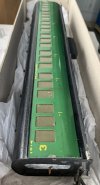
I have been doing some more work on the pre-WW2 Exley Southern all-3rd last seen in post #1,015.

In particular, in good light over this weekend, I have been attending to the damage to the green paint on the compartment side of the coach. This is the ‘before’ photo:

ACD9A80D-FF2C-49F1-89D3-9DE0E4B731E8.jpeg

Various small chips to the edge of the green paint and one larger area of paint loss. The sheet metal is slightly dented where the largest green paint loss has occurred, and the green paint around the edge of the bare metal had become detached from the metal surface. The risk of further losses of original paint was clearly high if the coach was subject to normal, albeit careful, handling. I decided filling in the areas of missing green paint with matching paint was essential for preservation.

Not an easy job. Making invisible paint repairs to plain colours on plane surfaces can be very tricky.

Note in this case that the edge of the green paint had been reinforced during manufacture. The spray-painted green has been over-painted using a brush just along the edge of the sheet metal. This might have been to cover exposed metal left after spray painting or to repair paint damage that occurred during assembly. The slight difference in colour and glossiness of the reinforcing edge paint needs to taken into account in the paint repair, but is a help in disguising the new paint.

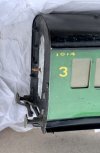
This is where I have got to this afternoon:

5E91AA9D-5378-400A-8893-0841664D8CDE.jpeg

43FA2098-BCF2-47CF-A47C-A450438631AB.jpeg

It’s not perfect under magnification, but I think it’s as close to invisible as I will get. In particular, note the imperfections in the surface and slight colour variations in the original paint. Also the touched in green paint applied during manufacture, for instance above the coach number below the cantrail. My paint repairs are not the worst imperfections in the coach’s paint work.

It’s a fine and quite scarce coach, but a lot of work to return it to original condition.

Martin
 

John R Smith

Western Thunderer
It’s not perfect under magnification, but I think it’s as close to invisible as I will get.

Nice work, Martin. These paint touch-ins are always a real nightmare. Your colour matching is very good. That buffer beam looks as if it has had a bang at some time - I see that you have a cracked buffer housing to deal with.

John
 

40057

Western Thunderer
Nice work, Martin. These paint touch-ins are always a real nightmare. Your colour matching is very good. That buffer beam looks as if it has had a bang at some time - I see that you have a cracked buffer housing to deal with.

John
Hi John

Thanks.

I don’t think there has been collision damage. The end casting simply isn’t very flat. The buffer housing is part of the casting for the whole coach end. The buffer heads were forced into the casting as part of manufacture. I think the split will have occurred then, not subsequently. So the bowed casting and split buffer housing are ‘original condition’, not later damage. I shall do nothing about the bow or split.

These pre-WW2 Exley’s have a real hand-made, cottage industry, Arts and Crafts, feel to them. The imperfections in the paint work, including the lettering, all done by hand, are part of the character they have. One of the challenges doing repairs is to avoid ‘putting right’ imperfections that are inherent in the manufacturing approach.

Your post-WW2 Exley’s I think are quite different — very precise and clinical, relatively speaking. I always see them as ‘modern models’, ahead of their time.

Martin
 

John R Smith

Western Thunderer
Your post-WW2 Exley’s I think are quite different — very precise and clinical, relatively speaking. I always see them as ‘modern models’, ahead of their time.

Martin

An interesting observation. They are in some respects 'modern models', but in other ways hark back to simpler times. Most of them are under scale length, by a compartment or two (shades of Hornby Dublo!). Roof ventilators, door and commode handles are merely embossed into the metal shell, rather than separate items. And there are no vacuum or steam pipes, lamp irons, brake gear or proper underframe detail.

And although they have lasted well (all of the O Gauge ones are now over sixty years old) they certainly have their problems. Amongst these are galvanic corrosion on the roof, dropped window glasses and loose interior details. To attend to these usually requires removal of the wooden floor which is by no means a simple task (the roof is not separate).

Nonetheless I must admit that I am very enamoured of them, and I now have about a dozen - more than could possibly fit onto my layout all at once! Here is the latest acquisition, an LMS Restaurant Car -

LMS RC 01.jpg

The RC makes an interesting addition to the evening express from Bristol, usually hauled as here by the Royal Scot. I got lucky with this one, and it was a modest £73 as I was the only bidder - as you can see, it is in very nice condition.

John
 

40057

Western Thunderer
Martin

An interesting observation. They are in some respects 'modern models', but in other ways hark back to simpler times. Most of them are under scale length, by a compartment or two (shades of Hornby Dublo!). Roof ventilators, door and commode handles are merely embossed into the metal shell, rather than separate items. And there are no vacuum or steam pipes, lamp irons, brake gear or proper underframe detail.

And although they have lasted well (all of the O Gauge ones are now over sixty years old) they certainly have their problems. Amongst these are galvanic corrosion on the roof, dropped window glasses and loose interior details. To attend to these usually requires removal of the wooden floor which is by no means a simple task (the roof is not separate).

Nonetheless I must admit that I am very enamoured of them, and I now have about a dozen - more than could possibly fit onto my layout all at once! Here is the latest acquisition, an LMS Restaurant Car -

View attachment 268661

The RC makes an interesting addition to the evening express from Bristol, usually hauled as here by the Royal Scot. I got lucky with this one, and it was a modest £73 as I was the only bidder - as you can see, it is in very nice condition.

John
Hi John

I don’t have any post-WW2 Exley’s but I have noticed corrosion of the roof (or repainting to address this) is common. I don’t understand why the roof should suffer when, apparently, the sides do not — though it’s all the same sheet of metal. Is the roof in contact with steel or some such that causes it to corrode?

Martin
 

John R Smith

Western Thunderer
I don’t understand why the roof should suffer when, apparently, the sides do not — though it’s all the same sheet of metal. Is the roof in contact with steel or some such that causes it to corrode?

Hello Martin

The spring steel clips which hold the glass window strips in place press against the glass and are sprung from the roof. They do not touch the sides. There is a strip of paper insulation to keep the steel apart from the dural roof, but this often deteriorates over time, hence the corrosion. Very late Exleys (Moddex ones) use a nylon spring clip, which solved the problem. Los of fun taking them all apart to fix this!

John
 

40057

Western Thunderer
Hello Martin

The spring steel clips which hold the glass window strips in place press against the glass and are sprung from the roof. They do not touch the sides. There is a strip of paper insulation to keep the steel apart from the dural roof, but this often deteriorates over time, hence the corrosion. Very late Exleys (Moddex ones) use a nylon spring clip, which solved the problem. Los of fun taking them all apart to fix this!

John
That explains it. The simpler type of pre-WW2 Exley’s (with the plastic windows mounted on a strip of wood) have almost no ferrous parts in the body. Some nails in the floor and nails through the end castings to hold the wood/glazing units in place. The Southern coach I am working on at the moment is an exception in that the metal wrapper is thin-gauge tinplate.

Martin
 

40057

Western Thunderer
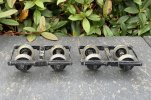
The bogies for the Exley Southern coach:

4EC1E0CC-E2EC-41FF-8C64-821B83BE65F1.jpeg

These were very oily and dusty so have been washed in warm water. I got these (and another identical pair) from a well-known Internet auction site. A lucky find since as far as I know these bogies were only used on the simpler type of pre-WW2 Exley coaches. Exley might also have sold them separately for use by scratch builders.

These Exley bogies are of very simple construction. Cast alloy sides, a tinplate bolster and a steel rod across each end, all soldered together. The alloy wheels are fastened on steel axles and are to Bassett-Lowke standards (27.0 mm back-to-back etc.). The wheel sets cannot be removed from the bogie. There is no springing or compensation but the axle holes are elongated vertically to allow the wheels to accommodate track irregularities.

When I bought it, the Southern coach was fitted with Bassett-Lowke’s superior quality LNWR-style coach bogies (catalogue number 612/0). These were definitely sold separately and offered as an upgrade for Bassett-Lowke’s range of lithographed tinplate coaches. Under some circumstances, I would have kept the B-L bogies as part of the coach’s history. They were sold as better replacements for standard bogies of B-L or other manufacture, so in that sense the B-L bogies were being used as the manufacturer intended. But they looked wrong on the Southern coach and had very heavy and coarse 1920s cast iron wheels. So the Southern coach is getting back the type of bogies Exley fitted when the coach was made.

Martin
 
Top