Rewanui (1940 NZR in 1:64)

Lawrence Boul

Western Thunderer
great minds - I have been working on servo drives for turnouts, on and off for some time. Arduinos offer the control, and can easily be interfaced with a CAN bus, which is the architecture I have elected to pursue for everything that is not loco control which remains DCC (I do have a couple of R/C but they are the exception and are not really intended for regular use - more an experiment).

CAN has many advantages, it is very tolerant of electrical noise, and can effectively work "plug and play" - for example, a lever frame can be plugged into the bus outdoors on a nice day, and indoors if the weather is inclement - though I guess you might not want the trains running in the rain. And lights, etc., can all be controlled by similar CAN compliant modules.

I saw an elegant solution for the servo cam drive a week or two back, I think it was one of the guys who are regular contributors to the Templot forum - rather than a cam, it used an eccentric and a small profile rolling element bearing. I didn't see or hear it operating, but it looked to be very well designed, with space to fit up to 4 microswitches I think. It's quite a bit bigger than your design, but that doesn't worry me as I am working in 7mm.

The beauty of a cam or eccentric drive is that the blades are pretty much locked with negligible power demand, backdrive is not possible. I guess that could also be a disadvantage, but generally I think not.

cheers
Simon
At the time I was hung up on something compact (and this is 16.5mm gauge). I also use servos for uncoupling so it simplified matters to use them for both. DCC - Ex is pretty much plug and play and the Rewanui control needs are relatively simple. No detection, signals, interlocking or anything of that nature.

CAD, 3D printing and cheap Chinese hardware does allow the creation of elegant solutions that in times past would have been impractical at home. Once upon a time you read about something and maybe built it with a few refinements. These days it's far more about gleaning the germ of an idea and building something tailored to need.

If this was a home layout the noise would be an issue for me, and I'd be looking for something silent or at least quiet. At a show audible confirmation is not a bad thing.
 

Lawrence Boul

Western Thunderer
Rods on NZR engines were typically what I understand as 'marine' style. It's possible to model them with laminated etches (as on the 1:48 W class below), but it is not all that convincing in the close up photos that I'm prone to. Compare the cast con rod, with the etched trailing coupling rod.

_HLB1694.jpg

The problem with cast rods is that they don't have the innate accuracy that etches do and some means to address that is needed.

Of late I've tried a new idea, which is to cast the rods, but model the ends to receive separate, adjustable brasses (just like the protype). This allows relatively simple, yet accurate adjustment of centres to the wheelbase.
Ab-rods.jpg
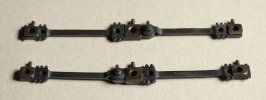
These are rods for a 1:64 Ab pacific. Note the elongated holes and the sprue of brasses to suit. Castings a little mediocre in this case.
9mm-We-bigends.jpg
In 9mm scale (We) the detail is a lot better (above), but even in 1:64 (class U below) it can still be very good.
U-conrod-big-end.jpg
Below a set of finished We rods in 1:64.
We-Rods.jpg
The method is pretty simple and works well. The main constraint is the practicality of casting workable ends and brasses and coping with crankpin diameter. For smaller engines in 1:64 it's more difficult as things are tight.
 

simond

Western Thunderer
Lawrence,

I love the cast rods, but surely you’d be better boring the crankpin holes on a mill rather than adjusting them with loose bushes?
(another 3DP jig to hold them for boring…)

I note you used lasered frames, and my experience with that was also very good, though I rather fancy waterjet would be better, as it would not soften the brass. Either way, with accurate frames and the rods machined, you’d be on track for a “freewheels first time” chassis.

best
Simon
 

Lawrence Boul

Western Thunderer
Lawrence,

I love the cast rods, but surely you’d be better boring the crankpin holes on a mill rather than adjusting them with loose bushes?
(another 3DP jig to hold them for boring…)

I note you used lasered frames, and my experience with that was also very good, though I rather fancy waterjet would be better, as it would not soften the brass. Either way, with accurate frames and the rods machined, you’d be on track for a “freewheels first time” chassis.

best
Simon
Simon

Thanks for the feedback.
Bear in mind that the rods are for kits and are supplied as raw castings. Almost all my work is 1:64, so boring on mills, while doubtless a good engineering option, doesn't really suit.

The 9mm We has lasered/etched frames, so combining the two processes is handy. It's the first time I've lasered metal, and was done as the frames are relatively thick. I like it but, for 1:64, etching is fine, and a good deal cheaper.
 
Top