
You are using an out of date browser. It may not display this or other websites correctly.
You should upgrade or use an alternative browser.
You should upgrade or use an alternative browser.
Prototype PhilH's Industrial Railway Photos
- Thread starter PhilH
- Start date

I've always assumed the NCB did the modification as they were too small for coal. I didn't manage to see many NCB ones but the modification appears fairly standard. They wouldn't have been suitable for BR engineers to use as ballast hoppers have to have a mechanism for opening the doors easily from either rail side or by being ridden on - the latter so much safer so the earlier ones with railside operation such as LMS/BR GANNET went in the late 1970s - although the GWR/BR HERRING lasted a lot laterDo you know if these extended hoppers were used for iron ore, Paul?
I'm guessing more likely they were extended for departmental use once no longer required for iron ore traffic?
Paul


PhilH
Western Thunderer
On 20th to 22nd June the Tanfield Railway held its annual 'Legends of Industry Gala' with 7 steam locomotives in use - 6 home and 1 visitor - plus two diesels.
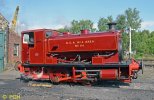
The visiting loco was No.54 Andrew Barclay 2320 of 1952 from the Appleby Frodingham Railway Society at Scunthorpe.

Inside Marley Hill Loco Shed early on the Saturday with TWIZELL, HORDEN and No.49 on the far road and No.54 and STANLEY on the near road.
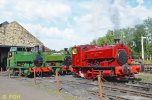
The three Andrew Barclays posed outside the shed, left to right: HORDEN (AB 1015), STANLEY (AB 1659) and No.54 (AB 2320). All three were originally NCB Durham Area locos.

TWIZELL (RS 2730) and No.49 (RSH 7098). TWIZELL was supplied new to the Beamish Colliery Railway in 1891 just a few miles from Marley Hill and passed to the NCB, latterly working at Handen Hold Colliery on the Beamish System. No.49 was originally from the NCB Northumberland Area at Backworth.
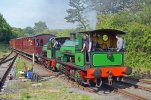
The other two locos in use were both originally supplied to Gasworks - SIR CECIL A. COCHRANE (RSH 7409) from Gateshead and No.2 (HL 2859) from Keighley, seen here arriving at East Tanfield the southern terminus on the Friday evening.

On the Saturday Fowler diesel hydraulic No.6 (JF 4240010) was in use, deputising for the failed TWIZELL, and seen here at Andrews House Station on a mixed train. No.54 at left at the rear of a train going in the other direction - hence the red lamp on the loco's front coupling hook.

TWIZELL was back in action on the Sunday, seen here being serviced at Andrews House Station.

Marley Hill Yard
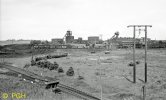
A photo I took from approximately the same position in 1966 on my first visit to the area, but turned slightly to the right. The sidings leading to the loco shed branch off on the left and compared with the previous photo the Austerity No.49 would be just off this photo to the left. In the distance is Marley Hill Colliery still in full production, it closed in 1983. On that first visit to the NCB Durham and Northumberland Areas in two days I saw 90 steam locos plus the Westoe Electrics. Its hard to imagine visiting the area today, much of which is pleasant rural countryside, the extent of the industrial railway systems and the collieries they served which once existed here.
The visiting loco was No.54 Andrew Barclay 2320 of 1952 from the Appleby Frodingham Railway Society at Scunthorpe.
Inside Marley Hill Loco Shed early on the Saturday with TWIZELL, HORDEN and No.49 on the far road and No.54 and STANLEY on the near road.
The three Andrew Barclays posed outside the shed, left to right: HORDEN (AB 1015), STANLEY (AB 1659) and No.54 (AB 2320). All three were originally NCB Durham Area locos.
TWIZELL (RS 2730) and No.49 (RSH 7098). TWIZELL was supplied new to the Beamish Colliery Railway in 1891 just a few miles from Marley Hill and passed to the NCB, latterly working at Handen Hold Colliery on the Beamish System. No.49 was originally from the NCB Northumberland Area at Backworth.
The other two locos in use were both originally supplied to Gasworks - SIR CECIL A. COCHRANE (RSH 7409) from Gateshead and No.2 (HL 2859) from Keighley, seen here arriving at East Tanfield the southern terminus on the Friday evening.
On the Saturday Fowler diesel hydraulic No.6 (JF 4240010) was in use, deputising for the failed TWIZELL, and seen here at Andrews House Station on a mixed train. No.54 at left at the rear of a train going in the other direction - hence the red lamp on the loco's front coupling hook.
TWIZELL was back in action on the Sunday, seen here being serviced at Andrews House Station.
Marley Hill Yard
A photo I took from approximately the same position in 1966 on my first visit to the area, but turned slightly to the right. The sidings leading to the loco shed branch off on the left and compared with the previous photo the Austerity No.49 would be just off this photo to the left. In the distance is Marley Hill Colliery still in full production, it closed in 1983. On that first visit to the NCB Durham and Northumberland Areas in two days I saw 90 steam locos plus the Westoe Electrics. Its hard to imagine visiting the area today, much of which is pleasant rural countryside, the extent of the industrial railway systems and the collieries they served which once existed here.
PhilH
Western Thunderer
Photos taken on a family holiday to Cornwall in September 1966.
On the way down it started off fairly reasonably (for a holiday) with a visit to Bicton Gardens in Devon, or to be more precise the 18" gauge Bicton Woodland Railway.
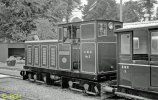
The Hunslet diesel CARNEGIE was working the train

Both locos are ex industrials, originally built for the Woolwich Arsenal Railway and now part of the Statfold Barn Railway collection.
The following day it was down by the seaside, but a little more industrial.
On the way down it started off fairly reasonably (for a holiday) with a visit to Bicton Gardens in Devon, or to be more precise the 18" gauge Bicton Woodland Railway.
The Hunslet diesel CARNEGIE was working the train
Avonside 0-4-0T WOOLWICH outside the loco shed.
Both locos are ex industrials, originally built for the Woolwich Arsenal Railway and now part of the Statfold Barn Railway collection.
The following day it was down by the seaside, but a little more industrial.
PhilH
Western Thunderer
The 2ft. gauge Penlee Quarry Railway has been described as the westernmost railway in England, although there were probably some short tramways in connection with mines to the west, at least underground if not on the surface. The Penlee Line connected hoppers at the quarry to a ship loading facility on the South Pier of Newlyn Harbour, a distance of about ¾ of a mile. It was opened with due ceremony on 27th November 1902, when the engine was named PENLEE by breaking a bottle of wine on it. PENLEE was a small 0-4-0WT built by Freudenstein & Co. of Berlin and supplied through the dealer Arthur Koppel, who probably also supplied the first 'V' skip wagons used on the line. One of the regular drivers was Janner Maddern who used to wear a bowler hat ! This seems to have been the line's sole motive power until an ex WDLR Baldwin 0-4-0 petrol loco was obtained secondhand in 1924, similar to MOELWYN on the Festiniog Railway, although this was fitted with a cut-down cab, fuel tank mounted at the front and later acquired a radiator projecting well above the bonnet. The steam loco was retired in 1946 and subsequently preserved on a concrete slab alongside the line.

In 1982 it was taken by the then owners of the quarry, A.R.C. Ltd, to their workshops in Oxfordshire for cosmetic restoration and its now on static display at the Leighton Buzzard Light Railway. Following the Baldwin, diesel locos of various makers were acquired, mainly secondhand, until the fleet was standardised on Ruston & Hornsby locos - of 33/40hp fitted with a cab for use on the line and 20hp cabless for use shunting the wagons under the hoppers.
Fortunately on my visit a ship was being loaded so the line was in use, with three of the larger Rustons on the trains and two smaller ones at the quarry hoppers. A further 3 locos were in the loco shed.
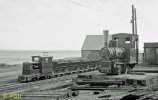
RH 375315 supplied new in 1954 and named J.W.JENKIN on an empty train passes PENLEE. Most of the line was double track with empty trains taking the seaward line and full trains taking the landward line. Trains comprised 12 'V' skip wagons, being pulled with the loco first to the pier when full and propelled with the loco at the rear back to the quarry when empty.
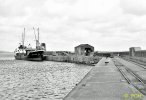
Newlyn Harbour South Pier with a loaded train about to enter the teeming shed, where the wagons were emptied on to a conveyor belt feeding the ship loading chute.

J.W.JENKIN again on a loaded train entering the double track section of the line.
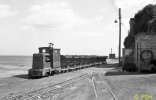
and returning to the quarry propelling the empty train. The siding in the foreground led to the loco shed.
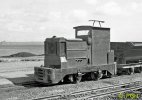
Another loco working the trains was No.2 RH 200748 of 1940.
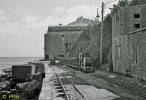
St.Michael's Mount just visible in the distance across the bay on the left of the photo.
The third loco was RH 375316 the other one of the pair supplied new in 1954 and named T.W.LEWIS, with an empty train on the short single track section leading to the quarry loading hoppers. The items dangling over the loco's cab are water spray outlets which were activated by the device fitted to the roof of the loco cabs to spray water over the loaded trains. This system was installed following complaints from residents living near the line about dust blowing off the loaded trains.
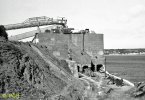
The quarry loading hoppers, fed by conveyors from the quarry with the sidings terminating in a headshunt.
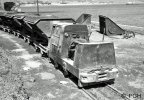
RH 221592/43 used for shunting wagons under the loading chutes.
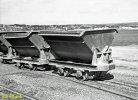
The line was replaced by a conveyor belt in 1972, rail traffic ceasing on 31/7/1972.
In 1982 it was taken by the then owners of the quarry, A.R.C. Ltd, to their workshops in Oxfordshire for cosmetic restoration and its now on static display at the Leighton Buzzard Light Railway. Following the Baldwin, diesel locos of various makers were acquired, mainly secondhand, until the fleet was standardised on Ruston & Hornsby locos - of 33/40hp fitted with a cab for use on the line and 20hp cabless for use shunting the wagons under the hoppers.
Fortunately on my visit a ship was being loaded so the line was in use, with three of the larger Rustons on the trains and two smaller ones at the quarry hoppers. A further 3 locos were in the loco shed.
RH 375315 supplied new in 1954 and named J.W.JENKIN on an empty train passes PENLEE. Most of the line was double track with empty trains taking the seaward line and full trains taking the landward line. Trains comprised 12 'V' skip wagons, being pulled with the loco first to the pier when full and propelled with the loco at the rear back to the quarry when empty.
Newlyn Harbour South Pier with a loaded train about to enter the teeming shed, where the wagons were emptied on to a conveyor belt feeding the ship loading chute.
J.W.JENKIN again on a loaded train entering the double track section of the line.
and returning to the quarry propelling the empty train. The siding in the foreground led to the loco shed.
Another loco working the trains was No.2 RH 200748 of 1940.
St.Michael's Mount just visible in the distance across the bay on the left of the photo.
The third loco was RH 375316 the other one of the pair supplied new in 1954 and named T.W.LEWIS, with an empty train on the short single track section leading to the quarry loading hoppers. The items dangling over the loco's cab are water spray outlets which were activated by the device fitted to the roof of the loco cabs to spray water over the loaded trains. This system was installed following complaints from residents living near the line about dust blowing off the loaded trains.
The quarry loading hoppers, fed by conveyors from the quarry with the sidings terminating in a headshunt.
RH 221592/43 used for shunting wagons under the loading chutes.
The 'V' type skip wagons were of two and one third yard capacity.
The line was replaced by a conveyor belt in 1972, rail traffic ceasing on 31/7/1972.
Last edited:

The surface tramway at Levant mine is 5 miles west of Newlyn and still has a loco on the remaining track. Currently in the "care" of the National Trust.The 2ft. gauge Penlee Quarry Railway has been described as the westernmost railway in England, although there were probably some short tramways in connection with mines to the west, at least underground if not on the surface.
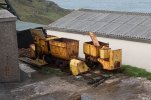
Also west of Newlyn would be Geevor mine which still has extant track and locos on the surface and had miles of track underground.
I think there's a lot of people that don't give industrial underground systems the regard and respect they deserve, despite the reality that they often had huge and extensive networks.
PhilH
Western Thunderer

The two cut-down Bagnalls at Par Harbour will be familiar to modellers as the subject of newly released 00 gauge versions by Rapido.
This is ALFRED the newest of the pair, just 13 years old.
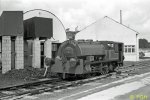
ALFRED with the loco shed behind. The shed is reached by a line crossing at 90 degrees to the line the loco is standing on. The older loco JUDY was out of use in the shed.
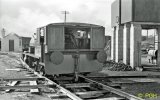
From the rear the I think loco's reduced height is even more apparent. The rear coupling ends in a hook with rope attached leading into the cab. Maybe the driver could couple to wagons at the rear while sitting in the cab !
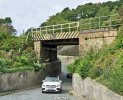
This is the problem bridge under the ex GWR main line with limited headroom. The line originally under it gave access to clay dries on the north side of the main line via sharp curves on each side, restricting its use to four coupled locomotives. For conversion to a road the level under it has been dropped substantially with steep gradients on each side. Photo courtesy Google Street View.
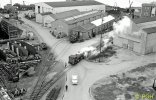
Falmouth Dock was one of the last industrial concerns to use steam locomotives, regular use officially ceasing in August 1986. Viewed from above is No.5 Hudswell Clarke works no.1632 at work.
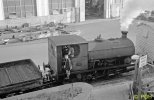
Hudswell Clarke 1632 was built in 1929, the first of their 14" cylinder 0-4-0ST design, and supplied new to CWS Ltd's Higher Irlam Margarine Works near Manchester. In 1961 it was sold with their other steam loco, a Peckett 0-4-0ST of 1919, to Falmouth Dock. After the end of steam operation it was sold to the Bygones Museum at St.Marychurch, Torquay in April 1987.

Peter Insole
Western Thunderer
Ah, happy memories of Par and Falmouth Docks! It wasn't just the friendly staff and gorgeous locomotives (and steam cranes!) that were so delightful... but the internal user fleet at the latter was a fascinatingly extraordinary rolling museum of ancient and decrepit wagonry!
Pete.
Pete.


LarryG
Western Thunderer
I worked on BR Parcels vans out of Manchester Victoria BR Parcel Depot throughout 1959 delivering & collecting in Salford and Weast etc. I saw the Hudswell Clarke 1632 of 1929 at CWS Ltd's Higher Irlam Margarine Works. There was also a Saddletank at the sewerage works and the Ship Canal 0-6-0T's were a familiar sight when delivering to Mode Wheel shed.
PhilH
Western Thunderer
The small port of Pentewan still had some 2'-6" gauge track, but not from the Pentewan Railway which was closed in 1918 and the track lifted, but from the later concrete and sand works. Sand was excavated from the beach and sandhills to the west and washed at the works for use as building material. Concrete blocks had also been produced here, but by 1966 the works had closed and the railway was disused. The three Ruston & Hornsby diesel locos were locked in the loco shed.
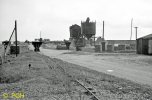
General view of the works looking towards the sea. The dock is off the photo to the left and the line curving round behind the shed on the right led on to the sand dunes.
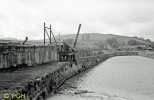
View of the dock showing the elevated line serving the tipping stage for loading boats. The dock always had a problem with silting up of the entrance and the last load of sand was shipped from here in 1940. The silt just appears in the bottom of the photo and the dock is now completely cut off from the sea. The elevated line and tipping stage are in a similar position to the original timber trestle of the Pentewan Railway, featured in photos of some of the steam locos.
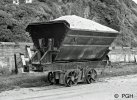
A tip wagon still loaded with sand.
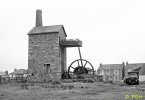
No photos of Cornwall would be complete without a couple of beam engine houses. This is the beam whim engine (winding engine) at Mitchell's Shaft, East Pool Mine, near Cambourne. Built in 1887 by Holman Bros. it ceased working in 1921 when a cave in underground closed this section of the mine. It's said to be the last beam whim engine to be installed in Cornwall.

The beam pumping engine at Taylors Shaft, East Pool Mine. Built in 1892 by Harvey & Co., it worked until replaced by electric pumps in 1954. Both engines are now in the care of the National Trust.
The South Crofty Mine at Cambourne had a 2'-0" gauge surface line connecting the Robinson's Shaft to the ore processing mill, a distance of just over ¼ mile. It was originally horse worked, later locomotives were used from c1950, with eventually a total of 4 Ruston & Hornsby diesel locos. Two were in use on the visit.
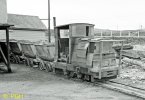
RH 213858/42 with a train of loaded tip wagons at the mine end of the railway. The handrail at the front of the loco was to enable the two men who filled and emptied the wagons to ride on the loco.
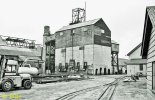
The loading hoppers at Robinson's Shaft with chutes on the side for loading the wagons.
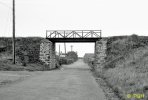
Bridge carrying the line over a minor road.

RH 213858/42 and empty train returning to the mine.

RH 264240/49 on the trestle leading to the tipping shed for the ore processing mill.
The line was replaced by a conveyor belt in 1970. The mine also has an extensive underground network of 1'-10" gauge worked by battery locomotives.
General view of the works looking towards the sea. The dock is off the photo to the left and the line curving round behind the shed on the right led on to the sand dunes.
View of the dock showing the elevated line serving the tipping stage for loading boats. The dock always had a problem with silting up of the entrance and the last load of sand was shipped from here in 1940. The silt just appears in the bottom of the photo and the dock is now completely cut off from the sea. The elevated line and tipping stage are in a similar position to the original timber trestle of the Pentewan Railway, featured in photos of some of the steam locos.
A tip wagon still loaded with sand.
No photos of Cornwall would be complete without a couple of beam engine houses. This is the beam whim engine (winding engine) at Mitchell's Shaft, East Pool Mine, near Cambourne. Built in 1887 by Holman Bros. it ceased working in 1921 when a cave in underground closed this section of the mine. It's said to be the last beam whim engine to be installed in Cornwall.
The beam pumping engine at Taylors Shaft, East Pool Mine. Built in 1892 by Harvey & Co., it worked until replaced by electric pumps in 1954. Both engines are now in the care of the National Trust.
The South Crofty Mine at Cambourne had a 2'-0" gauge surface line connecting the Robinson's Shaft to the ore processing mill, a distance of just over ¼ mile. It was originally horse worked, later locomotives were used from c1950, with eventually a total of 4 Ruston & Hornsby diesel locos. Two were in use on the visit.
RH 213858/42 with a train of loaded tip wagons at the mine end of the railway. The handrail at the front of the loco was to enable the two men who filled and emptied the wagons to ride on the loco.
The loading hoppers at Robinson's Shaft with chutes on the side for loading the wagons.
Bridge carrying the line over a minor road.
RH 213858/42 and empty train returning to the mine.
RH 264240/49 on the trestle leading to the tipping shed for the ore processing mill.
The line was replaced by a conveyor belt in 1970. The mine also has an extensive underground network of 1'-10" gauge worked by battery locomotives.
As in 1988 Falmouth DockyardAh, happy memories of Par and Falmouth Docks! It wasn't just the friendly staff and gorgeous locomotives (and steam cranes!) that were so delightful... but the internal user fleet at the latter was a fascinatingly extraordinary rolling museum of ancient and decrepit wagonry!
Pete.
And the rather special NERly survivors NERly Ballast wagons
Paul
PhilH
Western Thunderer
Delabole Slate Quarry - said to be the oldest operating slate quarry in the world (according to the company's website) and probably the biggest 'hole' in England.
The last of the six steam locomotives that worked the 2ft. gauge system were disposed of c1930, being replaced by three Motor Rail Simplex petrol locomotives obtained new between 1922 and 1928 (two being later converted to diesel).

No.2 Motor Rail diesel no.3739 of 1925. After use of the rail system ceased this loco was preserved on site and I believe its now on display in the visitor centre at the quarry.
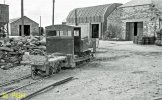
Another view of No.2 MR 3739/25, which shows at centre left of the photo how they crossed one track over another without a purpose made crossing - just using two removable rails !
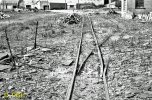
Another unusual bit of trackwork, a point on the line to the tip with normal pointed blades (sort of) but a stub switch for the frog or crossing - a 'semi-stub point'. Note also that blades and stub switch have separate operating levers.
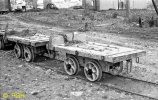
Slab wagons. The wagons here were fitted with single flanged wheels, unlike most Welsh slate quarries which used double flanged wheels on internal wagons such as slab and waste wagons. The wheels were loose on the axles, being retained with a washer or collar and split pin at the end of the axles - note the amount of grease round the wheel centres, so back to back would have been somewhat variable.


The last of the six steam locomotives that worked the 2ft. gauge system were disposed of c1930, being replaced by three Motor Rail Simplex petrol locomotives obtained new between 1922 and 1928 (two being later converted to diesel).
No.2 Motor Rail diesel no.3739 of 1925. After use of the rail system ceased this loco was preserved on site and I believe its now on display in the visitor centre at the quarry.
Another view of No.2 MR 3739/25, which shows at centre left of the photo how they crossed one track over another without a purpose made crossing - just using two removable rails !
Another unusual bit of trackwork, a point on the line to the tip with normal pointed blades (sort of) but a stub switch for the frog or crossing - a 'semi-stub point'. Note also that blades and stub switch have separate operating levers.
Slab wagons. The wagons here were fitted with single flanged wheels, unlike most Welsh slate quarries which used double flanged wheels on internal wagons such as slab and waste wagons. The wheels were loose on the axles, being retained with a washer or collar and split pin at the end of the axles - note the amount of grease round the wheel centres, so back to back would have been somewhat variable.
Waste wagons with Hudson 'Rugga' V skip wagons behind
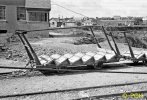
Incline man-riding car - passengers were expected to stand !
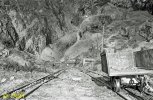
View down the incline into the quarry pit
Incline man-riding car - passengers were expected to stand !
View down the incline into the quarry pit
Another view down into the quarry with the incline descending at the bottom of the photo.
PhilH
Western Thunderer
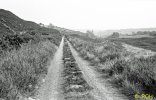
A view along the trackbed of the 4ft. gauge Redruth & Chasewater Railway (1825-1915) near Nantgiles Mine, looking towards Devoran. The vehicle wheel tracks straddle one row of the stone sleeper blocks, the other row is in the undergrowth to the left.
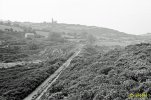
A view looking the other way towards Redruth from the site of Nangiles Mine. The chimney and ruined engine house of Wheal Henry Mine is on the horizon.
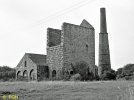
Great Wheal Busy Mine engine house. It was erected in 1856 to hold an 85" cylinder beam pumping engine, which was sold and removed about 10 years later when production moved to another part of the mine. In 1872 or 1873 a 90" engine was installed to investigate the reopening of the old workings, but the mine closed six months later due to the collapse in the price of tin, the mine's main production. In 1909 the mine was reopened for arsenic production and a secondhand 85" engine installed in the engine house. The mine finally closed in 1924 and the engine was scrapped in 1952. The adjoining boiler house was built in 1909 and housed 3 Lancashire boilers.
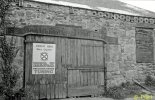
Doorway to the smithy and workshops of Great Wheal Busy Mine - a modelling challenge !
The small lettering above the main beam reads "Williams Perran Foundry Co.". More recent photos show the cast beam has been raised to increase the height of the door opening.
PhilH
Western Thunderer
The North Devon Clay Co. Ltd. operated a 3ft gauge system at Peters Marland in Devon for the extraction of ball clay, a type of clay used in the production of ceramics. It was a remnant of the Torrington & Marland Light Railway, constructed in 1880 from the LSWR terminus at Torrington 6¼ miles to the clay works at Marland. The engineer for the line was J.B.Fell, renowned for his work on mountain railways and the line included several timber structures including the 316 yard long timber viaduct over the River Torridge. About 4½ miles of the line from Torrington were later used for the route of the standard gauge North Devon & Cornwall Junction Light Railway, opened by the Southern Railway on 27th.July 1925, and the works were then served by sidings off that line.
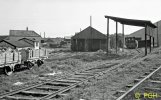
View of the works showing the narrow gauge loco shed and a standard gauge siding in the foreground with the standard gauge diesel PROGRESS in the distance. The track partly in view bottom right is the 3ft. gauge line to the tipping dock.

View from nearer the Torrington end of the yard showing the standard gauge and narrow gauge track leading to the tipping dock.

British Railways and 3ft gauge wagons at the tipping dock. The actual transfer of the clay was done in a shed just behind the camera where the narrow gauge wagons were tipped on a table at an angle to discharge their load through the side door.
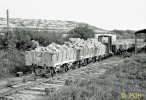
Ruston & Hornsby diesel no.518187 supplied new in 1965 arrives at the works with loaded wagons fore and aft. This was Ruston's type LFT of 48hp with drive via a Dowty hydrostatic transmission. It had a relatively short life, being scrapped in 1971 after the narrow gauge line closed.

The view along the line to the clay workings from the edge of the works.
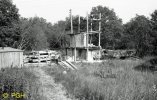
The clay was excavated either in underground mines or open pits, in 1966 there were nine mines and one small pit in operation. This is the shaft top of a closed mine near the works.

Ruston & Hornsby diesel type 48DL No.435398 supplied new in 1959. After the closure of the 3ft. gauge system it was sold to the Seaton & District Electric Tramway in 1972 and converted to 2'- 9" gauge. The locos and open wagons were fitted with a central buffer and connected with side chains.
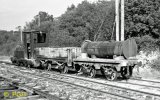
RH 518187/65 again with an open wagon and an improvised tank wagon. I believe the tank wagon was originally used as a tender for one of the three Fletcher Jennings 0-4-0ST's built in 1873/4/5 bought secondhand in 1908 from the Jersey Harbour Committee, St.Helier Breakwater. These were found to be too heavy for the track so the solution was to remove the saddle tanks and provide a separate tank on an open wagon chassis.
tbc
View of the works showing the narrow gauge loco shed and a standard gauge siding in the foreground with the standard gauge diesel PROGRESS in the distance. The track partly in view bottom right is the 3ft. gauge line to the tipping dock.
View from nearer the Torrington end of the yard showing the standard gauge and narrow gauge track leading to the tipping dock.
British Railways and 3ft gauge wagons at the tipping dock. The actual transfer of the clay was done in a shed just behind the camera where the narrow gauge wagons were tipped on a table at an angle to discharge their load through the side door.
Ruston & Hornsby diesel no.518187 supplied new in 1965 arrives at the works with loaded wagons fore and aft. This was Ruston's type LFT of 48hp with drive via a Dowty hydrostatic transmission. It had a relatively short life, being scrapped in 1971 after the narrow gauge line closed.
The view along the line to the clay workings from the edge of the works.
The clay was excavated either in underground mines or open pits, in 1966 there were nine mines and one small pit in operation. This is the shaft top of a closed mine near the works.
Ruston & Hornsby diesel type 48DL No.435398 supplied new in 1959. After the closure of the 3ft. gauge system it was sold to the Seaton & District Electric Tramway in 1972 and converted to 2'- 9" gauge. The locos and open wagons were fitted with a central buffer and connected with side chains.
RH 518187/65 again with an open wagon and an improvised tank wagon. I believe the tank wagon was originally used as a tender for one of the three Fletcher Jennings 0-4-0ST's built in 1873/4/5 bought secondhand in 1908 from the Jersey Harbour Committee, St.Helier Breakwater. These were found to be too heavy for the track so the solution was to remove the saddle tanks and provide a separate tank on an open wagon chassis.
tbc
PhilH
Western Thunderer
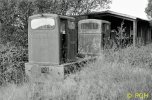
'Out to grass' literally were the two John Fowler diesel locos ADVANCE and EFFICIENCY. They were built in 1949 and 1951 respectively and with another Fowler of different design replaced the remaining steam locos. ADVANCE was partly dismantled minus its engine, while EFFICIENCY appeared to be complete.

The two locos were a result of the link between Fowlers and Marshalls of Gainsborough, using the latter's single cylinder two stroke diesel engine from their Field Marshall tractors. They were apparently not very popular here with difficult starting and gear selection, and the engines working loose from their mountings. ADVANCE was scrapped in 1970 while EFFICIENCY was sold to a private buyer and may still exist. The chassis in the foreground is from a Ruston loco bought for spares in 1965 and dismantled.

Open wagons were supplied by the Metropolitan Railway Carriage & Wagon Co. for the opening of the line and in subsequent batches in 1895 and 1901, totalling about 70. They were of 3 tons capacity with a door in the centre of each side. The side door was later replaced with a full length drop side and other alterations were probably carried out through the years during repairs. A brake was fitted on one side only acting on one wheel, and all the wagons seemed to have been positioned so that it was available to operate on the tipping dock - i.e. on the side away from the edge of the dock. Unfortunately that was the side in shadow on my visit and I failed to record the brake detail in a photograph ! However I did make a fairly detailed survey of one wagon including the brake detail, that had a body 9'-7" long x 5'-4" wide, the height overall from rail level was 4'-5", with 2'-1" dia. 6 spoke wheels on a 4'-8" wheelbase. The wagons were painted light grey.

Wagons were also built in the works here, and these are probably the unsprung ones shown second and fourth from the right.
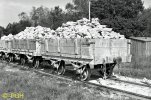
Loaded MRC&W Co. wagons.

Hudson 'V' tip wagons were used for the disposal of waste. They were coupled by side chains to hooks (bent steel strip) fixed to the top of the side frames at each end, as on the second wagon (No.111), although they seem to be missing on the first wagon.
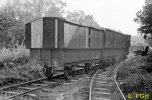
The Workmens 'coaches' - converted open wagons. The middle one is longer, possibly rebuilt from a standard wagon. They had a central doorway on the opposite side and internal seats around the perimeter.

The John Fowler diesel PROGRESS was working the standard gauge sidings. Bought new in 1945 it was the first of the makers 400 series, works no.4000001, of 60hp with a three speed gearbox. In 1977 it was rebuilt with a Leyland engine and Dowty hydrostatic transmission. After closure of the standard gauge sidings it was acquired by the North West Devon Railway Preservation Society, moving to the Bodmin & Wenford Railway, Cornwall in 1988. It is now back in North Devon, on the short length of track at the restored Torrington Station.
In 1969 underground mining ceased and from then all the clay has been excavated in opencast pits. Road transport replaced the 3ft. gauge system, with the last clay being transported by rail to the works in November 1970. The track was lifted shortly after. Use of the standard gauge sidings continued until the closure of the BR line in September 1982.
PhilH
Western Thunderer
The last visit on the trip was to Roads Reconstruction (1934) Ltd., Whatley Quarry near Frome. This was connected by a 2 mile long line to the BR (ex GWR) Frome to Radstock line at Hapsford, which replaced a 2ft. gauge line in 1943.
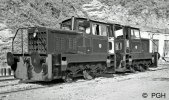

Thomas Hill diesel hydraulics Nos.1 and 2 at Whatley Quarry. Both converted from Sentinel steam locos, they were working in tandem on the line to Hapsford.

View of the loading hoppers and plant at Whatley Quarry from the road bridge. The line passed under the road in a sharp 'S' curve, which has since been replaced along with a new road bridge.

No.1 Sentinel 9374 of 1947 in use at Hapsford. This was one of three Sentinel steam locos supplied new in 1947/8. No.3 was out of use and No.2 was derelict outside the loco shed.
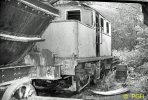
Railway type Sentinel 6090 of 1925 derelict alongside the loco shed at Hapsford.

Chassis and tank of Andrew Barclay 0-4-0ST MEDWAY AB 969 of 1903, latterly used as a tank wagon, and No.2 Sentinel 9386 of 1948 outside the loco shed at Hapsford. MEDWAY came from Burnham Cement Works in Kent c1943 and according to Andrew Barclay records was originally built as a 3'-6" gauge loco.

Hudson tip wagons at Hapsford. Originally stone was brought from the quarry in these wagons for further processing at Hapsford. The installation of additional stone processing plant at the quarry enabled BR wagons to be loaded there instead.

Thomas Hill diesel hydraulic No.3 works number 152V of 1965 in use at Hapsford.

View of the BR exchange sidings at Hapsford with diesel No.3. The point in the foreground is unusual, constructed on longitudinal timbers with rails connected by tie rods.
In 1973-4 a new line was built connecting the quarry with the BR line west of Hapsford. This included two tunnels and a viaduct over the old line. This enabled BR locos to work over the line to exchange sidings near the quarry.
Thomas Hill diesel hydraulics Nos.1 and 2 at Whatley Quarry. Both converted from Sentinel steam locos, they were working in tandem on the line to Hapsford.
View of the loading hoppers and plant at Whatley Quarry from the road bridge. The line passed under the road in a sharp 'S' curve, which has since been replaced along with a new road bridge.
No.1 Sentinel 9374 of 1947 in use at Hapsford. This was one of three Sentinel steam locos supplied new in 1947/8. No.3 was out of use and No.2 was derelict outside the loco shed.
Railway type Sentinel 6090 of 1925 derelict alongside the loco shed at Hapsford.
Chassis and tank of Andrew Barclay 0-4-0ST MEDWAY AB 969 of 1903, latterly used as a tank wagon, and No.2 Sentinel 9386 of 1948 outside the loco shed at Hapsford. MEDWAY came from Burnham Cement Works in Kent c1943 and according to Andrew Barclay records was originally built as a 3'-6" gauge loco.
Hudson tip wagons at Hapsford. Originally stone was brought from the quarry in these wagons for further processing at Hapsford. The installation of additional stone processing plant at the quarry enabled BR wagons to be loaded there instead.
Thomas Hill diesel hydraulic No.3 works number 152V of 1965 in use at Hapsford.
View of the BR exchange sidings at Hapsford with diesel No.3. The point in the foreground is unusual, constructed on longitudinal timbers with rails connected by tie rods.
In 1973-4 a new line was built connecting the quarry with the BR line west of Hapsford. This included two tunnels and a viaduct over the old line. This enabled BR locos to work over the line to exchange sidings near the quarry.