
You are using an out of date browser. It may not display this or other websites correctly.
You should upgrade or use an alternative browser.
You should upgrade or use an alternative browser.
MOVING COAL - A Colliery Layout in 0 Gauge
- Thread starter PhilH
- Start date


PhilH
Western Thunderer
Superb work on the Giesel chimney and the upgrade to the Dapol RTR Model(s) that you’ve undertaken Phil.
Truly inspiring stuff!
Love your scratch built Austerities also.
Your layout is looking great too.
Neil.
Thanks very much Neil, coming from you that's praise indeed.
PhilH
Western Thunderer
After what you told me during trial & efforts with the lining, I can see there's now't wrong with it. I'm glad haha.........
Thanks mate, I wouldn't like to say how many times I did some of the lines before I was reasonably satisfied - a box of cotton buds and white spirit were essential to erase some of the efforts.
PhilH
Western Thunderer

ALLEN with a train of loaded internal user wagons for the canal tip.
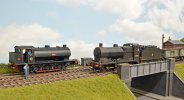
43981 arrives with empties from BR. The 4F is a refugee from one of LarryG's 0 Scale episodes, apparently it's the wrong scale !!!!
It's a Bachmann Brass model, painted and weathered by Larry with extra details.


James Spooner
Western Thunderer
I’m more concerned that the shunter may have a death wish…Phil,
I hate to offer criticism, particularly without offering a solution, but these recent photos are just too “clean” in my opinion.
Weathering? Grubbiness?
best
Simon
Nigel
PhilH
Western Thunderer
Phil,
I hate to offer criticism, particularly without offering a solution, but these recent photos are just too “clean” in my opinion.
Weathering? Grubbiness?
best
Simon
So what ?, grass too green, sky too blue, or is it the old myth that industrial locos were always filthy ?
With regard to ALLEN, in Post #218 I said "but the prototype was reasonably clean when I saw it on that first visit to Astley Green"
That was 25th July 1964. Another visitor on the same day might have had a different opinion, but failing that you'll just have to take my word for it, it's my interpretation of "reasonably clean".
PhilH
Western Thunderer
Hi Phil,
If anything, it was perhaps that the scene felt a bit too bright. I wasn’t thinking of the loco. But it’s only an opinion.
Best
Simon
OK, just for you at no extra charge:

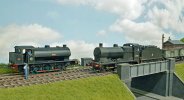
Better ?

James
Western Thunderer
Hi Phil,
If anything, it was perhaps that the scene felt a bit too bright. I wasn’t thinking of the loco. But it’s only an opinion.
Best
Simon
Sometimes industrial lines suprise you...
The filthiest place I have worked but parts could be brighter and cleaner appearance than one might expect.


PhilH
Western Thunderer
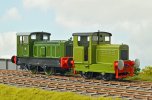
Things get a bit more attractive when you get a few quid off, well they do to me anyway !
So I now have an Accurascale Ruston 88DS and a Heljan 48DS. There is a reason (or perhaps I should say excuse) for acquiring these as they do fit in with the 'theme' of the layout, i.e. the National Coal Board Lancashire Area.
There was just one Ruston 88DS in the area, which the NCB acquired new in 1953 for the Alexandra Colliery, situated just North East of Wigan, where it replaced an elderly (1869) Wigan Coal & Iron Co. 0‑6‑0ST. The colliery closed two years later, but the screens and sidings were retained to process coal from another nearby colliery brought in by road. That closed in 1962 and the Ruston was then stored at Ince Moss Colliery, South East of Wigan, where I photographed it in the loco shed in 1964.
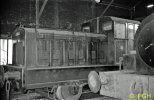
It was scrapped the following year. It's somewhat ironic that it had a working life of only 9 years while the loco it replaced had a working life of 84 years.
The model is fitted with DCC sound. I've removed all the lettering with T-Cut, and gone through the green paint slightly in places, but its going to be fairly heavily weathered like the prototype when I saw it. The plastic frame weights have been removed and the fixing holes filled in, so the frames need painting. The livery of the model is supposed to represent the Ruston works livery of olive green lined in light green, but this also included a very fine white line inside the light green, which you can just pick out in places in my photograph. However I won't be attempting to add that.
The Lancashire NCB had two Ruston 48DS locos, both originally purchased by the Wigan Coal Corporation Ltd. in 1942. One was employed at the NCB's Kirkless Workshops in Wigan, and the other at Victoria Colliery, situated alongside the West Coast Main Line just north of Wigan. The latter loco was the only standard gauge NCB loco at Victoria Colliery as most of the shunting was done by main line locos. Both these locos were of the open cab type.

I fitted the Heljan loco with the recommended Zimo Next 18 DCC sound decoder and stay alive. There isn't much room under the bonnet and a possible location for the stay alive used by some is in the cab. However I found that milling away part of the diecast block above the motor gives sufficient room to fit the stay alive above the motor.

It's reasonably powerful for its size and may see occasional use as the colliery shunter.