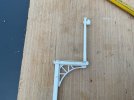
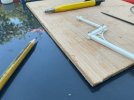
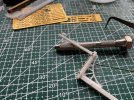
4mm Monks Ferry LNWR

jonte

Western Thunderer

jonte

Western Thunderer
As promised, a brief update on the plastic signal ordeal.

As it turned out, removing the cranks and cramps wasn’t quite the ordeal I was expecting.

A very early (crack of dawn) start before pending family visits to celebrate Father’s(Grandfather) Day, saw me snipping off the pivots at the rear of the signal, left of generous length to allow sufficient surface on which to apply s’per glue. Transpired that the glue hadn’t travelled far enough into the hole provided fora good fix and so it was a simple task to push them out using a needle. Due to only the slightest amount of cement having been used to secure the cramps on the front face of the signal to avoid the earlier unwanted bonding of crank to cramp, I recall three of them coming away with the pivot, the remaining being removed with the knife blade.

If I’d considered the previous day’s construction an ordeal, it was nothing compared to the catastrophe ahead. To say threading on operating wires to these tiny cranks without the pivots falling off and trying to remember which went where as they kept moving around, even with the use of tweezers (a hindrance more than a help!), was a fiddle would be an understatement. Then trying to attach the pivots to the trimmer without something moving out of place ……….. Anyway, to cut a long fiasco short, I managed to burst the hole on two of the cranks in the process. Attempting to glue just shrivelled ‘em. It was obvious that their use was a bum steer, and that’s how that modelling episode yesterday ended. As I shut up shop for the day (breakfast), it was apparent that if I were to use these signals, it would be back to plan A: please see the (clumsy) example in my previous modelling photo. Frankly, I was a bit lost at this massive disappointment and wasn’t really sure where to start.

But after the Day’s joyous festivity, I developed a more positive and robust approach to this quandary, and an APB put out for a missing (or remains of) a Finney kit proved dividends after it was recovered lurking between some railway books in my wardrobe. What it was doing there is anyone’s……..

To save waffling and giving a full itinerary of bits, please see the accompanying photo:

It was apparent that if this was to have any chance of working, more materials were required , so before I climbed the stairs to Bobos, I’d left an order with Wizard’s for some handrail knobs, handrail wire and tubing. Still not sure whether I’ll use the tubing as it might look a little clumsy, but as I’m already finding, wire alone as a fulcrum might not be up to the job. We’ll see.

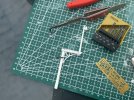
In the meantime, I’ve gathered a couple of the four handrails in the packet and a piece of very thin wire which was enclosed (0.45mm?), and which turns quite freely within. As an experiment, I’ve grabbed the shunt bracket signal (a bit more room to practice with than the more complicated bracket) and placed the items on the trimmer to see if my mind modelling was a go-er or just the usual bum steer.
A start was made using the holes provided in the trimmer which I opened gradually to a millimetre. I think it’s probably more like 0.9mm for the handrail bases but the drill set doesn’t have one unfortunately.whilst it would make gluing them more effective, it’s a bit of a nuisance playing with them as there’s a tendency for them to lift out of the holes whenever I’m anywhere near them eg when threading the very thin wire through the eye holes. Anyway, as ‘a picture paints..’, here’s a photo to give you a better idea than my rambling:
IMG_4548.jpeg

Frankly, I’m not sure whether the (only piece thin enough) wire is long enough fir the job, but as I won’t be able to get back to it for a couple of days after today, Iwant to try and make a little more progress to see whether it’s a go-er, so will probably press on with it.

Incidentally, the little brass brackets on the fret in the picture are what I’m hoping to solder to the ends of the wire, the outer holes having to be opened up to accommodate the stouter steel wires in the kit. There also a couple of bits I’m hoping to use as brackets to go between the handrails to prevent unwanted travel. These parts are so tiny, what’s the betting I gum everything up with solder……. I’ve ciggy paper somewhere and some ancient three in one lurking on the shelf in the garage which I’m hoping will assist as a (can’t think of the appropriate term at present).

Hope all that helps, and many thanks once again for your kind and welcomed interest.

Fingers crossed.

jonte

 

jonte

Western Thunderer
Hmm….

I fashioned a jig of sorts from balsa to seat the components whilst wire threaded:

IMG_4552.jpeg

It worked for the collars, but once handrails were in place it proved useless for fixing on the cams at the end. Not the best soldering result but will work. I think fir the bracket signal/doors I’ll opt for cams soldered to tubing for ease.

Then I customised two of the parts on the fret to act as cams:

IMG_4549.jpeg

The holes were too far apart for this job so I drilled another closer to the end and opened it out to hold the steel operating wire. There were four other smaller ones on the fret bu I’m saving those for the bracket.

The results:

IMG_4550.jpegIMG_4551.jpeg

Yep, not my best hot-bitting but I’m going with it.

At least the apparatus can afford 180* of movement which is more than the plastic cranks in the kit could, and probably more than required.

I’ll remove them next and wash off the flux before gluing the knobs into the holes in the trimmer. I might fit the operating wires before gluing - or may not. I’ll see which is easiest.

Thanks for reading.

jonte
 

Phil O

Western Thunderer
Hi Jon,

Don't take it too hard, we all have days when it would have been better to stay in bed. Take a day off, do something different and regroup and come back to it refreshed. I always have several jobs on the go and if something starts coming apart, put it down and look at something else and if it's after 3pm, it's time to go and have a couple of beers, and leave it until tomorrow.
 

jonte

Western Thunderer
Hi Jon,

Don't take it too hard, we all have days when it would have been better to stay in bed. Take a day off, do something different and regroup and come back to it refreshed. I always have several jobs on the go and if something starts coming apart, put it down and look at something else and if it's after 3pm, it's time to go and have a couple of beers, and leave it until tomorrow.

Wise words indeed, Phil :thumbs:

The temperature in the garden whilst working on the signal became a little unbearable which didn’t help so I gave up earlier than intended.

Ideally, a third handrail knob in the centre would add aesthetically to the appearance (the delicate wire became bent with all the work on such a short length of wire which I guess was inevitable) but I’d have to build up the height of the trimmer around the new hole in order to do so to match those either side. This would risk hindering the free movement achieved and thus operation of the signal, so when it comes to a choice between looking good and working, I’d choose the latter any day of the week. Still, I aim to improve things by removing some of the lumpy solder (Carrs 145 I find occasionally lumps up unlike rosin cored which I prefer, but I think requires a higher temperature - perilously so with such delicate objects in a relatively small space), followed by manipulating one of the end cams with pliers to ensure a ninety degree placement to the wire. Once the handrail knobs are glued on, I can use my smooth faced pliers to try and straighten out the wire between to resemble something more like the earlier pics.

But this won’t be until Friday at the earliest due to commitments; the break as you advise but without the beer :(

Best

Jon
 

jonte

Western Thunderer
Sweltering perhaps, but a free afternoon was too good to miss: apologies Phil @Phil O for ignoring your good advice, but when I’ve an itch…..

Since I last wrote, Wizard Models kindly obliged with a swift delivery and examining the contents filled me with renewed vigour.

Into the bin has gone the previous clumsy attempt at a rotating shaft thingy, to be replaced by stouter nickel silver wire in plentiful lengths and longer knobs. Frankly, the stouter wire would have served on its own as it resisted pressure far more robustly than the thin brass stuff of last, however, I needed to address unwanted travel between the knobs as before. As originally intended, I pressed the brass tubing into use which was easier to solder and looks better than undernourished collars of my previous attempt. Once more, the redundant brass fret was pressed into service, again customising the holes and spacings. Whilst I did well soldiering on in the heat while cutting out the parts, I eventually finished off crafting inside as tiny parts whizzing off into the garden was not only frustrating (no chance of tracing them) but I was mindful of the decreasing number of parts available on the small brass fret.

Anyway, here’s the result:

IMG_4553.jpeg


IMG_4555.jpeg

As you can see from the second shot, the longer knobs (and using the moulded raised holes on the trimmer) allow me to place the hole in the cam for the operating wire(s) nearer to the trimmer which not only looks better in my humble, but also keeps everything more in line.

I’ve since glued the knobs in place and can confirm I’ve been blessed with free movement along the mechanism.

Thanks for reading.

jonte
 

Phil O

Western Thunderer
Jon,

Good to see that you have some progress with this signal and things are now going 8n the right direction. Always excellent service from Wizard, I wish some of the other suppliers were as good.
 

jonte

Western Thunderer
Jon,

Good to see that you have some progress with this signal and things are now going 8n the right direction. Always excellent service from Wizard, I wish some of the other suppliers were as good.

Thanks, Phil.

Wizard were notably prompt on this occasion. Most pleased.

Jon
 

jonte

Western Thunderer
Having decided to use the plastic arms which came with the kit (despite having two packs of brass parts from Wizard, the corrugations, if I may remind you, have to be formed using 0.3mm brass wire - which I don’t have - that have to be soldered onto the arms, so took the easy route of using the plastic ones which have them moulded on), I thought I’d strengthen the holes provided in the face of the arm for the operating wire with some collar/spacer thingies found on the spares fret. So that’s where I started the day.

Having cut them and shaped them, my intention had been to glue them on to the perimeter of the hole. However, the lack of meat on the brass collars made this difficult without gluing everything together. I realised quickly that this was a non-starter. The only thing for it was to dig out the brass parts and see what I could muster. Before doing so, I decided to reinforce the plastic bearing on the post/doll, so opened it up with steadily increasing drill bits until a section of brass tube ( 0.9mm) could slide in. Thankfully, I did so without bursting the plastic. It was then super glued in:

IMG_4556.jpeg

I the began cutting lengths of nickel silver wire to length, forming a ninety degree bend at one end to fit in the holes provided in the fret. Then I began the slow repetitive task of soldering and carefully removing each from the fret, before tidying them up with a glass fibre pen and files:

IMG_4557.jpeg

The arms were then joined to their spectacle plates using wire and a track pin poked into a section of balsa previously drilled for the task. I’d decided that I’d use a piece of 0.45mm n/s wire which made a snug fit for the bearing in the doll as an axle, so that was soldered on in the balsa jig. I lost count of how often I had to clear the holes of solder………:

IMG_4558.jpeg

Yeah; looks okay, but please don’t tell the proper modellers that I’ve used oversize wire…….

A trial fit:

IMG_4559.jpeg

I quickly realised that something was amiss.

I searched umpteen photos for reassurance/guidance of how the arm should look, before reluctantly returning to the instructions accompanying the frets. I’d cocked up…… again! The darned things were suppose to be soldered to the REAR of the fret……. Why on earth did LNWR have to be different? Why on earth didn’t they just use flat arms like everybody else? Why didn’t I just read the bloody instructions?

How am I gonna cope with the Crewe Special build……..

Working into the evening, and thus reducing light, I restarted the corrugations with renewed vigour. This bloody thing wasn’t going to beat me!

I suppose looking at this with a glass half full outlook rather than half empty, at least I had the spare fret which came as a surprise with the ratio kit. It’s the best that can be said.

Anyway, I’ve three of the arms constructed; hopefully will finish the fourth tomorrow afternoon.

The new one mounted on the shunt bracket (will glue on the ring after it’s painted separately):

IMG_4560.jpeg

Thanks for sticking with all this drama.

jonte
 

jonte

Western Thunderer
‘Dual controls’ fitted to the bracket signal at last:

IMG_4561.jpeg
Please ignore the offcut of wire seen. Its purpose was to test free movement of the mechanisms.

This time, I’ve not glued them into the trimmer; this will make it easier to fit the operating wires which I’ll measure and fabricate next time.

Thanks for looking.

jonte
 
Top